-
-
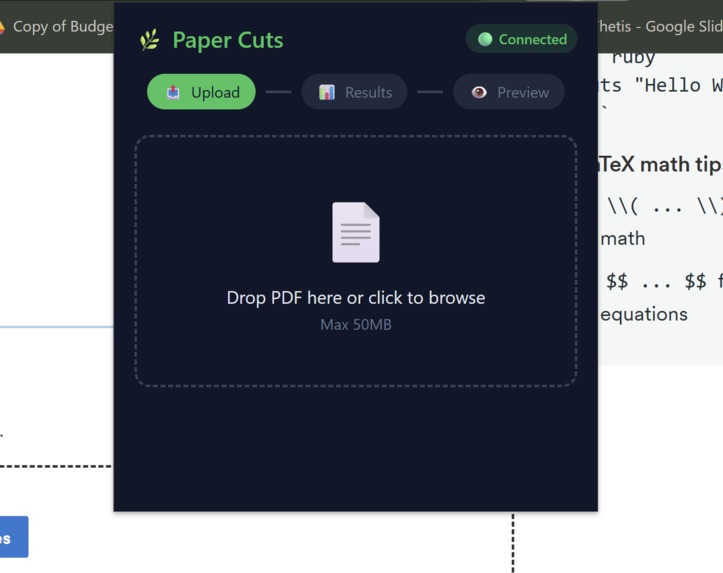
Effortless paper and ink saving with our Paper Cuts Chrome extension
Inspiration
The inspiration for PaperCuts came from seeing the massive amount of unnecessary paper and ink waste in academic and corporate environments. We wanted to create a tool that doesn't just tell people to "print less," but actually gives them the data and AI-driven insights to understand their impact and change their habits.
What it does
PaperCuts is a full-stack sustainability platform that provides users with AI-powered tips via Google Gemini to optimize document printing and reduce ink waste. It tracks printing metrics—such as pages used and ink density—and stores them in a centralized dashboard, allowing companies to identify patterns of overuse and implement data-driven strategies to reach their green goals.
How we built it
We built a robust, scalable architecture using: Frontend: A responsive and modern interface developed with React JS. Backend: A high-performance Java Spring Boot REST API to manage PDF conversion logic and user sessions. Database: MongoDB Atlas for flexible, cloud-based data storage. AI Integration: The Google Gemini API to generate real-time, intelligent optimization suggestions.
Challenges we ran into
One of our primary technical hurdles was mastering CORS (Cross-Origin Resource Sharing) to allow our React frontend to communicate securely with our Spring Boot backend. We also navigated the learning curve of REST API design, specifically ensuring our JSON data structures matched our Java models to avoid "405 Method Not Allowed" errors during integration.
Accomplishments that we're proud of
We are particularly proud of successfully connecting a local Java backend to a cloud-hosted MongoDB Atlas database and seeing live data persist. We also successfully integrated the Gemini API to turn a standard tracking tool into an "intelligent" assistant for the Sustainability Stream.
What we learned
This project was a deep dive into full-stack development, teaching us the importance of environment configuration, like using the Maven Wrapper (./mvnw) for cross-platform compatibility with our teammates. We also learned how to use tools like Postman to rigorously test API endpoints before building out the UI.
What's next for PaperCuts
In the future, we’re looking to strengthen the backend so it can handle way more users at once without breaking a sweat. We’re also excited about moving beyond a general API, and training our own custom AI model on document data to give even more specific, specialized advice.


Log in or sign up for Devpost to join the conversation.