-
-
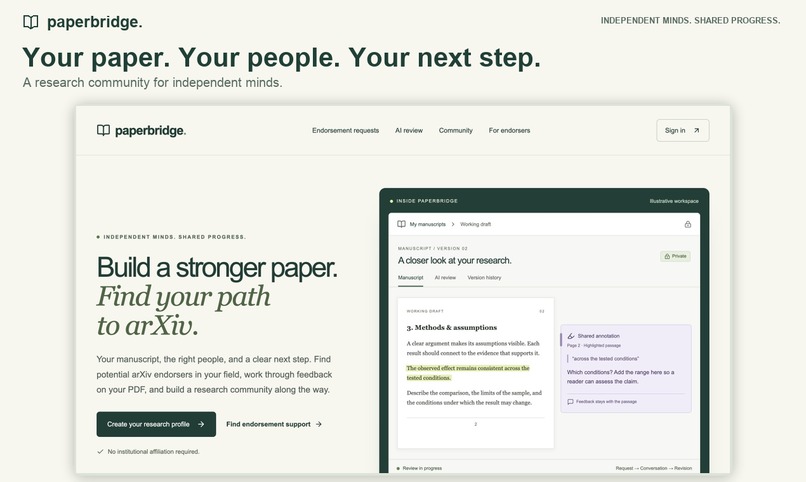
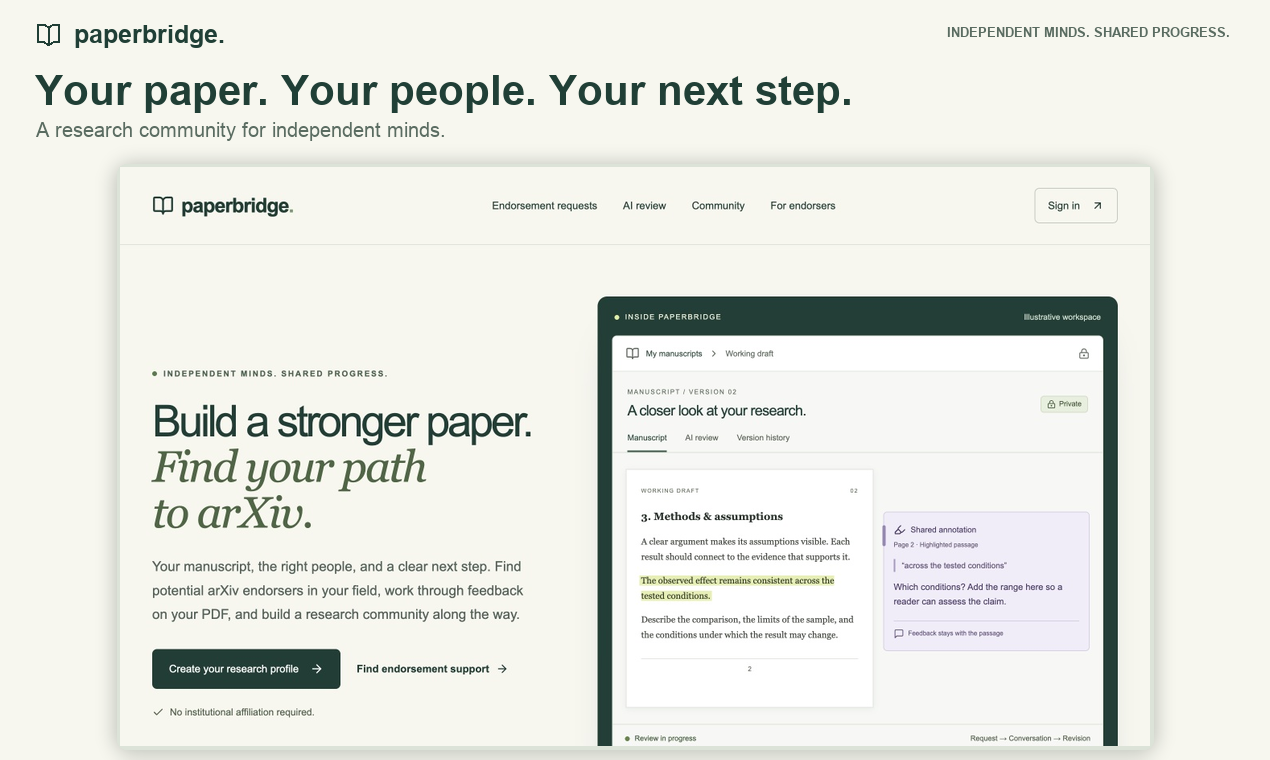
Discover researchers and potential arXiv endorsers by category and availability. Sample accounts shown.
-
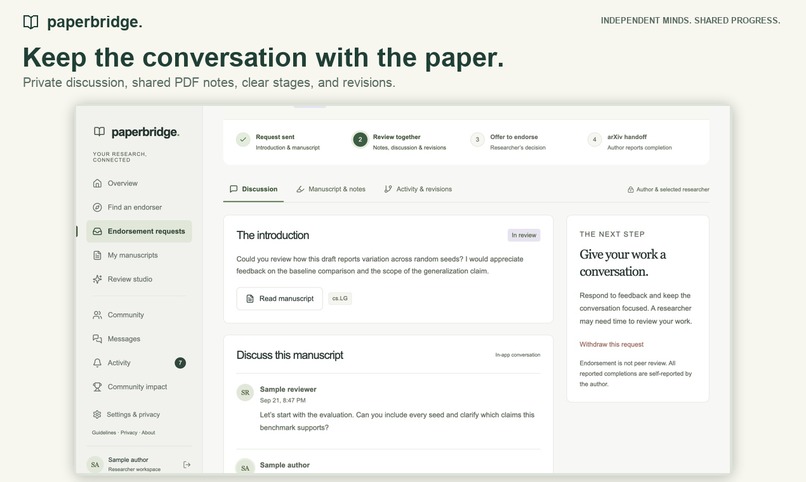
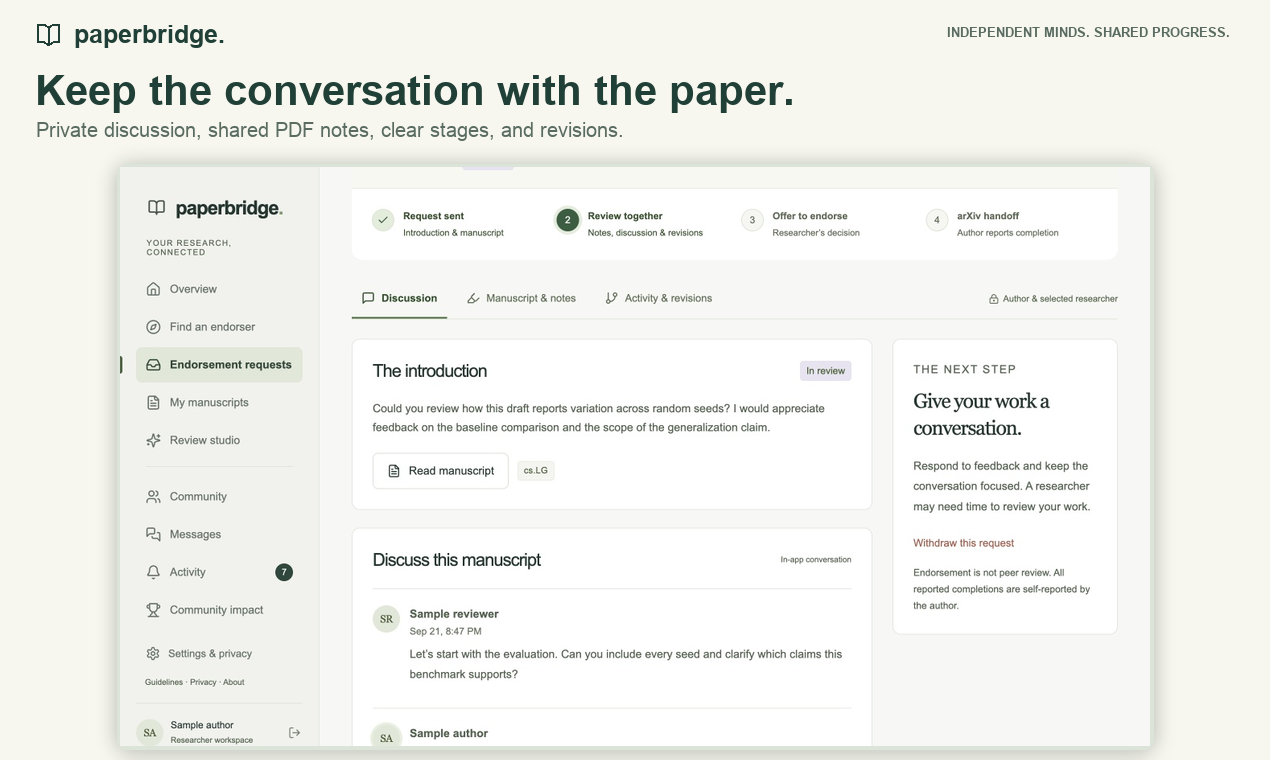
Private collaboration with versioned PDFs, anchored notes and review stages. Sample manuscript shown.
-
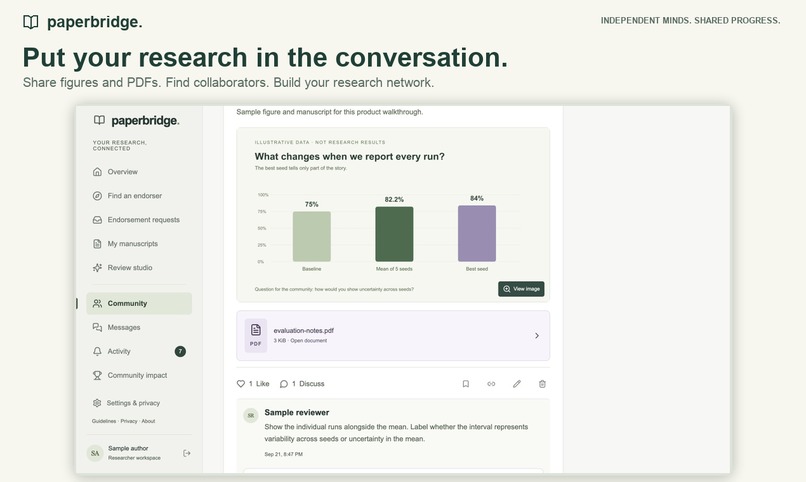
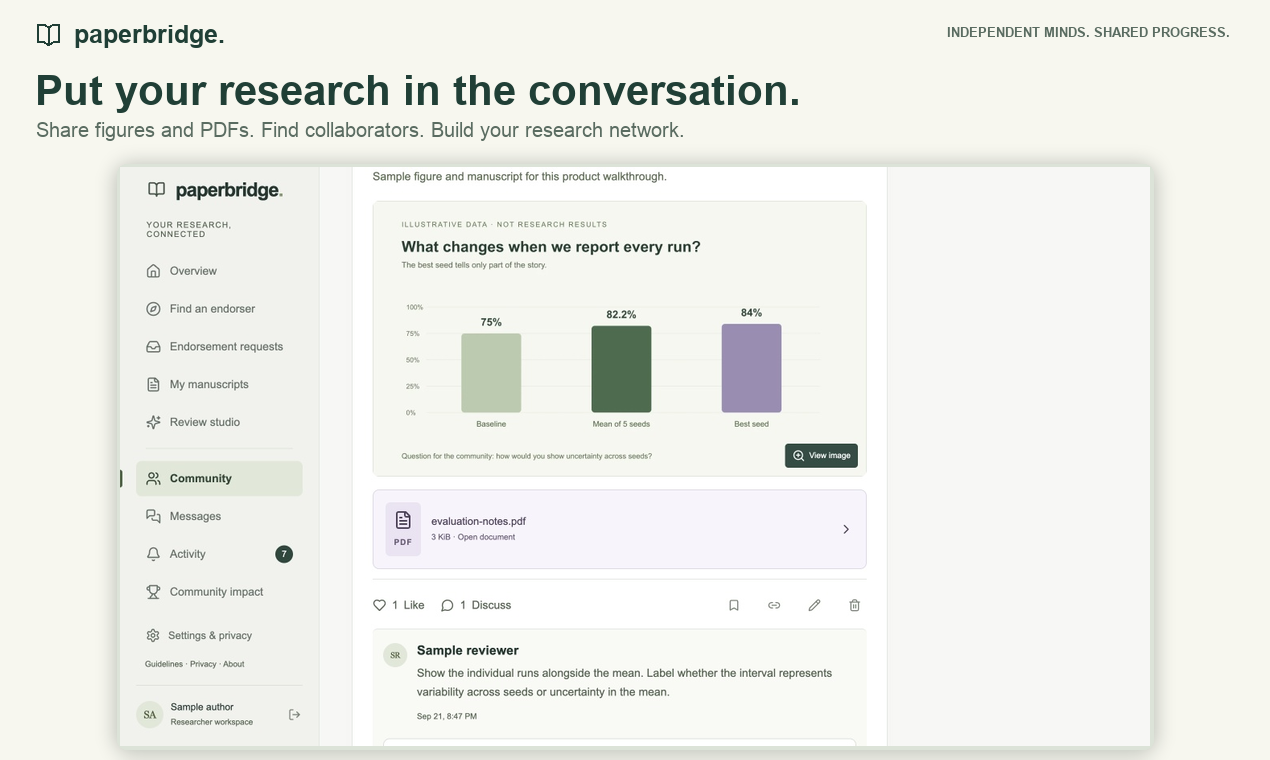
A research community for ideas, reading lists and ongoing conversations. Sample posts shown.
-
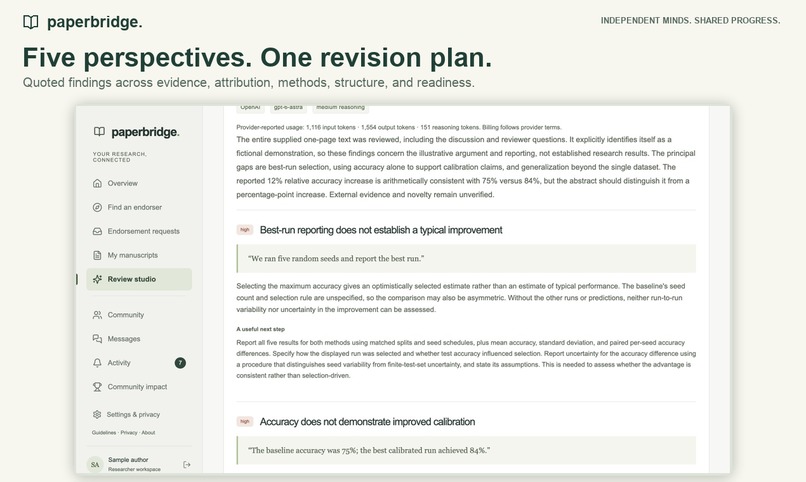
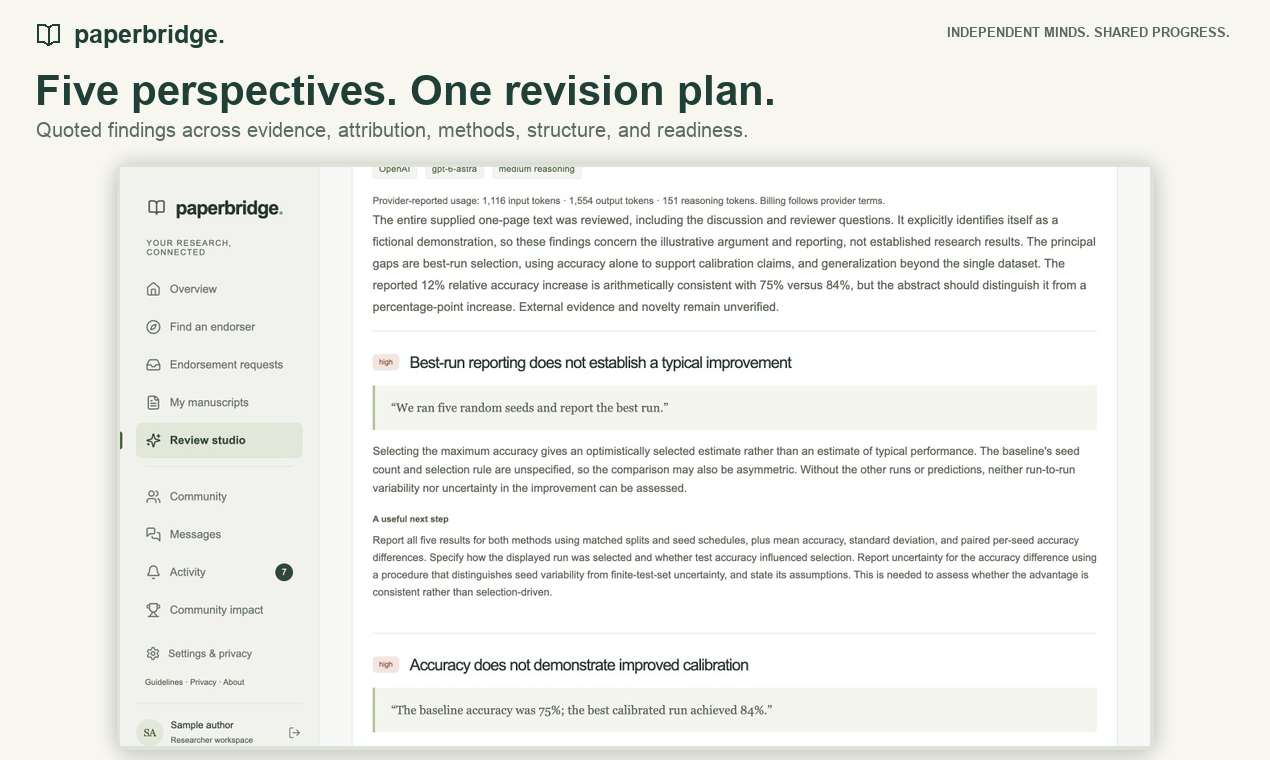
Five AI specialists and a synthesis step produce an actionable revision plan. Sample review shown.
Inspiration
Certain arXiv categories require an endorsement. Without an established academic network, finding someone with the right expertise and eligibility can become a project of its own. PaperBridge began with a practical question: how could that first connection become easier for an independent researcher?
That led to a bigger question: what infrastructure does an independent researcher need around the paper? Finding a collaborator is only the beginning. The draft, the discussion, the next revision and the feedback all need a place to live.
AI is helping more people explore ideas, write code and run experiments. Access to thoughtful criticism and experienced collaborators has not become equally easy. PaperBridge connects those missing pieces. The aim is to make useful feedback depend less on who a researcher already knows, while preserving the human judgment that research requires.
What it does
PaperBridge is a private-first research collaboration platform with a researcher community and optional specialist AI review.
- Find the right people. Discover researchers and potential arXiv endorsers across 155 categories. Profiles include research interests, self-reported eligibility, availability and capacity, so outreach has context.
- Move the conversation into a shared workspace. Send a private request and collaborate around the manuscript. Track discussion, review stages, revision history and the next action in one place.
- Keep feedback attached to the work. Upload versioned PDFs, search the manuscript, highlight passages and create private or shared annotations with threaded replies. Feedback stays associated with the relevant version.
- Get several perspectives on a draft. Five AI specialists examine evidence and claims, attribution and novelty, methods, formatting and structure, and submission readiness. A synthesis step turns their findings into a prioritized revision plan, with manuscript quotations and review-coverage information.
- Build a network beyond one paper. Publish research updates, share images and PDFs, follow researchers, save reading material, discuss ideas and continue conversations through private messaging and an activity inbox.
The core workspace is free. AI review is optional and uses the researcher's own OpenAI, Anthropic or Gemini key and provider billing. Researchers choose which manuscript to review and explicitly consent before its text is sent to the selected provider.
Try the product: paperbridge.web.app
Watch the walkthrough: PaperBridge product demo
PaperBridge is independent of arXiv. Endorsement takes place on arXiv itself. The platform does not certify peer review, guarantee publication or replace expert judgment. AI attribution feedback is not a comprehensive plagiarism check. The walkthrough uses sample manuscripts and demo accounts to show the workflow without exposing private research.
How we built it
I built PaperBridge as a solo project, owning the product design, frontend, backend, AI workflow, testing and deployment. The implementation and launch work were completed in September 2026. AI coding tools supported development; the product decisions, integration and verification remained my responsibility.
The interface: React, TypeScript and Vite, with React Router for navigation, Radix UI for accessible dialogs, and PDF.js for manuscript rendering and text interaction. The design connects discovery, collaboration and revision instead of treating them as separate products.
The application layer: Firebase Authentication, Cloud Functions, Firestore, Cloud Storage and Firebase Hosting. Server-side functions enforce permissions and workflow transitions. Direct client database access is denied. Manuscript links are temporary, revisions are immutable, and withdrawing a request prevents new reviewer access. Previously issued links expire rather than pretending a downloaded file can be recalled.
The AI layer: Separate adapters for OpenAI, Anthropic and Gemini, encrypted provider-key storage, configurable specialist models, structured findings and a final synthesis. Review coverage is explicit. Findings are checked against extracted manuscript text, and optional Crossref metadata lookups provide additional context. Model output is treated as feedback to inspect, not an authoritative verdict.
The operational layer: A durable email outbox with retry and delivery states, branded verification and recovery emails, duplicate-request protection, account export and deletion flows, upload validation, and responsive error and loading states. Unit, integration and Chromium/WebKit browser tests cover the critical journeys. Real OpenAI review and email flows were also checked; the other AI providers have adapter-test coverage.
Major third-party technologies are listed above and in Built with. The application, video and source repository are public. The repository includes setup instructions, architecture notes and automated tests.
Challenges we ran into
Sharing enough without sharing too much. A public research profile and a private unpublished manuscript have very different access requirements. Permissions had to remain correct across uploads, requests, notes, revisions, withdrawal and account deletion. Two-account tests helped expose mistakes that a single-user demo would miss.
Making feedback survive revision. An annotation is useful only if the reader can locate the passage it refers to. Immutable manuscript versions and version-aware notes keep a discussion from silently pointing at different text after a new upload.
Grounding AI review in the actual paper. PDF extraction introduces line breaks, hyphenation and layout noise. Quote validation needed to tolerate harmless formatting differences without accepting invented evidence. Partial extraction also had to be visible, so an incomplete review could not look comprehensive.
Making the surrounding workflow dependable. Verification emails, recovery links, stale chat state, duplicate requests and small-screen PDF controls are easy to overlook. Resolving those details was essential to making the product usable beyond a polished homepage.
Accomplishments that we're proud of
- A connected, deployed product. Researchers can move from discovery to a private request, manuscript discussion, AI feedback and a new revision within the same system.
- Useful AI with visible boundaries. Specialist findings, supporting quotations, coverage information and synthesis make the review easier to inspect and act on.
- Privacy designed into the workflow. Private drafts, scoped collaboration, temporary file links and encrypted provider keys are part of the implementation, not just promises in the interface.
- Evidence beyond a happy-path demo. Automated checks cover authentication, access control, collaboration, withdrawal, AI-result rendering and browser behavior. Live checks exercised real manuscript, email and OpenAI review flows.
- A product built around a practical research need. The result addresses the difficult work around research, not only the act of generating more text.
What we learned
The scarce resource is often a useful next conversation. Better discovery helps, but the real value appears when two people can work through a specific manuscript with shared context.
AI review needs an explanation of its own limits. A confident response is not enough. Researchers need to know what the system read, what evidence supports a finding and what still requires their judgment.
Trust is a chain of small product decisions. Who can open a draft? Which version was reviewed? Did the email actually send? What changes after withdrawal? Clear answers to those questions matter as much as the headline AI feature.
Building the whole journey also sharpened the distinction between a feature that works once and a product someone can return to. Recovery paths, empty states, mobile usability and testing belong in the core build.
What's next for PaperBridge
- Learn from real research workflows. Recruit independent researchers and experienced reviewers, observe where conversations stall, and prioritize changes based on their actual use. Early product reviews were simulated, so real user research is the next step.
- Improve discovery and trust signals. Help researchers find relevant collaborators while keeping self-reported expertise and arXiv eligibility clearly distinguished from verified information.
- Deepen revision support. Add clearer comparisons between manuscript versions and better ways to track which findings an author has addressed.
- Strengthen review evaluation. Expand expert-reviewed test cases, support difficult PDF layouts more reliably, and evaluate specialist feedback for accuracy and usefulness before broadening its scope.
- Grow the community responsibly. Improve moderation and operational capacity as usage grows, while keeping the core collaboration experience accessible.
The ambition is straightforward: give independent research the network, context and feedback it needs to move forward.
Built With
- anthropic
- crossref
- firebase
- gemini
- google-cloud
- openai
- pdfjs
- react
- typescript
- vite

Log in or sign up for Devpost to join the conversation.