Inspiration
Independent researchers and small teams repeatedly do the same invisible work after reading a paper: locate a testable claim, recover its assumptions, map it to code and data, build an environment, run it, compare the reported value, classify failures, and record what happened. Paper search and summarization tools stop too early. The researcher still has a paper, not evidence.
Paper2Proof starts where summarization ends. Its goal is not to decide whether a paper is “true.” It moves one bounded claim into a state where a human can see exactly what was tested, what ran, what was observed, and what judgment is still required.
What it does
A researcher supplies a public arXiv URL or chooses a transparent controlled demo. Paper2Proof then:
- normalizes and risk-assesses the source as untrusted data;
- extracts a numerical claim with source locator, conditions, unit, and tolerance;
- plans one CPU-sized, networkless reproduction experiment;
- blocks prohibited code or pauses for human approval when license, interpretation, cost, or safety is unclear;
- executes approved code in an isolated AgentCore Code Interpreter session;
- compares the reported and observed values with deterministic code; and
- packages source hashes, plan, runtime provenance, output, transitions, trace, limitations, verdict, and next action as downloadable JSON and Markdown evidence.
The browser is not holding the job open. It receives 202 Accepted and polls
a durable SQS-backed workflow. PASS, MISMATCH, BLOCKED, and
AWAITING_APPROVAL are all intentional, inspectable outcomes.
How we built it
Paper2Proof is a Python 3.13 Strands Agents workflow with six specialized roles: Intake & Risk, Claim Extraction, Reproduction Planner, Execution, Verification & Critic, and Report & Action. Public-paper roles use Amazon Nova 2 Lite with Pydantic structured outputs and Strands lifecycle/tool hooks.
The private agent service runs in Amazon Bedrock AgentCore Runtime with OpenTelemetry. A same-origin FastAPI web app is served by AWS Lambda Function URL. New jobs are persisted to DynamoDB and dispatched by encrypted SQS FIFO to a concurrency-bounded Lambda worker. The worker invokes the private Runtime; approved code is executed only through a Strands tool backed by AgentCore Code Interpreter. Evidence is canonicalized, SHA-256-addressed, and versioned in a private S3 bucket.
The model never authorizes itself. Deterministic policy owns SSRF defense, allowed sources, dependencies, forbidden code, execution budgets, state transitions, and numerical verdicts. Human approval is explicit and recorded. IAM policies are scoped to one model/profile, one Code Interpreter ARN, one Runtime endpoint, one queue, one table, and one S3 prefix.
Architecture
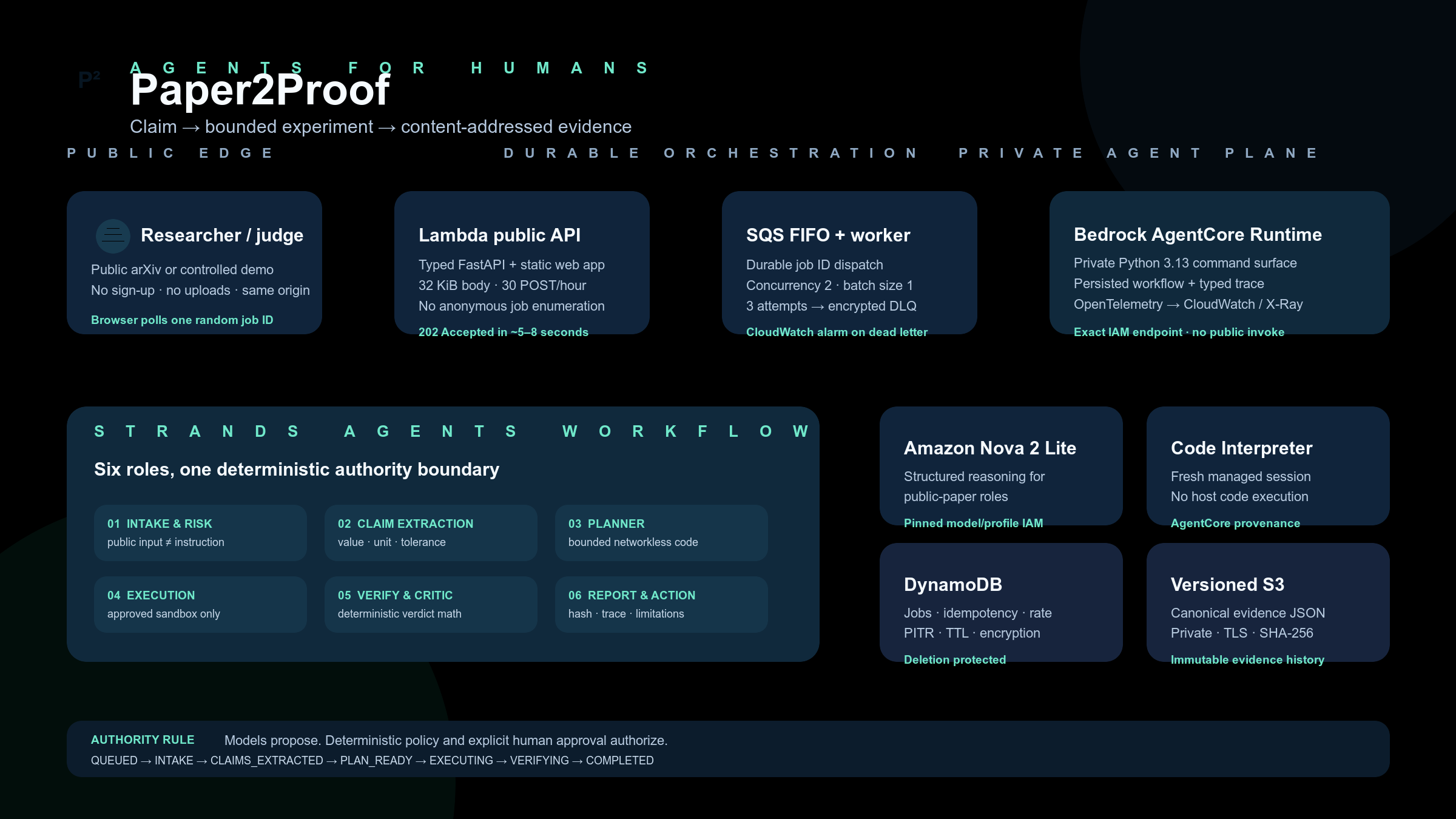
The public edge returns quickly while the private AgentCore plane owns durable execution, deterministic gates, and versioned evidence.
Challenges
The hardest problem was making “agentic” compatible with “auditable.” A model can generate plausible plans, but research evidence cannot depend on invisible model discretion. We separated proposal from authority: agents produce typed artifacts, while deterministic guards decide whether a transition or execution is legal.
A second challenge was durability. A synchronous browser request disconnected during an early managed run and left a nonterminal record. We changed the architecture to create the job first, enqueue only its opaque ID, and let a retry-bounded worker run it. The public request now returns in roughly 5–8 seconds while managed work continues.
A third challenge surfaced through adversarial testing: a dangerous controlled
fixture was initially rewritten by the model into harmless code, which made the
fixture appear to pass rather than proving the guard. No dangerous code ran,
but the test was semantically weak. We fixed the fixture path to use explicit
deterministic contracts, then verified live that import os is blocked before
Code Interpreter invocation.
Accomplishments
- A public, no-sign-in AWS demo backed by AgentCore Runtime and Code Interpreter.
- A live controlled PASS completed in 21 seconds with an AgentCore session ID, 22 trace events, and versioned evidence hash.
- A live unsafe plan blocked before execution.
- A live human-decision path paused and rejected without execution.
- A real arXiv run used three Nova-backed Strands roles to extract and plan a 28.4 BLEU claim, then correctly stopped for license/interpretation review.
- Idempotent replay returned the same job, session, hash, and one archive.
- A 12-case networkless evaluation passed 12/12 expected outcomes with 100% evidence completeness, 100% unsafe block rate, and zero unapproved writes.
- 116 automated tests, 86.65% branch-aware coverage, strict typing, security scans, least-privilege infrastructure, encrypted durable storage, alerts, and a $25 budget.
What we learned
Agents become more trustworthy when uncertainty is a product state rather than
an error to hide. AWAITING_APPROVAL is often a better scientific outcome
than an impressive-looking run. Likewise, a successful process execution is
not the same as reproducibility, and a claim-level PASS is not proof of an
entire paper.
We also learned that provenance has to be structural. Every execution is
labeled agentcore-live, docker-local, recorded, or
fixture-no-exec; the schema makes them difficult to confuse. The evidence
hash is content addressing, not a signature, so the product says exactly that.
What's next
The hackathon service deliberately accepts public sources only. The next step is an authenticated, tenant-isolated version with owner-authorized deletion, configurable retention, private repository/data connectors, and formal institutional security review. Scientifically, we would add domain-specific reproduction adapters, richer dataset provenance, repeated-run statistics, and reviewer/collaborator workflows while keeping deterministic authority and human judgment at the center.
Agents for Humans engineering notes
Built With
- amazon
- amazon-bedrock-agentcore
- amazon-web-services
- aws-cdk
- aws-lambda
- fastapi
- pytest
- python
- strands-agents
- web

Log in or sign up for Devpost to join the conversation.