-
-
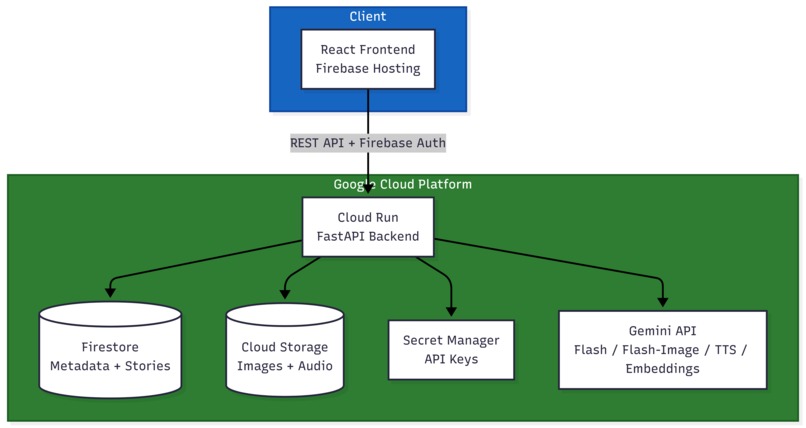
High-Level Overview
-
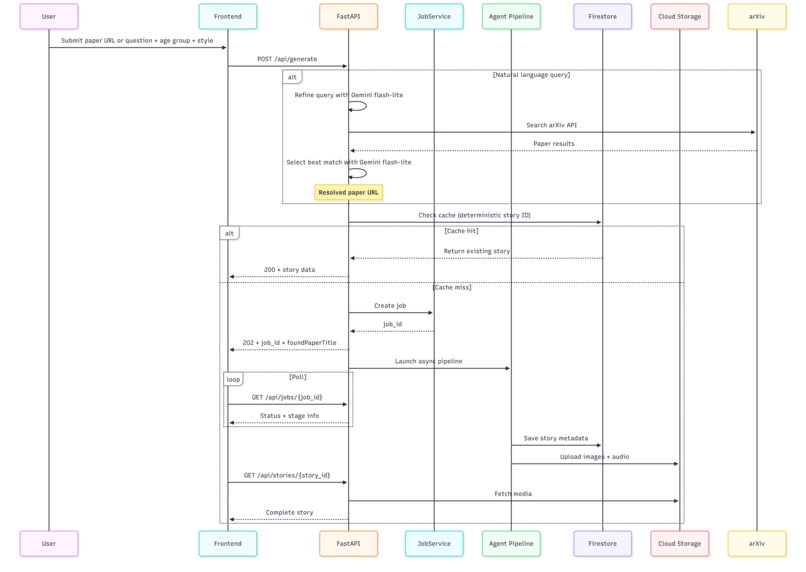
Request Flow
-

Agent Pipeline


Inspiration
Research papers hold the keys to humanity's most important discoveries — vaccines, climate models, quantum computing — but they're locked behind dense jargon, complex equations, and 30-page PDFs. A curious 8-year-old who asks "How do black holes work?" deserves a real answer drawn from real science, not a dumbed-down Wikipedia summary.
PaperTales bridges that gap. It takes any research paper and transforms it into a beautifully illustrated, narrated story tailored to the child's age — making cutting-edge science accessible to every young reader.
What it does
PaperTales is a 9-agent AI pipeline built with Google ADK that converts academic research papers into multimodal stories:
- Input: Paste a paper URL from 8 supported archives (arXiv, bioRxiv, medRxiv, ChemRxiv, SSRN, EarthArXiv, PsyArXiv, OSF) — or just ask a question like "What is a transformer?" and PaperTales finds the best matching paper automatically via Gemini-powered search.
- Processing: The paper flows through 9 specialized agents — parsing, concept extraction, language simplification, narrative design, input gating, interleaved story+illustration generation, audio narration, fact-checking, and assembly.
- Output: A complete illustrated story with:
- Interleaved text and images generated in a single Gemini call (mandatory for Creative Storyteller track)
- Voice narration for every scene via Google Cloud TTS
- Fact-check score using embedding-based semantic verification against the source paper
- Interactive glossary with tooltips for scientific terms
- Community voting with automatic regeneration at quality thresholds
Users choose from 3 age groups (6–9, 10–13, 14–17) and 4 story styles (fairy tale, adventure, sci-fi, comic book). Each combination produces a unique story with age-appropriate vocabulary, narrative complexity, and illustration style.
How we built it
Agent Framework — Google ADK:
PaperTales uses ADK's SequentialAgent as the backbone, with 9 specialized agents:
- Paper Parser (
BaseAgent) — Downloads and structures the PDF using PyMuPDF/pdfplumber. Skips the LLM call entirely when the paper is cached. - Concept Extractor (
LlmAgent) — Identifies 3–5 core science anchors and classifies the paper into one of 14 fields of study. - Language Simplifier (
LlmAgent) — Reduces vocabulary and complexity for the target age group, verified with Flesch-Kincaid readability scoring. - Narrative Designer (
LlmAgent) — Creates a plot outline with characters, conflict, and scene structure using curated story templates. - Narrative Gate (
BaseAgent) — Truncates input to 100K chars and validates science anchor coverage before the Story Illustrator. - Story Illustrator (
LlmAgent,gemini-2.5-flash-image) — The core creative agent. Writes the full story with interleaved text + images in a single call usingresponse_modalities=["TEXT", "IMAGE"]. - Audio Narrator (
BaseAgent) — Generates age-appropriate voice narration for each scene using Gemini TTS. - Fact Checker (
LlmAgent) — Verifies story accuracy against the source paper usinggemini-embedding-001for semantic similarity. - Story Assembler (
LlmAgent) — Packages the final JSON and persists to Firestore + Cloud Storage.
Agents 7 and 8 run in parallel via ADK's ParallelAgent — they share no read/write dependencies, saving 30–60 seconds per pipeline run.
Every agent communicates through shared session state with documented state contracts (e.g., Agent 6 writes generated_story, which Agents 7, 8, and 9 all read).
GCP Stack:
- Cloud Run — Backend (FastAPI, 4Gi RAM, 2 CPU, 600s timeout)
- Firebase Hosting — Frontend (React + TypeScript)
- Firebase Auth — Google, email, and anonymous sign-in
- Cloud Firestore — Story metadata, voting, leaderboard
- Cloud Storage — Images, audio files, full story JSON (workaround for Firestore's 1MB document limit)
- Cloud Build — Full CI/CD pipeline (
cloudbuild.yaml) - Secret Manager — API key storage
Smart Caching:
Story IDs are deterministic — sha256(paper_id + age_group + style) — so the same request returns a cached result instantly without re-running the pipeline.
Challenges we ran into
- Image generation model limitations:
gemini-2.5-flash-imagedoes not support function calling, so the Story Illustrator cannot use tools. All scene text and illustrations must be generated in a single monolithic call, which takes 90–180 seconds and accounts for 40–60% of total pipeline time. - ADK single-parent constraint: ADK agents can only belong to one parent agent. We couldn't reuse agent instances across different
SequentialAgentpipelines and had to design around this limitation. - Token budget management: The interleaved generation model has a 32K input token limit. We added a Narrative Gate agent (Agent 5) that truncates input to 100K chars and validates science anchor coverage before passing to the Story Illustrator.
- Rate limits: Free-tier Gemini accounts are limited to ~30 image generation requests/day. We implemented deterministic caching, retry logic with exponential backoff (5 attempts, 2–60s), and graceful degradation for TTS quotas.
- Firestore 1MB limit: Complete stories with base64 images exceed Firestore's document size limit. We implemented a hybrid storage pattern — metadata in Firestore, full story JSON in Cloud Storage.
Accomplishments that we're proud of
- End-to-end multimodal output: Text + images + audio + fact-check score, all from a single paper URL
- 315+ automated tests covering every agent, tool, API endpoint, and service — with zero skips
- Embedding-based fact-checking: Not just keyword matching — we use
gemini-embedding-001to compute semantic similarity between story claims and source paper chunks - Full CI/CD:
cloudbuild.yamlbuilds and deploys both backend (Cloud Run) and frontend (Firebase Hosting) in a single pipeline — infrastructure as code - Natural language search: Users don't need a paper URL — they can ask a question and PaperTales finds the best matching arXiv paper using Gemini-powered query refinement
- Community features: Voting, leaderboard by field of study, and automatic story regeneration when quality drops below threshold
What we learned
- Interleaved generation coherence: Getting Gemini to maintain character consistency across 5–6 illustrations in a single call requires detailed visual prompts in the narrative design — we learned to describe character appearances in the scene structure, not just the story prompt.
- State contracts matter: With 9 agents passing data through shared state, documenting exactly which keys each agent reads and writes prevented cascading bugs.
- ParallelAgent is a free win: Audio narration and fact-checking are completely independent — running them in parallel saved 30–60 seconds with zero code complexity.
- Deterministic caching is essential: Without it, every page refresh would trigger a 3–8 minute pipeline run. The
sha256(paper_id:age:style)pattern made the app feel instant for repeat requests. - ADK is production-ready: Despite being a new framework, ADK's abstractions (SequentialAgent, ParallelAgent, FunctionTool, state management) handled our 9-agent pipeline without issues.
What's next for PaperTales
- Live streaming: Stream story generation progress in real-time using Server-Sent Events
- Voice dialogue: Let children ask follow-up questions about the story using Gemini's live voice API
- Multi-language: Generate stories in the child's native language
- Classroom mode: Teachers can assign papers and track student engagement
- Accessibility: Screen reader support, dyslexia-friendly fonts, high-contrast mode
Built With
- cloud-build
- cloud-firestore
- cloud-run
- cloud-storage
- cloud-tts
- fastapi
- firebase-auth
- firebase-hosting
- gemini
- gemini-2.5-flash
- gemini-flash-image
- google-adk
- python
- react
- typescript

Log in or sign up for Devpost to join the conversation.