-
-
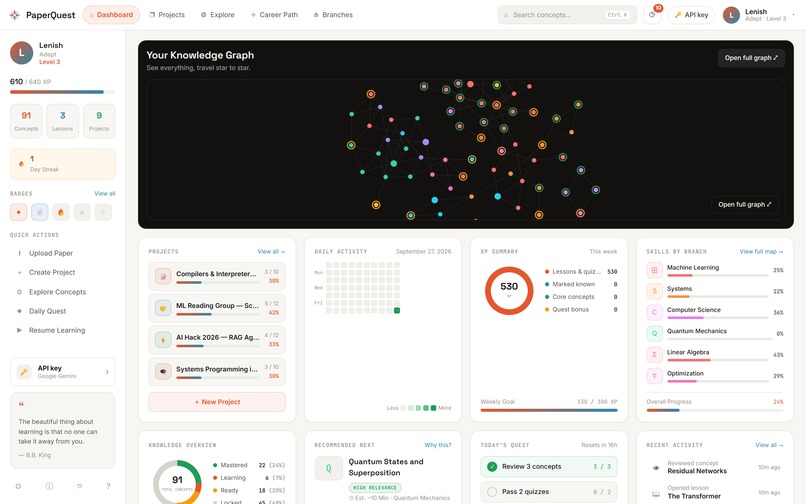
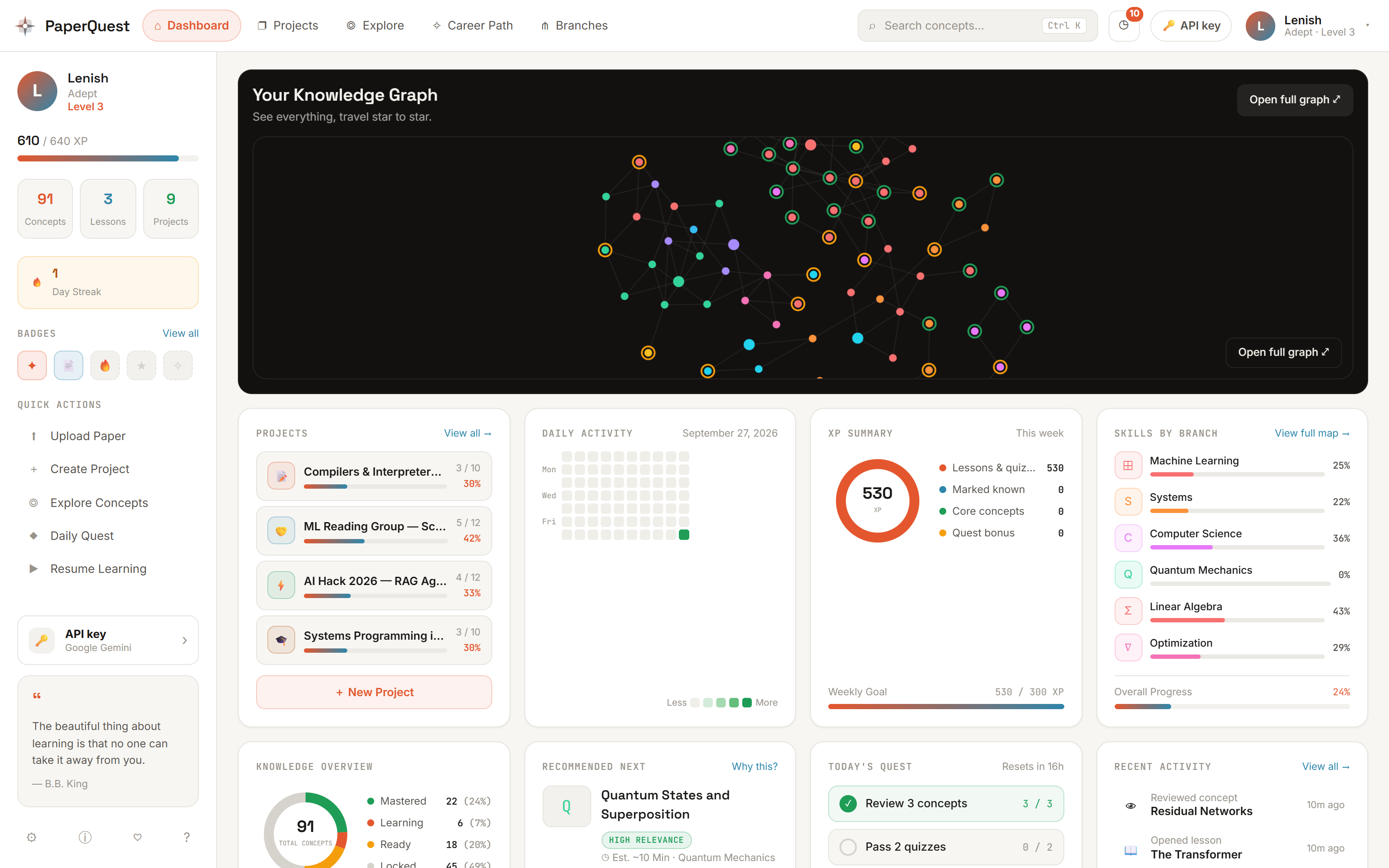
dashboard - optional to click stat tour
-
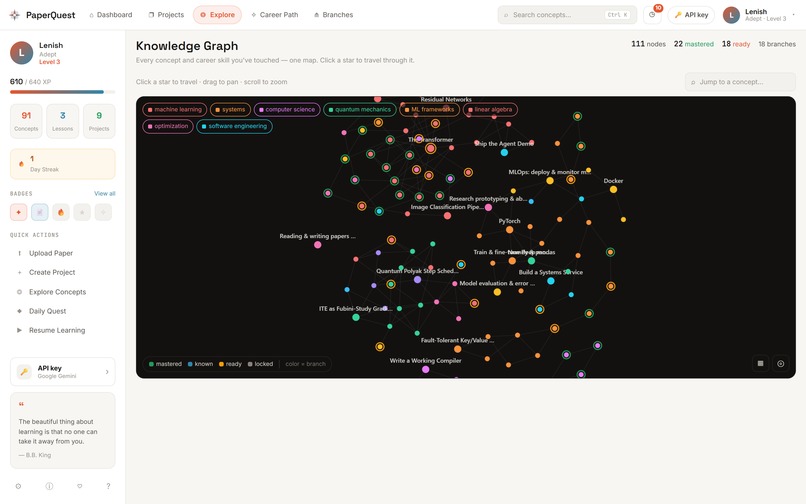
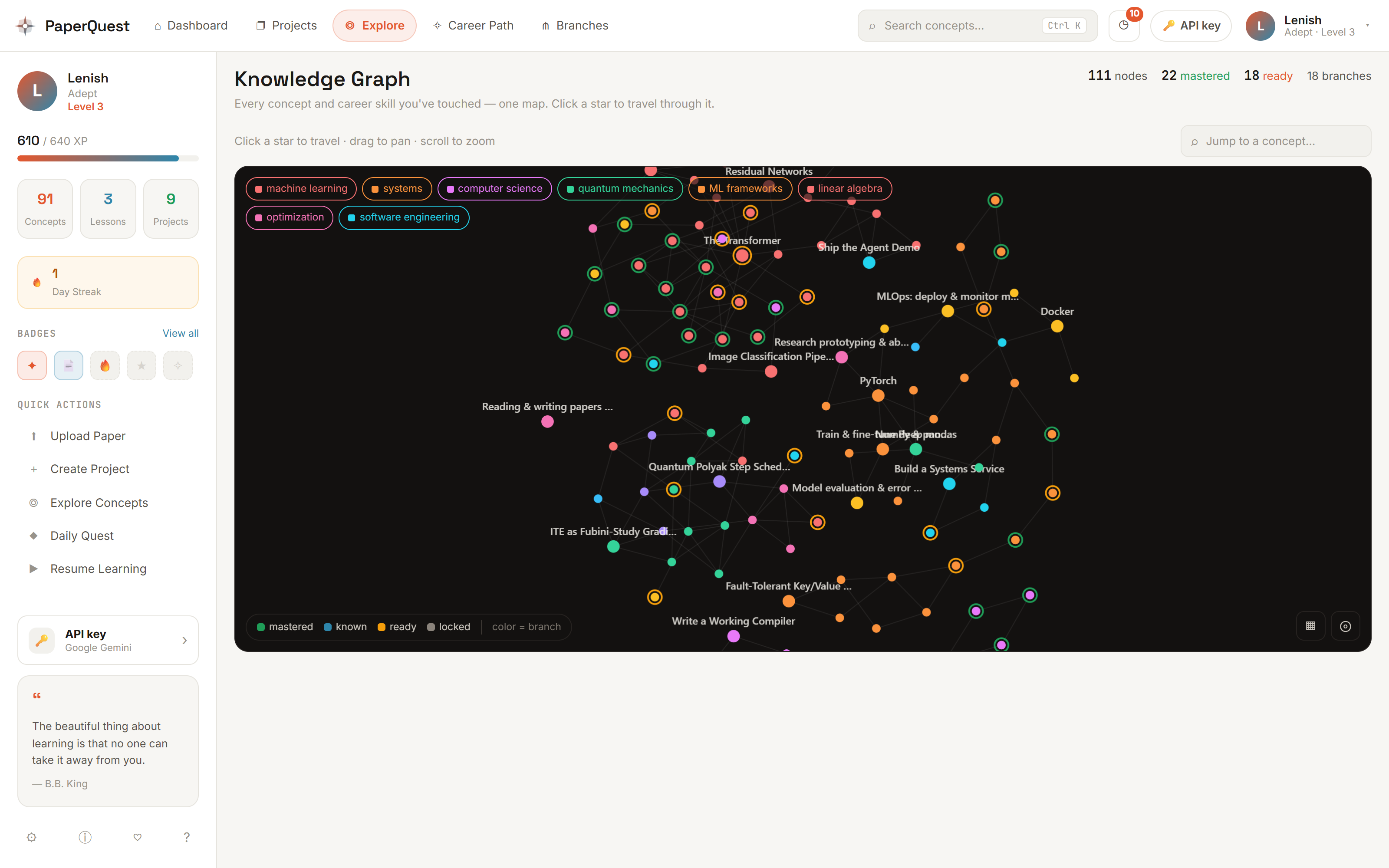
Knowledge graph
-
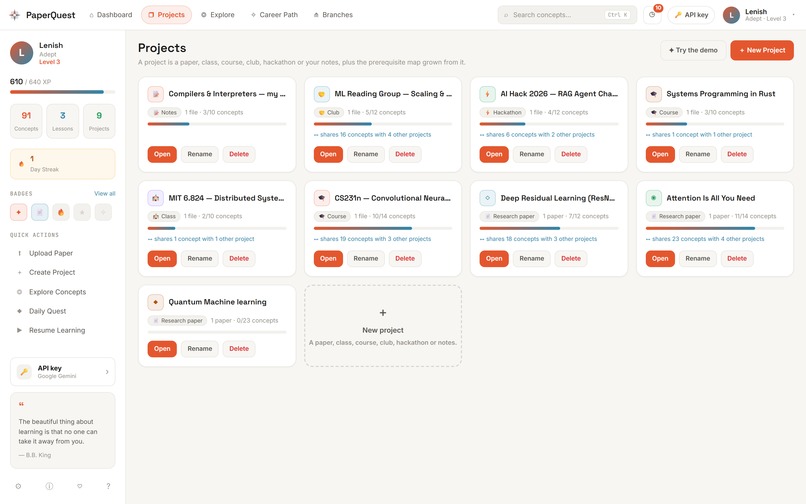
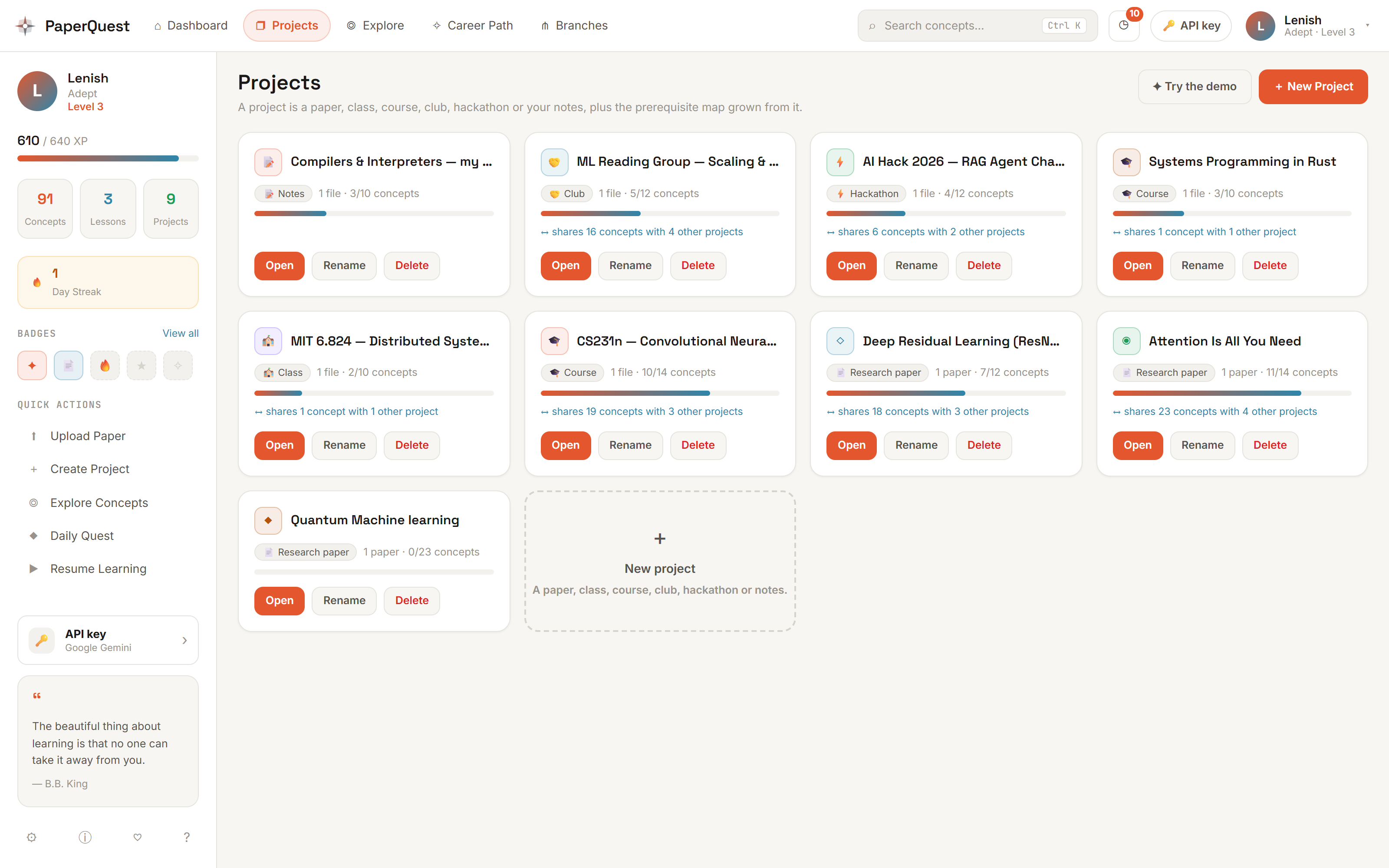
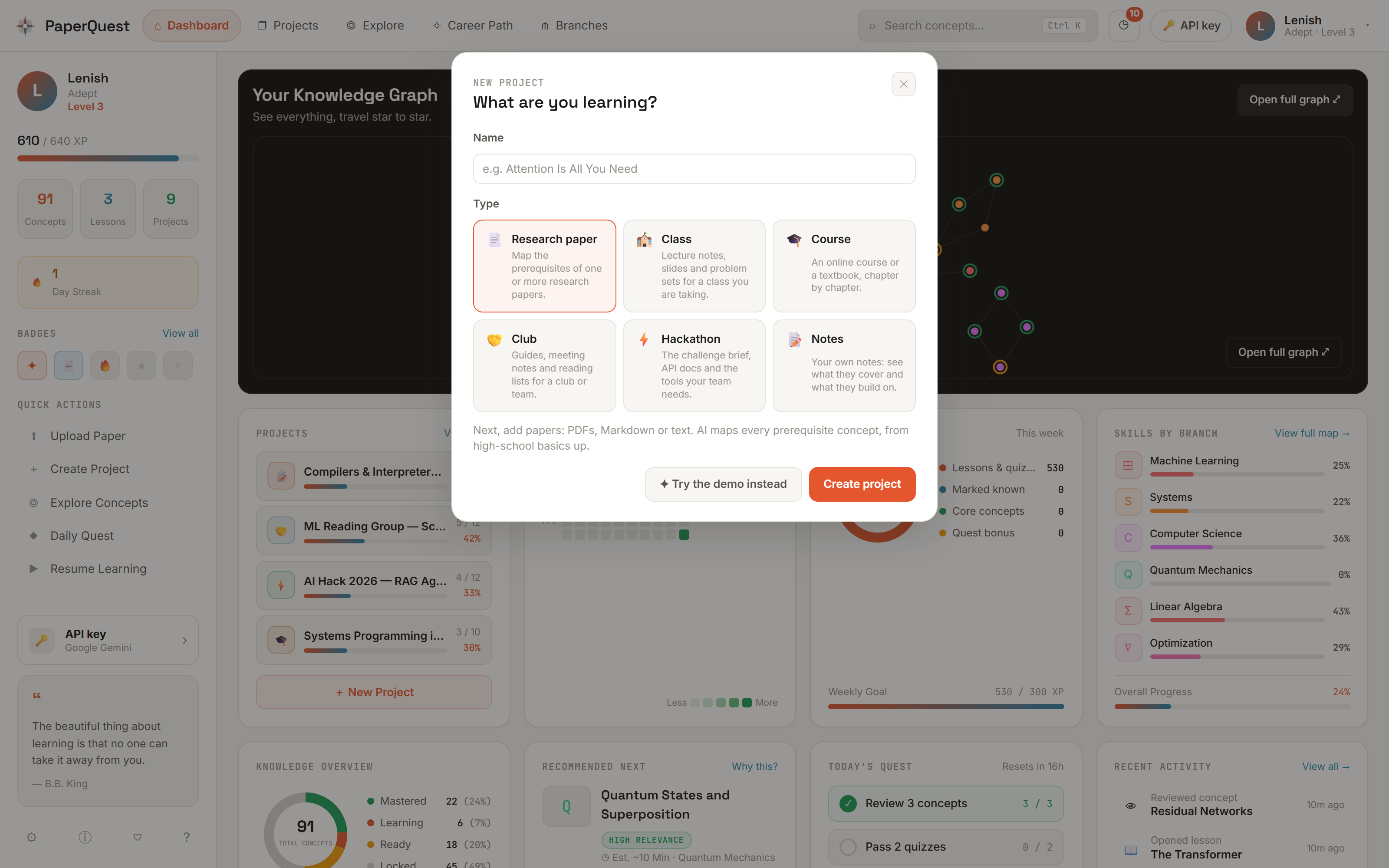
Projects - "courses, papers, any documents"
-
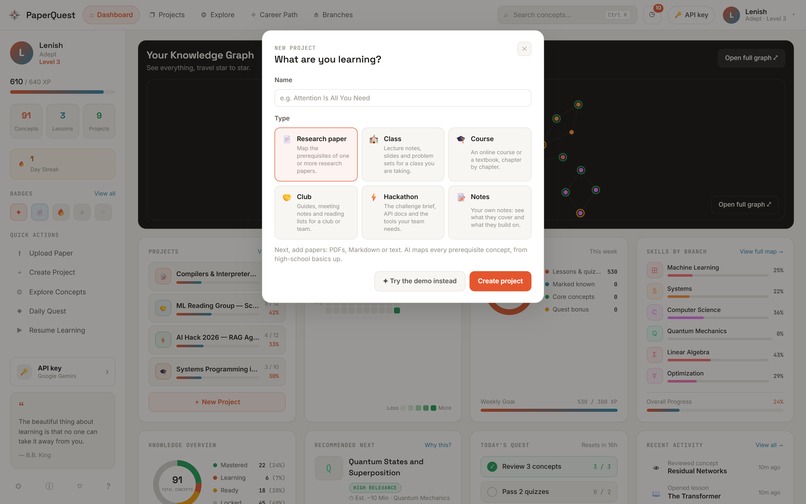
demo
-
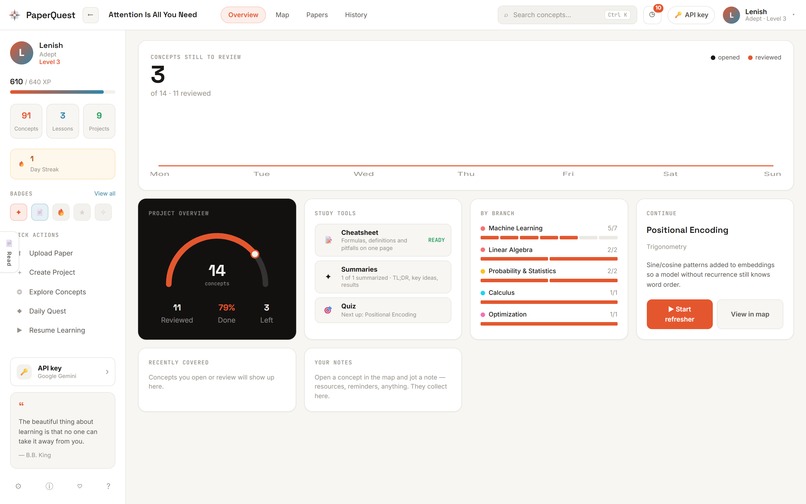
demo
-
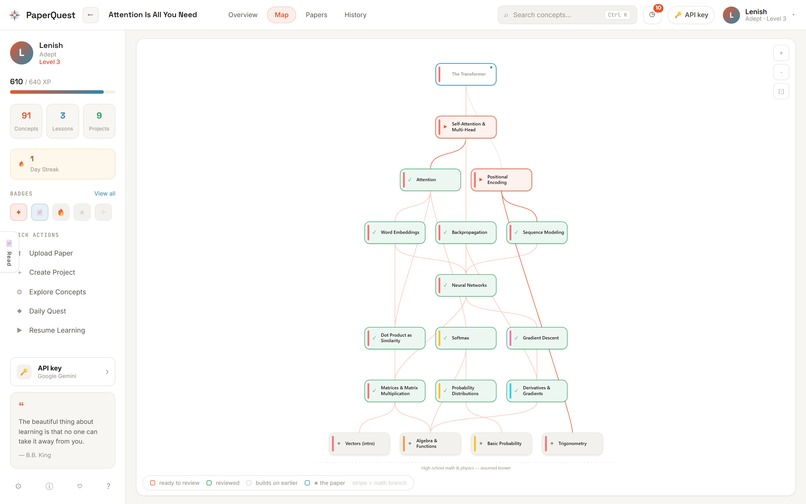
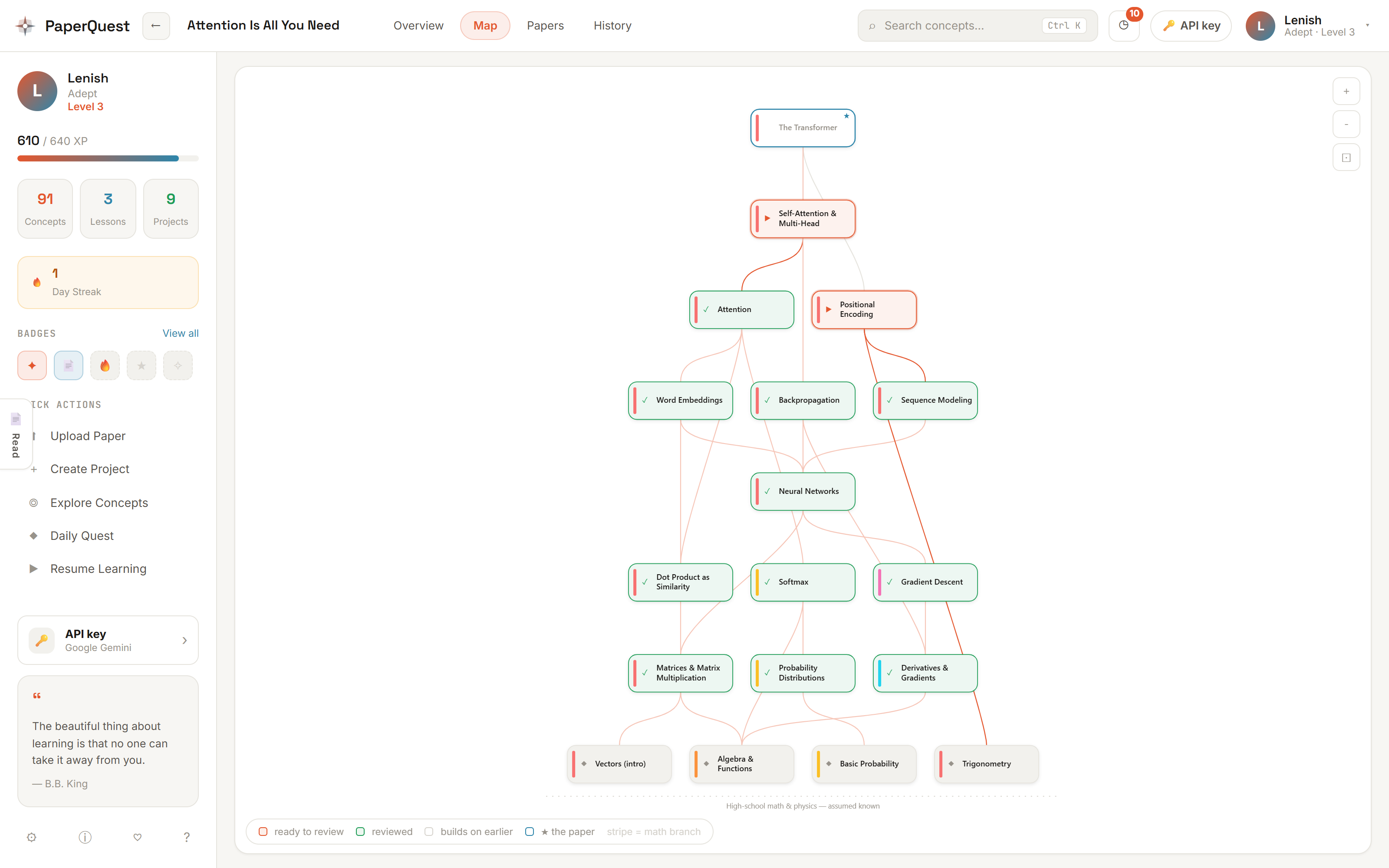
demo - map
-
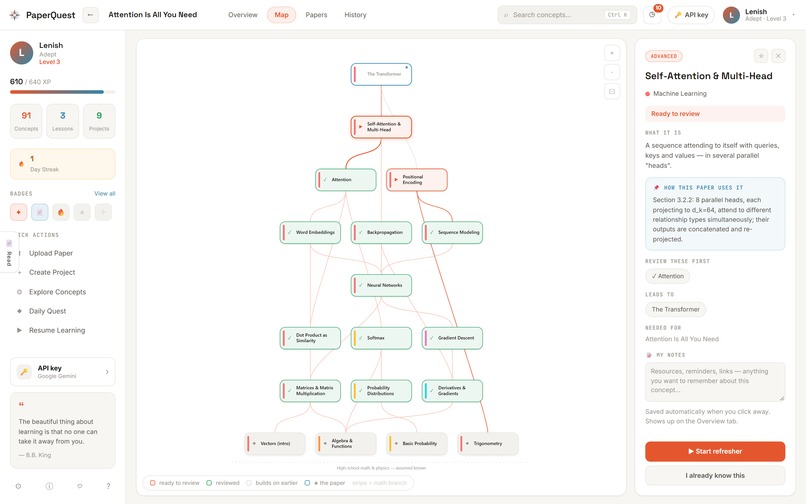
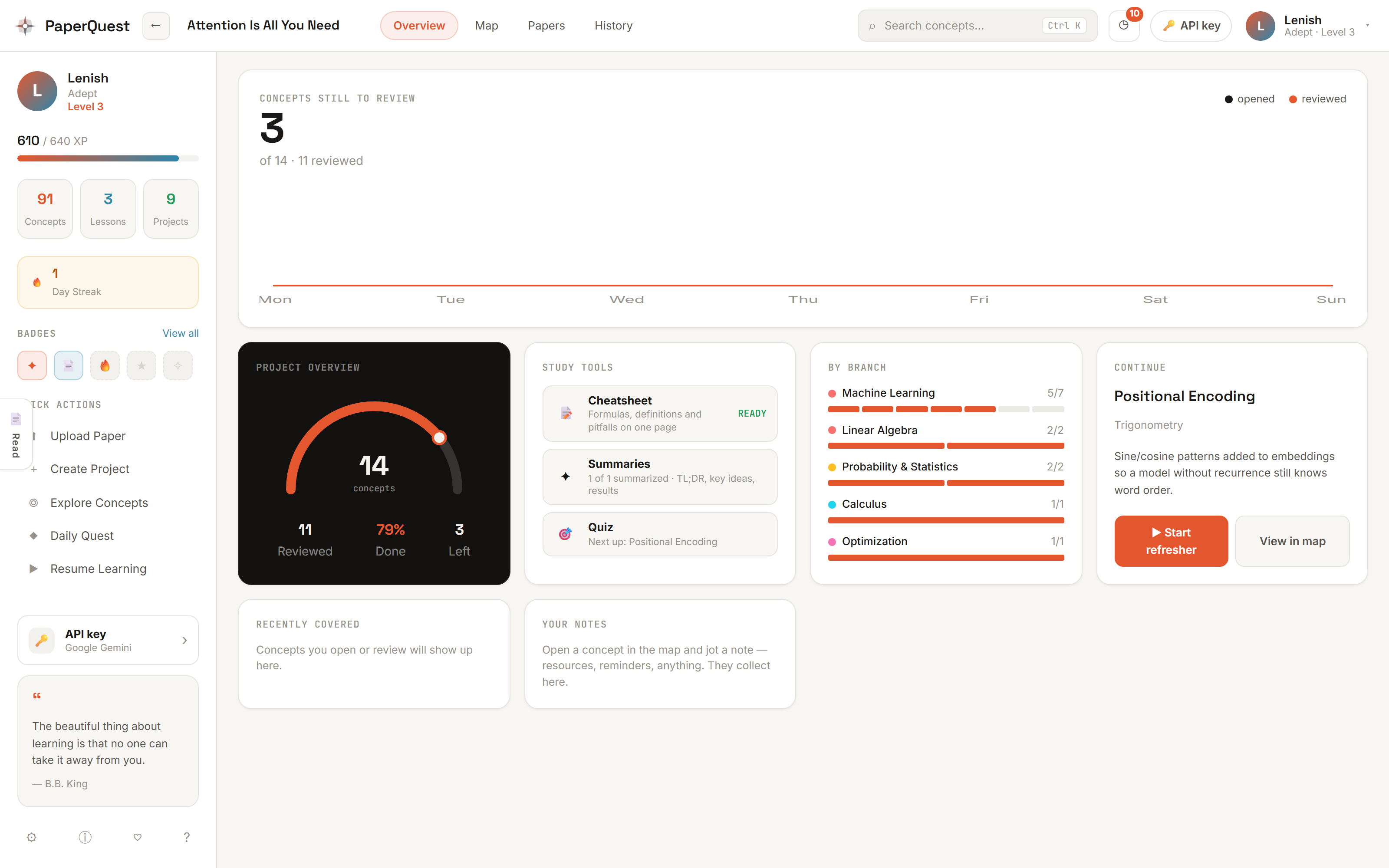
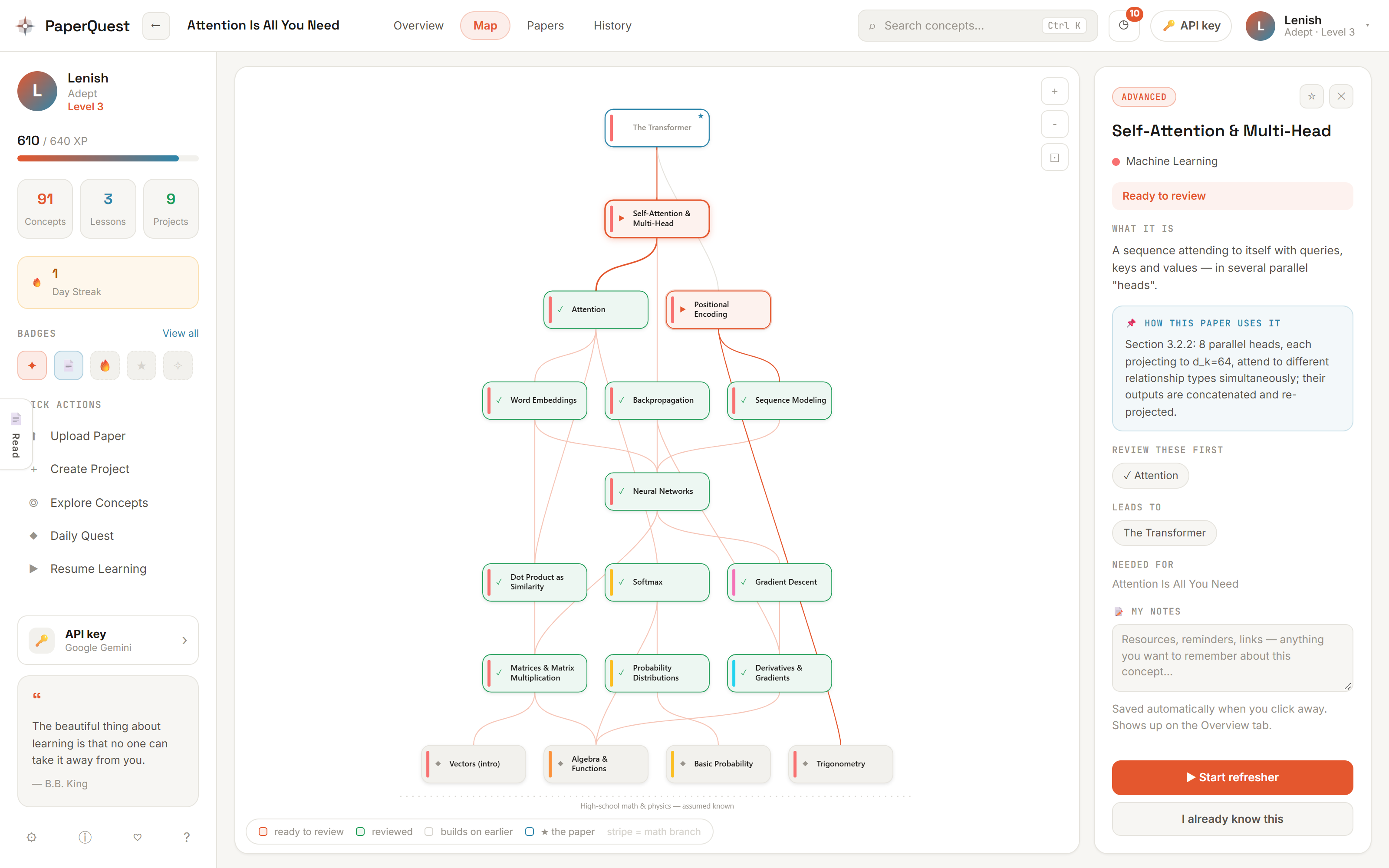
learning each module
-
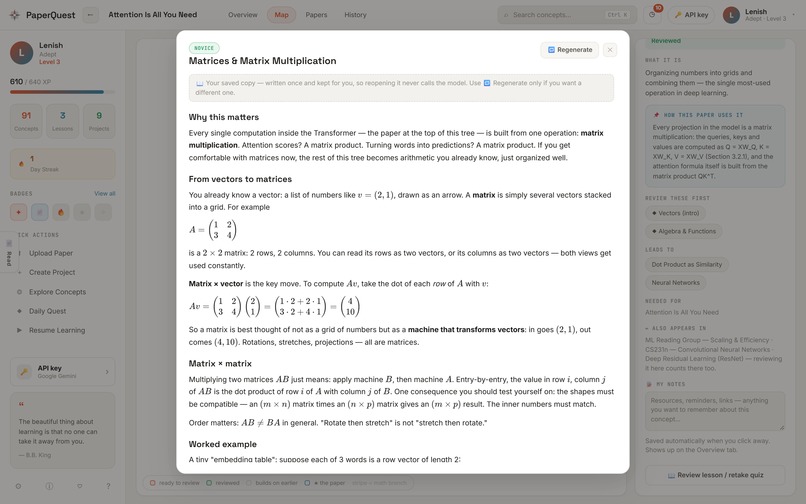
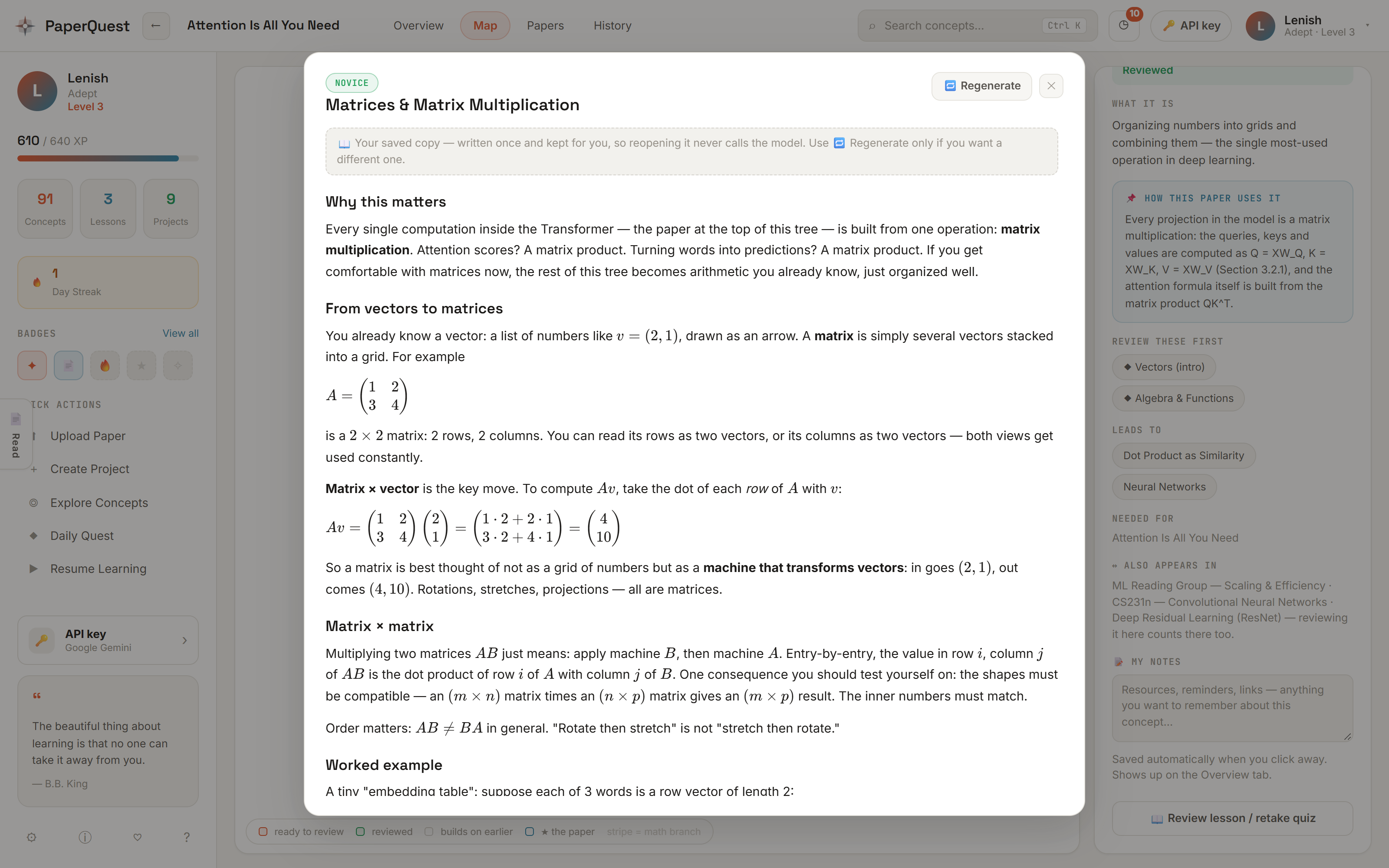
resources from Gen AI
-
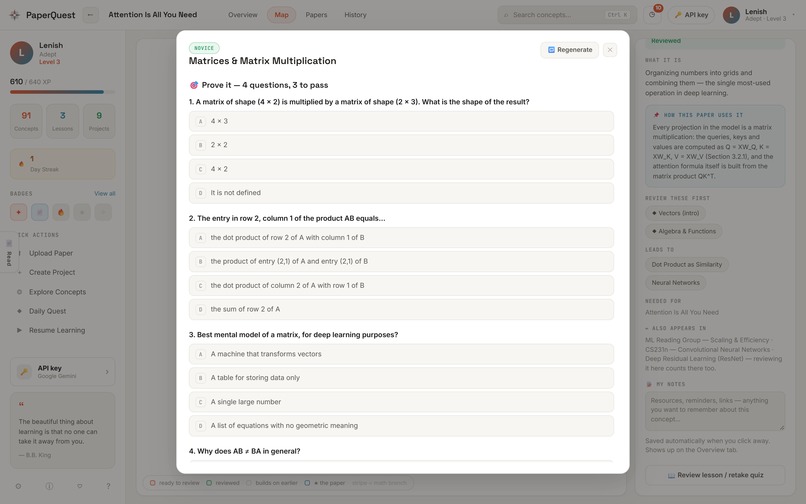
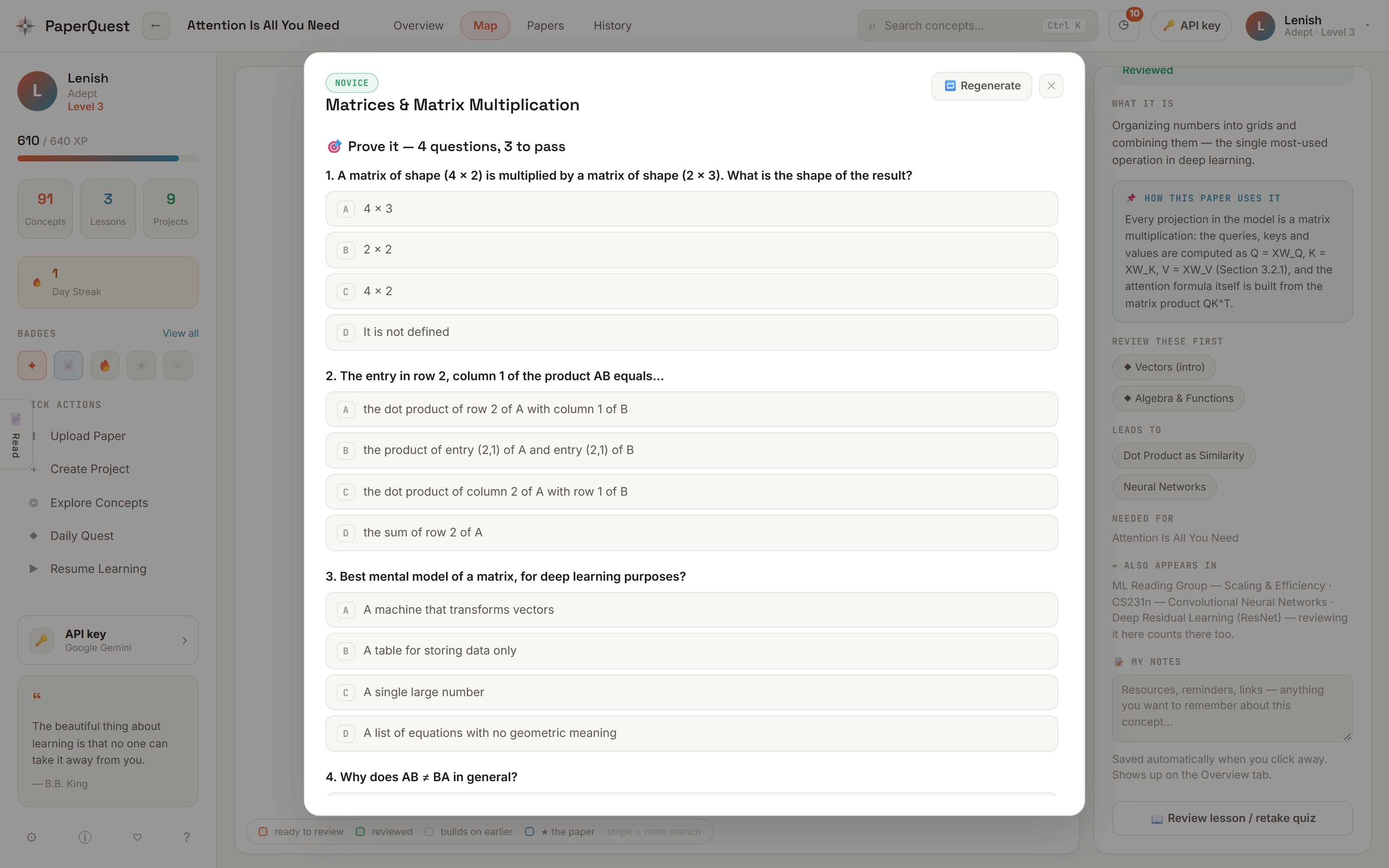
Quiz AI
-
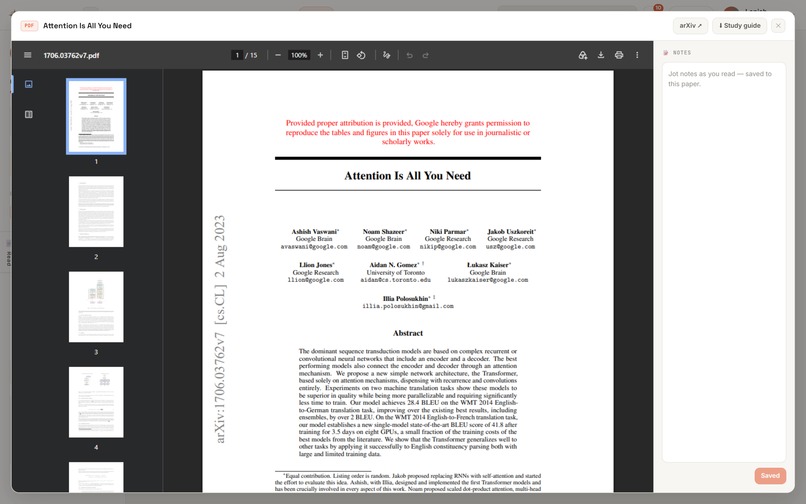
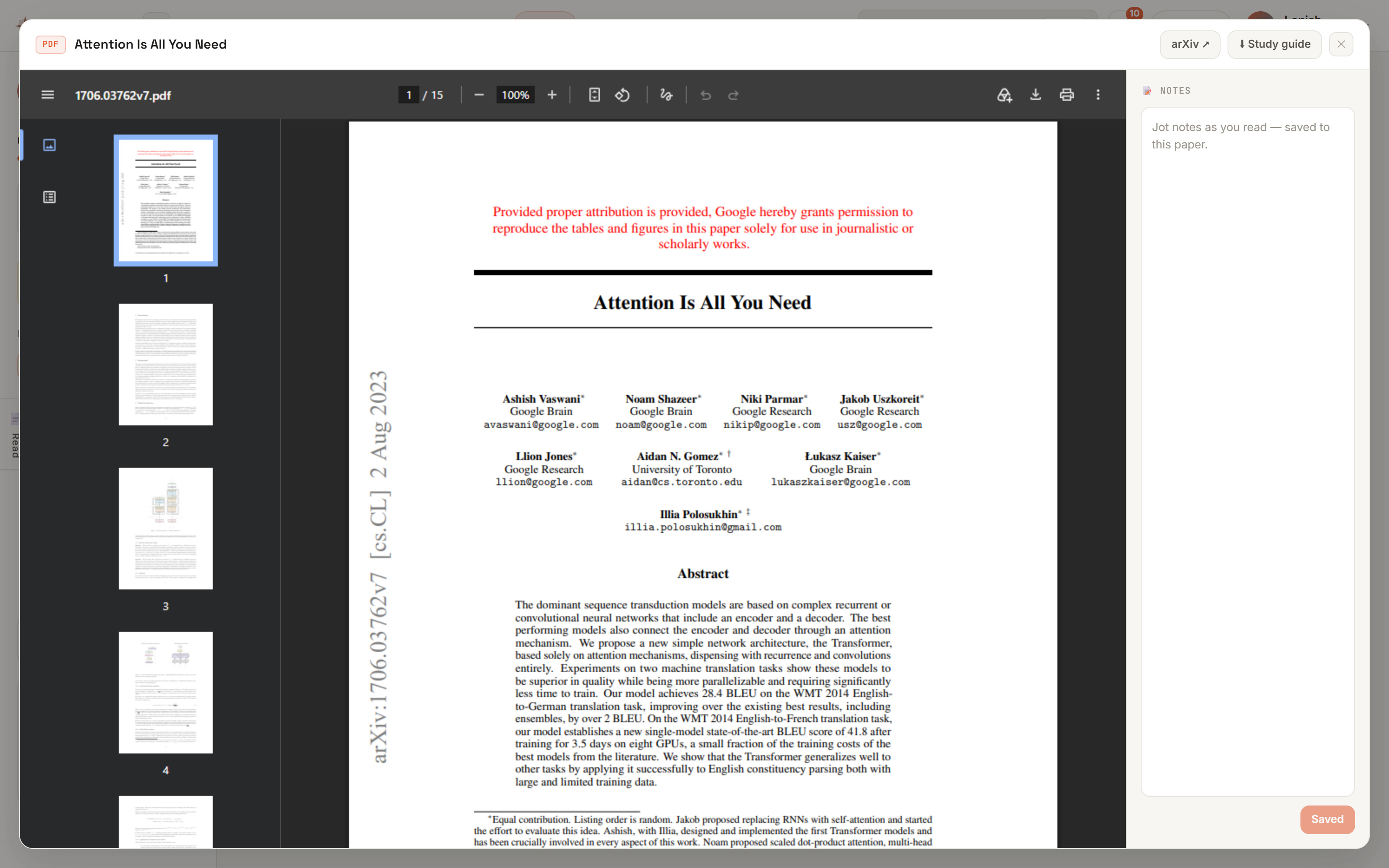
Paper
-
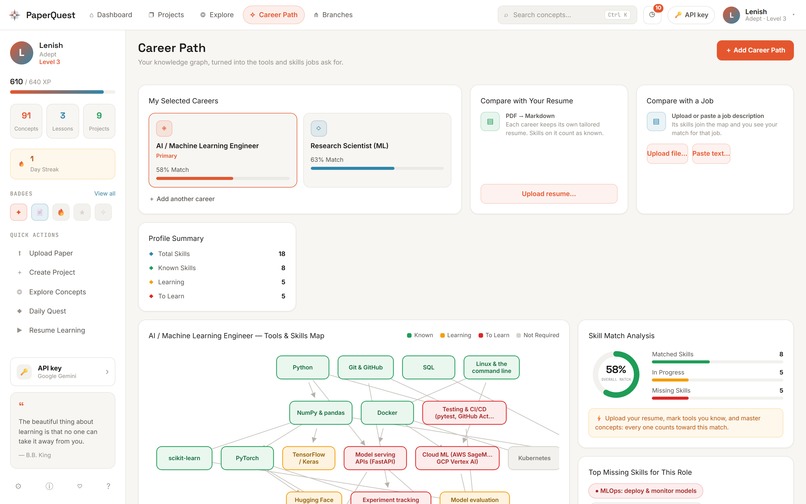
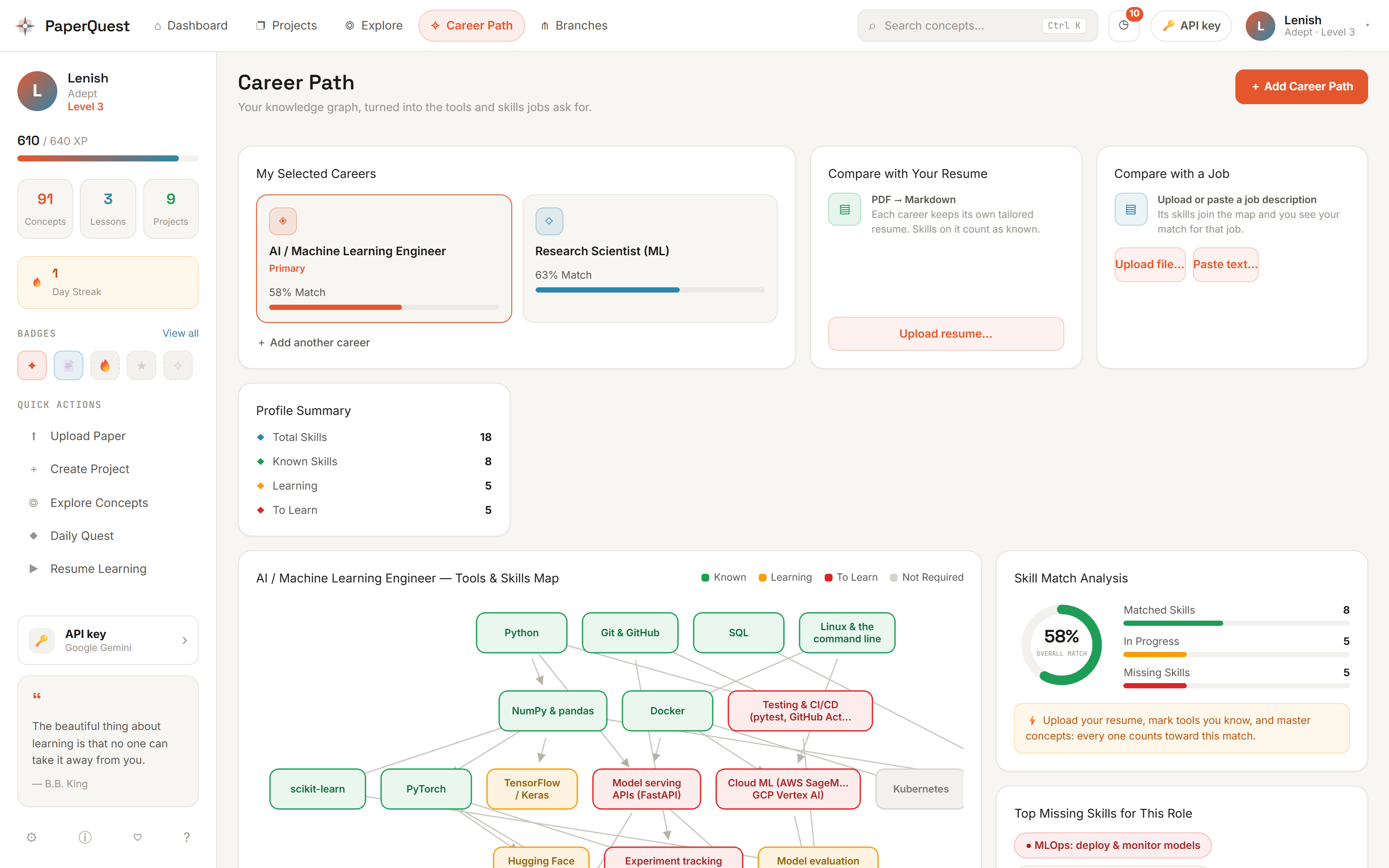
Career skills map
Inspiration
PaperQuest started with a question I kept asking myself: How do I turn everything I’m reading and learning into knowledge I can actually use?
I entered college as a physics major, moved into mathematics, and began exploring artificial intelligence, high-performance computing, quantum computing, and quantitative finance. As my interests evolved, I accumulated research papers, course materials, notes, and project ideas. Connecting those resources and figuring out what to learn next became increasingly difficult.
Learning happens across classes, projects, hackathons, clubs, and independent exploration. Each experience adds knowledge, but the connections often stay scattered across documents, folders, and our memory.
I wanted a tool that could organize those connections, reveal missing foundations, and turn ambitious learning goals into achievable next steps. That became PaperQuest.
What it does
PaperQuest turns complex documents into achievable learning paths, connecting what you already know to your next level of understanding.
Users organize documents into projects and build knowledge maps showing the concepts involved, their relationships, and the foundations needed to understand them.
The starting point could be:
- A research paper: Build a path from foundational mathematics to the paper’s advanced methods.
- A legal document: Break unfamiliar terminology and interconnected clauses into concepts to study and understand.
- A complex project idea: Identify the background knowledge, tools, and skills needed to begin implementing it.
- Personal notes or coursework: Connect scattered ideas, uncover gaps, and create a structured route toward deeper understanding.
Within each project, users can explore prerequisite maps, open concept refreshers, test their understanding with quizzes, and save notes and progress. Concepts connect across projects, allowing previous learning to contribute to new goals.
A combined knowledge graph makes those connections visible. Career paths help users relate their learning to professional interests, resumes, and job descriptions.
Users can also share read-only graph snapshots through an access key. A guided demo demonstrates the learning journey using Attention Is All You Need as one example.
How we built it
We built the interface with React and Vite, supported by a Node.js and Express backend. Interactive graphs let users explore dependencies within documents and connections across projects.
The document pipeline extracts text from uploaded PDFs and Markdown files. Language models identify concepts, organize prerequisite relationships, and generate learning material. Graph validation helps turn model output into usable learning structures, while saved refreshers can be reopened without generating them again.
We used PDF.js for PDF processing and KaTeX for mathematical notation. Google sign-in connects users to their saved workspaces, and server-side checks protect private data and developer features.
The application runs on Vercel, with Neon Postgres storing encrypted workspace data. AI-assisted development helped us iterate on implementation, debugging, and deployment.
Challenges we ran into
A central challenge was turning a document into a meaningful learning sequence. Identifying important terms is only part of the task: the map also needs to explain how concepts depend on one another and where a learner can begin.
Documents vary in structure, formatting, terminology, and assumed background knowledge. Extracting readable content while preserving equations and context required careful handling.
Connecting concepts across projects introduced another challenge: recognizing shared knowledge while preserving each document’s context and the user’s learning progress.
We also needed a dependable hosted experience with persistent storage, separate workspaces, account recovery, and controlled sharing. To make the first experience approachable, we created a guided sample that works without configuring an AI provider.
Accomplishments that we’re proud of
We built a working journey from an uploaded document to a concept map, focused refreshers, and a clearer next learning step.
We brought nine existing research projects into one connected workspace while preserving their documents, saved lessons, and progress. This gave us a concrete collection with which to explore connections across different subjects.
We’re also proud of connecting learning with career exploration. Users can see how concepts from their documents contribute to broader skills and professional goals.
The guided demo and read-only sharing make that experience easier to explore and demonstrate.
What’s next for PaperQuest
- A source-grounded learning agent: An agent harness that answers general questions across documents, retrieves supporting passages, explains connections, and suggests next steps with citations.
- Learning toward a chosen goal: Let users define an outcome—understand a topic, complete a course, or build a project—and generate a manageable sequence of learning milestones.
- More formats and integrations: Import slide decks, web resources, document collections, and learning-platform materials.
- Adaptive learning plans: Adjust recommendations based on demonstrated understanding, available time, and changing interests.
- Evidence behind each skill: Connect knowledge nodes to the documents, completed projects, and assessments that support them.
- Collaborative learning spaces: Help study groups, project teams, and mentors build and explore shared knowledge maps.
Our goal is to make every document a starting point for deeper understanding and an achievable next step.
Built With
- 3d-force-graph
- css
- express.js
- google-gmail-oauth
- html
- javascript
- library
- multer
- node-postgres
- node.js
- npm
- openid
- postgresql
- serverless-http
- snowflake
- vite

Log in or sign up for Devpost to join the conversation.