-
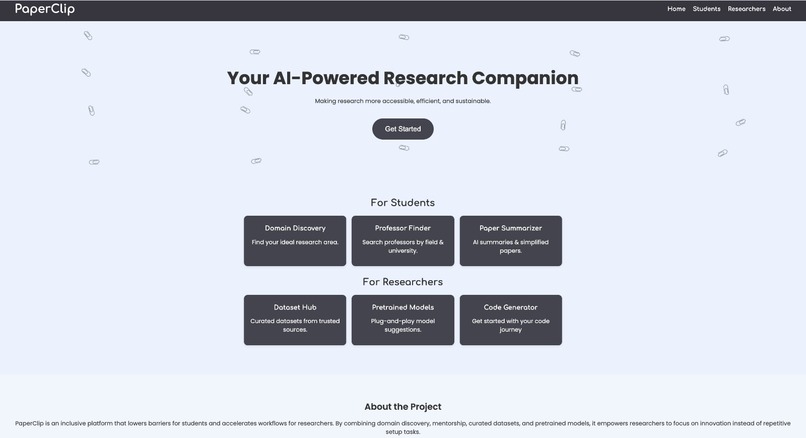
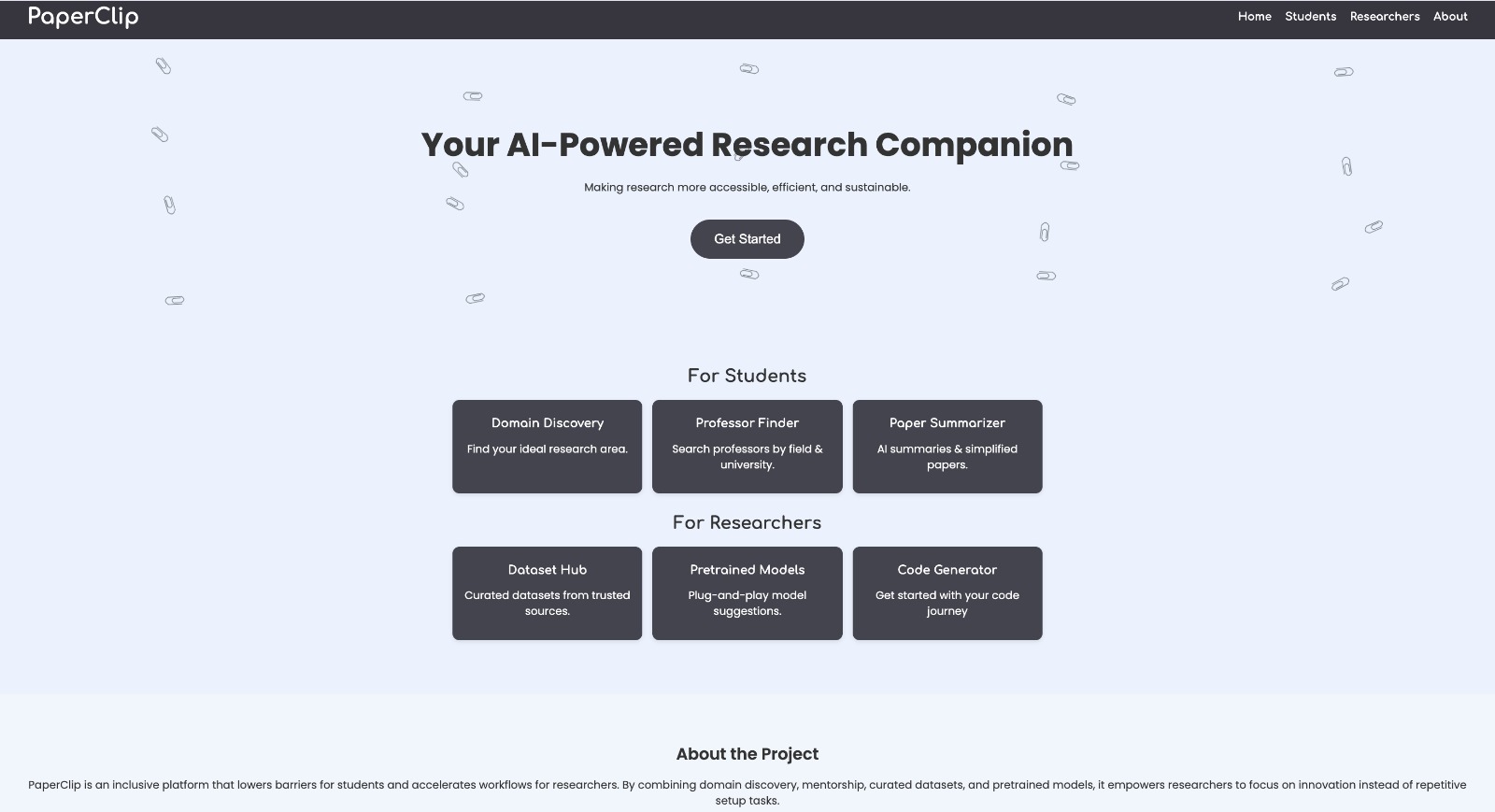
This is the landing page of Paperclip. It has a clear representation of features available and the navigation to the chatbot
-

Lets the user enter just the Username to retrieve any session information and contexts.
-
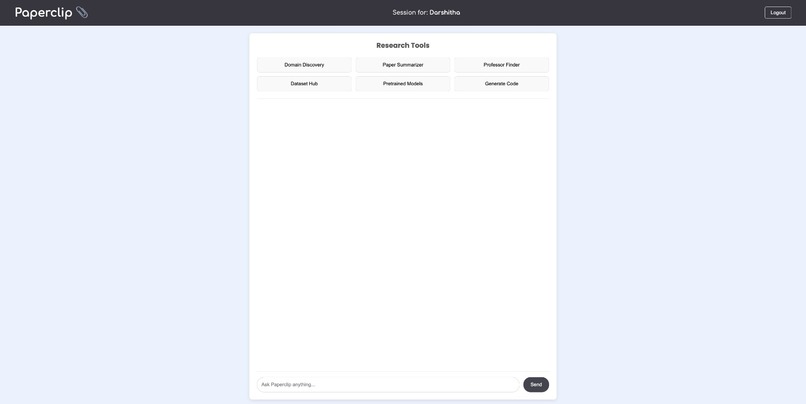
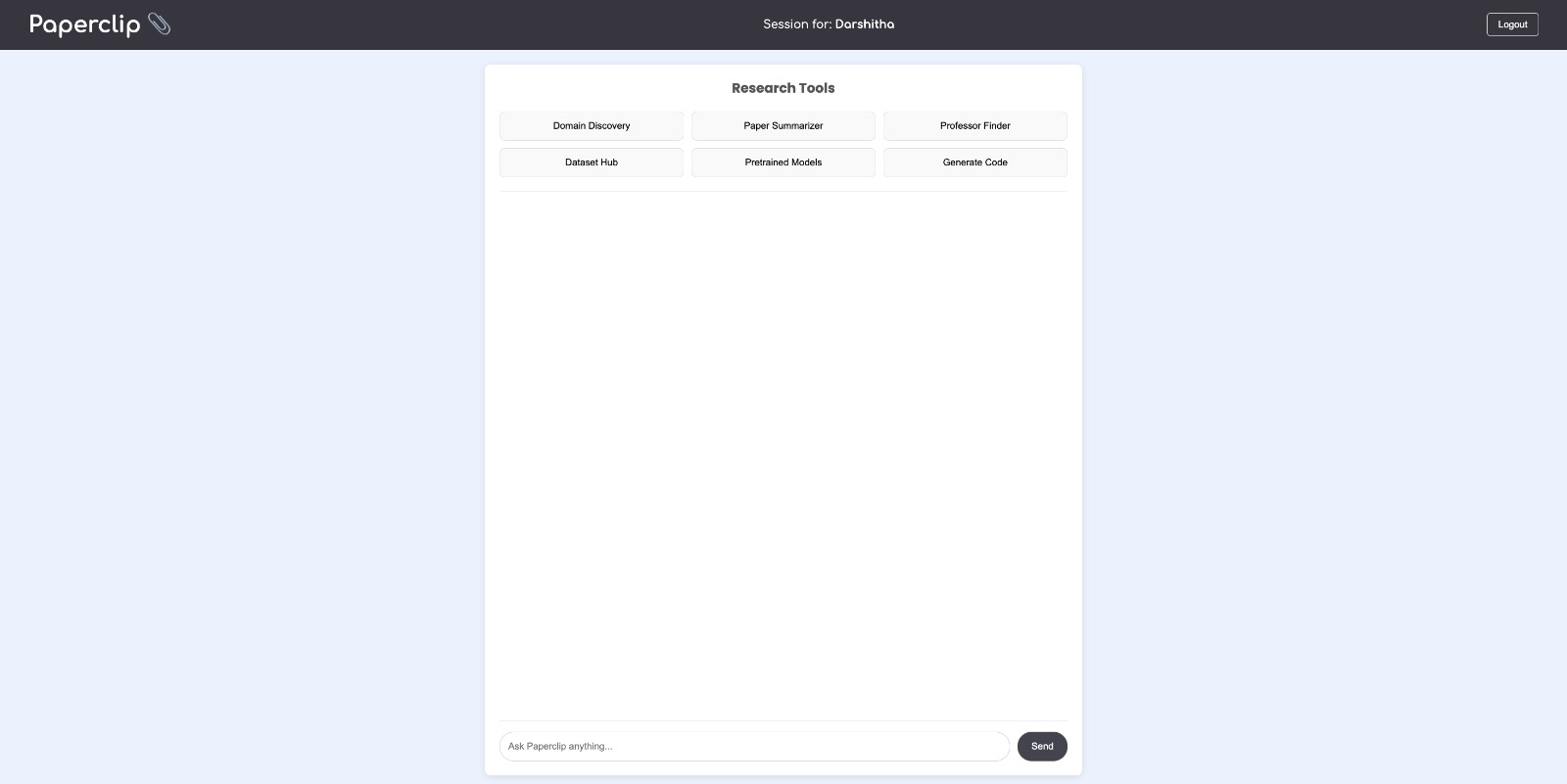
Paperclip Agent interface that lets the user interact and converse with the chatbot.

📎 Paperclip: Your All-in-One Research Companion
💡 Inspiration: The Need for Synthesis
Research, for most of us, sparks both excitement and anxiety—endless questions, sleepless nights, and a dozen tabs open at once. You Google for domains, scroll ArXiv for papers, use an LLM to summarize them, dig through GitHub for code, search university websites for professors, and repeat. It’s fragmented, exhausting, and often discouraging.
What if all of that came together in one place?
That’s why we built Paperclip—your all-in-one research companion.
| User Group | Paperclip's Value Proposition |
|---|---|
| For Students | Makes the journey less overwhelming: suggests domains, connects with professors, summarizes papers in accessible language, and provides ready-to-run starter projects. |
| For Researchers | Delivers speed and sustainability: curated datasets, pretrained models, and GitHub code come together into ready-to-run pipelines—saving precious compute, time, and energy. |
The result? Faster, more inclusive, and more sustainable research. With Paperclip, sleepless nights can finally become breakthrough mornings.
⚙️ What It Does: Transforming the Research Workflow
We built Paperclip to transform research from a fragmented, overwhelming process into a seamless journey, addressing two distinct user needs:
1. For Students: Onboarding & Accessibility
We created tools to guide students from confusion to clarity:
- Domain Discovery: Input a simple idea, and the AI maps it to relevant domains and subfields, providing direction at the very start.
- Professor & Researcher Finder: Centralizes university data, allowing students to easily explore professors, their focus areas, and recent publications.
- Paper Aggregator: Brings in recent papers and summarizes them in simple, multilingual explanations, ensuring students don't feel left out by complex jargon.
- Accessible Starter Projects: Ensures that every student, regardless of their resources, can run lightweight, compute-efficient projects on free platforms like Colab.
2. For Researchers: Efficiency & Sustainability
We focused on cutting down duplicated effort and wasted compute:
- Dataset Compilation Hub: Curates datasets from multiple sources so researchers don't waste time searching.
- Pretrained Model Recommender: Surfaces ready-to-use models, reducing the need to train from scratch.
- Open-Source Code Integrator: Pulls in relevant GitHub repositories, summarizes their usage, and provides quickstart guides to shorten setup time.
- Starter Project Generator: Combines datasets, pretrained models, and repos into a single boilerplate notebook that can be run instantly.
- Sustainability Insights: Measures the compute, time, and energy saved by reusing resources, powered by integrations to carbon-tracking APIs.
🛠️ How We Built It: Core Modules
| Module | Technologies | Key Function |
|---|---|---|
| Frontend Dashboard | .tsx (Typescript), Streamlit | Clean, accessible UI with tabs for every core feature (Domain Discovery, Code Generator, Sustainability, etc.). Designed for research workflows and multilingual support. |
| Backend & AI Engine | FastAPI, Python | Acts as the central hub, providing asynchronous API endpoints for all data flows. |
| AI Intelligence | Cohere (LLM) | Summarizes papers, validates data, generates reproducible starter notebooks, and is the engine for multilingual explanations. |
| Agent Orchestration | LangChain (Conceptual Pattern) | Structured our workflow as a sequential, Multi-Agent Orchestration pattern: fetching, validating, and integrating resources into runnable pipelines. |
| APIs / Data Sources | Git, ArXiv, Kaggle | Provides real-time access to code, academic papers, and curated datasets. |
| Context Management | SQLChatMessageHistory | Maintains user session information across multiple requests, allowing the AI to relate to earlier conversations and preserve context. |
🚧 Challenges We Ran Into
- Integrating Multiple APIs into One Platform: We had to bring together diverse sources—Cohere, ArXiv, Git, and Kaggle. Each API came with different structures, rate limits, and authentication, requiring careful, asynchronous orchestration.
- Balancing Depth with Accessibility: Students need simplified, multilingual explanations, while researchers want detailed technical depth. Designing an AI layer that adapts to both audiences without overwhelming either side took extra care.
- Sustainability Metrics Integration: Quantifying compute savings, time reductions, and energy impact from reusing models isn’t straightforward. We had to design an estimation pipeline combining theoretical models and API data, which added complexity.
- Handling Diverse File Formats & Data Standards: Normalizing metadata from sources with wildly different standards (e.g., ArXiv vs. HuggingFace) to fit our internal Pydantic models was challenging.
🏆 Accomplishments We're Proud Of
- Multi-Agent Orchestration: We successfully built a complex AI workflow where specialized agents seamlessly collaborate to fetch papers, curate datasets, interpret code, and stitch them into complete starter projects.
- Multilingual Support for Accessibility: We enabled the platform to summarize research outputs in multiple languages, directly supporting inclusivity in research and democratizing access to knowledge globally.
- Smarter Domain Discovery: Our discovery process doesn’t just surface existing areas; it uses the LLM to highlight future developments and emerging trends, inspiring more forward-thinking projects.
- Contextual Intelligence: The platform’s responses adapt based on user type (student vs. researcher) and conversational history, ensuring the advice and resources provided are always relevant and tailored.
🧠 What We Learned
- Multi-Agent Collaboration in Practice: We gained hands-on experience designing and coordinating AI agents to work in unison for complex, sequential tasks, mastering control flow and error handling.
- From Concept to Execution Under Pressure: Turning a big, abstract idea into a working prototype in such a short span forced us to ruthlessly prioritize, focus on the core value proposition, and adapt quickly to API failures.
- Maintaining Context in Conversational AI: We now have a deeper understanding of session management and how to preserve user context across different functional modules without confusing the system.
⏭️ What's Next for Paperclip
- Accommodation of Other Input Formats: Integrate support for voice, PDFs, and images as initial research inputs.
- Specialized Repository Integration: Expand data sourcing to specialized academic repositories (e.g., PubMed, IEEE, Zenodo).
- Collaboration Features: Add shared research workspaces and citation management to the frontend.
- Scaling and Monetization: Scale the platform as a Research-as-a-Service tool for university labs and academic institutions.
- Enhanced Sustainability Dashboards: Develop even clearer, real-time energy/impact reporting directly in the UI.


Log in or sign up for Devpost to join the conversation.