Inspiration
After my regular 8-5
I would get home, completely mentally fatigued. All I wanted to do was boil instant noodles, but I knew I should eat something healthy. I stood there staring at my fridge, too tired to think.
My usual hack was to open Gemini, manually type in a list of what i have, and ask for a recipe. It worked okay, but it was friction-heavy. I had to type everything out every time. Sometimes the AI would hallucinate ingredients I didn't have ("Just add red oil!"). Other times, it gave me complex recipes that took an hour when I just needed something easy. Worst of all, I couldn't "save" the search results to create a meal plan for next week.
I realized that while LLMs are great for ideas, they are terrible at managing state. I didn't need a chatbot; I needed an Inventory Operating System.
I asked myself: What if I could just scan the food instead of typing it? What if I could sort recipes by "Ease of Cook" instead of just random suggestions? What if I could save these searches and actually build a meal plan from them, or have some other food auto added to my list which could be auto ordered from grab, Amazon?
That is why I built PantryFlow. I wanted a tool that creates a healthy meal from my chaos, without the hallucinations, and without forcing me to register just to get a recipe.
I want to wake up on Saturday to see all the ingredients at my doorstep because they were pre-approved by my own system. PantryFlow is the first step toward that reality.
What it does
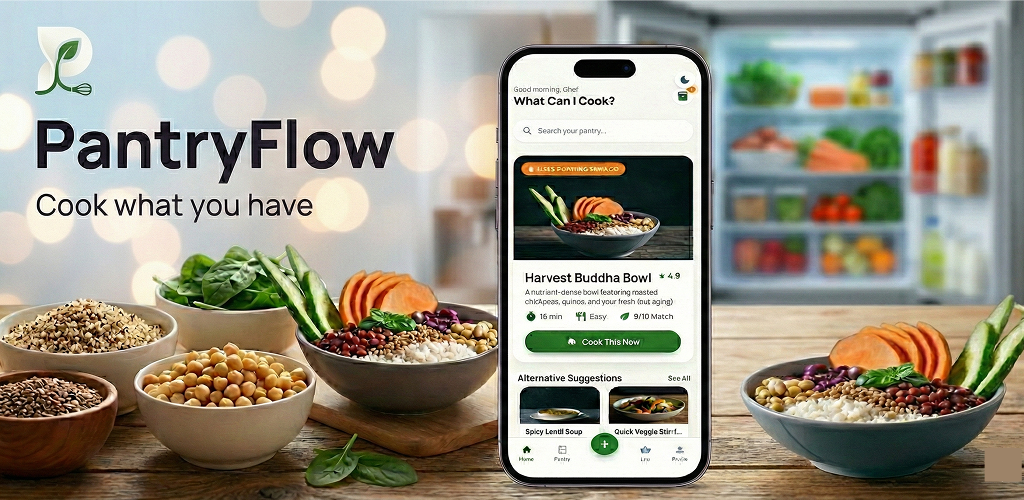
PantryFlow is a "reverse recipe" engine that prioritizes inventory over desire. Instead of asking "What do you want to eat?", it asks "What do you have?"
Scan & Cook: Users can scan barcodes (via FatSecret) or snap photos of their fridge to instantly populate a digital pantry.
The "Strict Match" Engine: We filter millions of recipes to show meals you can cook with 100% of your current inventory. No "just run to the store for saffron."
Lazy Registration: We removed the login wall completely. You can download, scan, and cook immediately. We only ask for a sign-up when you want to back up your data or sync devices.
Smart Aggregation: We act as a search engine for food, aggregating recipes from across the web and deep-linking users to the original creators for instructions.
How we built it
We built PantryFlow by chaining together a specific set of high-performance APIs to create a "God Mode" backend that is both powerful and free to operate:
The Scanner (Input): We integrated the Gemini 3 recognition. This handles the heavy lifting of translating a barcode into "Heinz Ketchup, 500ml."
The Brain (Search): We use the Edamam API to power our search logic. It allows us to perform complex boolean queries (e.g., ingredients=["chicken", "rice"] AND time="<30min").
The Visuals (Dynamic Fallback): One of our biggest technical hurdles was recipes without images. We built a dynamic image matcher using the Unsplash API. If a recipe lacks a photo, our system parses the title (e.g., "Avocado Toast") and fetches a high-res, royalty-free stock image in real-time.
The Frontend: We focused on a "Local First" architecture, storing the user's pantry data on the device initially to allow for the instant, no-login experience.
Challenges we ran into
The "Empty Room" Problem: A pantry app is useless until you add data, and typing 50 items is terrible UX. We solved this by building "One-Tap Staples" (Eggs, Milk, Oil) and a "Guest Flow" that lets users see potential value before doing any work.
API Economics: Finding a way to offer this service for free at first was. We initially looked at premium APIs that cost $500/month. We had to optimize our calls and cache results aggressively to stay within the free tiers of our API partners. We explored free food data and uses pixels and google vector for image search.
Accomplishments that we're proud of
The "Lazy" Flow: We successfully implemented a friction-free onboarding. Analytics show that users who "cook first" and "login second" have a much higher retention rate.
What we learned
Friction is the enemy: I learned that the hard way so allow users to use the app without an account also stripping 50% of input fields to scanning process.
Gemini vs. Databases: I learned the hard way that LLMs are great for ideas but terrible for state.
What's next for PantryFlow
So this came to mind, What if we don't have to create UI for PantryFlow? What if UI were created on the fly. I am talking Consumer Generative UI. or AI agents in food that actually understand you, your health. No hallucination. Recommends, orders, plan, reminds. I think the future is wild.
Join PantryFlow community https://chat.whatsapp.com/IOWDvgePE6TIDNtqIrnRrt?mode=gi_t


Log in or sign up for Devpost to join the conversation.