-
-
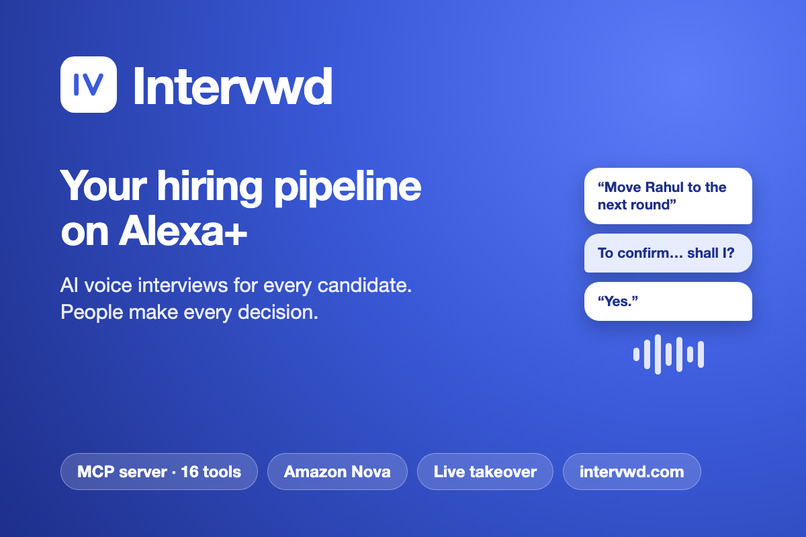
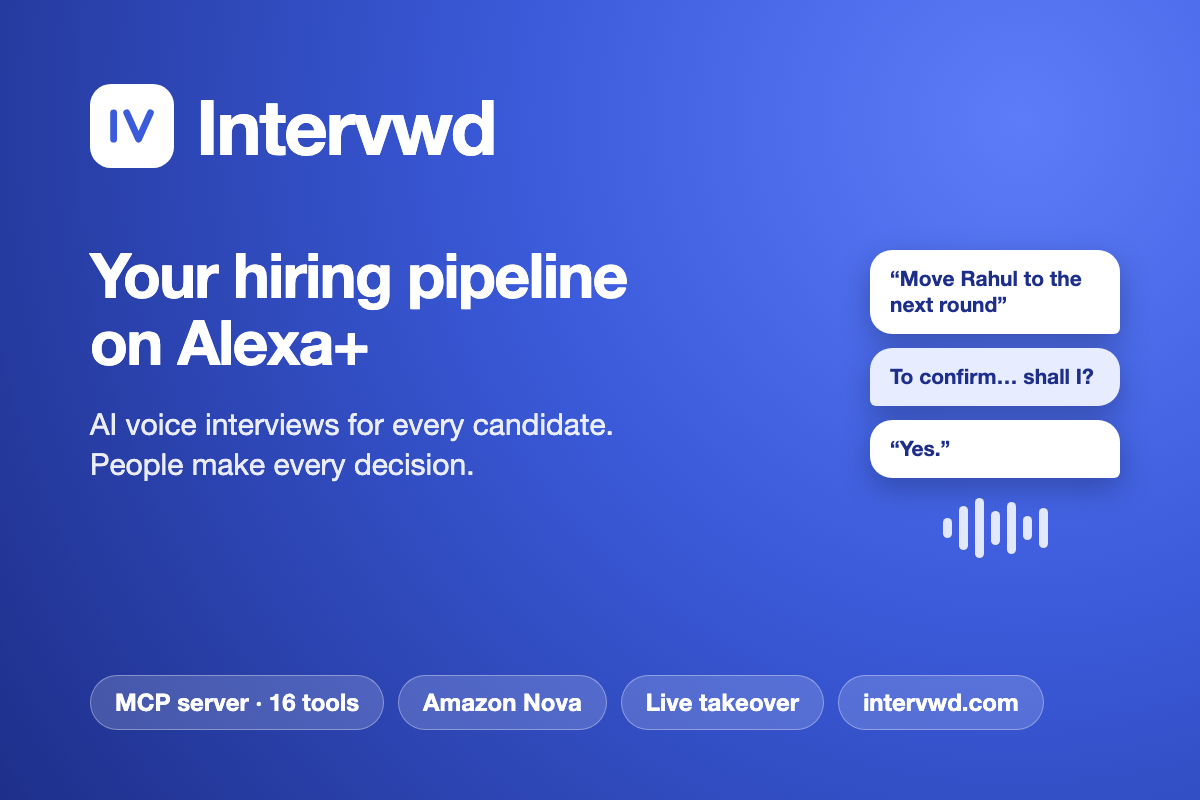
Intervwd: your hiring pipeline on Alexa+. AI voice interviews for every candidate; people make every decision.
-
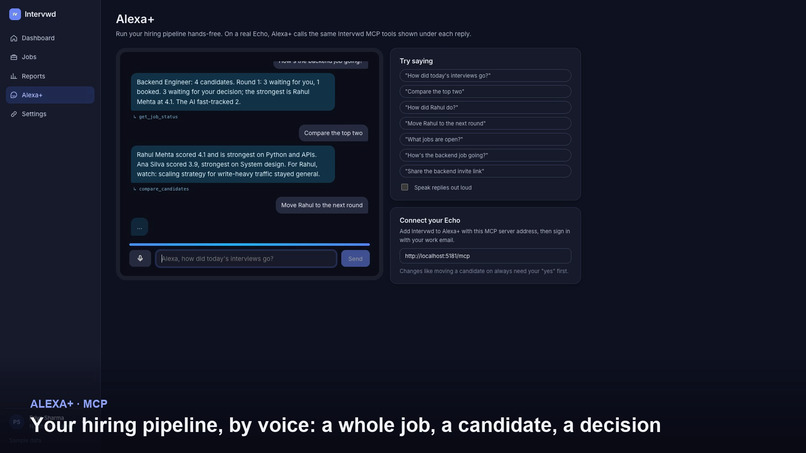
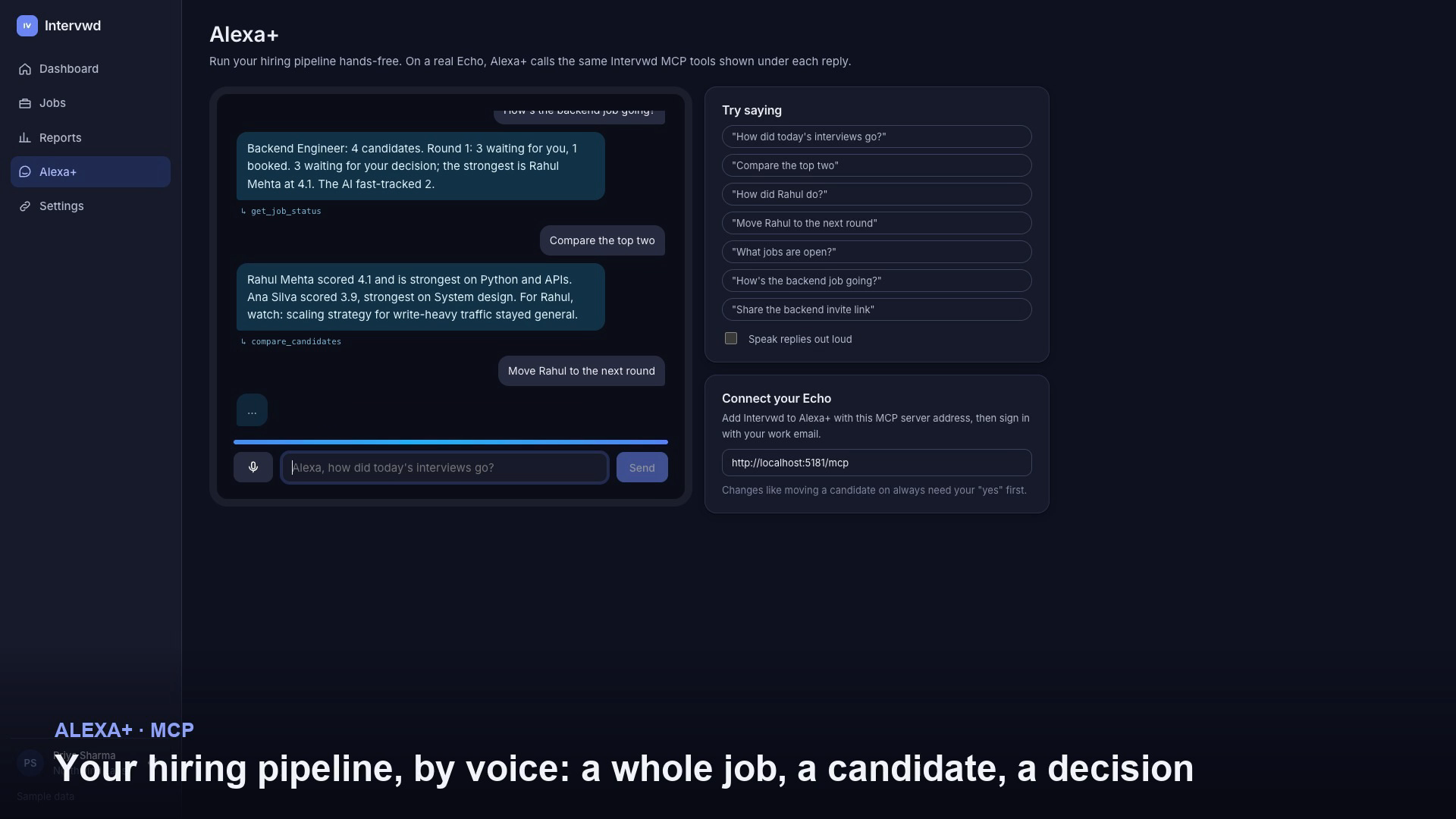
Alexa+ runs the hiring pipeline through our MCP server: 16 tools, and every decision asks for a "yes" first.
-
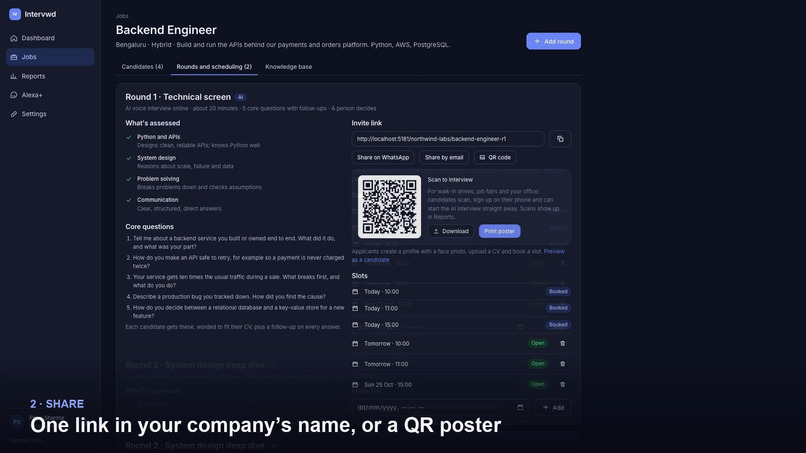
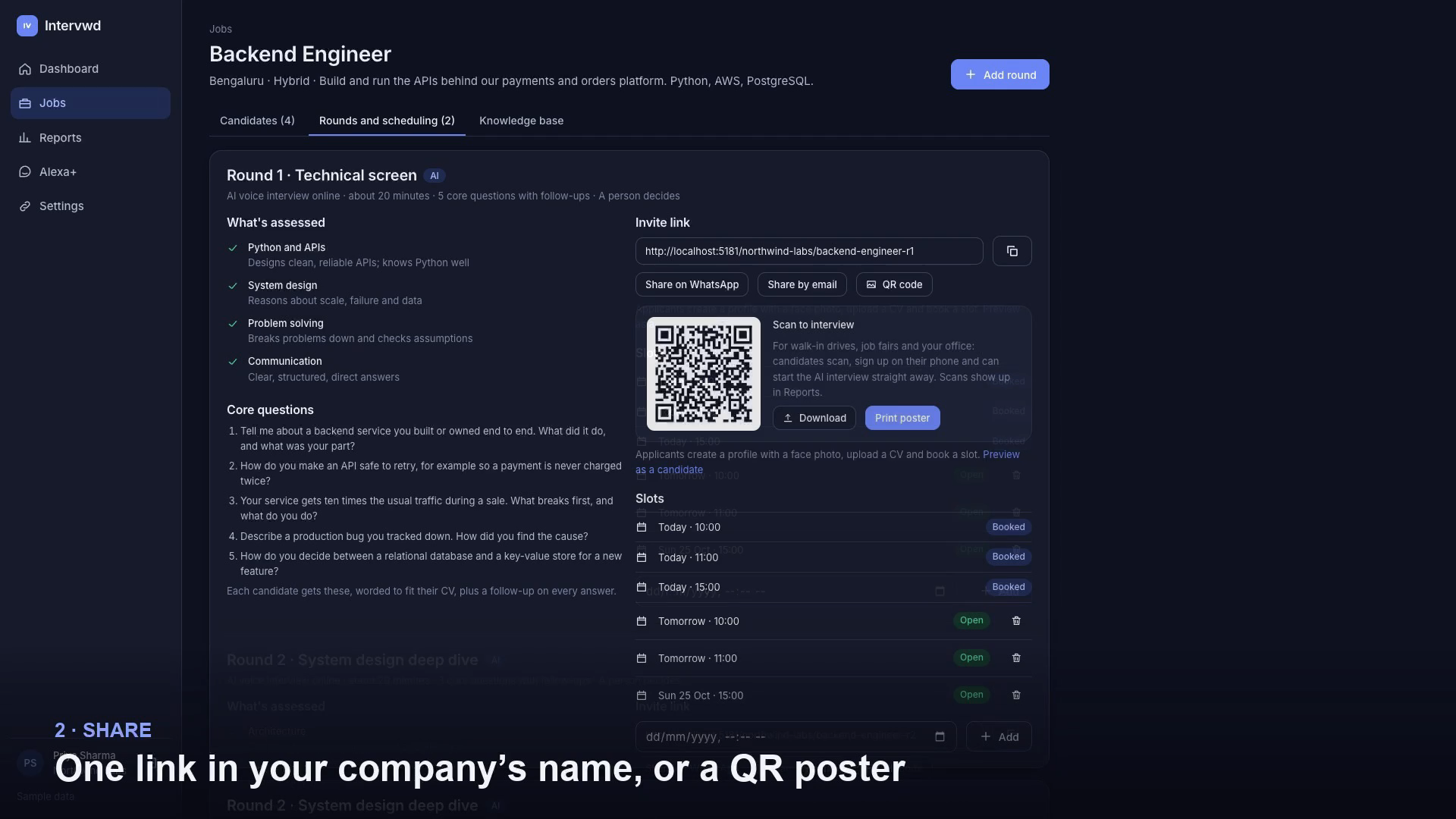
One link in the company's name, or a printed QR poster for walk-in drives.
-
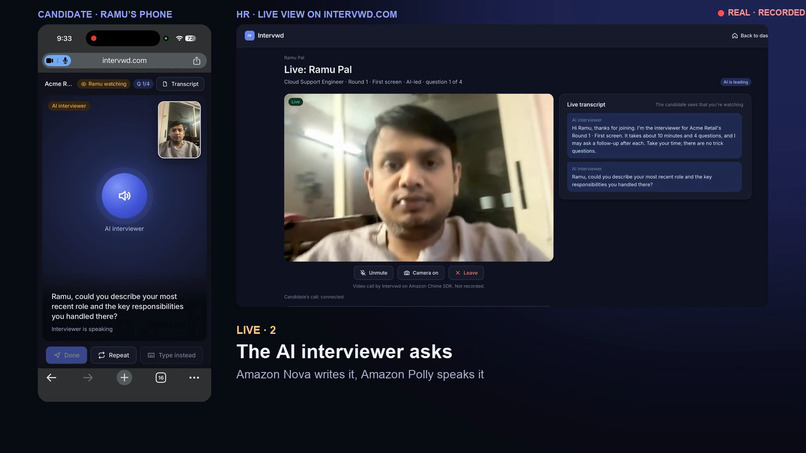
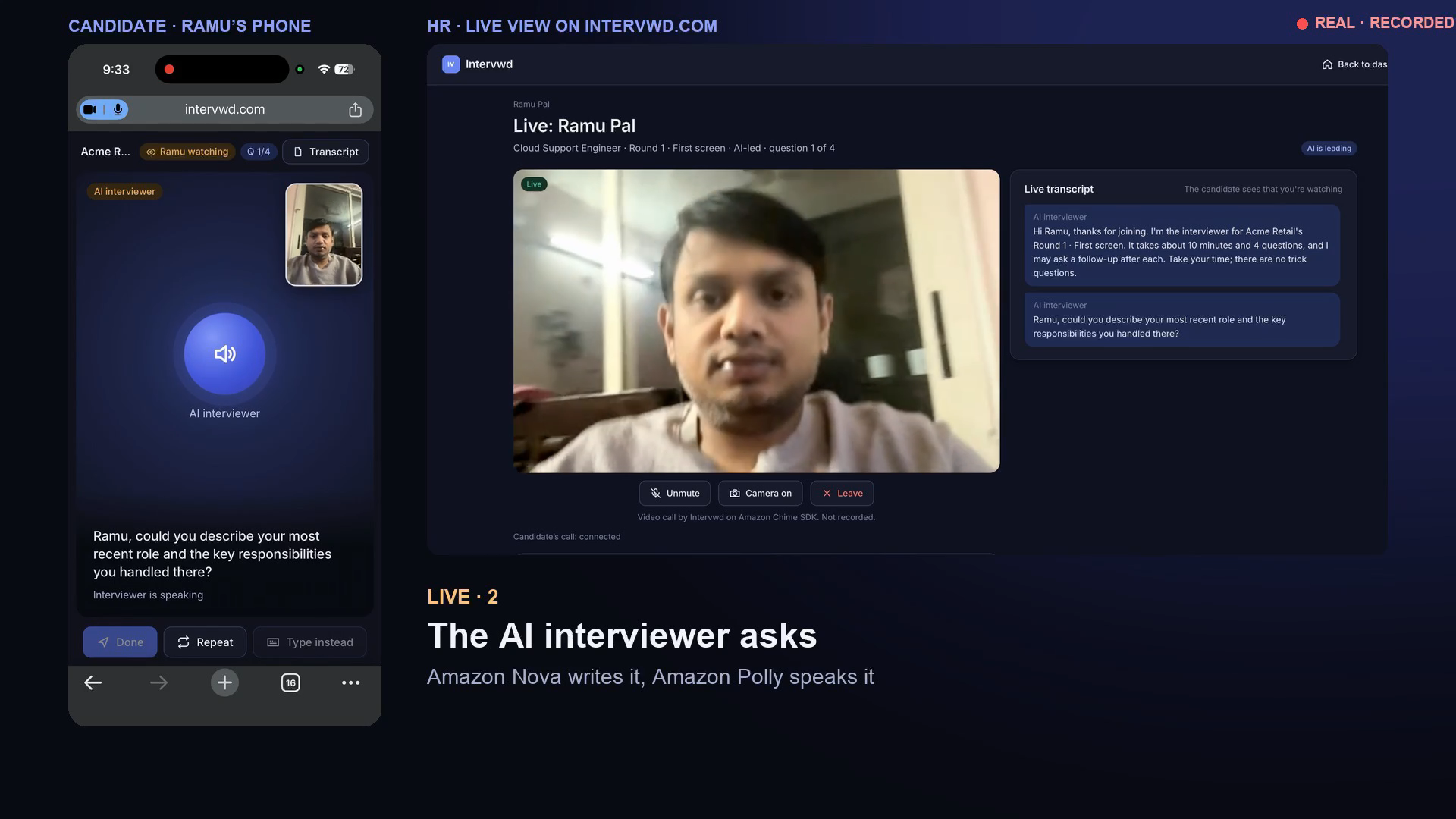
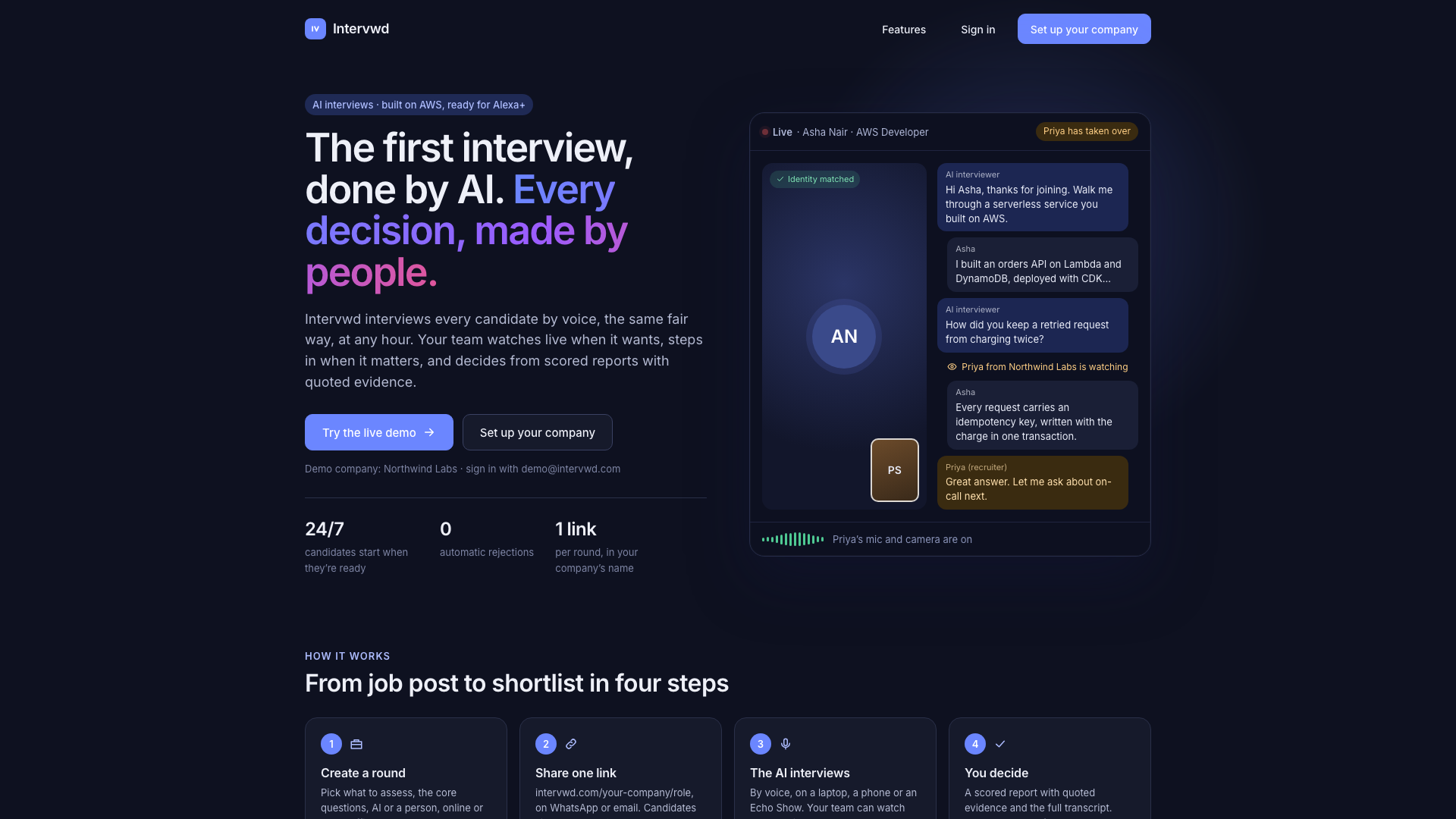
The AI interviewer asks by voice: Amazon Nova writes the question, Amazon Polly speaks it. HR watches live.
-
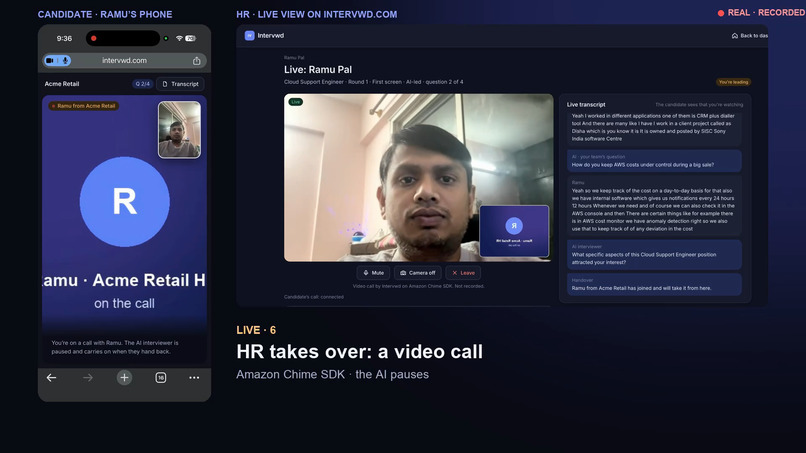
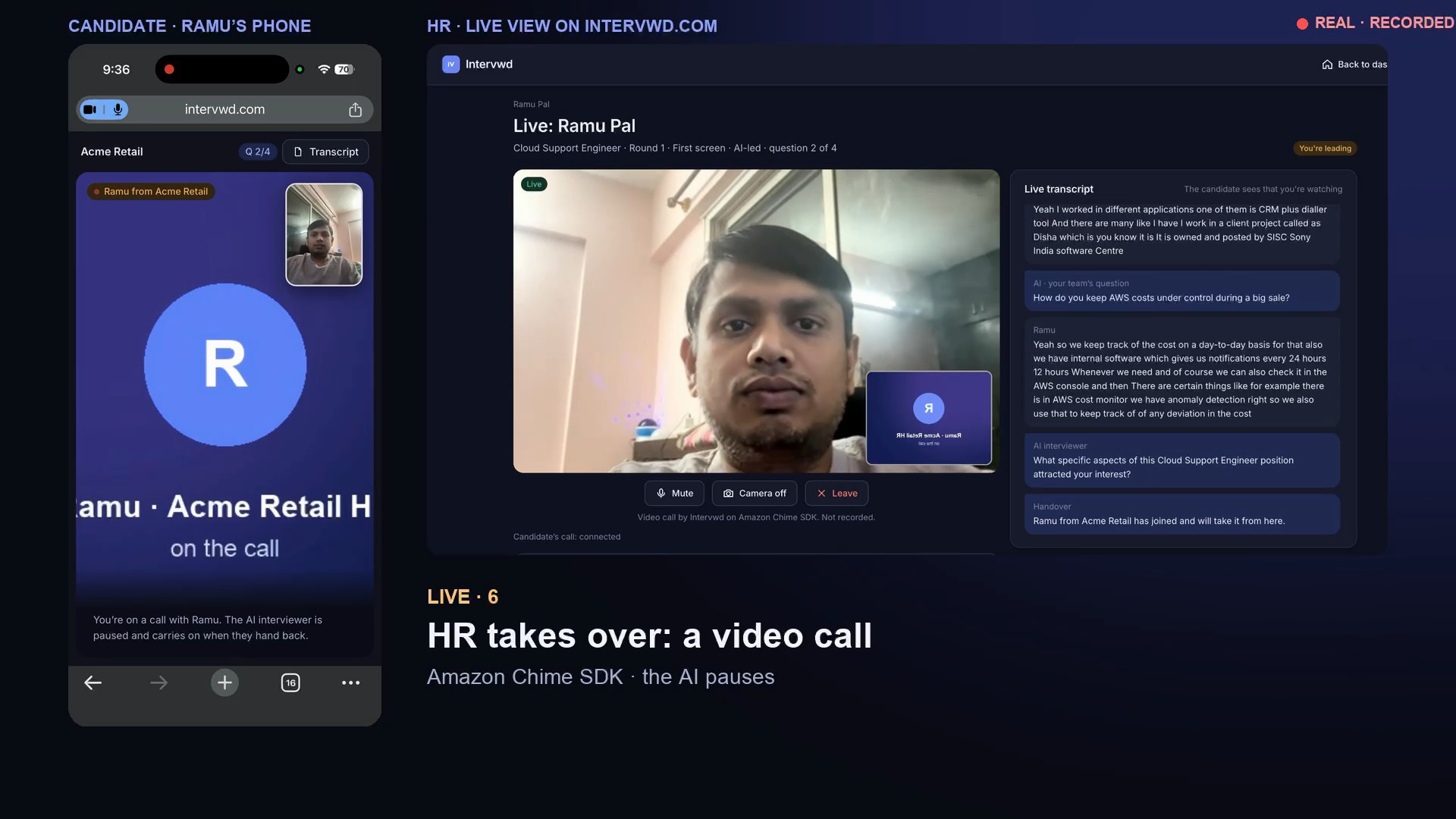
HR takes over on a live video call (Amazon Chime SDK); the AI pauses and the candidate sees who joined.
-
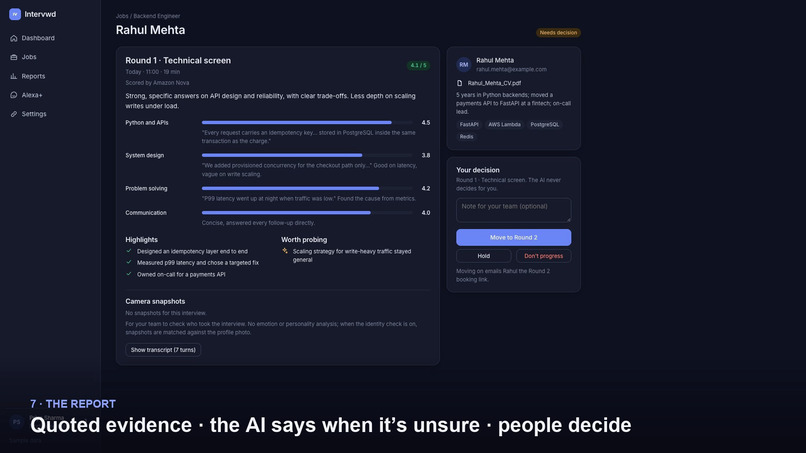
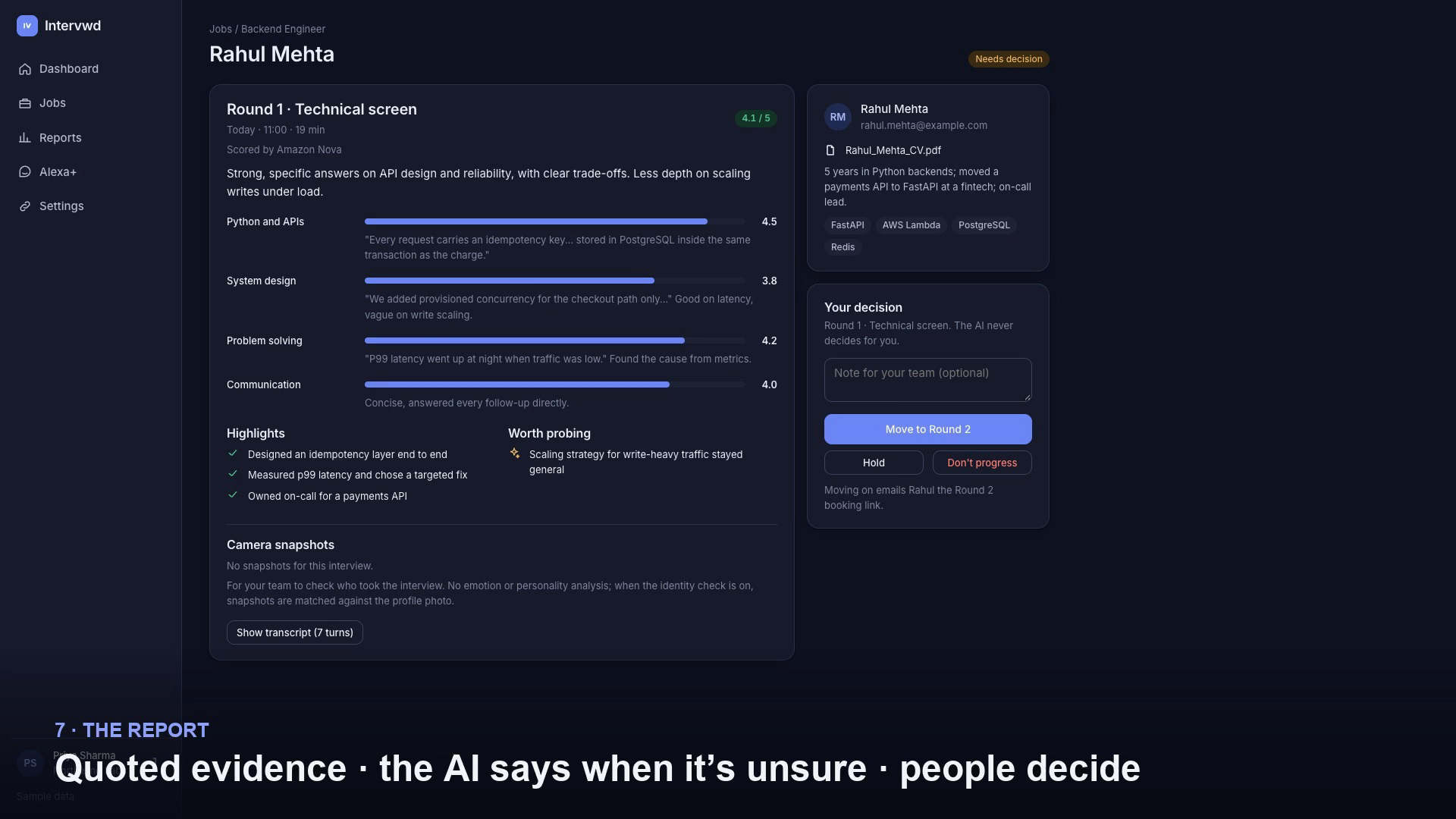
The report: each skill scored with quoted evidence. The AI says when it's unsure, and people decide.
-
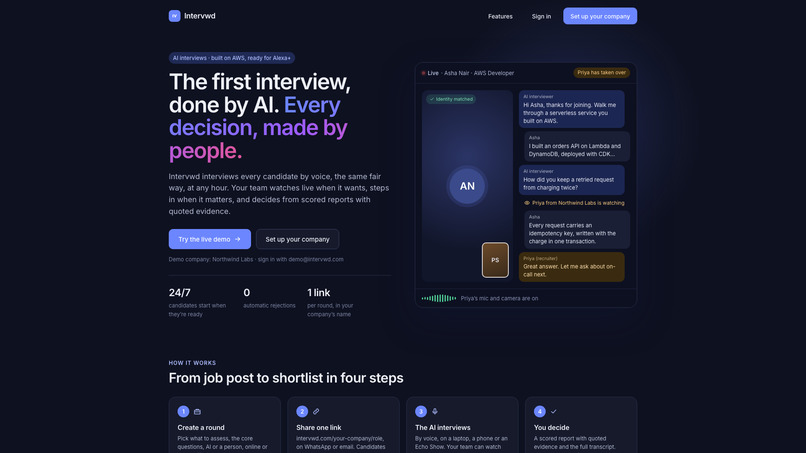
intervwd.com: the first interview done by AI, every decision made by people.
-
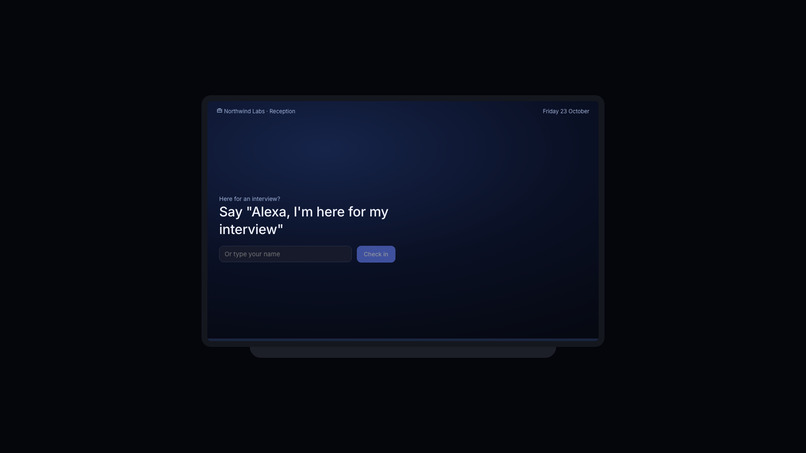
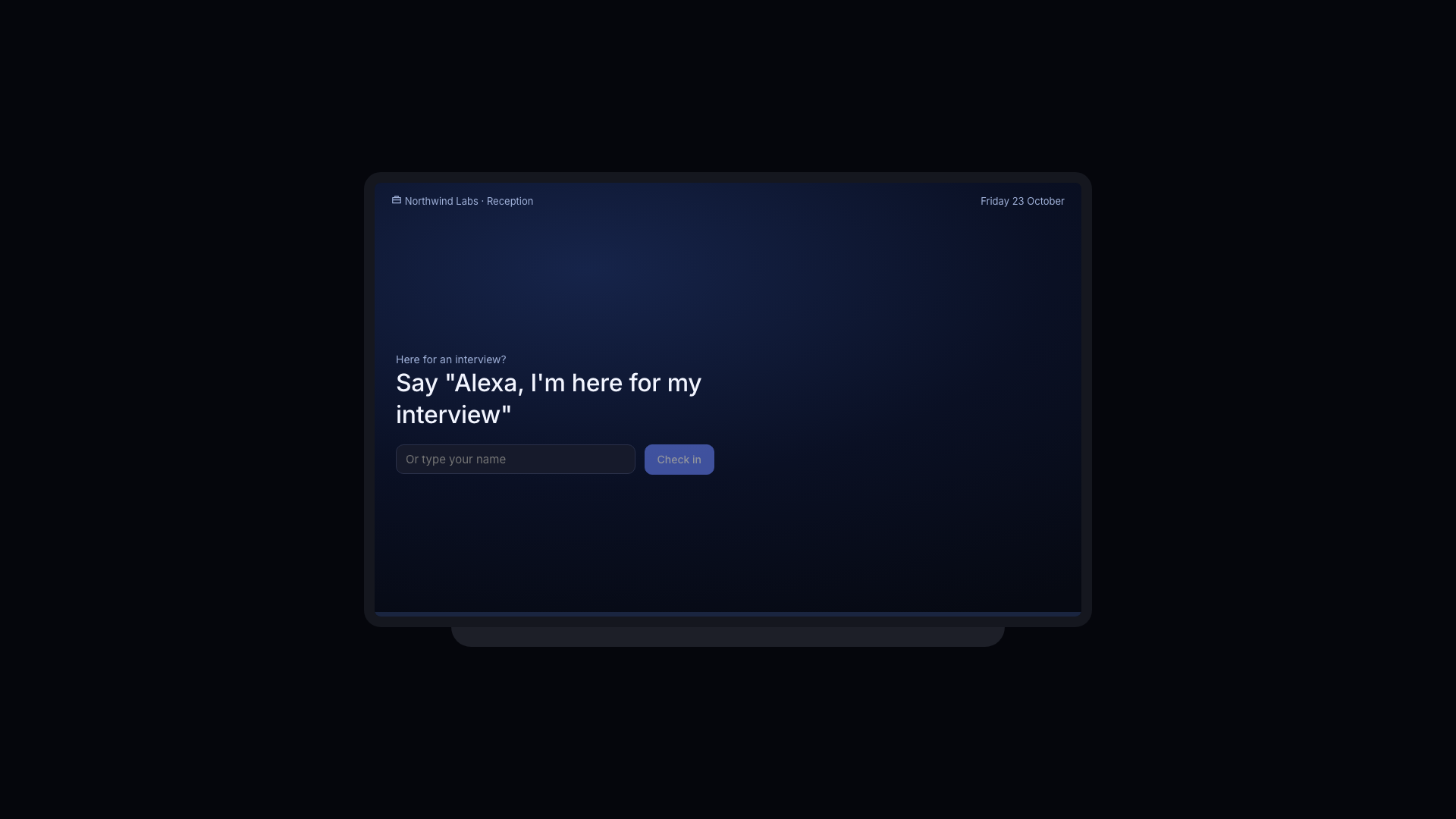
Office hiring day: "Alexa, I'm here for my interview." Check-in and face check at reception, then off to the room.
Inspiration
First-round interviews are the bottleneck of hiring. A recruiter screening 200 applicants for one role spends weeks on the same 20-minute call, and candidates wait days for a slot, often outside working hours they can make. Automated screening tools exist, but they tend to be one-way video questionnaires or black-box filters that reject people without a human ever looking.
We wanted the opposite: an interviewer that is available at any hour, asks every candidate the same fair questions in a real conversation, and never makes the final call. And because hiring isn't only online, we wanted it to work for walk-in drives and office hiring days too, with Alexa at reception.
What it does
The heart: your hiring pipeline as an MCP server, for Alexa+
Everything a recruiter does in Intervwd is a tool on our MCP server at intervwd.com/mcp: 16 tools behind our own OAuth 2.1 server (PKCE, dynamic client registration), scoped to one company.
- 10 read tools: how a single job is going (every round and stage, who's waiting, fast-tracks, the next open slot), today's interviews, who's waiting for a decision, a candidate's report, compare candidates, the briefing ("what's new"), the office hiring day, open jobs, invite links, pending approvals.
- 6 change tools: move a candidate on, hold, not progress, approve a sign-up, let someone in after a failed identity check, add interview slots. Every decision asks for a spoken "yes" first.
- A recruiter just talks to Alexa+: "How's the backend job going?" → "Compare the top two" → "Move Rahul to the next round" → "To confirm… shall I?" → "Yes." The same tools work from any MCP client (Claude, agents, your own tools), and they run on the same service as the web app, so voice and screen always agree.
For companies
- Create a job and its rounds in a minute: what to assess, the core questions, AI or a person, online or at the office. Mix them in any order (Round 1 AI → Round 2 video call with an engineer → Round 3 AI).
- Share one link in the company's name (
intervwd.com/acme-retail/aws-developer-r1) on WhatsApp or email, add candidates directly (they get a personal link by email), or print an A4 QR poster for walk-in drives. Every booking sends a calendar invite. - Join any AI interview live: watch the candidate's video and a live transcript, queue a question for the AI to ask in its own voice, or take over with your own camera and mic, then hand back. The AI picks up where it left off.
- Get a report for every interview: each skill scored 1–5 with a quote from the answer and the AI's confidence, the full transcript and snapshots.
- AI triage, people decide. Clear passes can be fast-tracked to the next round. When the AI is unsure (close to the bar, mixed scores, thin answers, an identity question, a CV in someone else's name) it says why and a person decides. The AI can only move someone forward; only people reject.
- Reports: hiring funnel, score spread, triage reasons, how often the team agrees with the AI, per-job and per-skill breakdowns, QR sign-ups, live takeovers and identity checks.
For candidates
- Sign up from a link or a QR scan, add a CV, and start straight away or book a time.
- A hands-free voice interview: the AI speaks each question, listens, asks a follow-up when an answer is thin, and moves on when you pause. It looks like a video call: the interviewer large, you small in the corner.
- A live identity check before the interview compares the camera with the profile photo. It never rejects anyone: three misses bring in a recruiter.
- Practice mode with different questions (checked so they never leak the real ones) and coaching after each answer, never shared with the company.
- You always see when someone from the company is watching, and who.
For office hiring days
- At reception, candidates say "Alexa, I'm here for my interview". Alexa finds them, checks their face and sends them to a room, where an Echo Show-style screen runs the interview by voice. HR sees the whole day on the dashboard: expected, at reception, interviewing, done, no-shows.
How we built it
Serverless on AWS, deployed with AWS CDK and GitHub Actions on every push to main:
- Amazon Nova 2 Lite (Amazon Bedrock) plans questions tailored to each CV, writes follow-ups, scores answers against the rubric with quoted evidence and confidence, reads CVs, answers the candidate's own questions at the end, writes practice questions and checks they don't resemble the real ones, and powers the recruiter assistant. Structured outputs come from forced tool calls returning JSON.
- Amazon Polly (neural voice) speaks for the interviewer.
- Amazon Rekognition CompareFaces runs the one-to-one identity check. Face photos are deleted when the company decides, or after 30 days.
- Amazon Chime SDK powers the built-in video calls: human rounds, and recruiters joining an AI interview live.
- Amazon SES sends branded HTML emails with calendar invites (ICS).
- AWS Lambda (Python 3.13, Starlette, arm64) behind Amazon CloudFront, with Amazon DynamoDB (single table) and Amazon S3 for CVs and snapshots.
- The MCP server (MCP Python SDK, Streamable HTTP, stateless) with 16 tools and our own OAuth 2.1 server (dynamic client registration, PKCE, a consent page). Tools return a short
sayline for Alexa to speak plus structured data, and every decision tool needsconfirm: true, which Alexa+ only sends after the recruiter says yes. - Web app: React, TypeScript and Vite, served from S3 and CloudFront.
The server owns the interview: greeting → tailored question → follow-up → … → candidate's questions → closing → scoring → triage. Live-call state, watcher heartbeats and team questions live in separate records, so a recruiter watching can never overwrite a candidate's answer.
Challenges we ran into
- Mobile browsers and audio. iPhone Safari only plays sound that starts from a tap, so later questions were silent. We now unlock one audio player on the first tap and reuse it, with a tap-to-hear fallback. iOS also lets a page capture the camera once, so the live call reuses the interview's own camera stream instead of opening it again.
- Race conditions in live joining. Saving whole interview documents while a recruiter watched could erase the meeting ID or drop answers. We split live state and heartbeats into their own records, and made double-clicks on "take over" harmless.
- Keeping the AI fair and neutral. Nova sometimes used gendered pronouns, or picked up a different name from a CV. We ask for neutral language, keep names out of CV summaries, swap any wrong name for the candidate's own, and flag CVs in someone else's name for a person.
- Practice that doesn't leak. Practice questions are checked twice, for word overlap and with Nova for meaning, so they never resemble the real ones.
- Knowing when the AI shouldn't decide. We built triage rules (near the bar, spread across criteria, low confidence, too few words, identity issues) so the AI hands the hard calls to people and explains why.
Accomplishments that we're proud of
- The whole pipeline is an MCP server: Alexa+ can run hiring end to end by voice, safely, with a confirmation before every decision.
- A complete, working product on a real domain, not a mock: sign-up to report, with real email, video calls, face checks and voice.
- A human can join an AI interview at any moment and hand it back, and the candidate always knows.
- The AI can never reject anyone, and every score has evidence a person can check.
- One platform for online interviews, walk-in drives (QR posters) and office hiring days (Alexa at reception).
- 30+ automated tests, plus a check that runs the full suite inside AWS against the real Nova, Chime and Polly.
What we learned
- Voice changes everything: answers are longer and more honest than typed ones, but timing (when the candidate has finished) matters as much as the questions.
- Trust comes from transparency: showing who is watching, quoting evidence, and saying why the AI is unsure.
- Browser media on phones has more rules than on desktop, and designing for them early saves a lot of debugging.
What's next for Intervwd
- Run the reception and room experience on real Echo Show devices as Alexa+ opens camera access to skills.
- More interview languages (Polly and Nova both support them) and accessibility options.
- ATS integrations (Greenhouse, Lever, Workday) so decisions flow into existing tools.
- Calibration reports per interviewer, comparing human scorecards with the AI's scores.
Try it
- Live app: https://intervwd.com
- Demo company (Northwind Labs): sign in at https://intervwd.com/signin with
[email protected]; the code is in the testing instructions. - Code: https://github.com/ramudevhub-90/INTERVWD (MIT licence)
- Bonus: the MCP server in action (67 s): https://youtu.be/fKz1HXoVTSo
Built With
- alexa
- amazon-bedrock
- amazon-chime-sdk
- amazon-cloudfront
- amazon-dynamodb
- amazon-nova
- amazon-polly
- amazon-rekognition
- amazon-ses
- amazon-web-services
- aws-cdk
- aws-lambda
- mcp
- python
- react
- starlette
- typescript
- vite

Log in or sign up for Devpost to join the conversation.