-
-
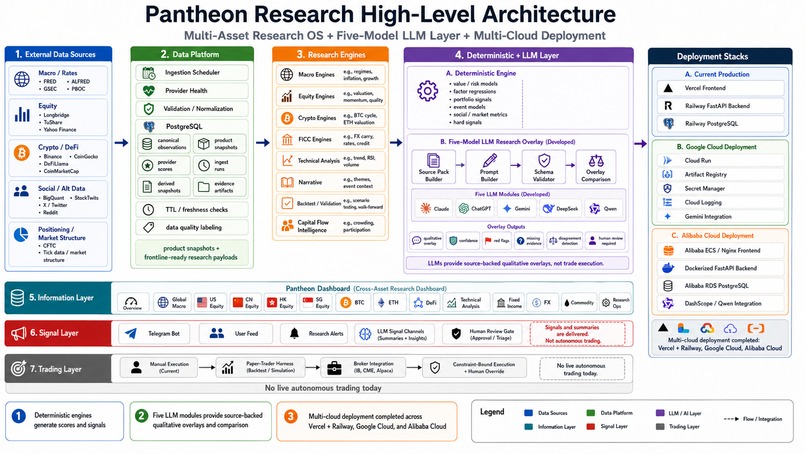
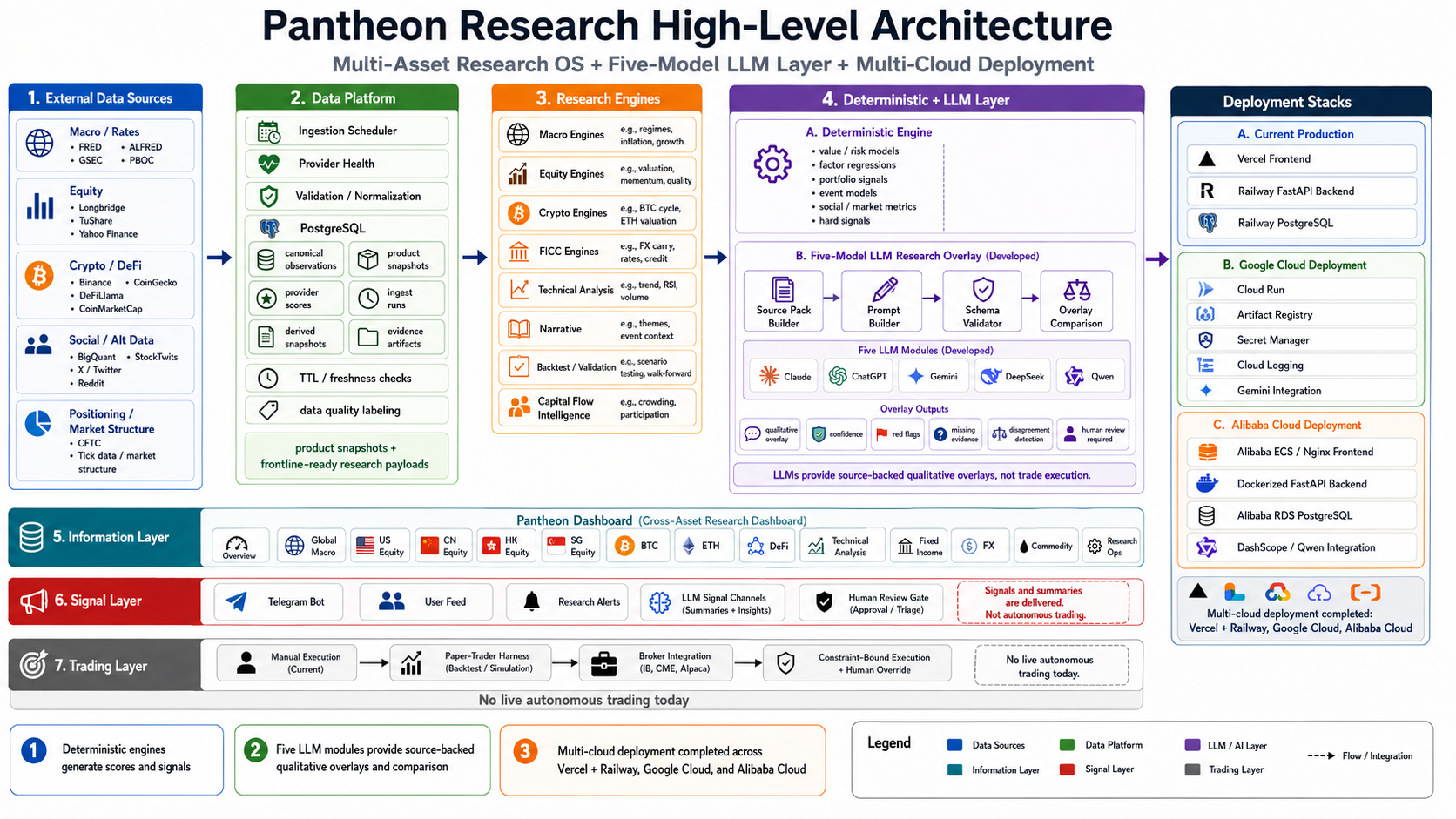
Pantheon Research High Level Architecture
-
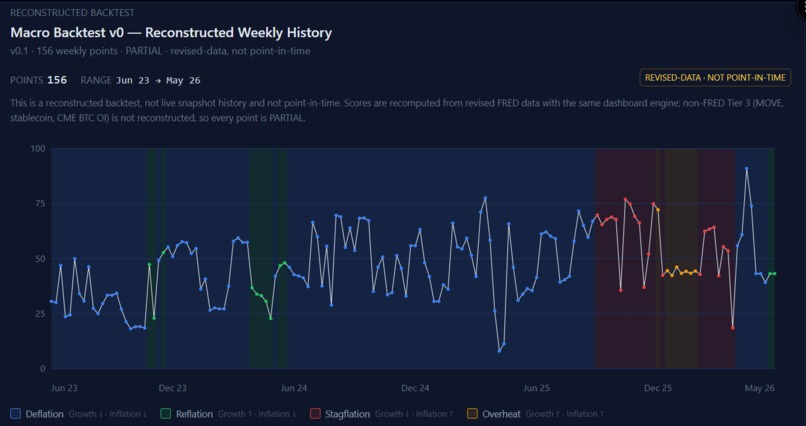
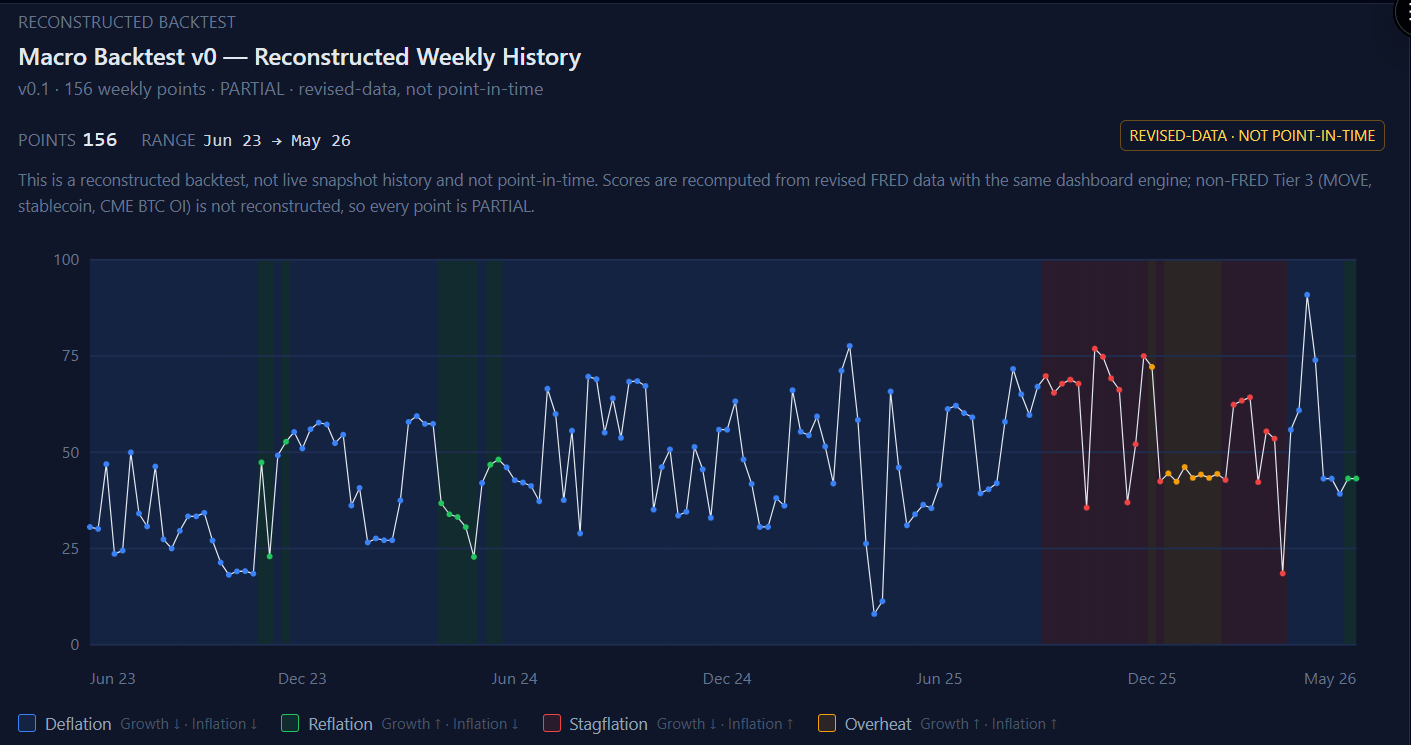
Global_Macro_Framework_Backtest
-
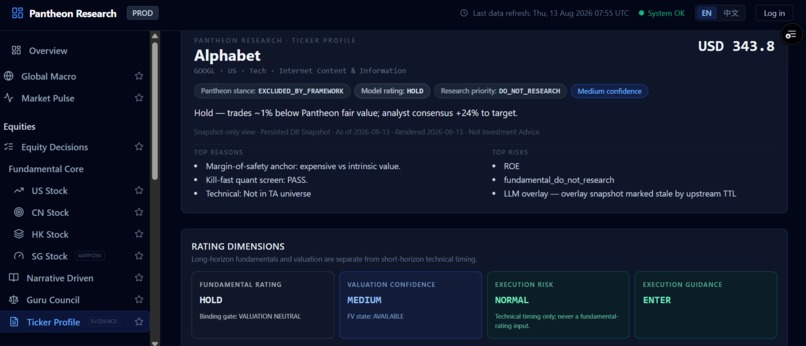
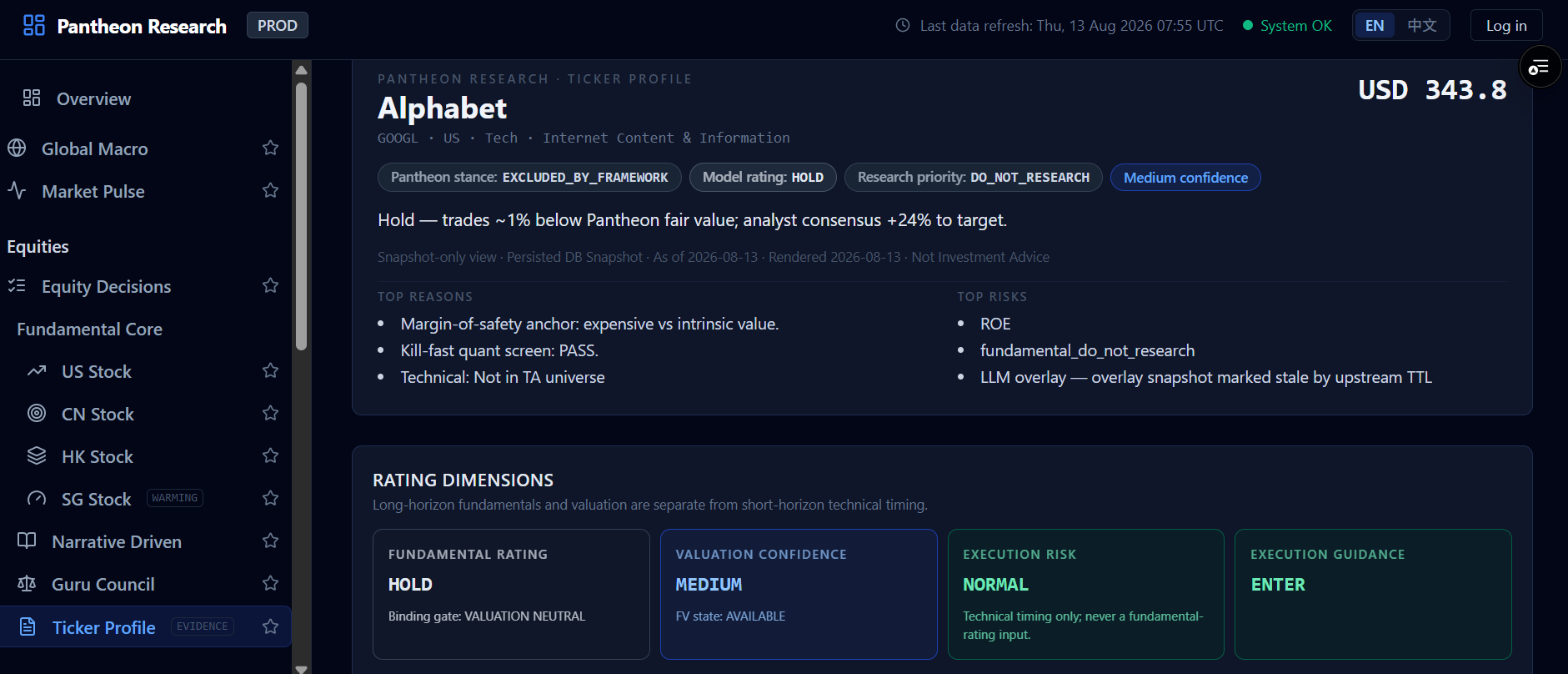
Equity_Ticker_Profile_GOOGL.png
-
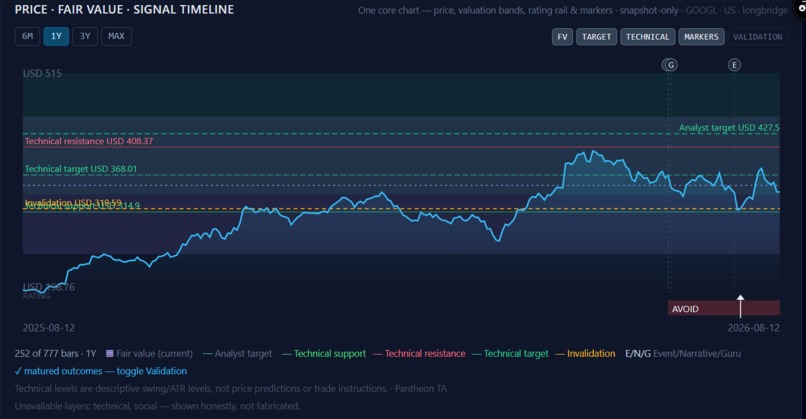
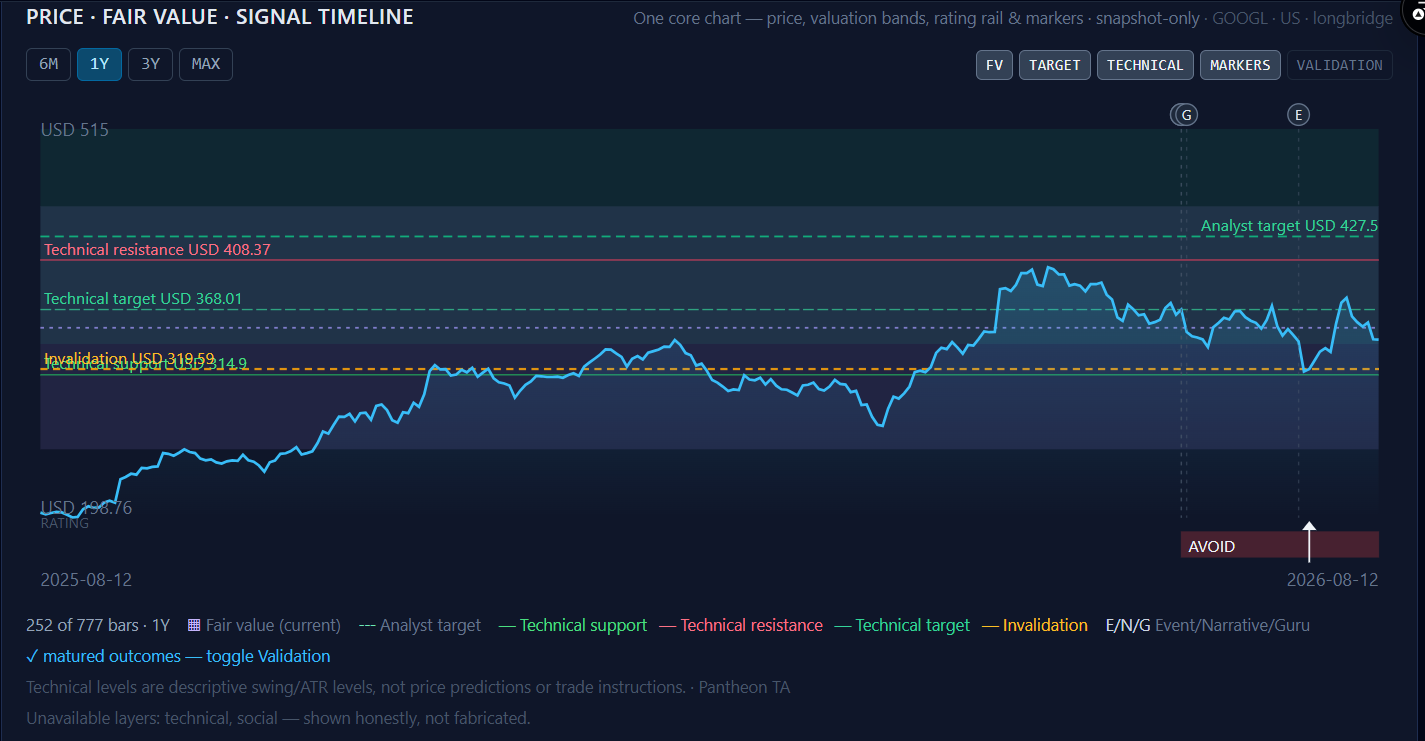
Google_Price_Target_and_Fair_Value
-
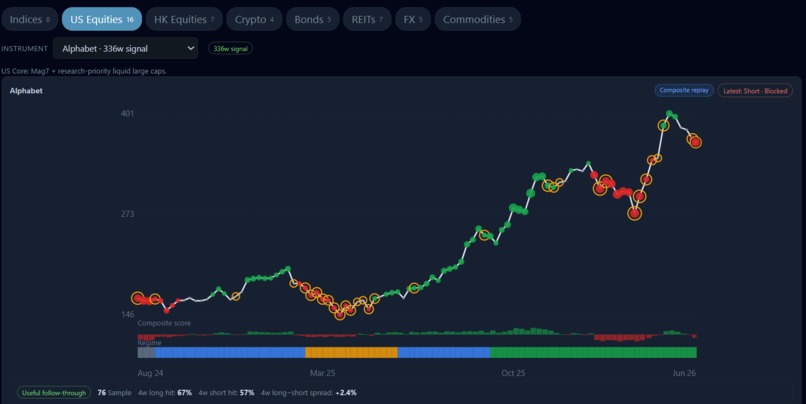
Google_Technical_Signal_Timeline.png
-
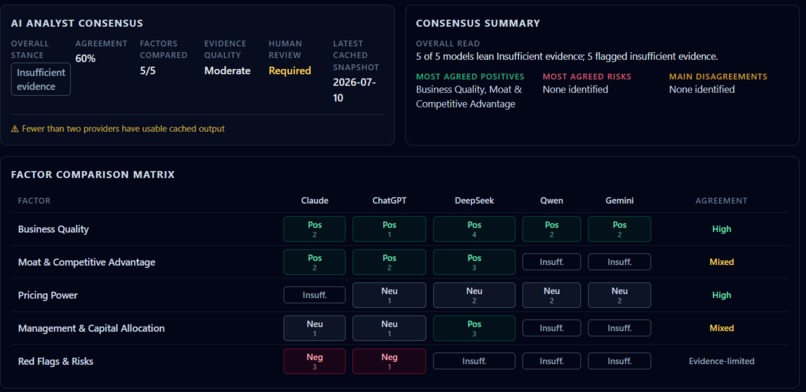
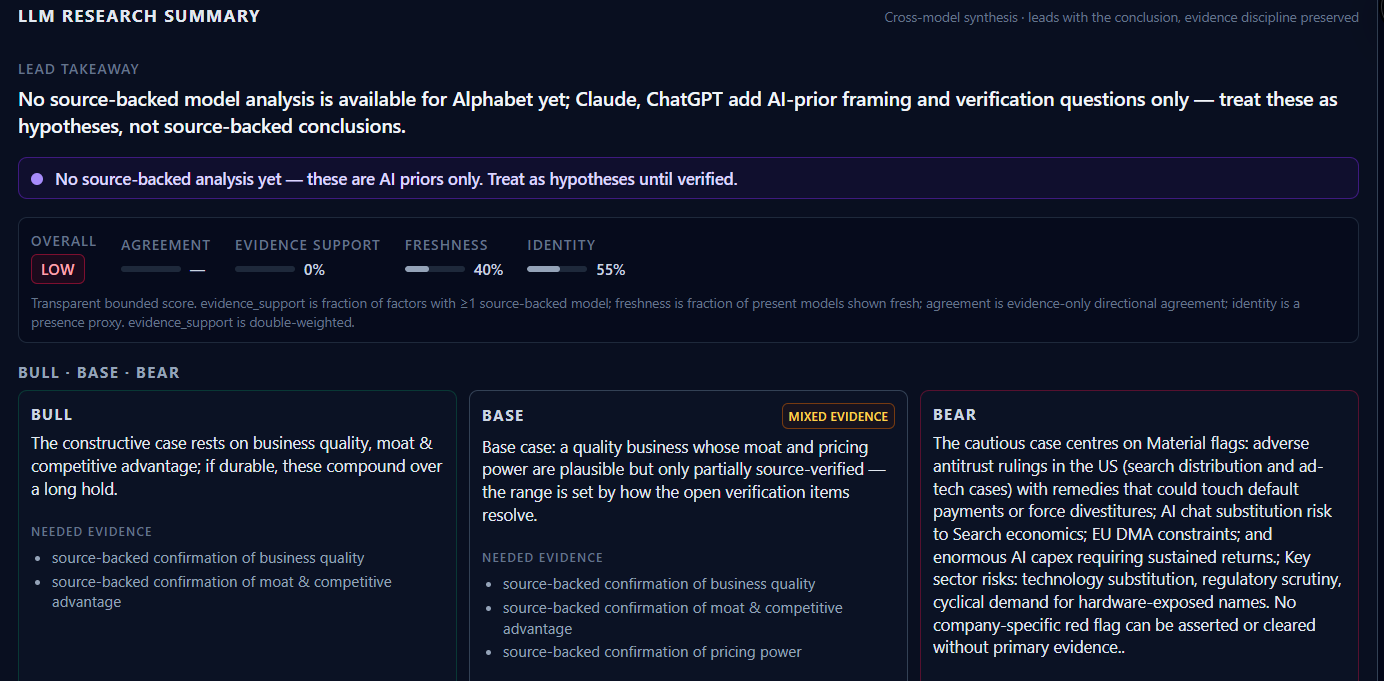
LLM_Research_Summary_GOOGL.png
-
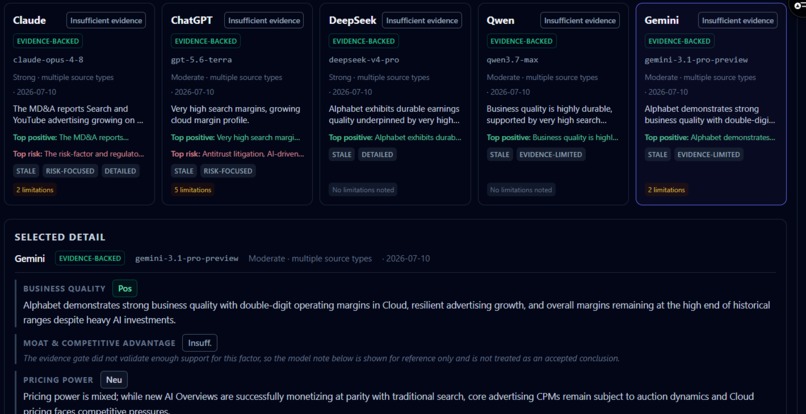
LLM_Research_Summary_GOOGL.png
-
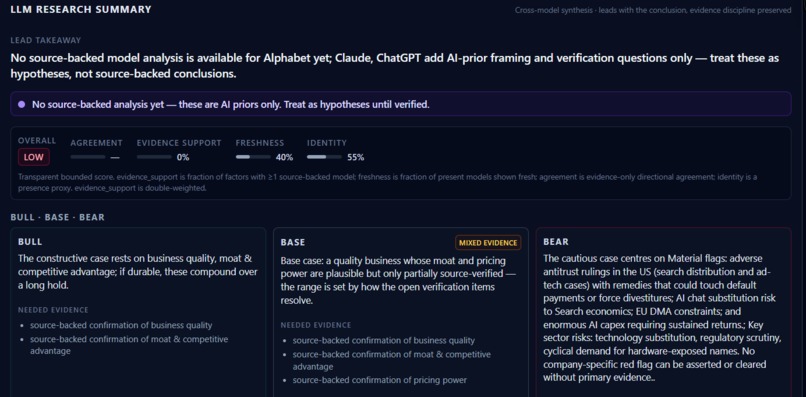
LLM_Research_Summary_GOOGL.png
-
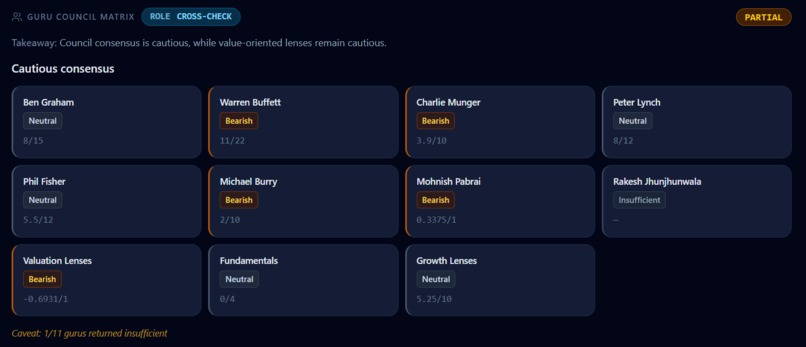
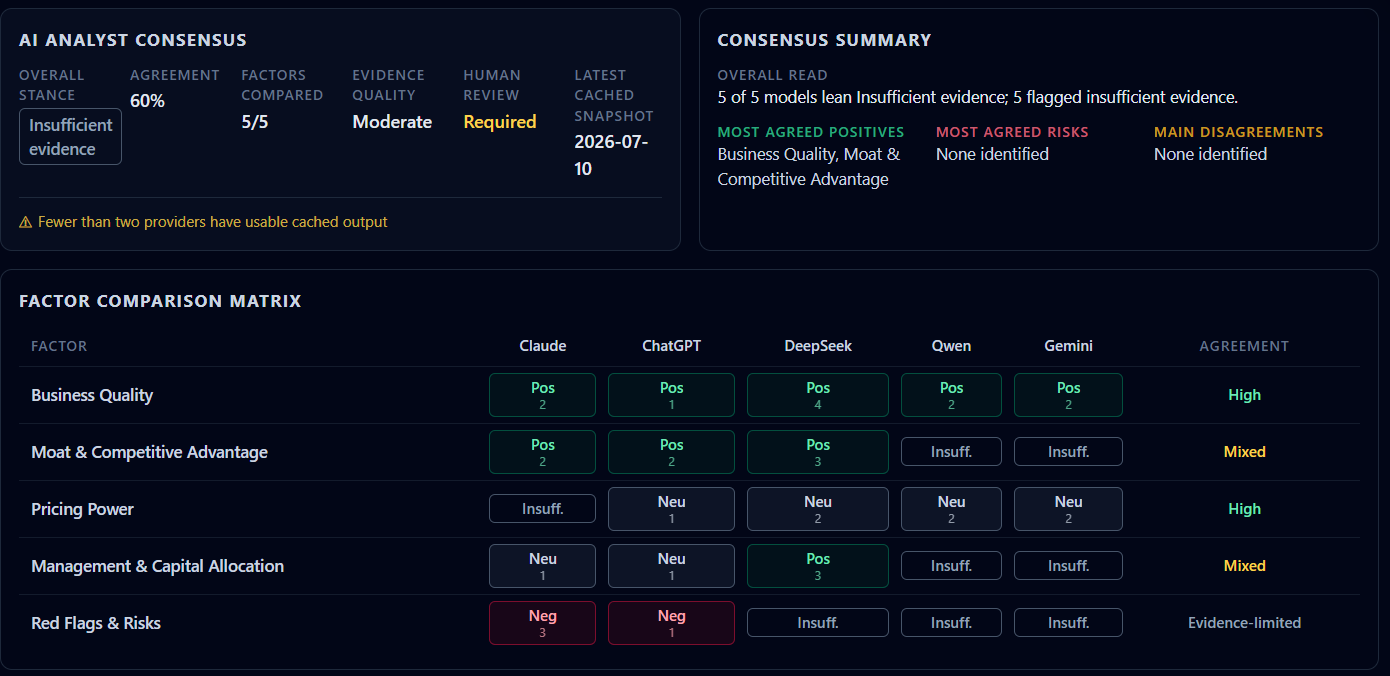
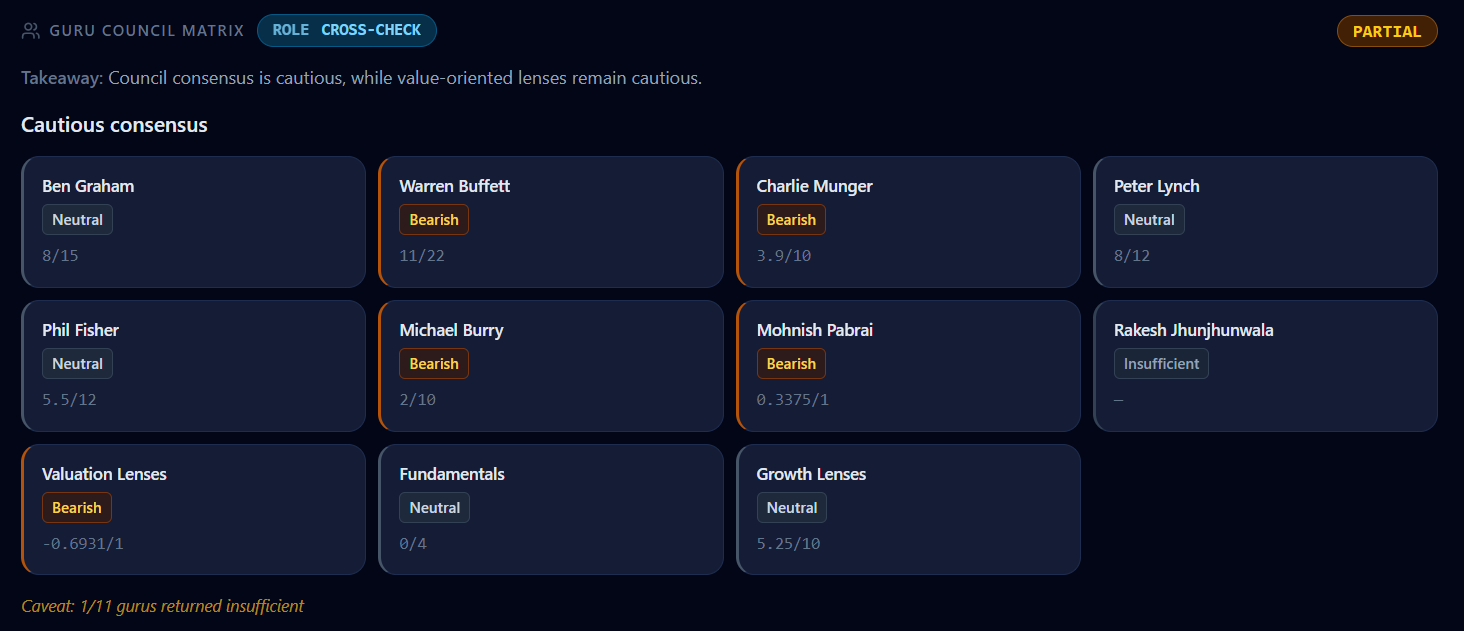
Guru_Council_Consensus.png
-
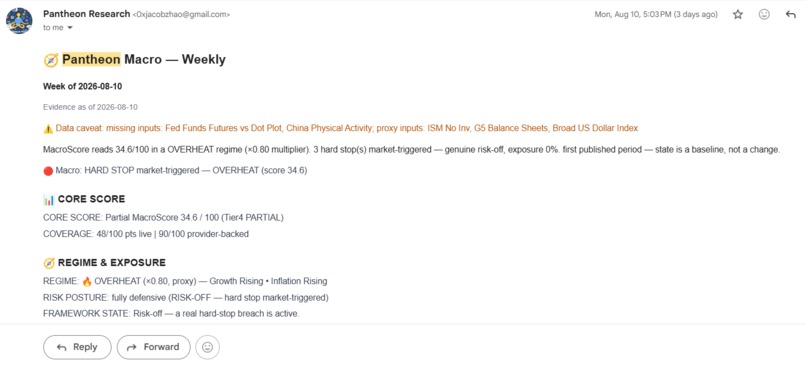
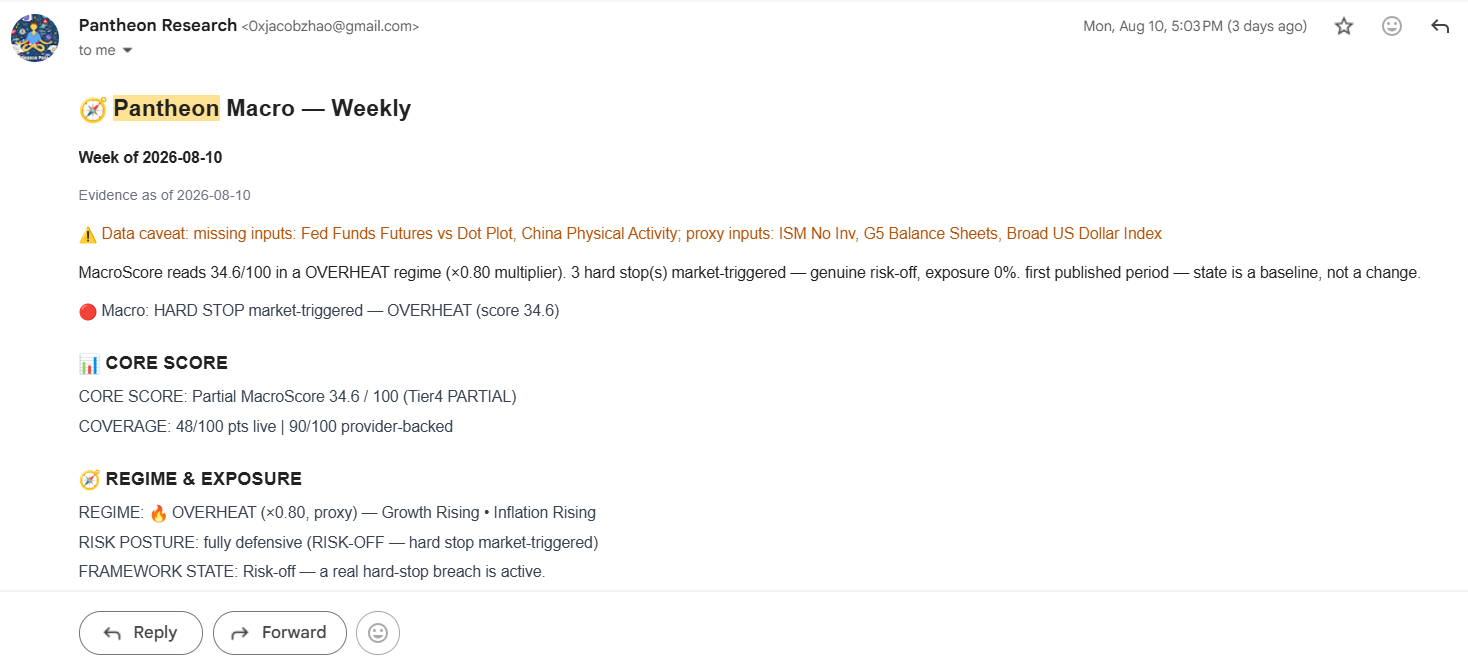
Automated_Research_Report_Email.png
-
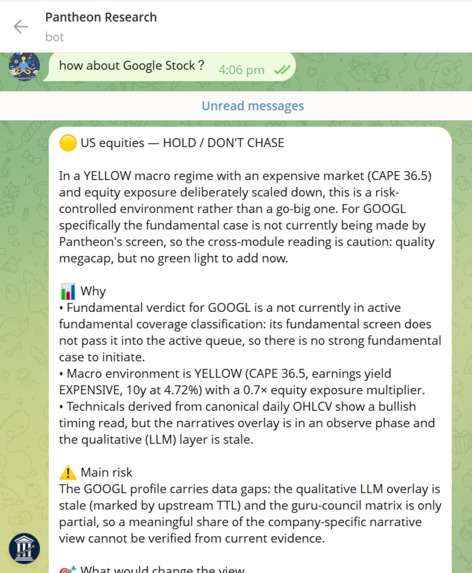
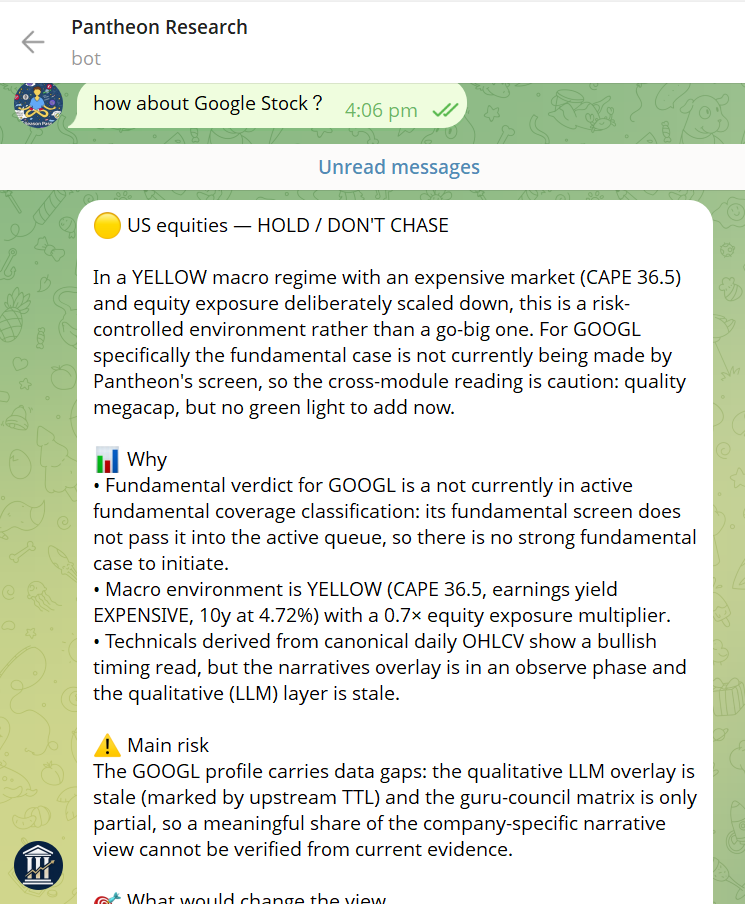
Pantheon OpenClaw Agent Features
-
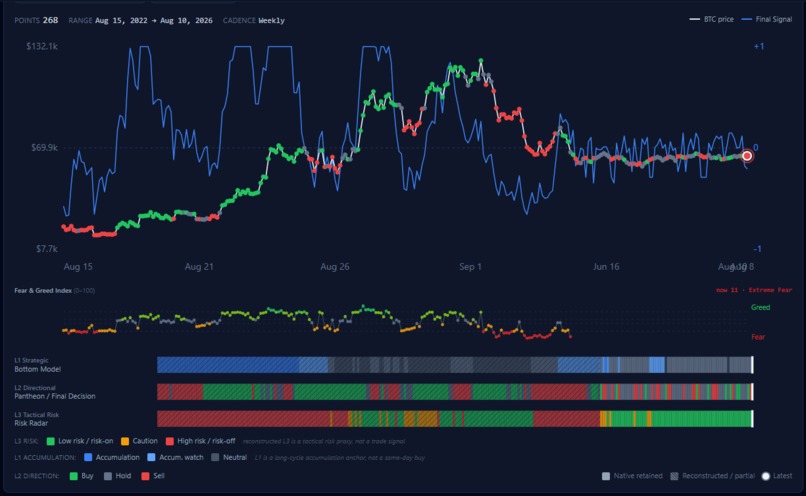
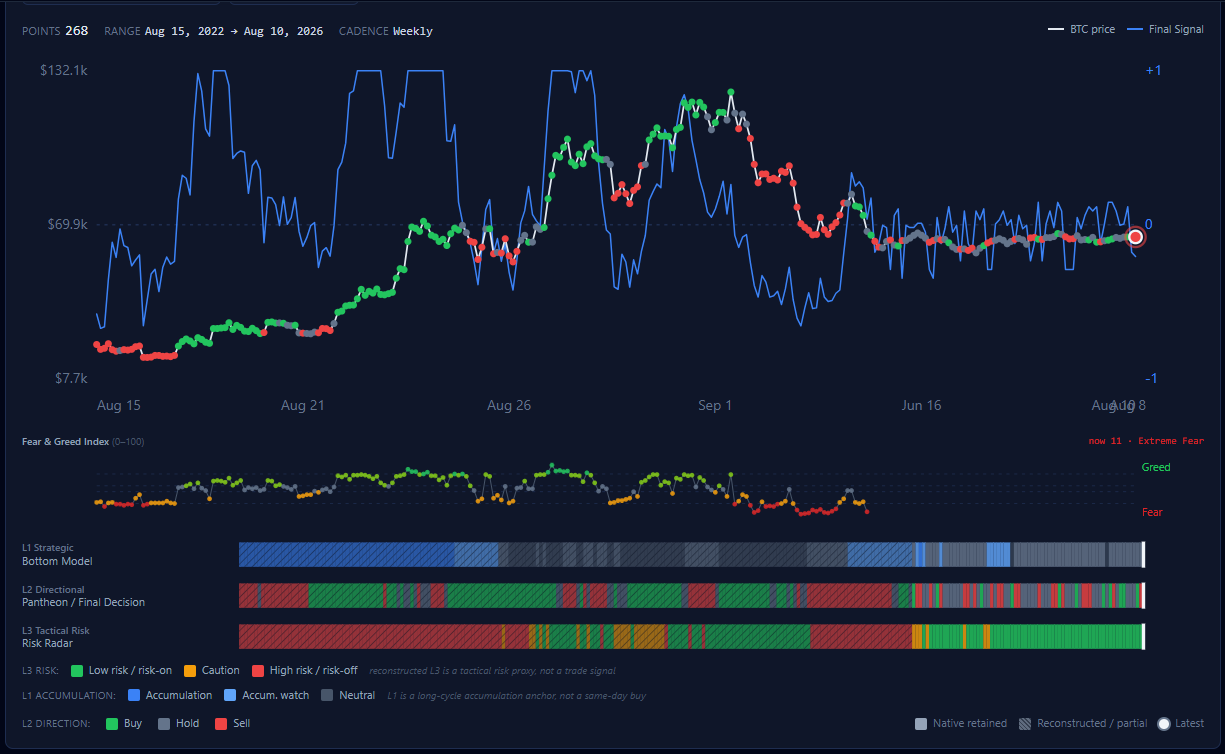
Bitcoin_Cycle_Framework.png
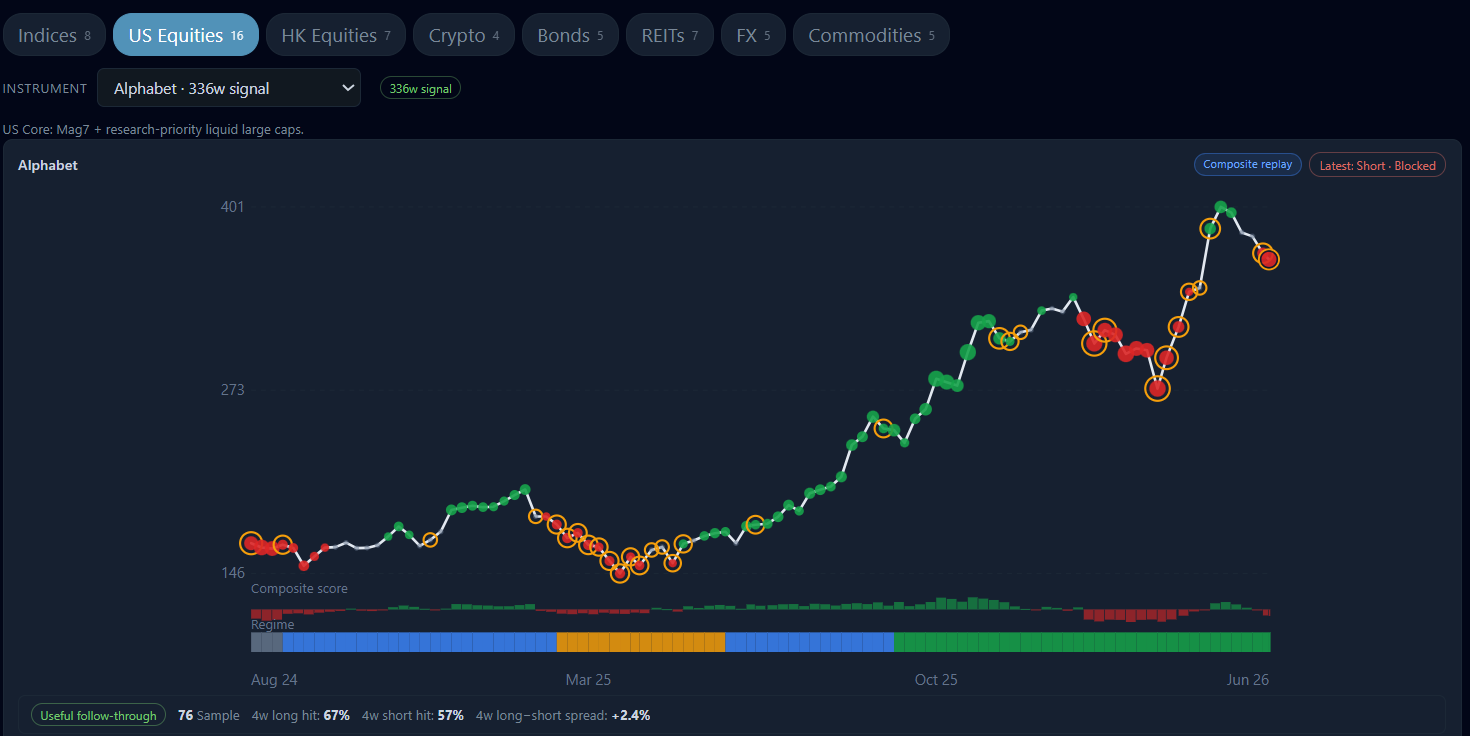
Inspiration
Modern investors are not short of data. They are short of governed, explainable, decision-ready intelligence.
A single investment decision can involve macro liquidity, rates, credit, earnings, valuation, crypto flows, on-chain data, positioning, technical structure, news, sentiment, portfolio exposure, and execution risk. Large institutions solve this with analyst teams, data engineers, risk committees, internal research systems, and trading infrastructure. Individual investors, family offices, advisors, and smaller investment teams usually stitch together dashboards, spreadsheets, newsletters, broker screens, social media, and general-purpose AI tools.
Pantheon Research started from a simple question:
What would an AI-native investment research operating system look like if it combined institutional-style investment frameworks, governed data, deterministic research engines, multi-model AI, forward validation, and human review — without allowing AI to execute trades?
The thesis is simple:
Wrong Strategy × AI = Faster Loss
Right Strategy × AI = Compounded Discipline
Pantheon is built around one principle:
AI should not replace the investor. AI should compound the investor's discipline.
What it does
Pantheon Research is a live, human-in-the-loop, cross-asset investment research operating system.
It is not a finance chatbot and it is not an autonomous trading system. Pantheon separates the research workflow into seven layers:
External Data Sources — macro/rates, equities, crypto/DeFi, social and alternative data, positioning, derivatives, and market-structure inputs.
Governed Data Platform — scheduled ingestion, provider-health monitoring, validation and normalization, canonical PostgreSQL observations, product and derived snapshots, evidence artifacts, freshness/TTL checks, and explicit data-quality states.
Strategy / Research Engines — deterministic frameworks across Global Macro, US/CN/HK/SG equities, BTC, ETH, DeFi, Fixed Income, FX, Commodities, Technical Analysis, Narrative / Capital Flow, and Backtest / Forward Validation.
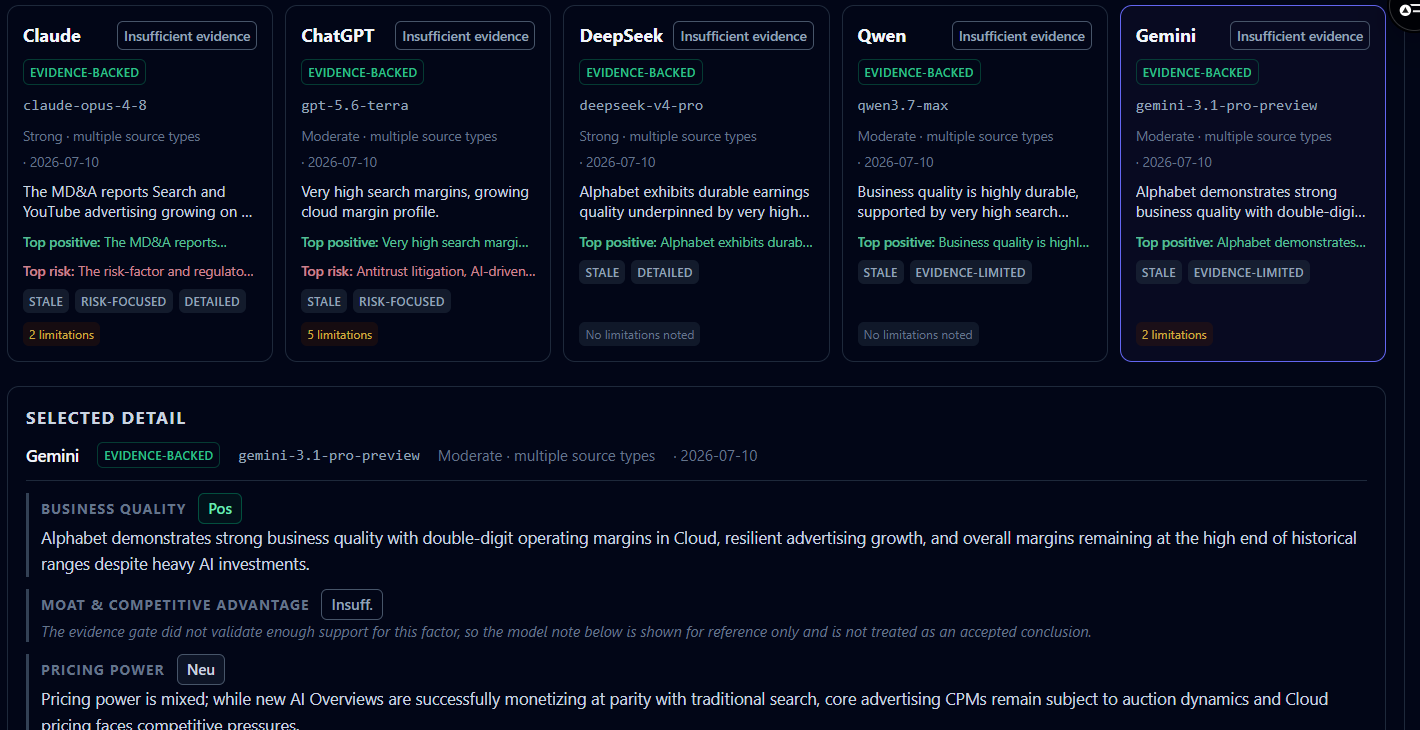
Deterministic + Multi-Model AI Layer — deterministic engines own structured ratings, regimes, valuation outputs, risk states, and signals. Claude, ChatGPT, Gemini, DeepSeek, and Qwen interpret governed evidence packs through a schema-validated research-overlay workflow.
Information Layer — the live Pantheon dashboard exposes cross-asset research, Ticker Profiles, AI Analyst Consensus, LLM Research Summaries, validation records, and research operations.
Signal + Agent Layer — research alerts, Telegram, automated reports, user-facing research interactions, and human-review gates.
Execution Boundary — execution remains independently gated and manual today. There is no live autonomous trading path from an LLM output to an order.
The end-to-end workflow is:
Providers → Canonical Evidence → Deterministic Research → Gemini / Multi-Model Analysis → Signals → Human Review → Human Decision
Gemini Hackathon contribution
For this submission, I built the Gemini Analyst / Risk-Review layer.
Gemini receives a bounded evidence pack rather than an open-ended market prompt and produces structured research fields such as:
- business quality;
- moat and competitive advantage;
- pricing power;
- management and capital allocation;
- red flags and risks;
- missing evidence;
- confidence;
- human-review triggers.
Gemini does not place trades, move funds, override deterministic ratings, or manage a portfolio.
How I built it
Pantheon is framework-first, data-governed, and DB-first.
The system first converts raw financial inputs into governed database artifacts. Research engines consume canonical observations and persisted snapshots rather than repeatedly fetching uncontrolled data at request time.
The LLM workflow then follows:
Governed Evidence Pack → Prompt Builder → Gemini API → Structured Output → Schema Validation → Multi-Model Comparison → Human Review
The Gemini submission layer uses:
- Python / FastAPI for the backend;
- React / TypeScript / Vite for the judge-facing frontend;
- Gemini API with
gemini-2.5-flashfor the analyst / risk-review overlay; - Google Cloud Run for the deployed service;
- Artifact Registry for the container image;
- Secret Manager for Gemini API credentials;
- Cloud Logging for deployment observability;
- SHA-256 evidence provenance for structured evidence packs;
- explicit fail-closed states rather than fabricated successful results.
The primary Pantheon product continues to run on Vercel and Railway. The Gemini hackathon service is a separate Google Cloud proof deployment and is not the canonical production writer.
I also implemented a public Circle Agent Wallet proof for the Agentic Economy Prize. A founder-funded, operator-mediated USDC transaction on Base demonstrates a bounded agentic payment rail. It does not move user investment capital and is not autonomous trading.
Challenges I ran into
The hardest challenge was not calling an LLM. It was building a workflow where AI could be useful without weakening research discipline.
Data quality before AI
Financial data can be stale, missing, revised, delayed, or inconsistent across providers. Pantheon therefore tracks provenance, freshness, provider state, and explicit degradation before downstream research consumes the data.
Fail-closed AI behavior
A missing credential, provider error, stale evidence pack, or parse failure must not become a confident answer. Gemini therefore exposes explicit failure states rather than returning a hollow success.
Deterministic research vs. AI interpretation
Pantheon deliberately separates reproducible ratings and signals from qualitative AI analysis. The model can explain, challenge, identify gaps, and escalate review, but it cannot silently rewrite deterministic investment outputs.
Multi-model disagreement
Claude, ChatGPT, Gemini, DeepSeek, and Qwen do not always agree. Instead of averaging disagreement away, Pantheon surfaces it as a research signal that may require human review.
Backtest vs. forward evidence
Historical reconstruction is not the same as prospective performance. Pantheon separates backtests, point-in-time evidence, forward maturation, and matured outcomes so immature evidence is not presented as validated alpha.
Product safety
The system separates research, signal delivery, human judgment, and execution. There is no direct LLM-to-order path.
Deployment proof
A local prototype is not enough for a production-oriented AI business. The Gemini layer therefore had to be containerized, deployed on Google Cloud, secured through Secret Manager, observable through Cloud Logging, and independently verifiable through public proof endpoints.
Accomplishments
The result is a live cross-asset research operating system with a governed Gemini layer rather than a standalone chatbot demo.
Key accomplishments include:
- a live Pantheon Research web product;
- governed cross-asset research across macro, equities, crypto, DeFi, FICC, and technical analysis;
- deterministic research engines operating before LLM interpretation;
- a five-model AI research architecture using Claude, ChatGPT, Gemini, DeepSeek, and Qwen;
- a Gemini Analyst / Risk-Review layer built specifically for this submission;
- a live Google Cloud Run deployment using
gemini-2.5-flash; - Secret Manager, Artifact Registry, Cloud Logging, and public proof endpoints;
- evidence-backed vs. AI-prior separation;
- model disagreement and missing-evidence detection;
- backtest and forward-validation infrastructure;
- Telegram Agent and automated-report workflows in controlled beta;
- a public Circle Agent Wallet payment proof;
- a strict human-in-the-loop boundary with no live autonomous trading.
Most importantly, Pantheon demonstrates that AI can make investment research more disciplined and auditable, not merely faster.
What I learned
The biggest lesson is that AI in finance should be treated as part of a governance system, not as an oracle.
Useful AI investment infrastructure needs:
Frameworks before prompts.
Data quality before conclusions.
Deterministic outputs before probabilistic interpretation.
Disagreement before false consensus.
Forward evidence before performance claims.
Human judgment before capital execution.
I also learned that model comparison is often more valuable than model selection. Gemini becomes more useful when its conclusions can be checked against evidence provenance, deterministic outputs, other models, and explicit review triggers.
The operational lesson was equally important: deployment is part of product truth. A serious AI product needs reproducible infrastructure, secret management, observability, cost controls, failure states, and clear evidence of what is actually running.
What's next
The next phase is product validation and commercialization rather than adding more research modules.
The priorities are to broaden Gemini evidence-backed coverage, onboard external beta users, improve portfolio-aware research, continue forward validation, strengthen Watchlists and recurring reports, expand governed Agent interactions, and test conversion into Pantheon Pro and Research Credits.
The commercial roadmap is:
Free Research → Pantheon Pro → Research Credits → Skills / Advanced Data → B2B Research Infrastructure
Execution will remain manually controlled until validation supports a different decision.
Pantheon's long-term goal is to become the governed intelligence layer between market noise and human investment judgment.
Built With
- artifact-registry
- chatgpt
- circle
- claude
- codex
- deepseek
- docker
- fastapi
- gemini
- google-cloud
- google-cloud-run
- hermes
- human-in-the-loop
- openclaw
- postgresql
- python
- railway
- react
- secret-manager
- telegram
- typescript
- vercel
- vite

Log in or sign up for Devpost to join the conversation.