-
-
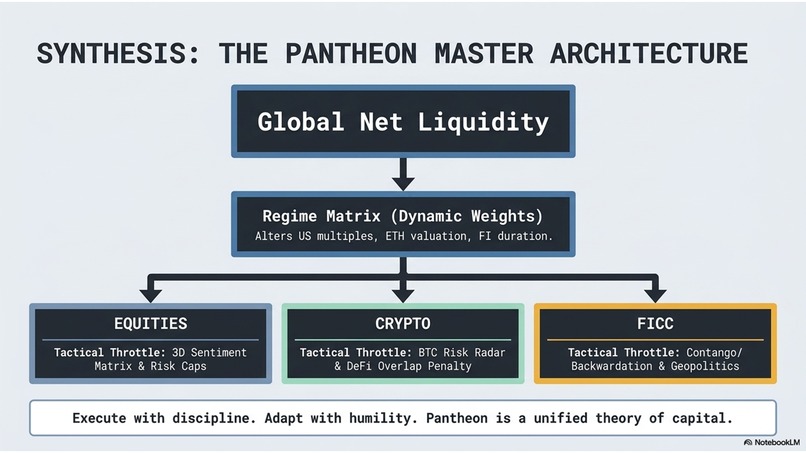
The Pantheon Research Master Coverage
-
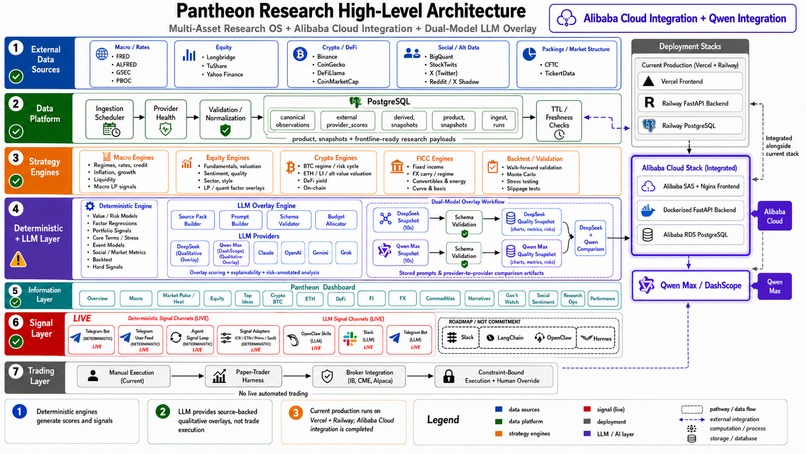
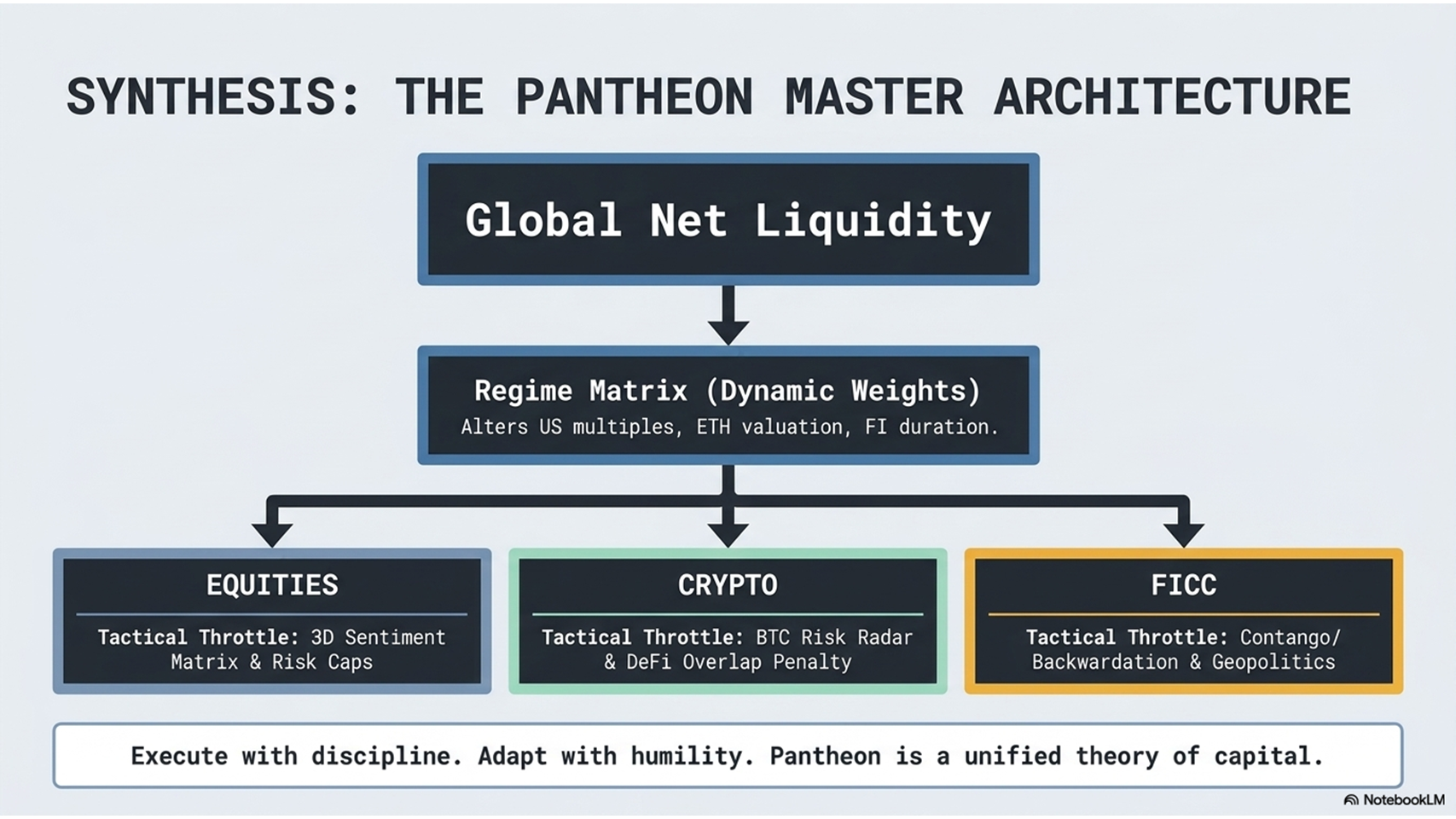
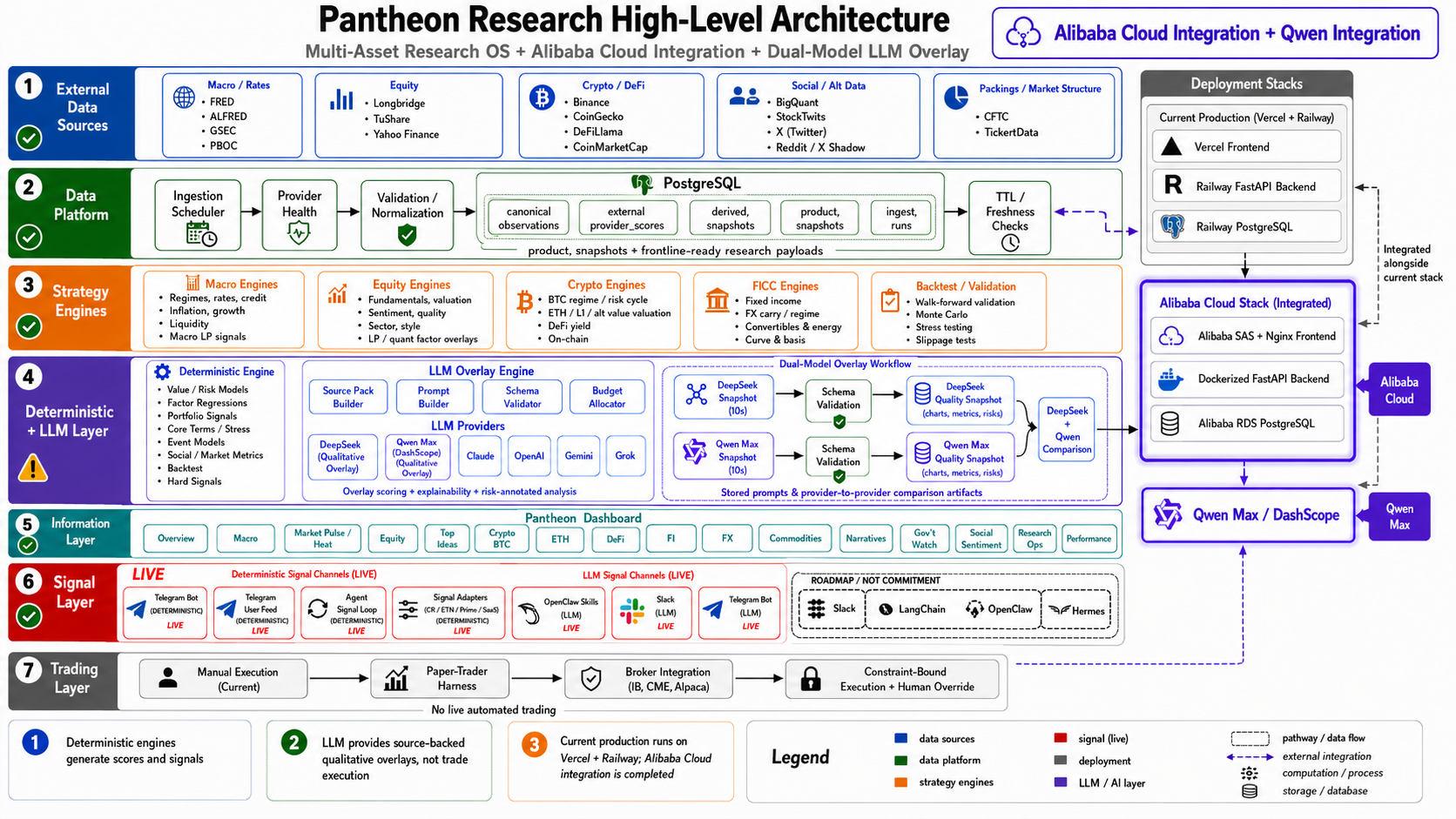
Pantheon Research High Level Architecture
-
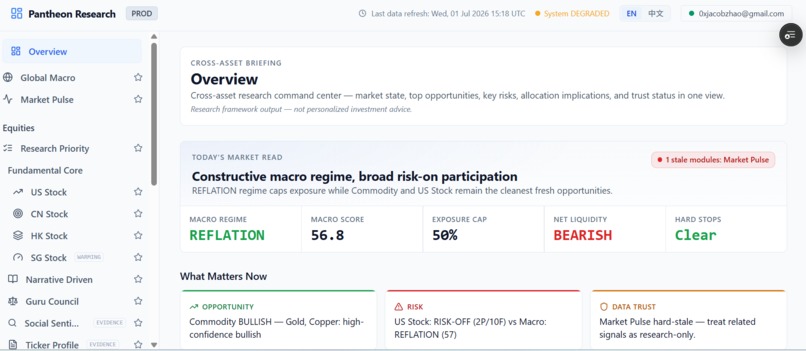
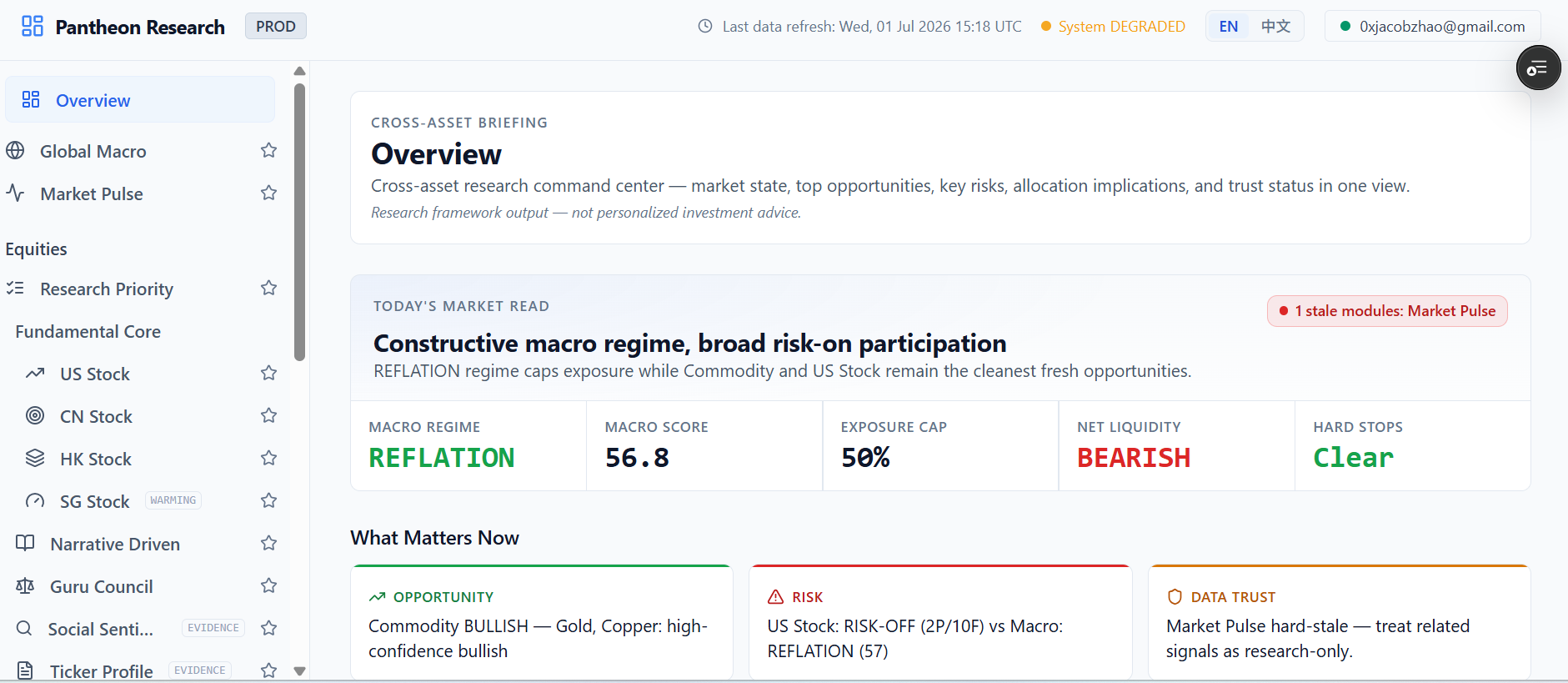
Overview Cross-asset research command center
-
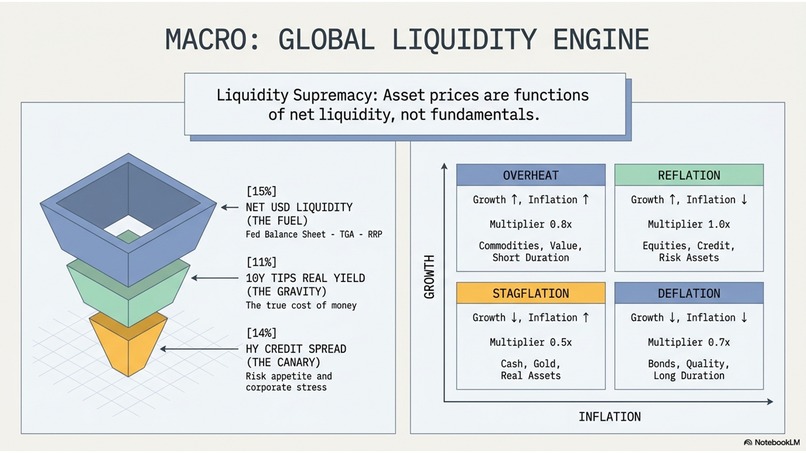
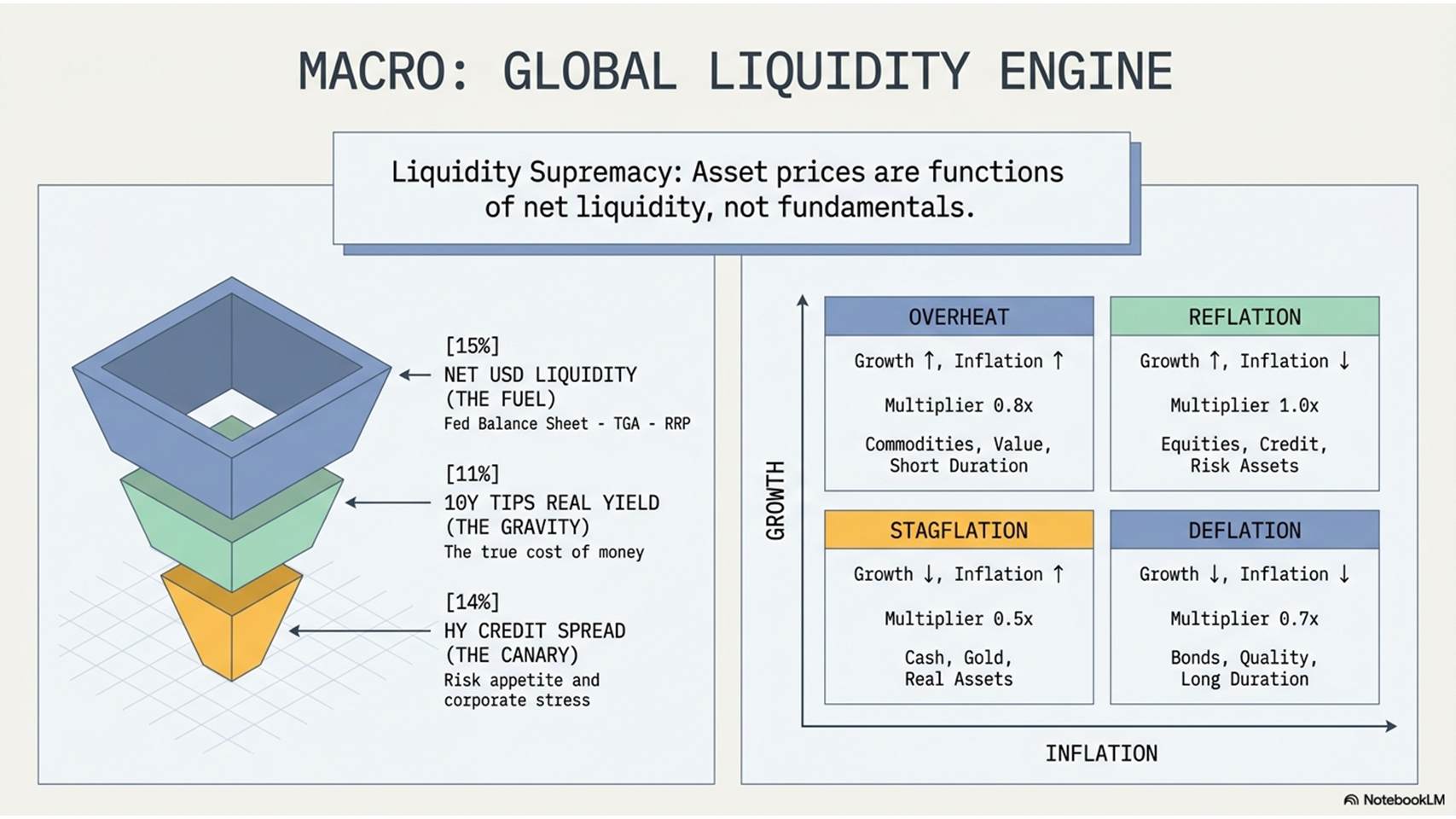
Macro Framework Overview
-
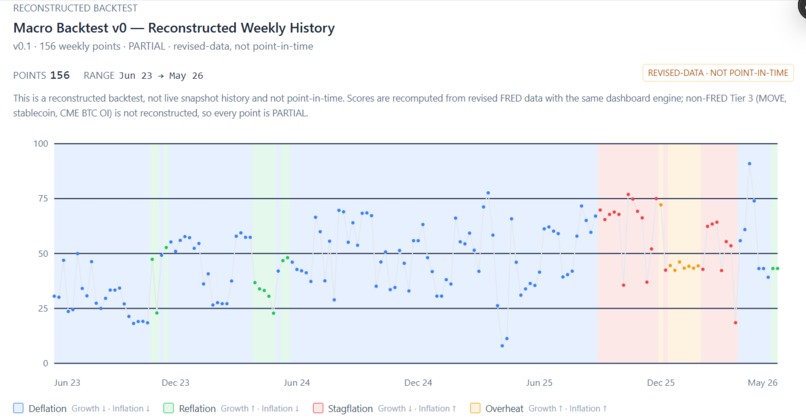
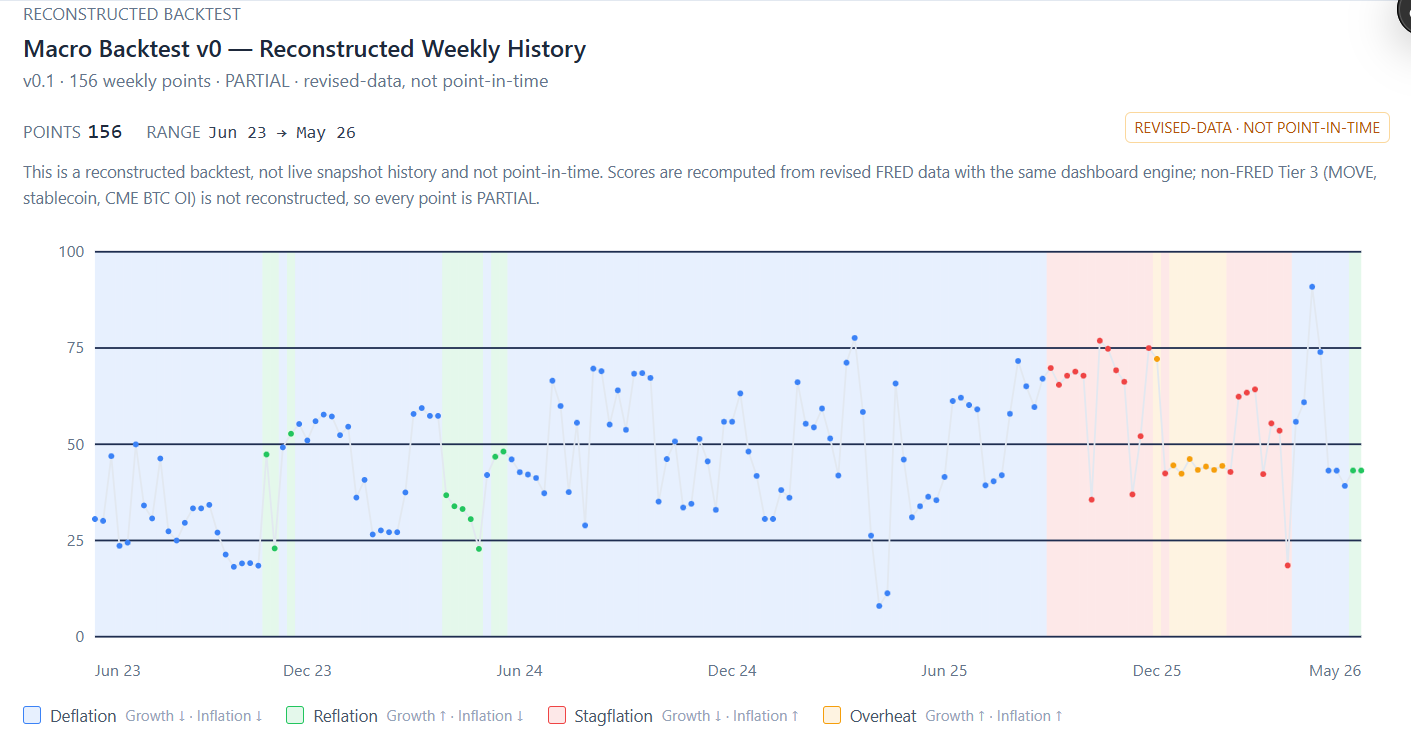
Macro Framework Reconstructed signal backtest
-
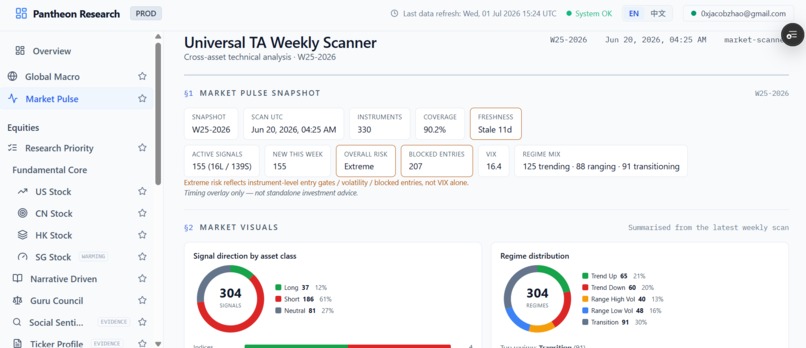
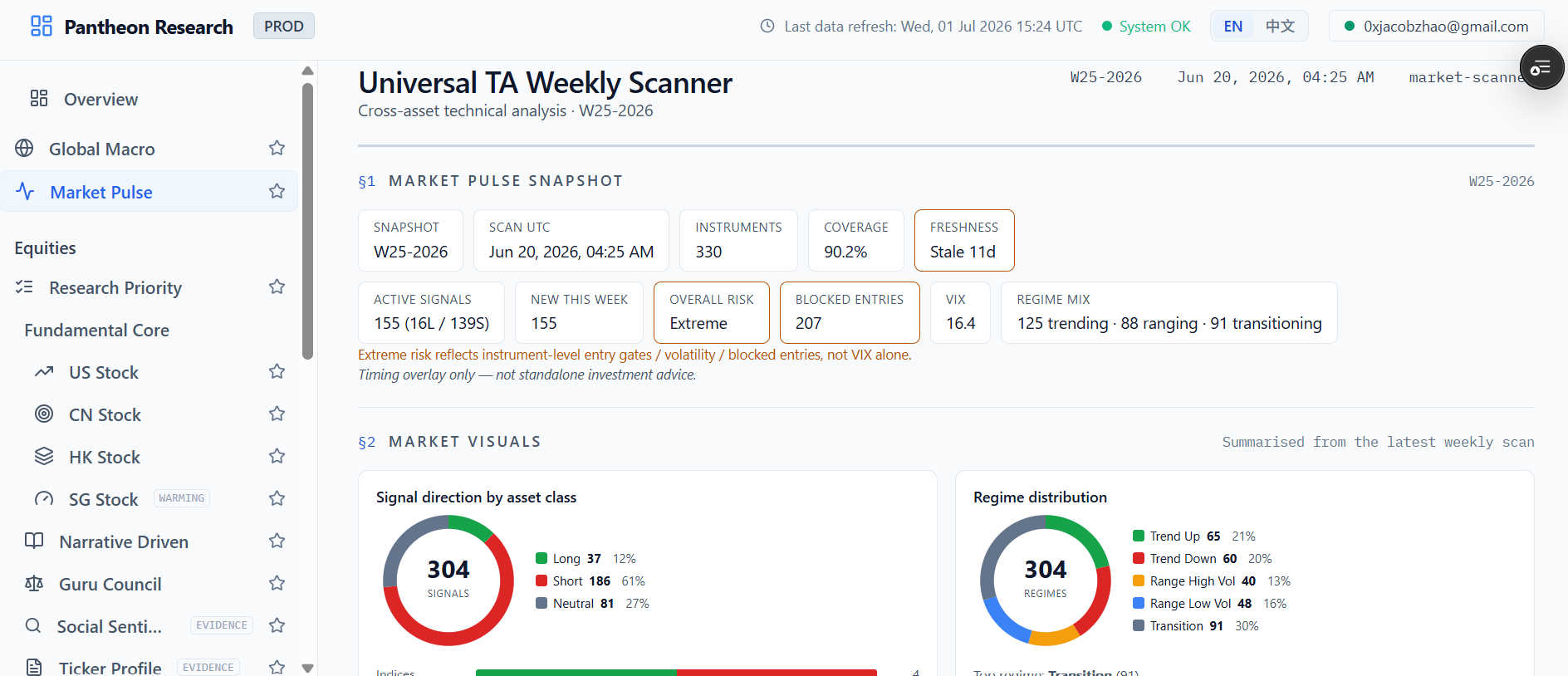
Universal Technical Analysis Weekly Scanner
-
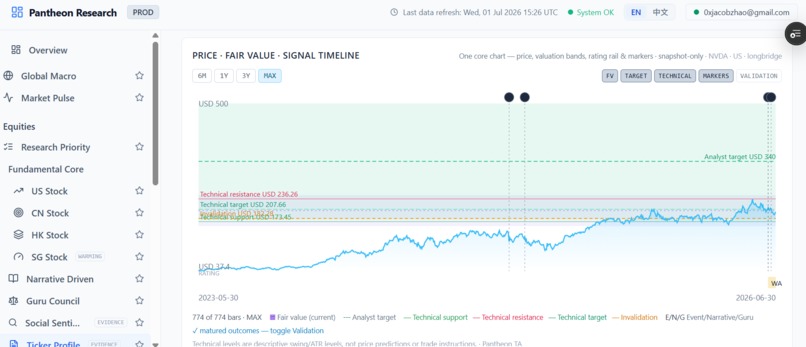
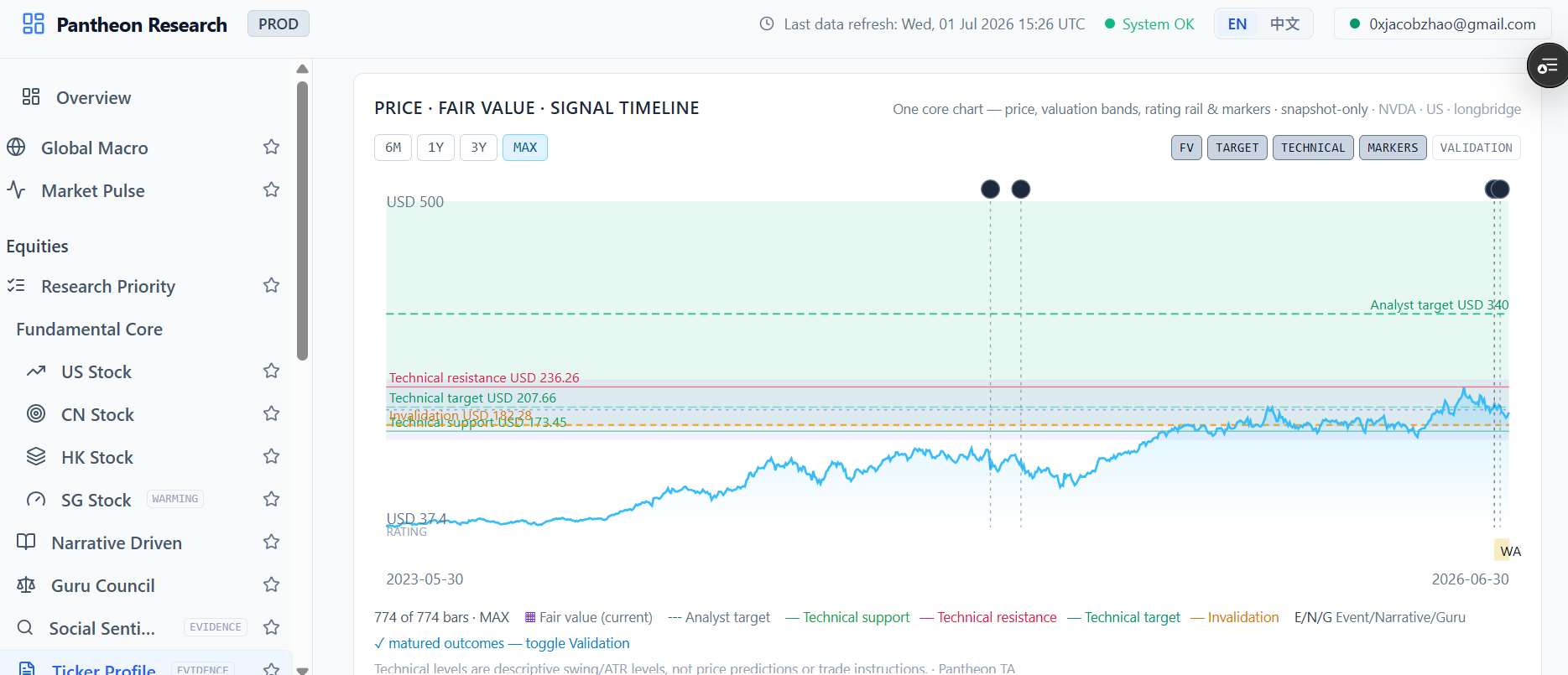
NVDA Price · Fair Value · Signal Timeline
-
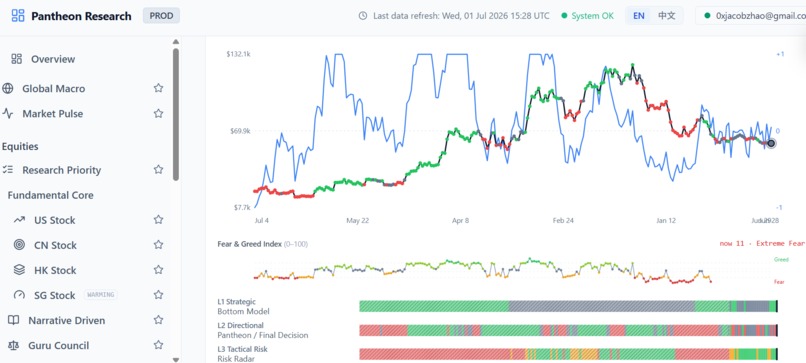
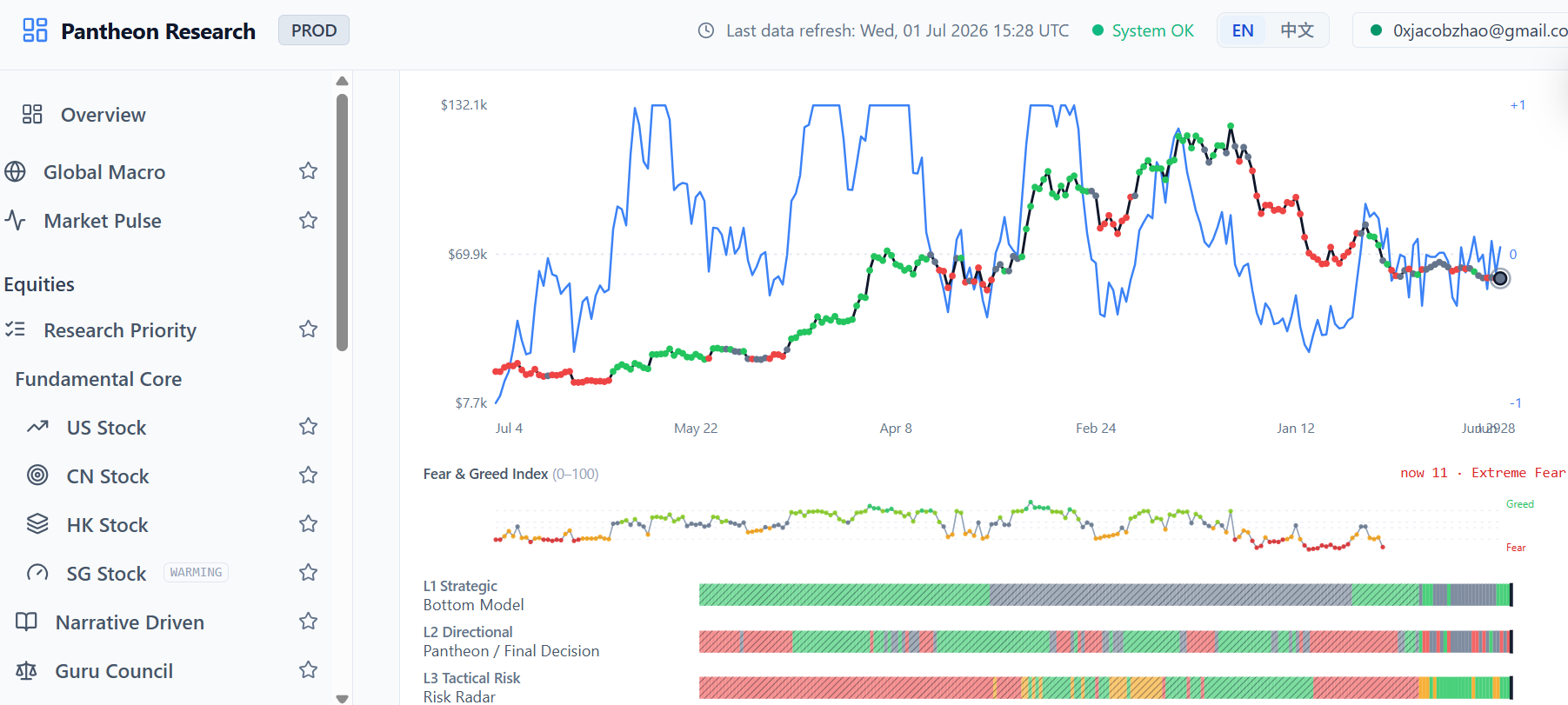
BTC Price & Signal History
-
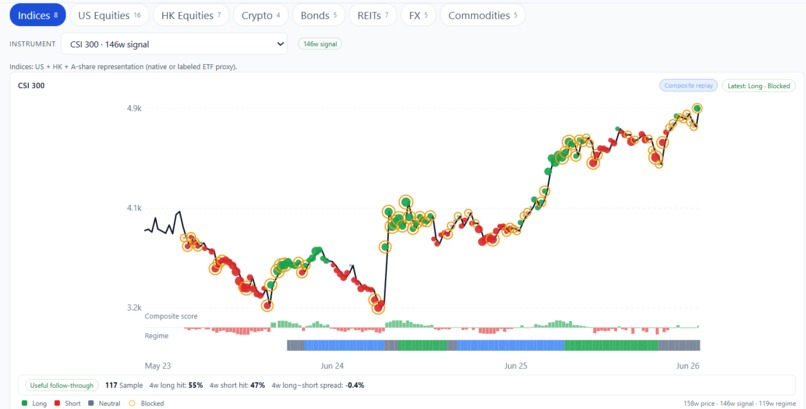
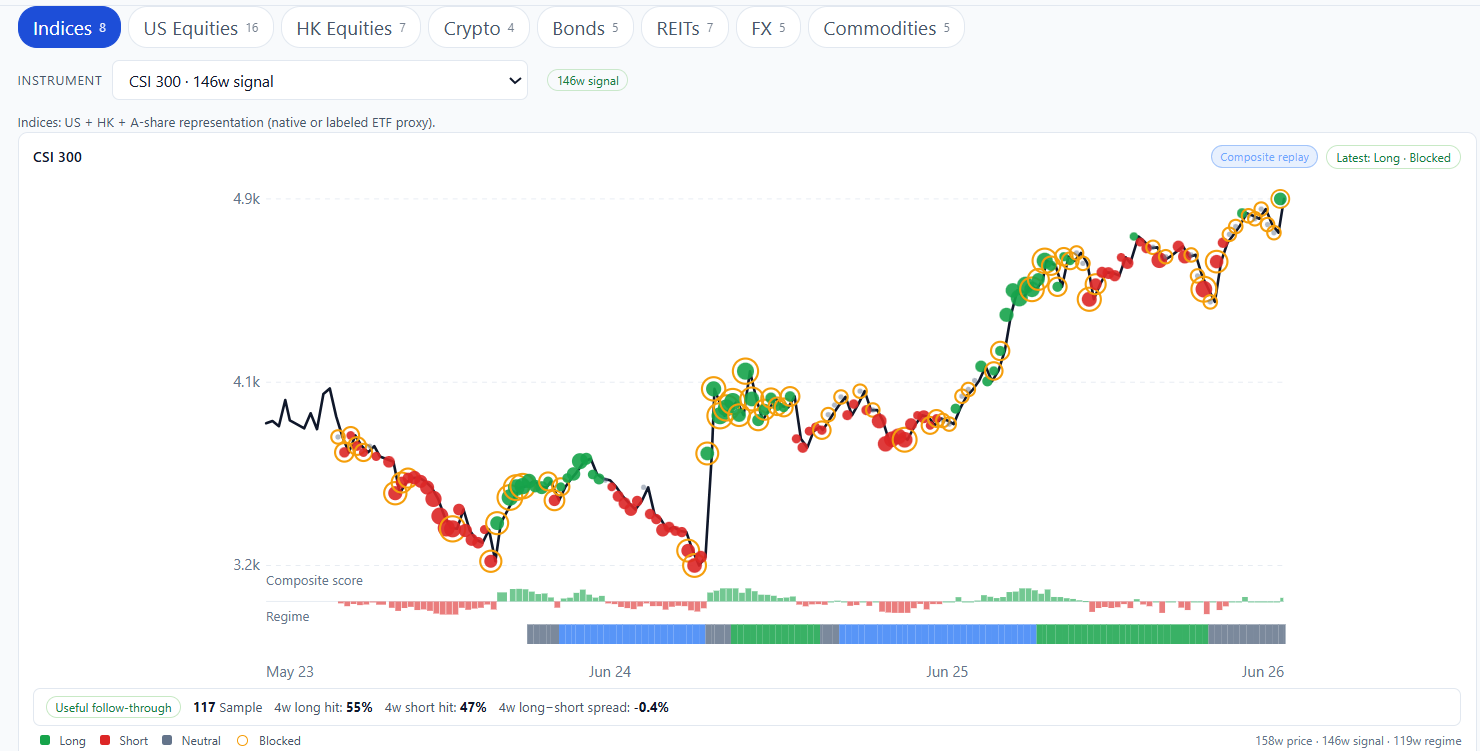
Technical Analysis Signal Chart
-
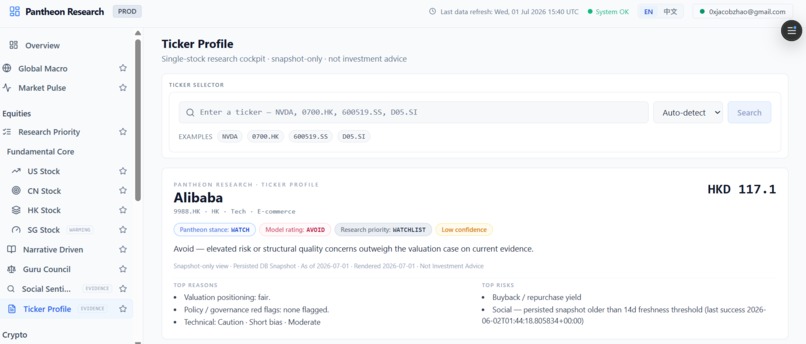
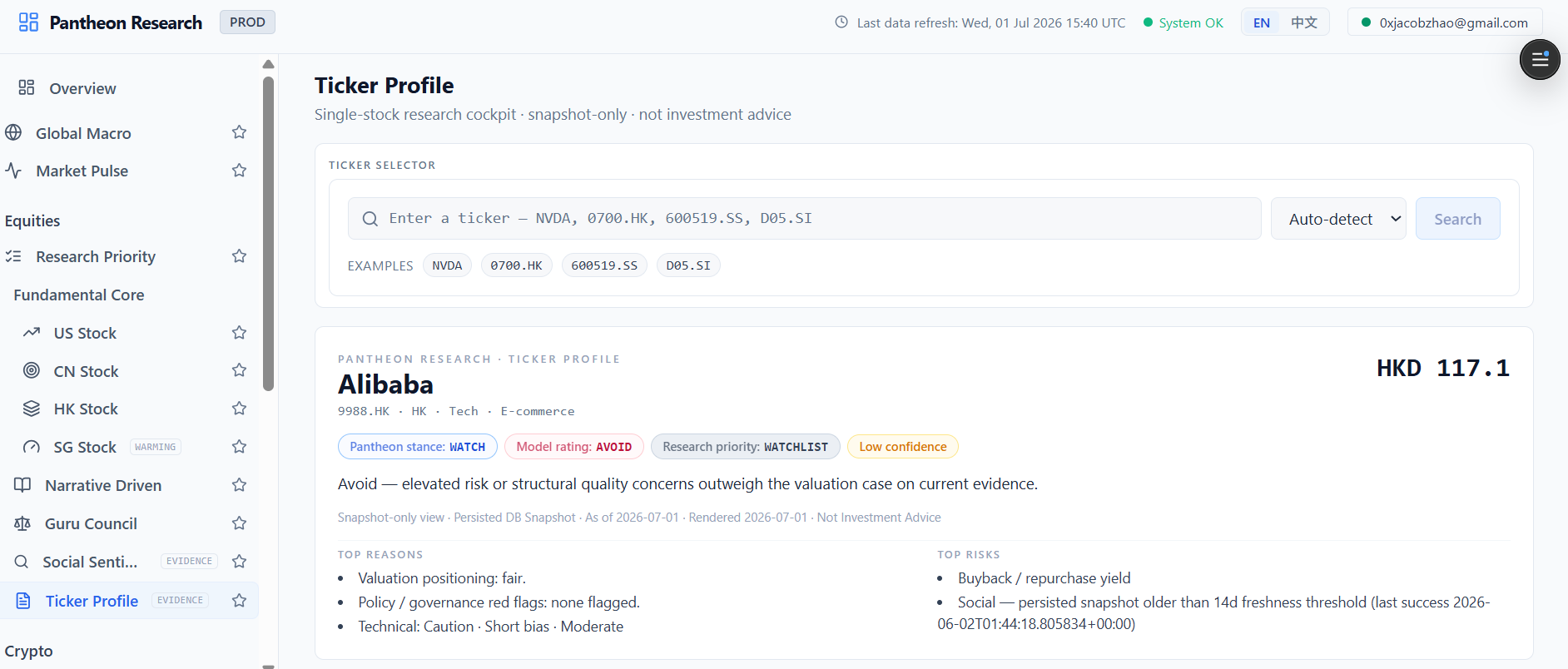
Alibaba Ticker Profile
-
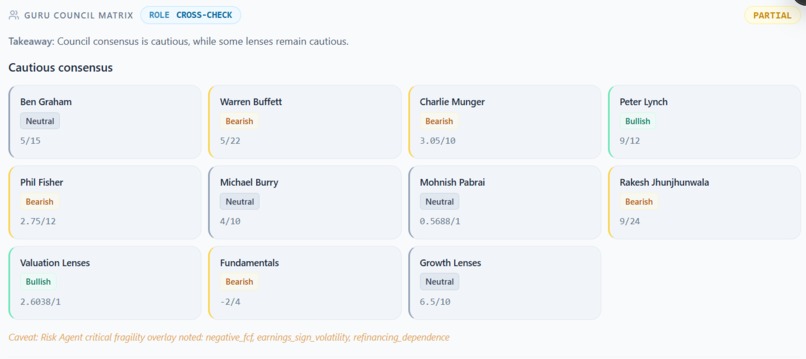
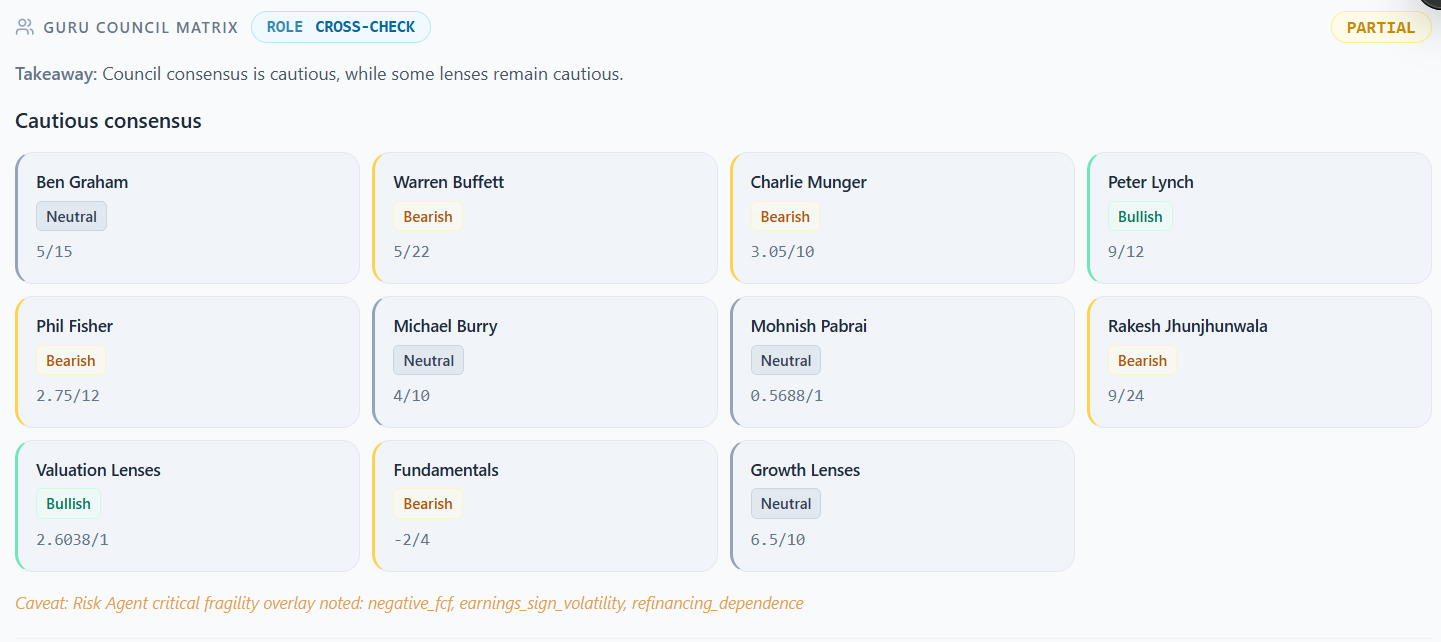
Guru Council Matrix
-
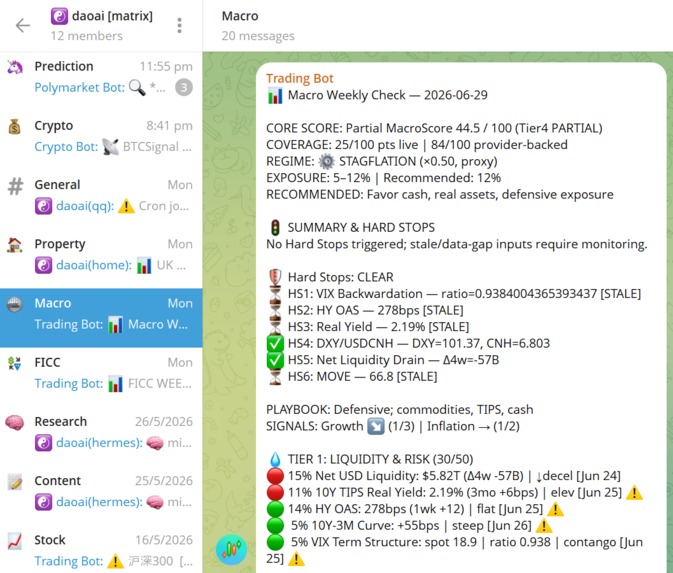
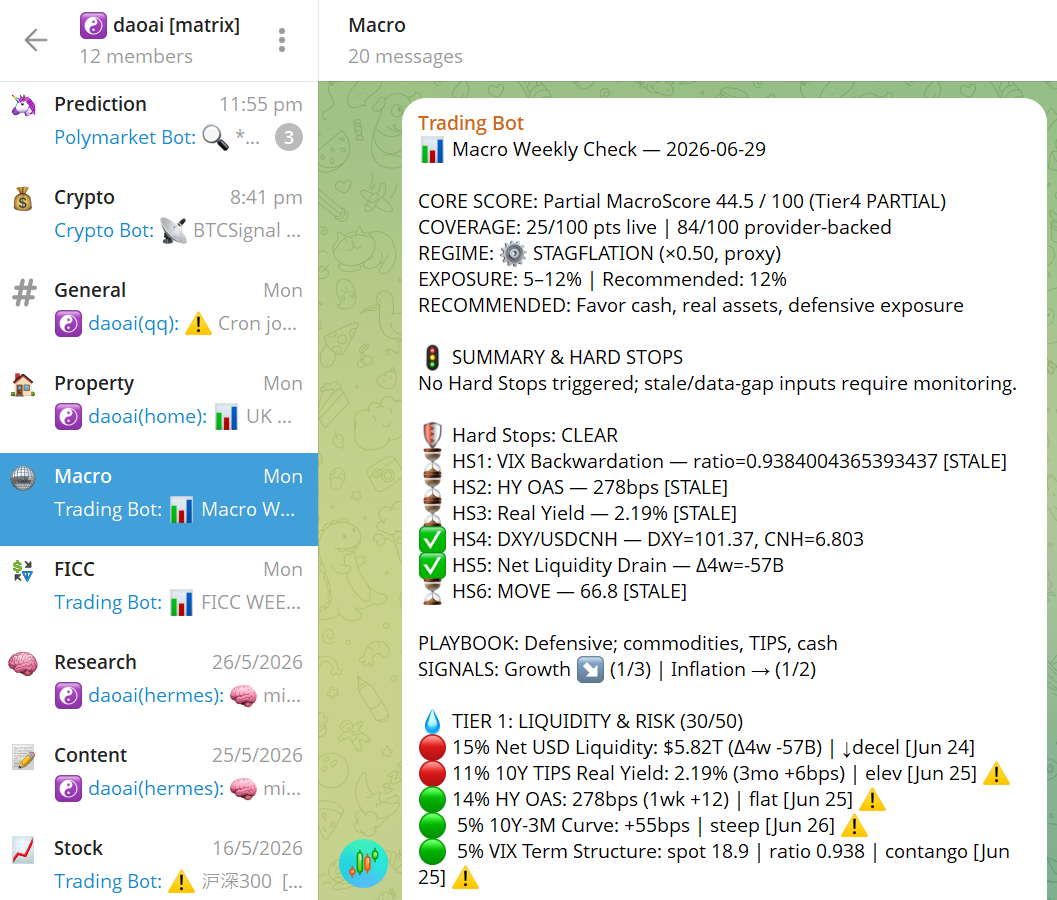
Macro Signal Weekly Telegram report
-
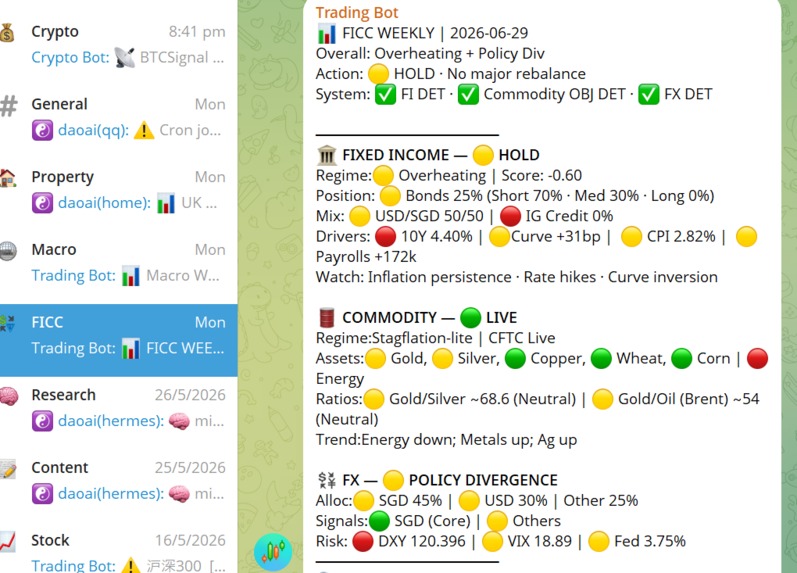
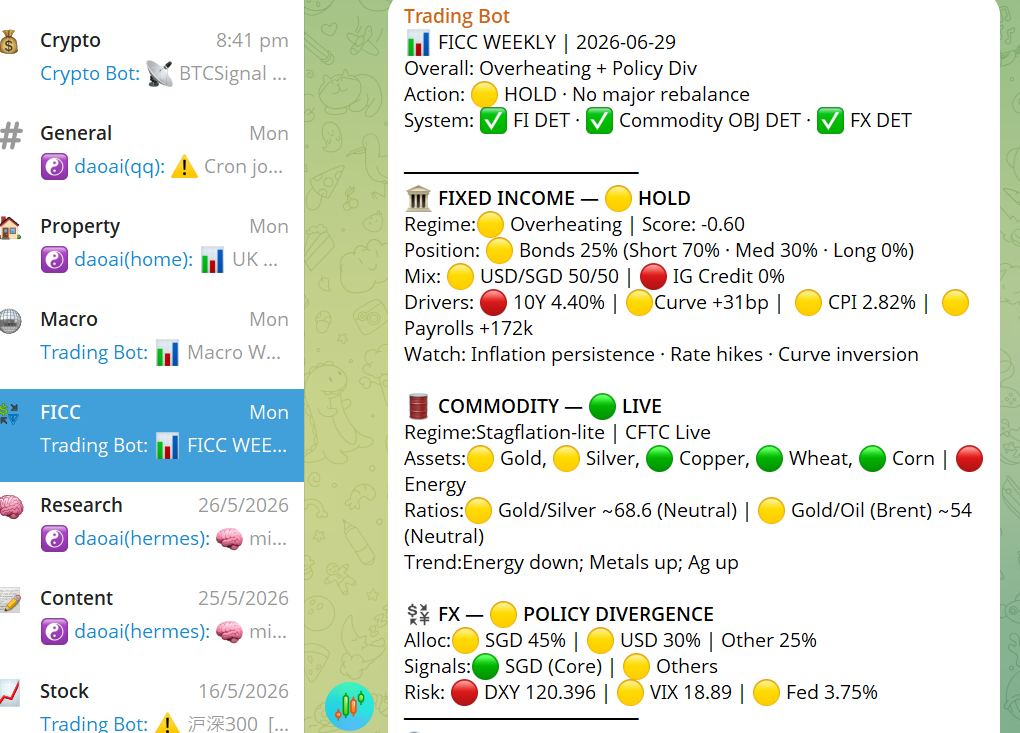
FICC Signal Weekly Telegram report
-
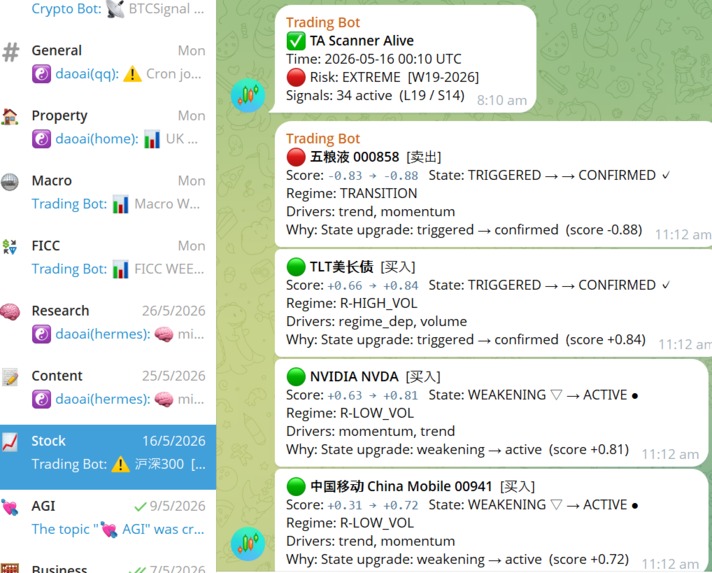
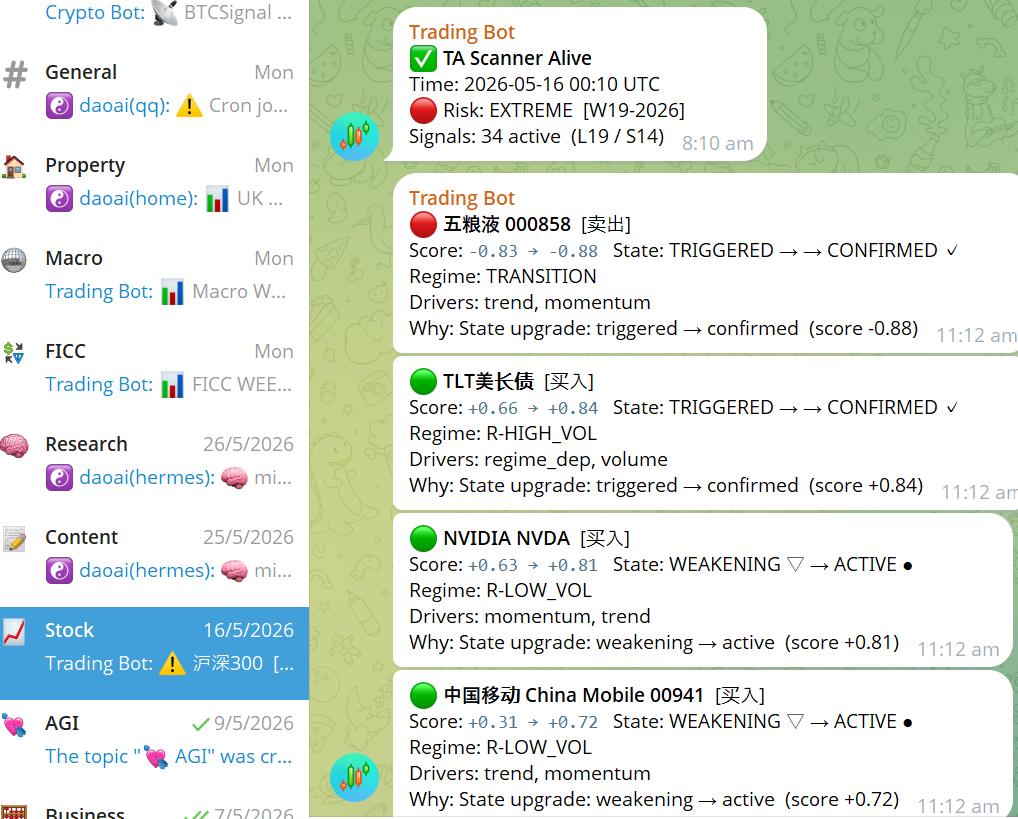
Stock Technical Analysis Signal Telegram report
-
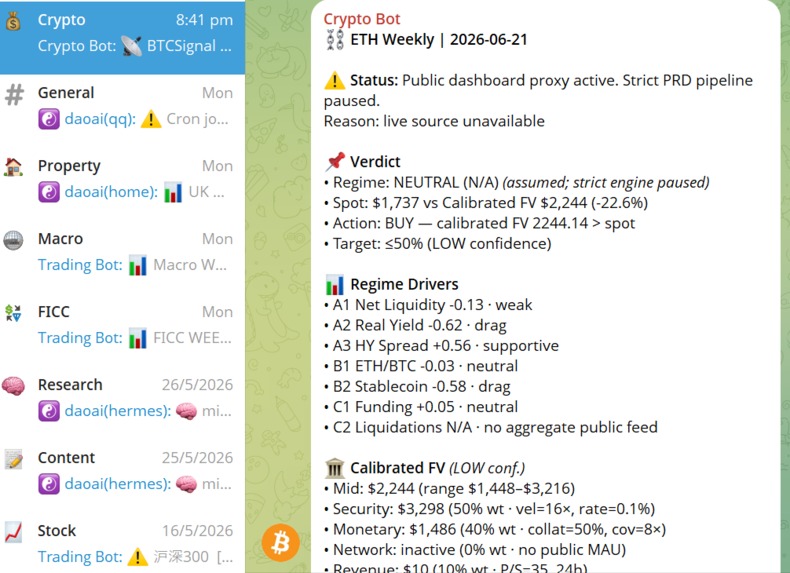
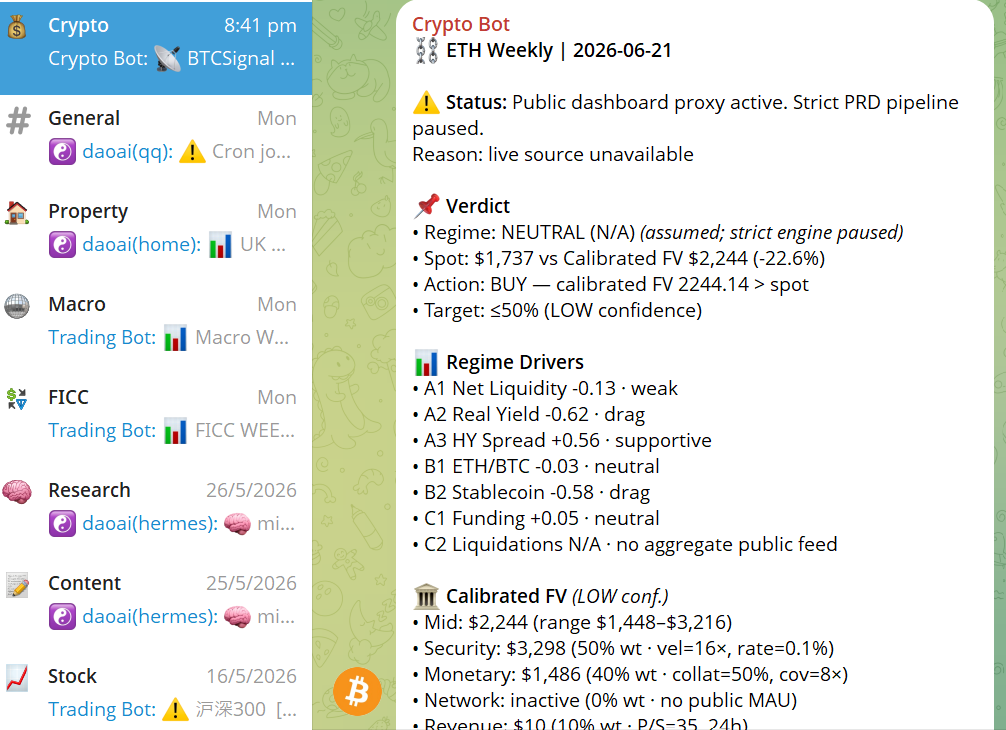
ETH Valuation Weekly Telegram report
Inspiration
Pantheon Research was inspired by a simple but painful problem: modern investors have access to more market data than ever, but the actual research workflow is still fragmented.
To understand one asset, an investor may need to check macro indicators, price charts, valuation metrics, earnings data, news, sentiment, crypto liquidity, backtest results, and personal notes across many different tools. The hard part is not only collecting data, but turning fragmented information into a coherent investment view.
Pantheon Research started from one question:
What would an AI-native investment research operating system look like if it combined structured financial data, institutional-style investment frameworks, deterministic signal engines, and LLM-powered reasoning?
The goal is not to build another finance chatbot or an AI stock picker. The goal is to build a disciplined research platform where AI helps investors reason from evidence, understand uncertainty, and make better human decisions.
The deeper inspiration is that AI can give an individual investor something that used to require a full institutional research team: systematic frameworks, continuous monitoring, data pipelines, research summaries, signal distribution, model comparison, and eventually execution support.
Pantheon Research is built around one core belief:
AI should not replace the investor. AI should compound the investor's discipline.
In simple terms, the thesis is:
$$ \mathrm{Wrong\ Strategy} \times \mathrm{AI} = \mathrm{Faster\ Loss} $$
$$ \mathrm{Right\ Strategy} \times \mathrm{AI} = \mathrm{Compounded\ Discipline} $$
What it does
Pantheon Research is an AI-native investment research platform for public markets. It helps users analyze macro conditions, equities, crypto assets, DeFi yield, fixed income, foreign exchange, commodities, technical signals, and prediction markets in one unified system.
The platform combines:
- Structured market data
- Macro and cross-asset indicators
- Equity fundamentals and technical signals
- BTC and ETH cycle research
- DeFi stablecoin yield monitoring
- Fixed income, FX, and commodity dashboards
- Technical analysis / Market Pulse scanning
- Prediction market research
- Backtest analytics
- Data quality and provider health checks
- Telegram / Slack signal delivery
- Qwen and DeepSeek qualitative research overlays
Pantheon Research is organized as a four-layer investment AI stack:
Strategy Layer Institutional-style frameworks across macro, equities, crypto, DeFi, FICC, technical analysis, and prediction markets.
Information Layer Dashboards, data plumbing, canonical databases, APIs, data quality checks, and research artifacts.
Signal Layer Telegram bots, Slack workflows, alerts, and AI-generated briefs that distribute scored research signals.
Trading Layer A roadmap from manual decision-making to paper trading, broker integration, human-approved execution, and eventually constraint-bound automation.
The workflow is:
$$ \mathrm{Raw\ Market\ Data} \rightarrow \mathrm{Canonical\ Snapshot} \rightarrow \mathrm{Deterministic\ Signal} \rightarrow \mathrm{LLM\ Overlay} \rightarrow \mathrm{Human\ Decision} $$
For the Qwen Cloud Hackathon, the most important new feature is the Qwen + DeepSeek dual-model qualitative overlay. Qwen Max and DeepSeek analyze the same structured equity evidence packs independently, using the same schema, and their outputs are compared factor by factor.
The system does not ask an LLM to directly decide what to buy. Instead, it first builds a structured evidence layer, then uses Qwen and DeepSeek to analyze business quality, moat, pricing power, capital allocation, red flags, and missing evidence.
How we built it
Pantheon Research was built as a full-stack research platform with a modular architecture.
The frontend is a responsive web dashboard built with React, TypeScript, and Vite. It organizes different research domains into clear modules, including Global Macro, Equities, Crypto, DeFi Yield, FICC, Technical Analysis, Prediction Markets, and Research Ops.
The backend is built with Python / FastAPI-style services. It provides API endpoints for market data, signal generation, backtest analytics, research snapshots, Qwen / LLM outputs, and admin operations.
The data layer follows a DB-first architecture. Market observations, provider snapshots, derived signals, and research artifacts are stored in PostgreSQL-style databases before being used by the application.
The core architecture looks like this:
Market Data / APIs / Scrapers / Filings
        ↓
Data Ingestion + Normalization
        ↓
Canonical Research Database
        ↓
Derived Snapshots + Evidence Packs
        ↓
Deterministic Signal Engines
        ↓
Qwen / DeepSeek Qualitative Overlay
        ↓
Dashboard + Telegram + Slack + API
        ↓
Human Investment Decision Workflow
The current stack includes:
- React / TypeScript / Vite for the frontend dashboard
- Python / FastAPI for backend services and APIs
- PostgreSQL / Railway PostgreSQL / Alibaba RDS for structured storage
- Vercel for the primary frontend deployment
- Railway for the primary backend / API deployment
- Alibaba Cloud for the Qwen hackathon deployment path
- Nginx + Dockerized FastAPI backend on the Alibaba Cloud deployment
- Qwen Max / DashScope for qualitative overlay and model comparison
- DeepSeek as a parallel qualitative research model
- Telegram and Slack workflows for signal delivery and research interaction
The Alibaba Cloud deployment is now working as a demo-ready path. The frontend, backend, database connection, and major dashboard flows were repaired and verified for the hackathon demo. The stack now supports a live Alibaba Cloud deployment with Qwen integration:
Alibaba Cloud
    ↓
Nginx Frontend / Reverse Proxy
    ↓
Dockerized FastAPI Backend
    ↓
Alibaba RDS
    ↓
Qwen / DashScope Qualitative Overlay
A key design principle is the separation between deterministic signals and AI interpretation.
The deterministic engine owns:
- Scores
- Gates
- Regimes
- Hard stops
- Data quality labels
- Validation states
- Framework verdicts
The LLM overlay owns:
- Business quality analysis
- Moat interpretation
- Pricing power review
- Capital allocation review
- Risk and red-flag synthesis
- Missing evidence detection
This separation reduces hallucination risk. The LLM is not the source of truth. The data and framework are the source of truth. Qwen and DeepSeek act as analyst layers on top of structured evidence.
Qwen integration
For the Qwen Cloud Hackathon, Pantheon Research integrated Qwen through Alibaba Cloud Model Studio / DashScope as a core qualitative research overlay model.
The Qwen workflow works as follows:
Ticker Evidence Pack
        ↓
Qwen Analysis
        ↓
Schema Validation
        ↓
Stored Research Snapshot
        ↓
Comparison with DeepSeek Output
        ↓
Agreement / Divergence / Evidence Gap
Qwen and DeepSeek are treated as independent research analysts. They receive the same structured evidence pack, use the same output schema, and are stored separately. The comparison engine then evaluates where the models agree, where they diverge, and where the evidence is not strong enough.
Current Qwen overlay results include:
| Metric | Result |
|---|---|
| Qwen comparison-capable coverage | 312 tickers |
| Markets covered | US / China / Hong Kong / Singapore |
| Healthy model comparisons | 312 / 312 |
| Qwen market split | US 117 / CN 69 / HK 103 / SG 23 |
| DeepSeek baseline universe | 1,331 tickers |
| Persist recovery result | 16 / 16 recovered |
| Full-universe parity status | Not pursued; low-liquidity tail intentionally excluded |
The purpose is not to decide which model is “right.” The purpose is to detect overconfidence, missing evidence, and model disagreement before a human investor makes a decision.
This is especially valuable in finance, where a confident unsupported answer can be more dangerous than no answer.
Challenges we ran into
The biggest challenge was data reliability.
Financial data is fragmented, inconsistent, and often incomplete. Different providers have different coverage, refresh frequency, symbol formats, rate limits, and data quality. This made it necessary to build data gap audits, provider health checks, fallback routes, canonical database tables, and explicit freshness labels.
During the Alibaba Cloud deployment work, we faced real production-style issues:
- Environment mismatch between Railway and Alibaba deployments
- Macro data returning mock-mode payloads despite valid DB snapshots
- Market Pulse / Technical Analysis becoming stale because provider authentication and Yahoo access behaved differently on Alibaba Cloud
- Provider rate limits causing equity rows to be skipped
- BTC data becoming partially degraded because some price and macro inputs were not configured in the Alibaba environment
- Frontend route and data-state issues that had to be repaired for a reliable demo path
These challenges became part of the product design. Pantheon Research does not hide degraded states. It labels them.
For example, the system distinguishes:
- Fresh
- Stale
- Hard stale
- Provider degraded
- Data gap
- Not implemented
- Insufficient coverage
Another challenge was preventing AI hallucination. In finance, a confident but unsupported answer is dangerous. Pantheon Research addresses this by grounding AI-generated narratives in structured signals, stored observations, explicit frameworks, and schema-validated evidence packs.
A third challenge was product complexity. The platform covers macro, equities, crypto, DeFi, fixed income, FX, commodities, technical analysis, and prediction markets. Without a clear architecture, the product could easily become overwhelming. We solved this by organizing the system into the four-layer stack:
Strategy → Information → Signal → Trading
We also had to think carefully about execution. Signals are not the same as trades. A signal may tell us direction, risk level, or position cap, but trading requires order routing, slippage control, reconciliation, attribution, broker integration, and risk overrides.
That is why Pantheon Research intentionally builds trading last, after the research framework, data layer, and signal layer are stable.
Accomplishments that we're proud of
We are proud that Pantheon Research became more than a demo. It is a real research operating system with multiple asset classes, production APIs, data pipelines, admin controls, signal bots, and AI-powered interpretation.
Some accomplishments we are especially proud of:
- Built a unified research dashboard across macro, equities, crypto, DeFi, FICC, technical analysis, and prediction markets.
- Created a four-layer investment AI architecture: Strategy, Information, Signal, and Trading.
- Built institutional-style frameworks for macro, US equities, China equities, Singapore equities, BTC, ETH, DeFi yield, fixed income, FX, commodities, technical analysis, and prediction markets.
- Created a DB-first architecture for more reliable market research.
- Integrated deterministic signal engines with Qwen and DeepSeek qualitative overlays.
- Built a dual-model comparison workflow across US, China, Hong Kong, and Singapore equities.
- Generated Qwen qualitative overlays for 223 / 223 target equities.
- Built an Alibaba Cloud deployment path with Nginx, Dockerized FastAPI, Alibaba RDS, and Qwen / DashScope integration.
- Repaired the Alibaba frontend and made the main demo path usable for the hackathon.
- Restored Macro and Market Pulse / Technical Analysis readiness on the Alibaba deployment.
- Built Telegram and Slack workflows for signal delivery and research briefs.
- Built Research Ops tools for data quality, provider health, readiness monitoring, and data gap audits.
- Added backtest analytics to evaluate whether signals have historical usefulness.
- Designed the trading roadmap carefully, starting with manual decisions and paper trading before any automated execution.
- Supported bilingual research workflows for English and Chinese-speaking users.
- Designed the platform around explainability rather than black-box AI output.
Most importantly, Pantheon Research demonstrates that AI in finance should not just generate text. It should sit on top of a structured research system and help users reason from evidence.
What we learned
We learned that useful financial AI is mainly an infrastructure problem.
A strong model is important, but the quality of the output depends heavily on the quality of the data, the structure of the signals, and the clarity of the research framework.
We also learned that deterministic systems and AI systems are complementary.
Deterministic pipelines are better for:
- Calculation
- Normalization
- Scoring
- Backtesting
- Consistency
- Auditability
- Fail-closed behavior
AI systems are better for:
- Summarization
- Explanation
- Translation
- Contradiction analysis
- Business-quality reasoning
- Evidence synthesis
- Model-to-model comparison
The most important lesson is:
AI should not replace the research process. AI should make the research process more structured, faster, and more explainable.
We also learned that AI trading projects fail when they skip layers. If a project jumps directly from an LLM to trade execution, it becomes a fast loss machine. The correct order is:
Strategy → Information → Signal → Trading
Pantheon Research taught us that the future analyst workflow will likely be a loop between human judgment, data infrastructure, deterministic systems, and AI reasoning.
The human still needs the framework. AI compounds the framework.
What's next for Pantheon Research
The next step for Pantheon Research is to evolve from a research dashboard into a full AI-native investment research and execution stack.
Product-wise, the roadmap follows the four-layer architecture:
Strategy Layer Continue refining institutional-style investment frameworks across macro, equities, crypto, DeFi, FICC, technical analysis, and prediction markets.
Information Layer Improve data coverage, data quality, provider routing, canonical database design, research dashboards, and admin monitoring.
Signal Layer Expand Telegram, Slack, email, API, and AI-agent delivery surfaces so research signals can reach users in real time.
Trading Layer Move carefully from manual decisions to paper trading, broker integration, human-approved execution, and eventually constraint-bound automation.
Near-term product priorities include:
- Expanding Qwen-powered research overlays beyond the current 223-equity target universe.
- Adding sector-specific and multilingual CN/HK prompts.
- Improving Qwen vs DeepSeek model-comparison diagnostics.
- Strengthening Alibaba Cloud deployment reliability.
- Improving data provider routing and freshness monitoring.
- Expanding browser-level smoke tests and route-contract checks.
- Completing the paper-trade harness where every signal becomes a trackable ticket with P&L attribution.
- Improving visualization for valuation, technicals, macro regimes, and historical signal performance.
- Building personalized watchlists, alerts, and research briefings.
- Strengthening mobile / PWA experience for daily signal consumption.
Commercially, Pantheon Research will explore several business model paths:
- Pro research subscription for individual investors and power users.
- Premium AI research reports across macro, equities, crypto, DeFi, and FICC.
- Signal and alert products delivered through Telegram, Slack, email, or API.
- B2B research tools for family offices, crypto funds, independent analysts, and wealth managers.
- Data quality and Research Ops tooling for teams building their own AI investment systems.
- Enterprise or white-label deployment for financial institutions that need customized AI research infrastructure.
The next business milestone is to move from a builder-led product to a more scalable company structure. This means clarifying the target customer, validating willingness to pay, designing pricing tiers, and identifying which modules are most commercially valuable: macro research, equity research, crypto signals, DeFi yield, or AI-powered cross-asset allocation.
Pantheon Research also plans to build a small founding team around several key roles:
- AI / LLM engineer
- Full-stack product engineer
- Data engineer
- Quant / backtesting researcher
- Financial research analyst
- Growth / business development lead
The long-term vision is for Pantheon Research to become an AI-native investment co-pilot: a system that continuously monitors markets, detects regime changes, explains risks, validates signals, distributes research, and helps investors make more disciplined decisions.
The core belief remains:
AI should not replace the investor. AI should compound the investor's discipline.
Built With
- akshare
- alfred
- alibaba-cloud
- alibaba-dashscope
- alibaba-rds
- binance
- deepseek
- defillama
- docker
- fastapi
- fred
- hkex
- longbridge
- nginx
- openclaw
- postgresql
- python
- qwen-max
- railway
- railway-postgresql
- react
- sec-edgar
- sgx
- slack
- telegram-bot
- tushare
- typescript
- vercel
- vite


Log in or sign up for Devpost to join the conversation.