-
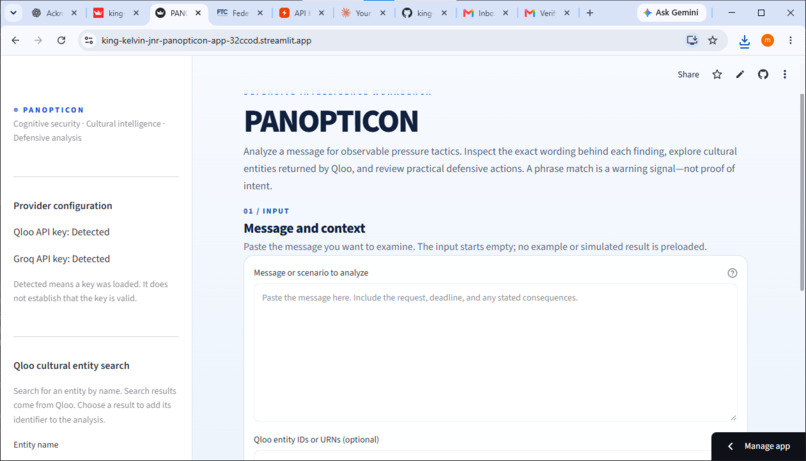
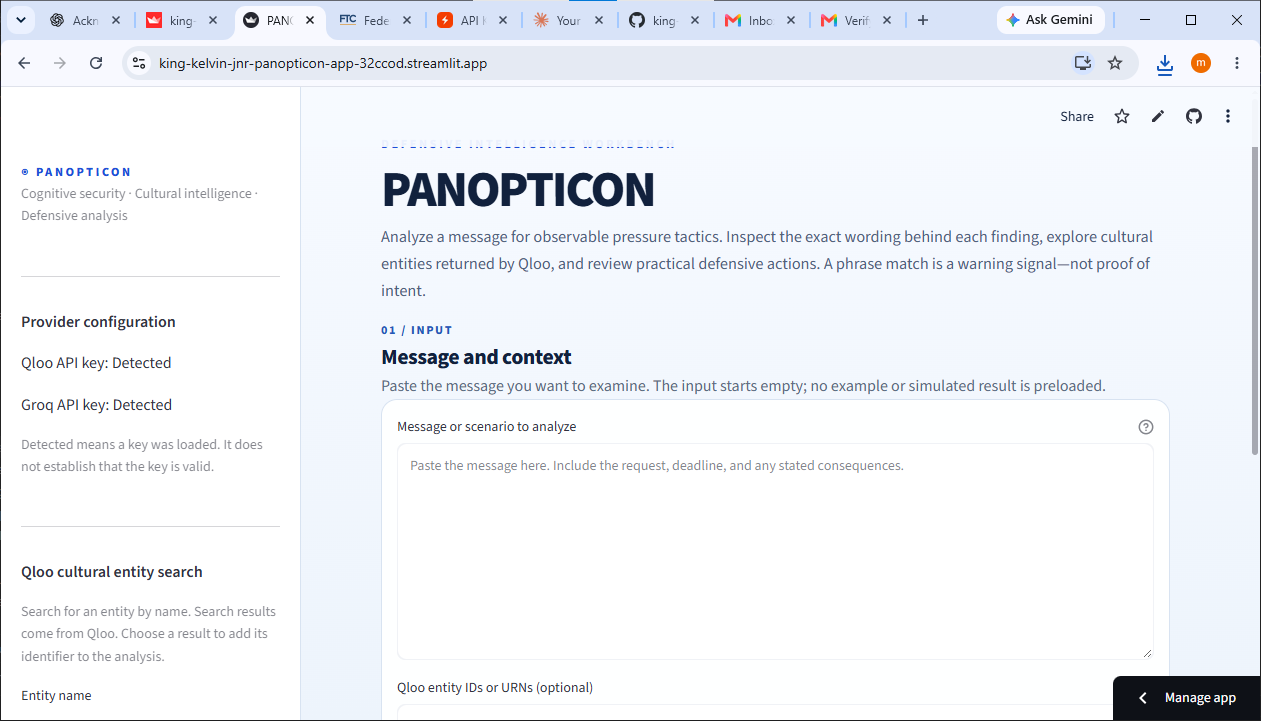
PANOPTICON live application showing its cognitive-security analysis interface.
Inspiration
AI systems can produce convincing explanations, but they do not always distinguish observable evidence from interpretation. Manipulative messages may use urgency, false authority, secrecy, or social pressure. Cultural references can also matter when interpreting a scenario, but cultural associations must not be mistaken for proof of a person's intentions or psychological vulnerabilities.
PANOPTICON explores a responsible approach to cognitive security by combining explainable manipulation-pattern detection, live cultural intelligence from Qloo, and AI-assisted reporting. Its purpose is to help analysts recognize potentially manipulative communication and respond with evidence-based defensive measures.
What it does
PANOPTICON is an AI-assisted cognitive-security workbench that allows users to submit a message or fictional scenario for structured analysis.
- Explainable risk detection: A deterministic rule engine identifies predefined manipulation patterns, quotes the exact matching wording, and explains the finding and its severity.
- Cultural intelligence: Users can search for cultural entities through Qloo and retrieve live API results for relevant entity identifiers. The returned context is presented separately from the evidence used to flag language patterns.
- AI-assisted analysis: Groq generates a readable narrative that summarizes the findings while keeping the rule-based evidence visible for inspection.
- Defensive countermeasures: The application recommends practical responses, such as pausing before acting and independently verifying urgent requests through a trusted channel.
- Transparent limitations: A phrase match is a warning signal, not proof of malicious intent. Cultural associations do not establish an individual's beliefs, susceptibility, or psychological profile.
How we built it
We built PANOPTICON with Python and Streamlit. Its modular architecture separates configuration, the risk-analysis engine, defensive recommendations, Qloo API communication, Groq integration, and workflow orchestration.
Qloo provides live cultural-intelligence data, while Groq generates the secondary narrative. Environment variables protect local configuration, and Streamlit Secrets provides a secure way to configure API credentials in the deployed application.
We also created automated tests for core behavior and provider integrations.
Challenges we faced
One challenge was connecting external APIs reliably while keeping credentials out of the public source repository. Another was separating deterministic findings, retrieved cultural information, and AI-generated interpretation so that a fluent narrative would not be mistaken for verified evidence.
We addressed these challenges through modular components, automated tests, explicit evidence quotations, and careful communication of uncertainty.
What we learned
Building a useful AI-assisted security tool requires more than connecting a language model to an interface. Findings should be inspectable, external data should be genuinely retrieved rather than fabricated, and limitations should be visible to users.
We also learned that cultural intelligence must be applied carefully. Cultural connections can provide context for an investigation, but they cannot establish why an individual acted or whether that individual is vulnerable to manipulation.
Current status and next steps
PANOPTICON is deployed and accessible through Streamlit Community Cloud. We have verified 17 automated tests locally and completed live integration checks confirming that Groq can generate an analysis narrative and Qloo can return live result rows.
Our next priority is to strengthen the way relevant Qloo context contributes to the analyst's workflow and to evaluate that contribution more systematically. The goal is a reproducible, evidence-linked tool that helps people recognize potentially manipulative communication without overstating what AI or cultural data can establish.

Log in or sign up for Devpost to join the conversation.