-
-
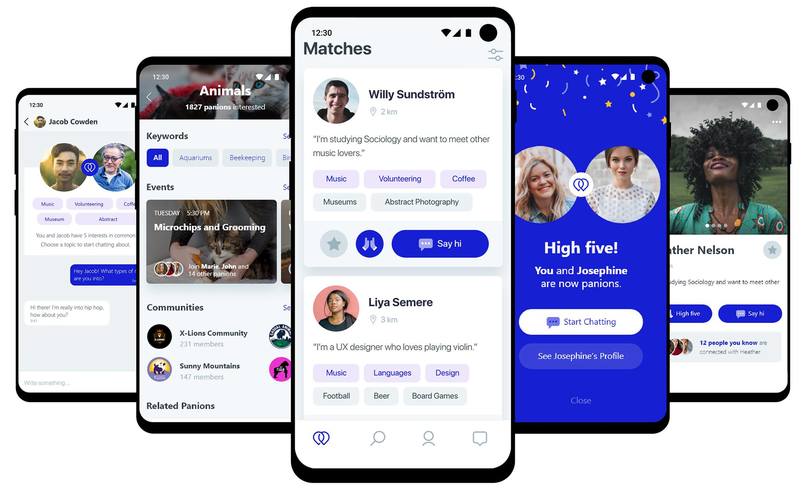
Inside the app.
-
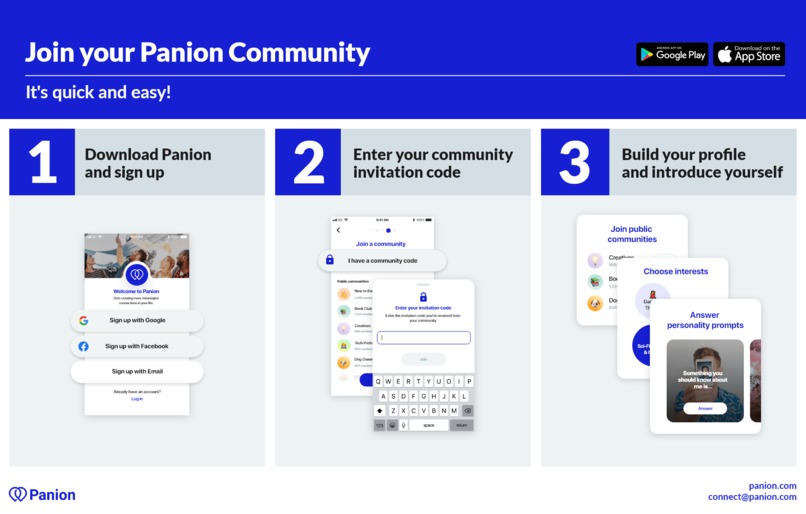
Quick Start Community Guide

Inspiration
When I moved from New York City to Malmö, Sweden 6 years ago, I quickly realised that making friends in this new part of the globe would be very difficult. As an expat in the country that continuously ranked number 1 as the hardest place to make new friends, I struggled to feel at home, but I soon realised I wasn’t the only one! So I started to build a prototype for a tool that would help others feel more connected in Sweden. The idea gave birth to Panion, a social meeting place for like-minded people with common interests.
What it does
We have successfully built a data-driven social app that connects people through common interests. It is our mission to solve the loneliness epidemic by connecting like-minded people for shared activities. We are now using our experience in connecting individuals to build Panion Communities, a community-engagement platform for purpose-driven community builders.
Panion Communities supports organizations in encouraging and facilitating social interactions and activities amongst its members. It’s the virtual water cooler, the digital coffee corner, that allows for meaningful informal interactions and moments of togetherness that build trust and engagement, especially in times of “social distancing.”
With Panion, users create profiles that are tagged with their interests and values. They can use filters and our algorithm to find people who truly get them. This can be done by joining an interest-based public community, or a closed community run by a curated group of community managers.
Our Team
We have an international staff based in 7 different countries. In total, we speak 14 different languages. The majority of us are women. One thing we have in common is that all of us have experienced what it's like to move somewhere new and confront the challenging of building a new community and meaningful friendships. While we all work in tech now, we have diverse educational backgrounds in anthropology, international affairs, computer science, design, photography, education, and media and communications.
Insights
Friendship is a highly complex concept. It is an amorphous term and filling the need for friendship means thinking about its wide range of cultural and personal definitions. For some, friendship is about deep conversations and sharing personal information, while for others it may be based on hobbies and shared interests. It's a challenge to encompass all of these wants and needs and difficult to determine which one we can focus on.
How we built it
Our mobile application was built using React Native to ensure we could ship code quickly as we reuse most of our code across both iOS and Android and still have the ability to access native layers whenever necessary.
We've ensured the application is scalable and so we do not have to worry about server downtime as we grow. We began by setting up an auto-scaling load balanced architecture. We have configured our load balancer to determine if the backend API is getting too many requests and then automatically start a new server to cater to those requests to ensure limited downtime.
Our backend is built in Python, Django, with a REST Framework, and to ensure that users can make meaningful connections, we have devised an algorithm that first analyses user interactions using NLP and then finds attributes that lead to more positive interactions. Using the output from this algorithm, we have created a second algorithm that predicts the likelihood of a positive interaction between two people who haven't yet interacted.
Challenges we ran into
The original concept for Panion was to encourage more people to meet each other in person for shared conversations and activities, however, with the recent emergence of COVID-19, that clearly had to be revised. We have chosen to focus on our community-building feature to address the needs of large virtual networks and those building global interest-based and purpose-driven communities. One of our current challenges is economic uncertainty. We are intensifying our efforts to raise money from mental health, e-health, and impact investors as well as to apply for government-based grants, to ensure we have the required financial resources to keep our engines running and to continue to grow. As we are a two-sided marketplace, we need to grow our user base quickly. Otherwise, we run the risk that our users will not find the genuine connections they are looking for - and therefore will not return to the app. Our success is highly dependent on having the means to optimize our product and scale our marketing efforts.
Accomplishments that we're proud of
During the most challenging months of confinement, we saw a huge increase in use. People were chatting and connecting with new people way more than ever. We witnessed increases of over 300% in the number of user conversations occurring on the app.
We're also proud of the speed and efficiency with which we pivoted. It took us 10 weeks to move from concept to implementation of our b2b product offering. And we're proud of how our new communities offering has been received by our users. There has been a 49.1% increase in average time spent in app by users since we introduced our updated communities feature, as compared with all other releases
What we learned
On the technical side, we've learned a lot about the importance of process to building a quality product - that how we do things matters, and often influences the end results. We have improved our agility through stronger communication within our wider team, feedback loops and more rigorous attention to sprint planning. On the development side, while managing an application for over a 100,000 users, we also learned how to manage server clusters as opposed to everything running on a single server. We switched to running a stateless application so we do not have to worry about which server handles the request for a user and hence not having problems when scaling. We made progress in identifying inappropriate images in the platform as well to make sure we don't annoy our users. We managed to setup models using convolutional neural networks to remove 98.9% of inappropriate images from our system without users having to flag them for us!
We've also learned that we are not our users, and that we have to ensure that we get user feedback at all stages of the process, from initial idea to after implementation, so that we can continue to improve our product.
What's next for Panion
In the near future, we're looking forward to expanding the Communities feature, by adding features that solve our users' problems. This will continue far beyond the Hackathon. These features include community membership fees, which would provide monetization possibilities for both Panion and community managers and a "groups" feature within larger communities. Long-term goals include building the Panion web app and a comprehensive analytics dashboard for managers of Panion communities.

Log in or sign up for Devpost to join the conversation.