-
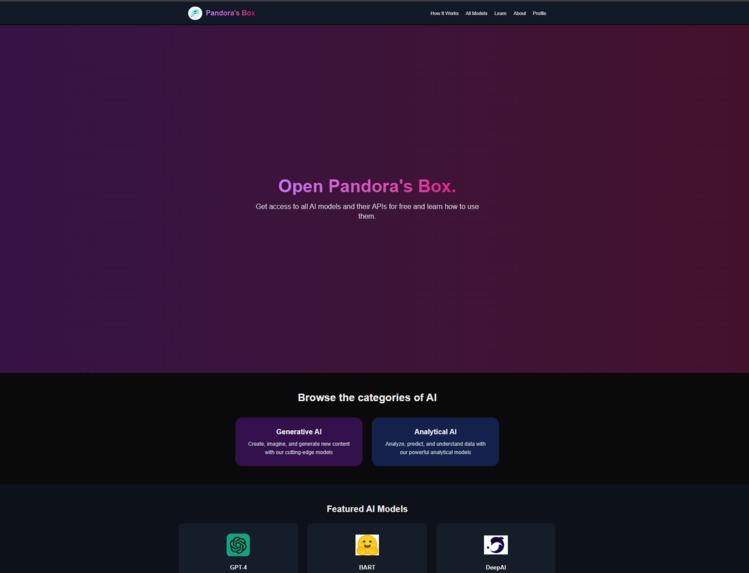
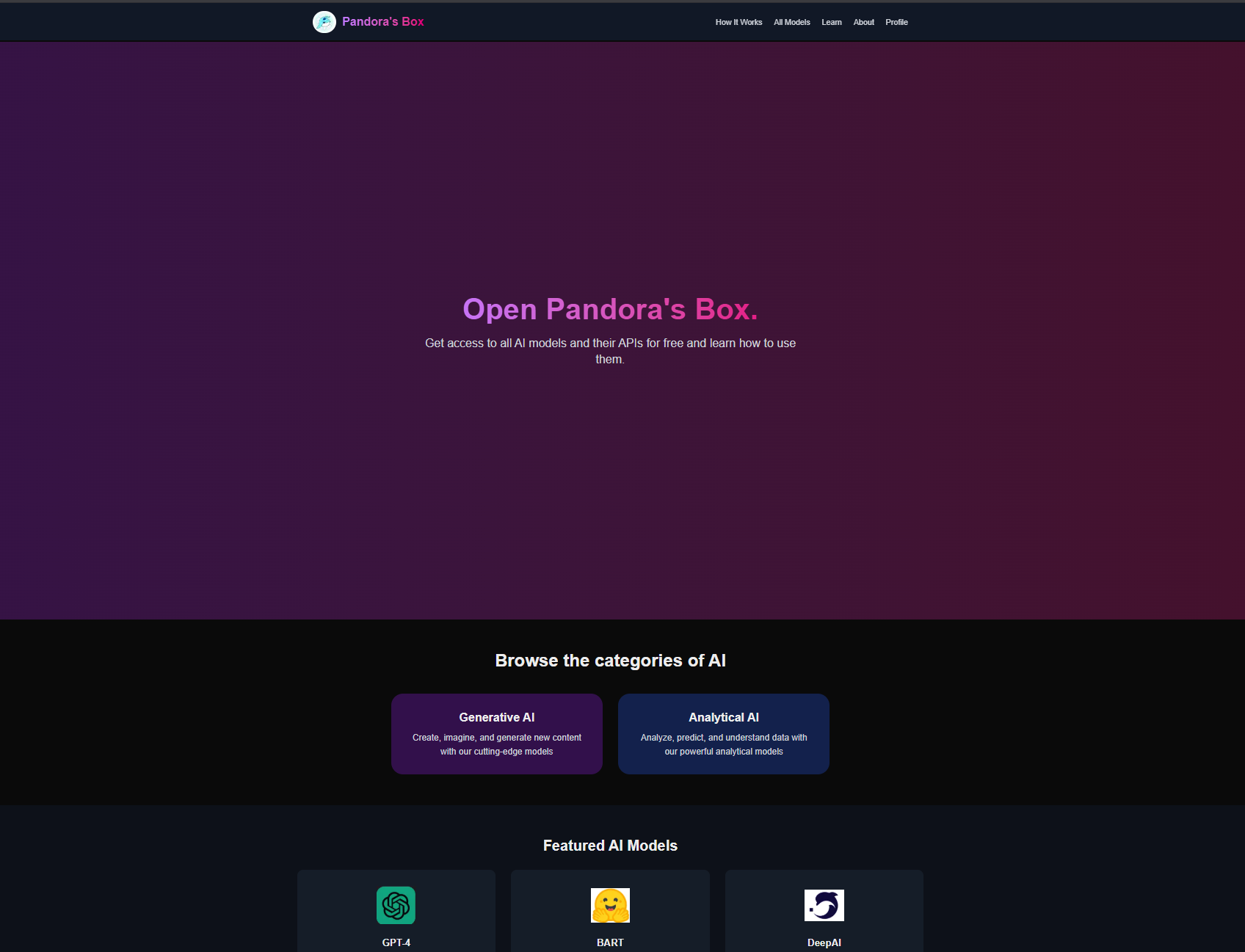
Home-page, zoomed out
-
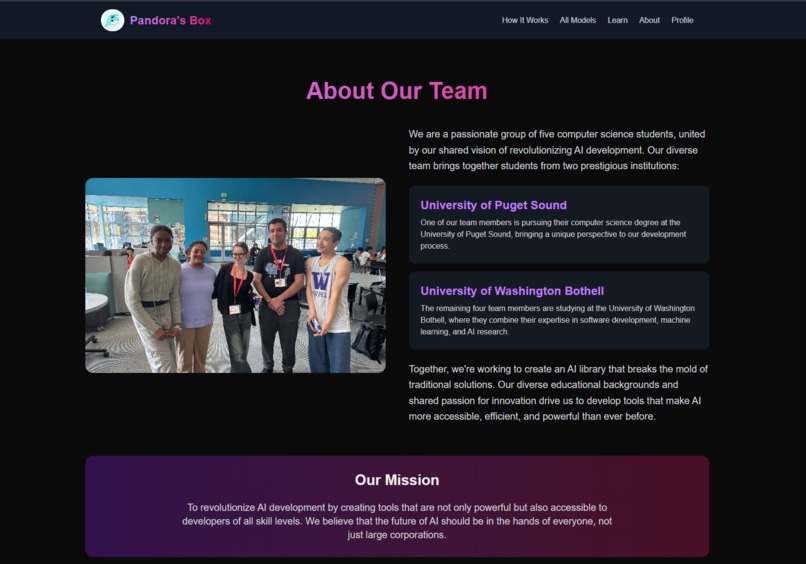
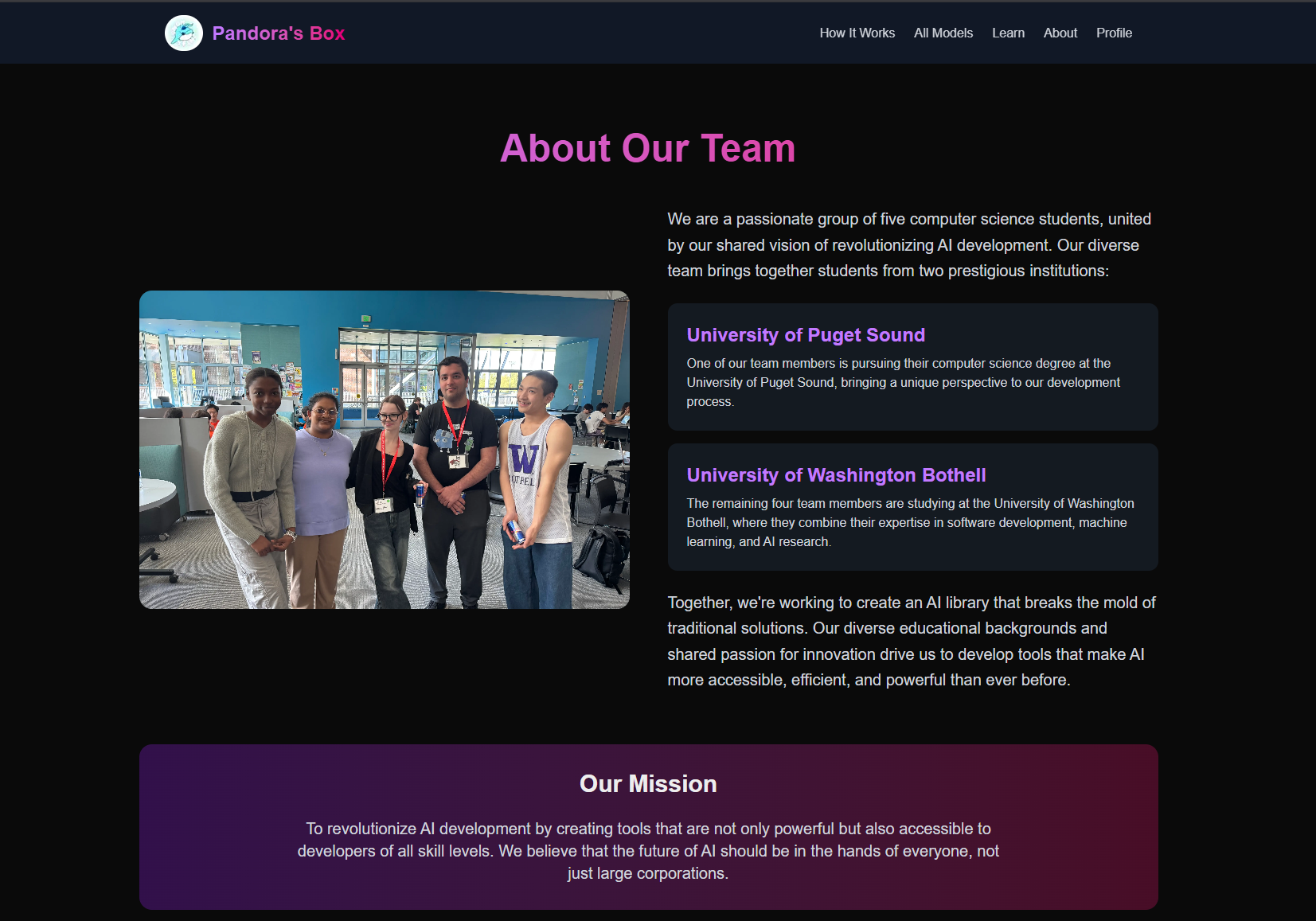
About Page
-
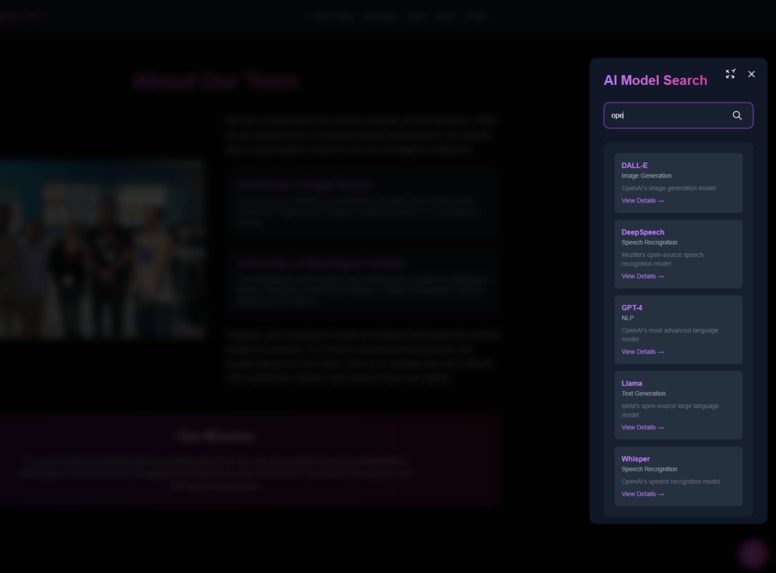
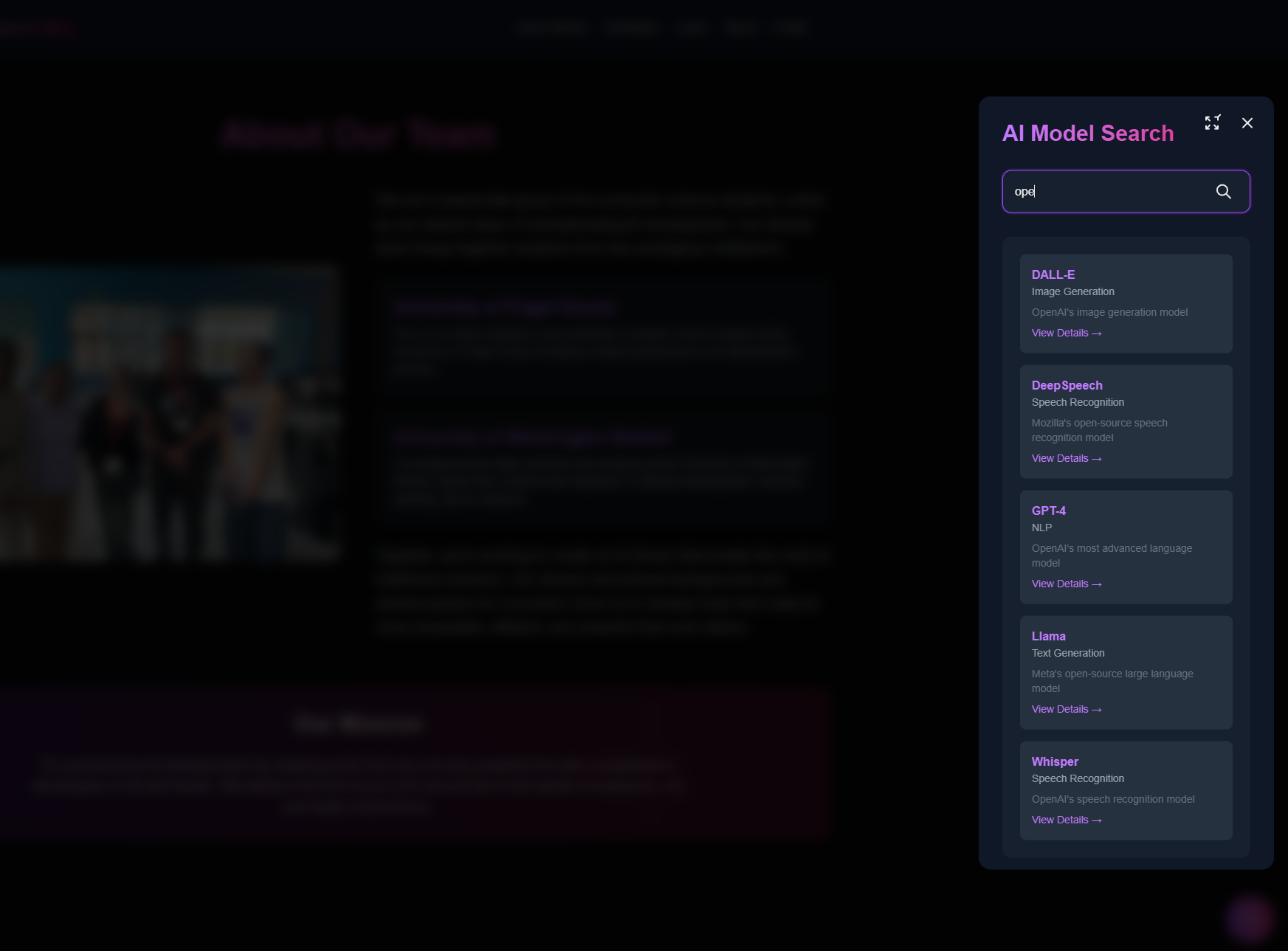
AI powered website search
-
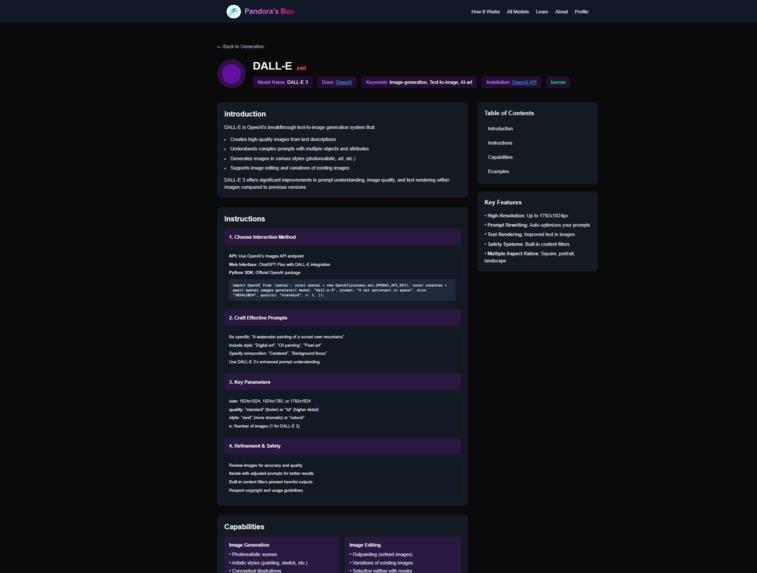
One of the ai model pages with borrow functionality, zoomed out

Inspiration
There is a lot of buzz around AI lately. Compared to 3 years ago, we are now seeing a wide range of improvement and opportunity within the AI field. Many companies want to enter the rapidly growing field; however, just because they want to jump into the race in this AI market, and finding how tough it is to learn about and use AI. As a result many of these companies end up seeking contractors to build their AI integrations. Startups and open source projects may not have the funds to access these services though. A month ago, when we learned about this hackathon, we all decided as a team to spend some time poring over some technologies to learn and improve our skills so we could showcase some new skills in the hackathon. One challenge we all collectively ran into was reading and understanding API documentation and AI learning. We spent countless hours trying to understand what they mean and how to use them. The thing about AI is that the majority of the population now uses it in their everyday lives, however, not all of those people know how to use AI or be able to access and run the latest models. This furthers this social divide, the digital divide, and promotes misinformed and ignorant uses of AI technology.
After countless hours of brainstorming and scrapping 6 ideas, we ended up thinking, “wait, Hack Save the World? We won't save the world in 3 days, but we can help those who are saving the world by giving them a tool no one has ever made before.” Pandora Box, our website, is a hub for all things AI, ensuring a level playing field for all companies, students, and workforce members trying to utilize different models within their projects. By finding and categorizing all AI models into one, concise website, we can explore a market of Information. Thanks to the broad range of AI’s functionality, we can build a strong center of activity where the sole purpose is to educate. We've opened Pandora's box with AI, its about time we find a way to control the chaos.
What it does
Pandora’s Box is your go-to guide for navigating the world of AI models. We understand that choosing the right AI for your specific prompt can be overwhelming. That's why we've created a platform that simplifies this process. By categorizing various AI models based on their strengths—be it content creation, data analysis, or other functionalities—, giving you the ability to test any model, and providing ample learning material to understand any model, we help you find the perfect match for your needs. No more guesswork or endless research; just a straightforward path to the AI that fits your task.
The most distinctive feature about Pandora's Box is our human-curated approach. Unlike solutions such as AIMLAPI, which offers access to over 200 AI models through an unified API, for developers and technically inclined users in the first instance, or Aixploria, as a gigantic catalog offering over 5,000 AI tools of various types, we prefer to give you personalized directions so that you can make informed decisions. Our interest is in a carefully selected subset of AI models, so users, technically skilled or otherwise, can confidently select the most suitable AI model for their needs. Pandora's box is the online version of the library. In Pandora's box you can borrow paid AI models for free, pay for unlimited monthly access regardless of how many people are borrowing a model, sell your own models and consulting services, learn about models through detailed quality controlled tutorials, and ask our sidebar assistant aka the librarian for a direct recommendation based on your use case.
How we built it
This project was built using Next.js, TypeScript, TailwindCSS, React, Node.js, and Vercel. The group was split into design, front-end, back-end, and full-stack groups to focus on one aspect of the project while still contributing to other parts. This lack of direct leadership encouraged everyone to pitch in ideas, to lead when their specialties were brought up, and allowed stronger initiative among members.
The team made use of Figma to work on the initial prototype of the project. This was used to get an idea of what the final project was going to look like. Then, it was translated into code using Next.js for both the frontend and backend development. React and TailwindCSS were used to build an interactive and responsive user interface, while Node.js handled backend functionalities. TypeScript was used throughout the project to ensure code consistency and make it easy for bookkeeping.
The project was finally deployed on Vercel, making it accessible online. Therefore, each tool and technology was able to help the team collaborate efficiently and build a seamless application for the users.
Challenges we ran into
Our biggest challenge was coming up with the right idea. We brainstormed for an entire day, exploring different aspects of everyday life before finally landing on this one. Initially, we had a different idea in mind, but after speaking with one of the mentors, we realized it wasn’t the best fit. He advised us not to aim for solving massive problems, especially since there are already so many solutions out there. He also shared valuable tips and strategies for succeeding at a hackathon. After that conversation, we decided to scrap our original idea and shift our focus to something smaller and more relatable.
We reflected on challenges we faced personally, and one that stood out was the difficulty of navigating API documentation, especially for AI models. It's often overwhelming and hard to understand, even for people with some experience.
Another major challenge we encountered was finding and categorizing AI models. With so many available on the market, it wasn’t realistic to research and include every single one within the 48-hour time frame. Choosing which models to feature and how to organize them efficiently became a key part of our process.
Accomplishments that we're proud of
We are proud of the unique features that went into the project. One of the unique features is searching specifically for what unique AI to use. A fully fledged AI assistant tool was built into the project, which added a distinctive layer of interaction to the platform.
We are also proud of our flexibility and efficiency during the brainstorm process. We had a robust and structured process to create ideas, verify idea feasibility, verify idea alignment with hackathon tracks, and verify idea marketability with mentors. This flexible, collaborative, and extensive brainstorm project helped us make sure our production and planning phases for our product were distinct and concise.
I am especially proud of the integrity we maintained in our project choices including Pandora's box. Focusing on providing quality services for the community through our projects in order to gain attention and then funding from organizations and investors rather than using money to gain attention.
What we learned
Throughout this hackathon, we gained a lot of valuable life skills, communication skills, pair programming experience, and, of course, new programming knowledge.
One thing I’m especially proud of is that we committed to coding together in person. We didn’t work online or in a hybrid setup — we made sure to stay together for as long as possible and push through the work side-by-side. That made a huge difference in how we learned about teamwork. At first, things felt a little awkward, but as time went on, we grew more comfortable and worked together harmoniously.
We also learned a lot about using Git. In the beginning, working on the same branch led to many merge conflicts. But after a few mistakes, we got the hang of how to properly push and pull, and we even learned how to resolve conflicts when they happened. On top of that, we figured out how to divide the workload more effectively, assigning tasks based on each person’s strengths instead of spreading everyone too thin.
Coming into this hackathon the majority of the team was unfamiliar with the tools and technologies our project uses. I am most proud of the collaborative and positive environment we fostered as experienced coders helped members get up to speed to the point where those unexperienced members were able to point out errors the pre-established coders were making.
What's next for Pandora's Box
If we had a longer time to do it, we would also include Pandora's Box for additional classes of generative and analytical AI, such as audio and video generation, that currently have a "coming soon" placeholder. We will also integrate heavy security measures such as cloudflare integration for the safety of our code, external databases like neon for api key storage and by increasing the open source and malleable nature of Pandora's box to allow heavier community engagement. Our AI model catalog will always be increasing and as a result so will our learning resources.
We also plan to enhance the search facility by allowing the users to simply type in the desired prompt in the search pop-up. The feature would analyze the prompt and present the best-fit AI models to get the desired output, making the model selection an easier task. We also intend to implement a user rating system where users can rate and review AI models based on their experience. The user-based rating system would provide valuable feedback and help users make the right choice while choosing AI tools.
Built With
- next.js
- node.js
- react
- tailwindcss
- typescript
- vercel


Log in or sign up for Devpost to join the conversation.