-
-
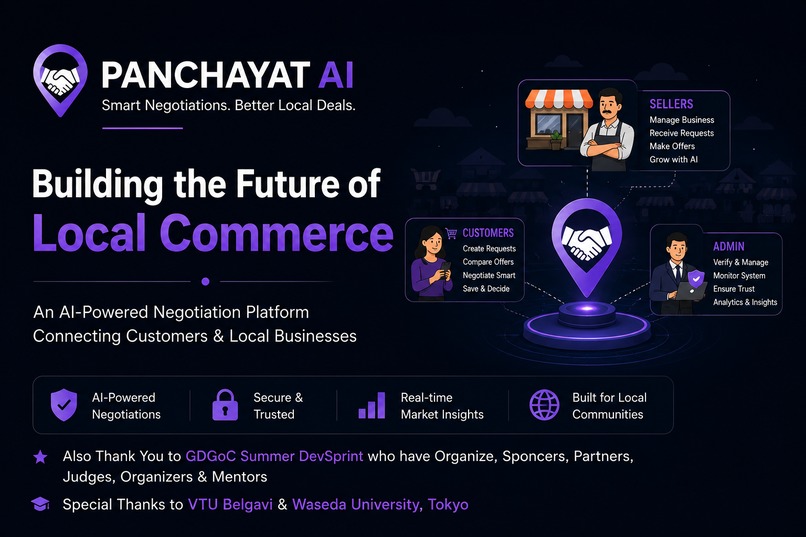
Panchayat-AI
Inspiration
The inspiration came from a simple real-world experience:
Why should a customer have to negotiate with five different shops when an AI agent could coordinate the process?
When purchasing something from a local market, customers typically follow this process:
Find Shop A ↓ Ask Price ↓ Negotiate ↓ Remember Price ↓ Find Shop B ↓ Negotiate Again ↓ Find Shop C ↓ Compare ↓ Repeat
The problem isn't necessarily finding a shop. The problem is discovering what the market is actually willing to offer.
We wanted to build something beyond a conventional price-comparison platform.
Our idea was:
Online marketplaces compare listed prices. Panchayat-AI helps discover negotiated prices.
The name Panchayat represents bringing multiple parties together to reach an informed decision. In our system, those parties are customers, local businesses, and AI agents.
What it does
Panchayat-AI allows a customer to express a requirement naturally, for example:
"I need a laptop for coding under ₹60,000 near me."
The platform converts this request into a structured requirement and begins the discovery and negotiation workflow.
Core workflow Customer Requirement ↓ Requirement Agent ↓ Real Device Location ↓ Local Business Discovery ↓ Participating Seller Connection ↓ Seller Responses ↓ Fact Bus ↓ Negotiation Agent ↓ Offer Verification ↓ Deal Intelligence ↓ Customer Recommendation Specialized AI Agents
Requirement Agent
Converts natural-language or voice requests into structured requirements such as product, budget, location, preferences, warranty requirements, and other constraints.
Seller Discovery Agent
Uses requirement and geographic context to identify relevant local businesses.
Negotiation Agent
Uses customer constraints and verified market context to formulate negotiation actions.
Offer Extraction Agent
Converts seller responses into structured information such as:
Price Availability Warranty Terms Seller response Timestamp
Deal Intelligence Agent
Evaluates available verified offers and provides a transparent recommendation rather than simply returning the lowest number.
Fact Bus
The Fact Bus acts as the shared real-time memory of the negotiation.
For example:
Seller A → ₹62,000 Seller B → ₹61,000 Best Offer → ₹61,000 AI Counter-Offer → Sent Seller B → ₹59,500 Offer → Verified
Agents consume these structured events instead of relying only on isolated conversations.
Role-Based Platform
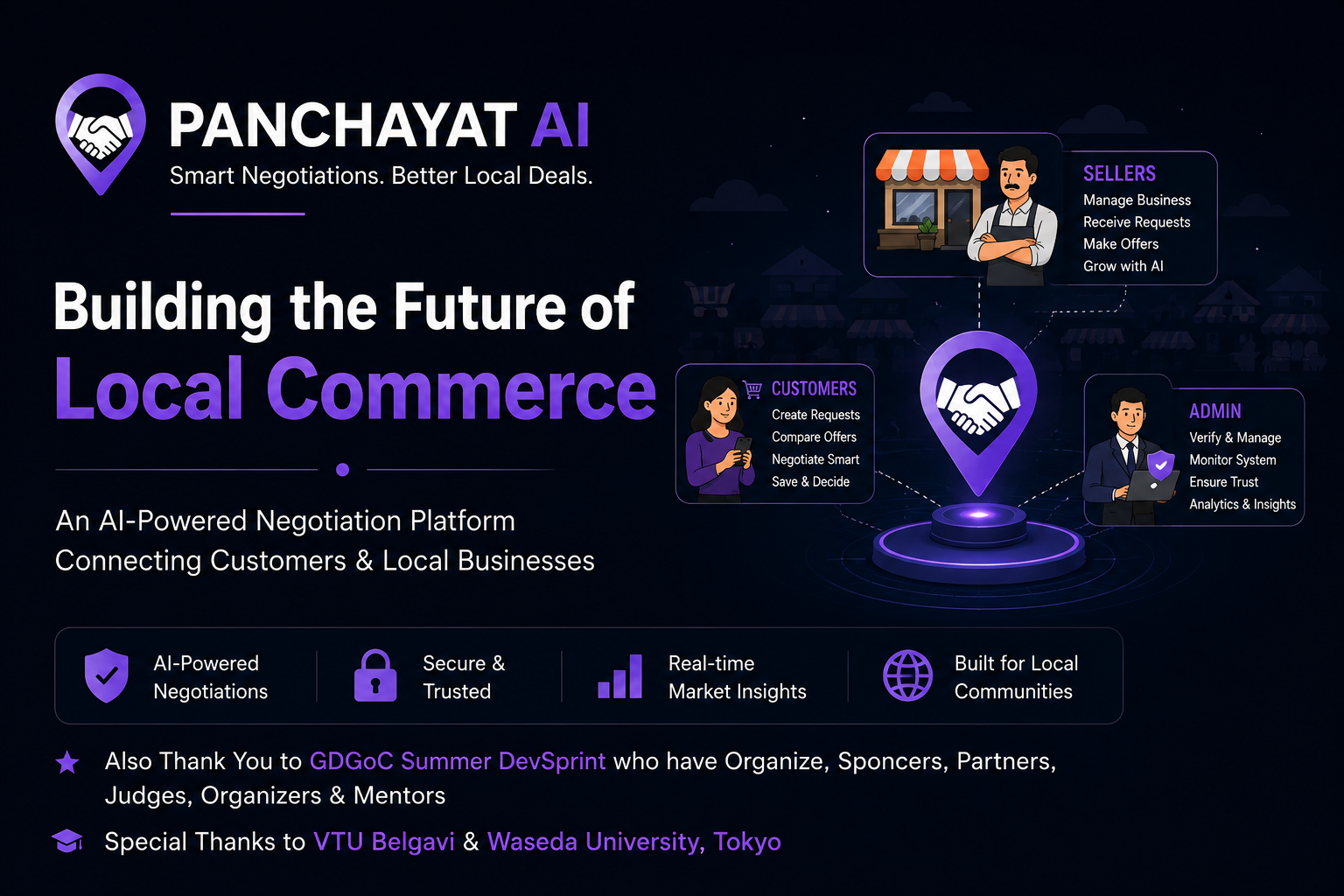
Panchayat-AI provides three primary roles:
Customer
Create purchase requests Use voice/text Discover nearby sellers View live offers Compare offers Track negotiations
Seller
Verify business Manage products Manage availability Receive negotiation requests Submit offers Counter offers Configure negotiation policies View analytics
Admin
Verify sellers Manage users Monitor negotiations Inspect AI decisions Review audit logs Monitor system health Access platform analytics
How we built it
We designed Panchayat-AI as a real-time, event-driven, multi-agent system rather than a simple chatbot.
Frontend
We built a modern AI-first interface using:
Next.js TypeScript Responsive UI Real-time offer updates Interactive dashboards Customer workflows Seller portal Admin dashboard
The UI focuses on making complex AI negotiations understandable to normal users.
Backend
The backend uses:
FastAPI Python REST APIs WebSockets Authentication Role-Based Access Control Event-driven services Data Layer
We use MongoDB for operational and transactional information including:
Users Seller profiles Products Negotiation sessions Seller responses Offers Verification records Fact Bus events Audit logs Location Intelligence
The platform uses real device location with user permission and business/location services to identify relevant nearby businesses.
An important architectural distinction is:
Business Discovery ≠ Seller Participation ≠ Negotiation Authorization
Finding a business through a public listing does not mean that the business has consented to automated negotiation.
Only appropriately connected and authorized sellers should participate in negotiation workflows.
AI Architecture
Our architecture separates AI reasoning from deterministic system operations:
LLM ↓ Agent Decision ↓ Tool / Service ↓ Validation ↓ Execution ↓ Verified Event
This prevents an AI-generated response from automatically becoming a trusted market fact.
Our design principle is:
LLMs propose. Deterministic services validate and execute.
Real-Time Architecture
WebSockets and event-driven updates allow negotiation states to change without requiring the customer to repeatedly refresh the application.
A negotiation can therefore progress as:
OFFER_RECEIVED ↓ OFFER_EXTRACTED ↓ OFFER_VERIFIED ↓ COUNTER_OFFER_GENERATED ↓ COUNTER_OFFER_SENT ↓ SELLER_RESPONSE ↓ BEST_OFFER_UPDATED
Challenges we ran into
- Building a genuinely real-time negotiation system
A normal request-response application was insufficient because offers and seller responses can change while a negotiation is active.
We had to design real-time state synchronization using WebSockets and event-driven updates.
- Preventing AI hallucinations
An AI system could potentially invent a price, availability, seller response, or warranty.
We therefore separated:
AI-generated proposals External data Seller-provided information Verified system facts
Only validated information should become part of the trusted negotiation state.
- Real business discovery vs. real seller participation
One of the biggest practical challenges was understanding that discovering a local business does not automatically give us permission to negotiate with it.
This required us to design an explicit seller connection and authorization layer.
- Making recommendations trustworthy
The cheapest offer is not always the best offer.
For example:
Best Deal =Lowest Price
A recommendation may need to consider:
DealScore=f(Price,Availability,Warranty,Distance,Reliability,Preferences)
This motivated our Deal Intelligence layer.
- Designing secure RBAC
We did not want role-based access to simply mean hiding buttons in the frontend.
Permissions are therefore designed to be enforced at the API and resource/service layers as well.
- Building without fabricated market data
We deliberately avoided hardcoded sellers, fake prices, fake locations, and fabricated negotiation results.
The system is designed around the principle:
No fake sellers. No fake offers. No fake locations.
Accomplishments that we're proud of
🤖 Multi-Agent Architecture
We transformed a conventional price-comparison idea into a specialized AI-agent workflow involving requirement understanding, seller discovery, negotiation, offer extraction, and deal intelligence.
⚡ Real-Time Fact Bus
We developed a shared event-driven context layer that allows multiple agents to consume the same structured negotiation state.
📍 Hyperlocal Intelligence
The system combines customer requirements with geographic context to focus on relevant local businesses.
🤝 AI-Assisted Negotiation
Panchayat-AI moves beyond static price comparison toward dynamic negotiation workflows.
🔐 Role-Based Architecture
Customer, Seller, and Admin workflows are separated through proper authorization rather than UI-only restrictions.
🔎 Transparent Recommendations
Instead of simply saying "this is the cheapest", the system can explain why an available offer is competitive based on its verified attributes.
🏪 Connecting Offline Commerce with AI
Our biggest accomplishment is creating an architecture that can potentially bring fragmented local businesses into an intelligent digital negotiation network.
What we learned
AI agents are systems, not just prompts.
A powerful LLM alone cannot operate a reliable commerce platform.
Real-world agents need:
Tools APIs Databases Validation Authorization Event systems Observability Auditability Verified facts matter more than generated answers.
We learned to distinguish between:
What the AI thinks
and
What the system has actually verified.
This became one of the core architectural principles of Panchayat-AI.
Real-world AI requires strong backend engineering.
The AI component is only one part of the platform. Location, authentication, seller identity, consent, real-time communication, database consistency, security, and failure handling are equally important.
Local commerce is fundamentally different from e-commerce.
Offline markets involve:
Dynamic pricing Negotiation Relationships Local availability Trust Human communication Geographic constraints
Building for this environment required us to think beyond traditional marketplace architectures.
The best deal isn't always the cheapest price.
A slightly higher price with verified availability, warranty, reliability, and proximity can be more valuable than an unverified low price.
What's next for Panchayat-AI
Our goal is to evolve Panchayat-AI from a hackathon prototype into a local-commerce intelligence network.
🌐 1. Expand the Seller Network
Create stronger seller onboarding, verification, and authorized communication workflows.
🗣️ 2. Multilingual Voice Negotiation
Support natural voice interactions in languages commonly used in local markets, including:
Hindi Kannada Marathi Telugu Tamil Urdu English 🏪 3. Seller Integrations
Allow participating businesses to connect their own product catalogs, inventory, availability, and business systems.
📦 4. Inventory Intelligence
Move from:
"Who has the product?"
toward:
"Who has it, what can they offer, when is it available, and what are the terms?"
💳 5. Transaction Layer
Future versions could support:
Secure payments Digital invoices Order management Pickup Delivery coordination Transaction tracking 📊 6. Local Market Intelligence
With sufficient participating data and appropriate privacy protections, Panchayat-AI could provide aggregated insights into:
Demand patterns Price movements Product trends Local supply gaps Seasonal demand 🚀 Long-Term Vision
We envision Panchayat-AI becoming an AI-powered negotiation infrastructure for local commerce.
Instead of customers individually navigating fragmented markets, AI agents can help coordinate discovery, negotiation, verification, and decision-making across participating local businesses.
From fragmented local markets to an intelligent negotiation network.


Log in or sign up for Devpost to join the conversation.