Inspiration
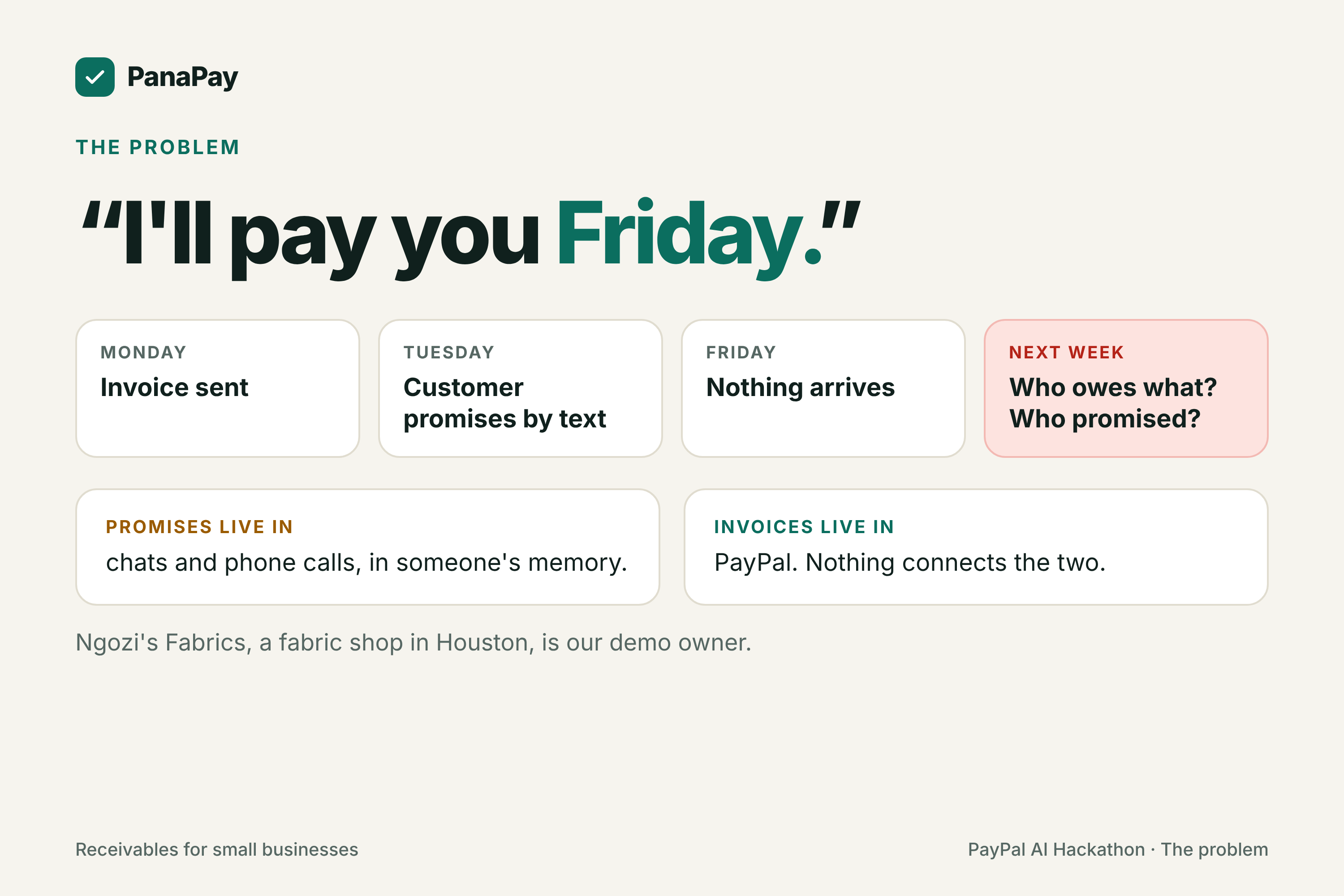
Small businesses don't always struggle because customers are unwilling to pay. Often, they struggle because payment commitments are difficult to track and verify. Business owners are left wondering who owes them, how much was agreed upon, when payment was promised, and whether the money has actually arrived. These commitments are often scattered across WhatsApp messages, phone calls, and informal conversations rather than organised records. As a result, payment follow-ups depend on memory, transactions become difficult to reconcile, and businesses risk losing money—not necessarily because customers never paid, but because they lack a reliable way to track what is owed, what has been paid, and what remains outstanding.
What it does
PanaPay is an intelligent receivables management platform that helps small businesses track invoices, monitor customer payment commitments, and automatically reconcile incoming payments.
Our demo business, Ngozi's Fabrics, based in Houston, uses PanaPay to manage the entire payment follow-up process in one place.
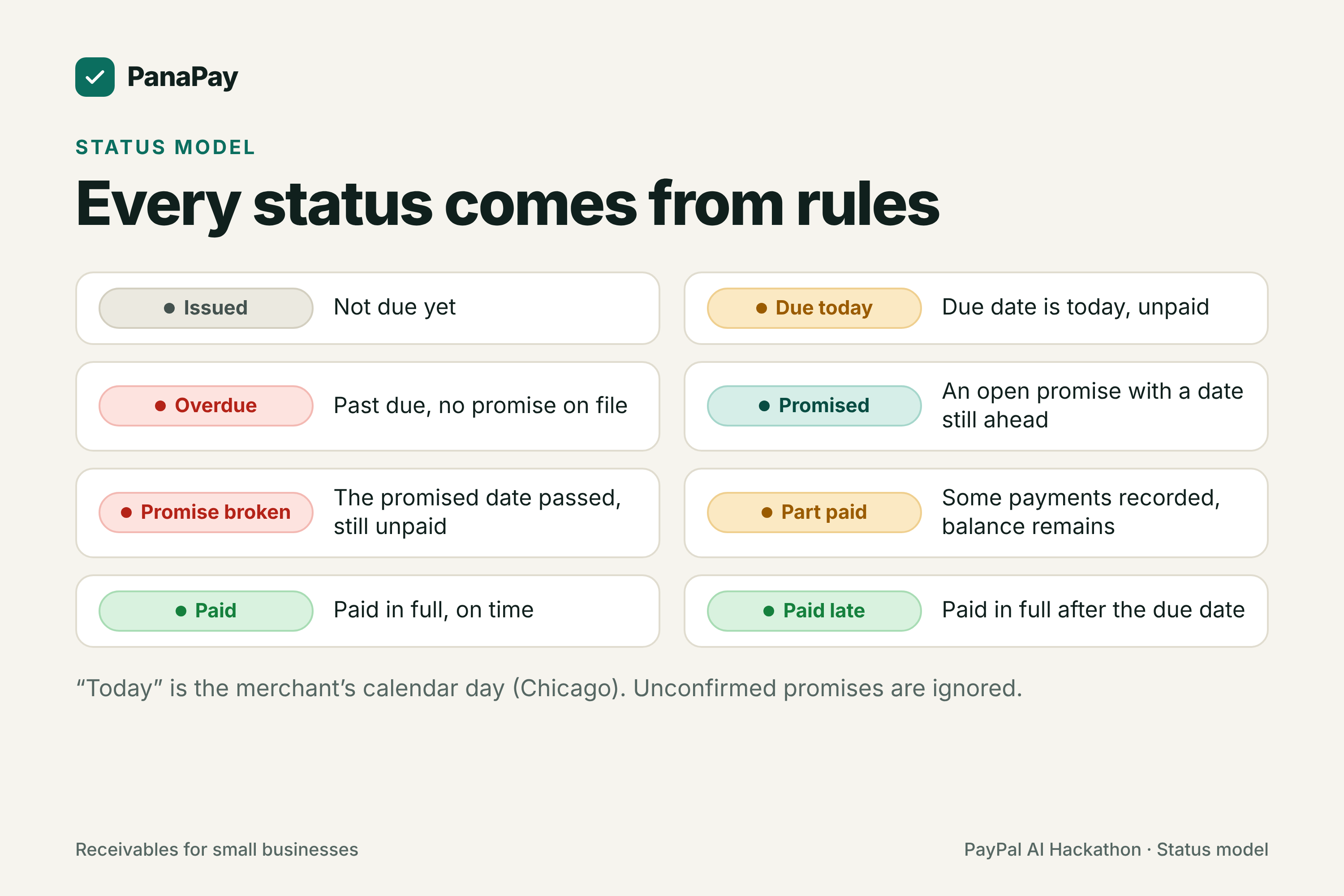
A Real-Time Invoice Dashboard: Every invoice appears on a central dashboard with a status determined by business rules, not guesswork. Statuses include issued, due today, overdue, promised, broken promise, partly paid, paid, and paid late. Each customer record provides supporting evidence for its current status.
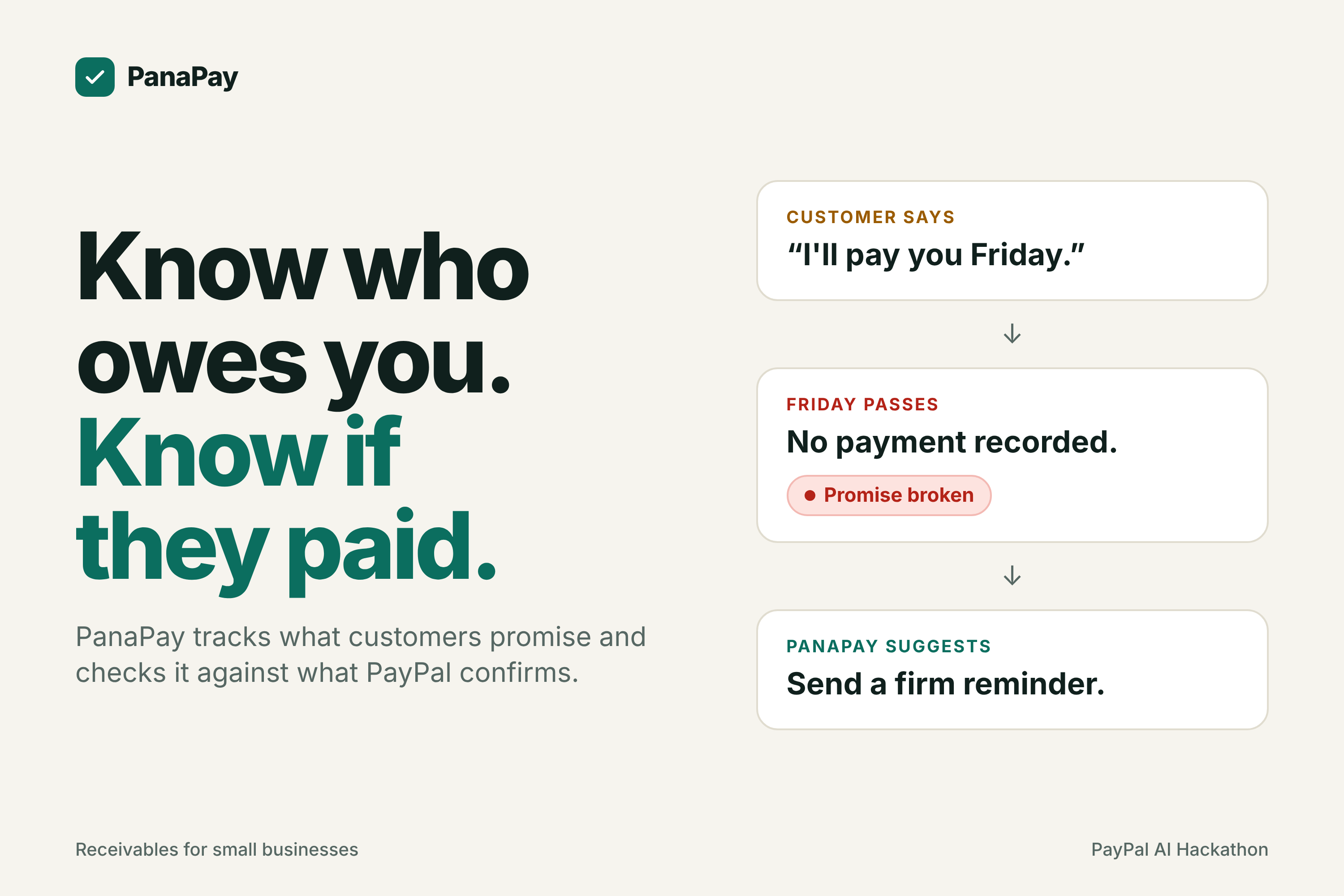
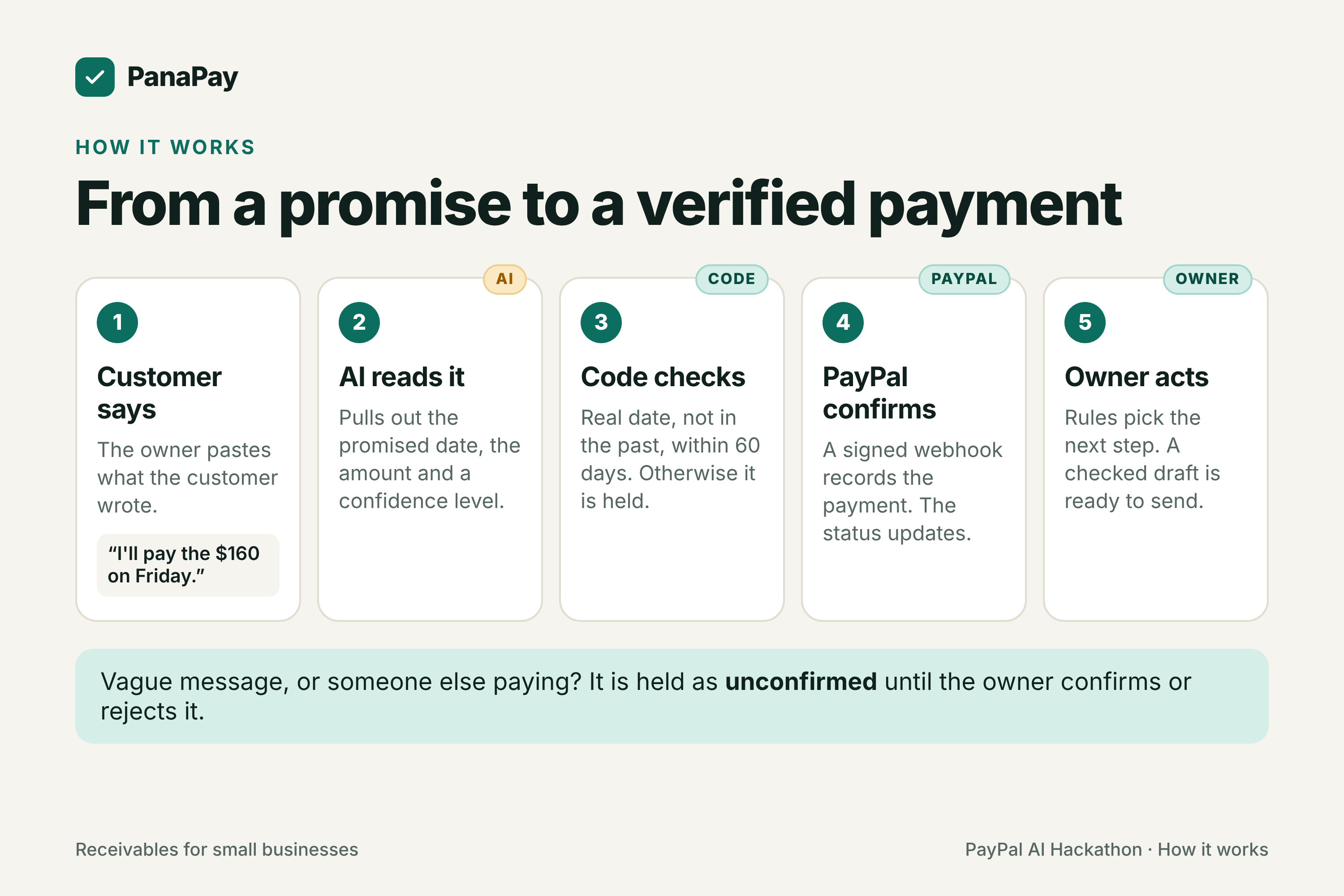
Turning Conversations into Payment Commitments: Customers often communicate payment intentions through informal messages. PanaPay allows the business owner to paste these messages, such as "I'll pay $160 on Friday." AI extracts the promised amount, date, and confidence level into a structured record. Ambiguous commitments or promises made by someone other than the customer are marked as unconfirmed until the owner approves or rejects them.
Automatic Promise Verification: PanaPay monitors payment activity through PayPal. When a promised payment date passes without a corresponding verified payment, the system automatically updates the invoice status to Broken Promise.
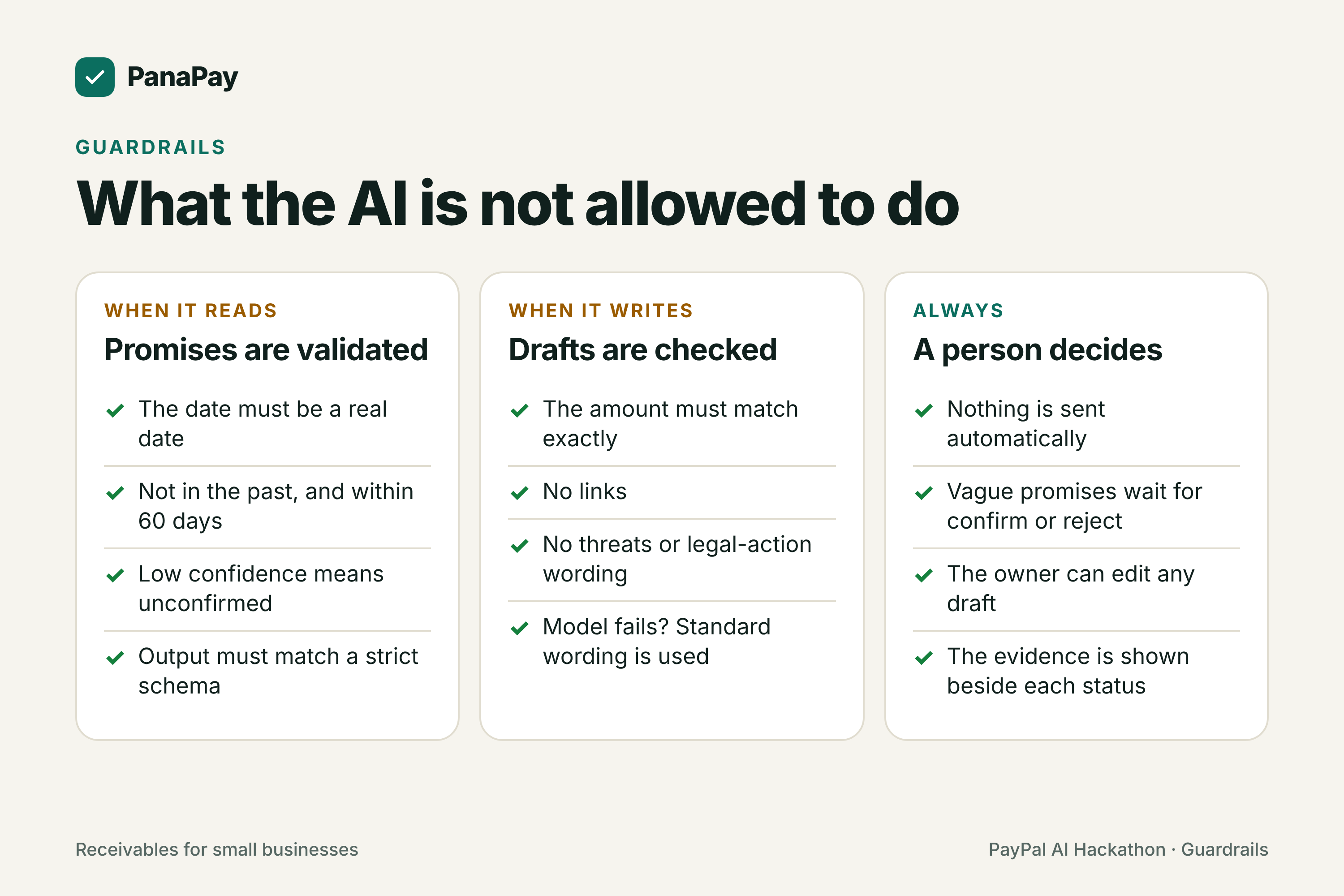
Intelligent Follow-Ups: Based on invoice status and payment history, predefined rules determine the appropriate next action, whether that's a friendly reminder, a firmer follow-up, or a request for the outstanding balance. AI drafts messages using verified invoice and payment information only. Built-in validation rejects drafts containing incorrect amounts, unauthorised links, or threatening language. The business owner reviews and sends the reminder through PayPal.
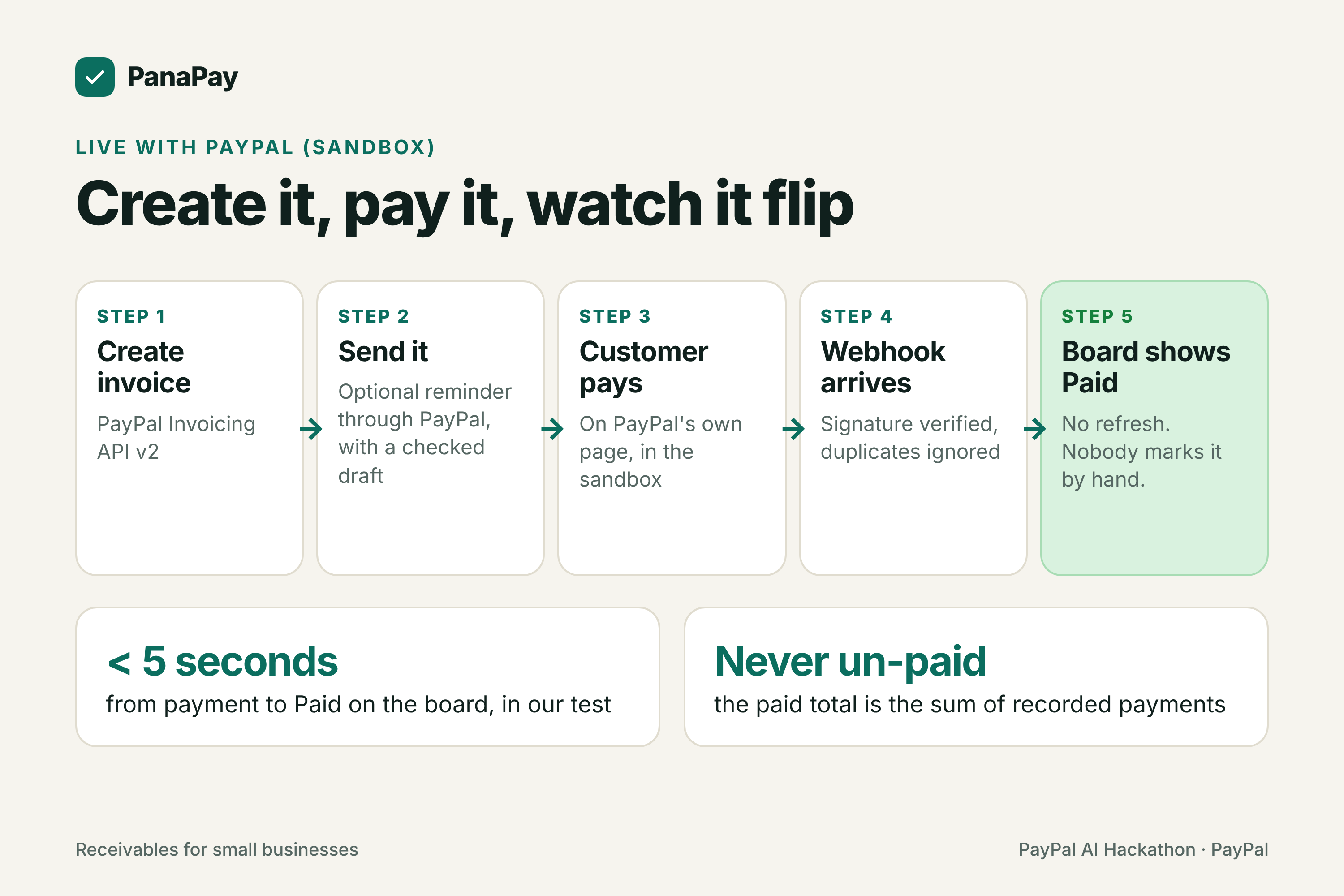
Live Payment Tracking: Business owners can create invoices directly through PayPal. When a customer pays in the sandbox, PanaPay receives a signature-verified webhook, validates the payment, and updates the invoice dashboard to Paid within seconds.
Ultimately, PanaPay turns scattered payment conversations into structured commitments and verified transactions, giving small businesses greater visibility and control over the money owed to them.
How We Built It
PanaPay was built using Node.js, Express, SQLite, and vanilla JavaScript, with AG Grid powering the interactive invoice dashboard.
We integrated the PayPal Invoicing API v2 to support invoice creation, sending, retrieval, and reminders. PayPal webhooks, backed by signature verification, enable PanaPay to receive and validate payment events in real time.
A core engineering principle guided the entire development process:
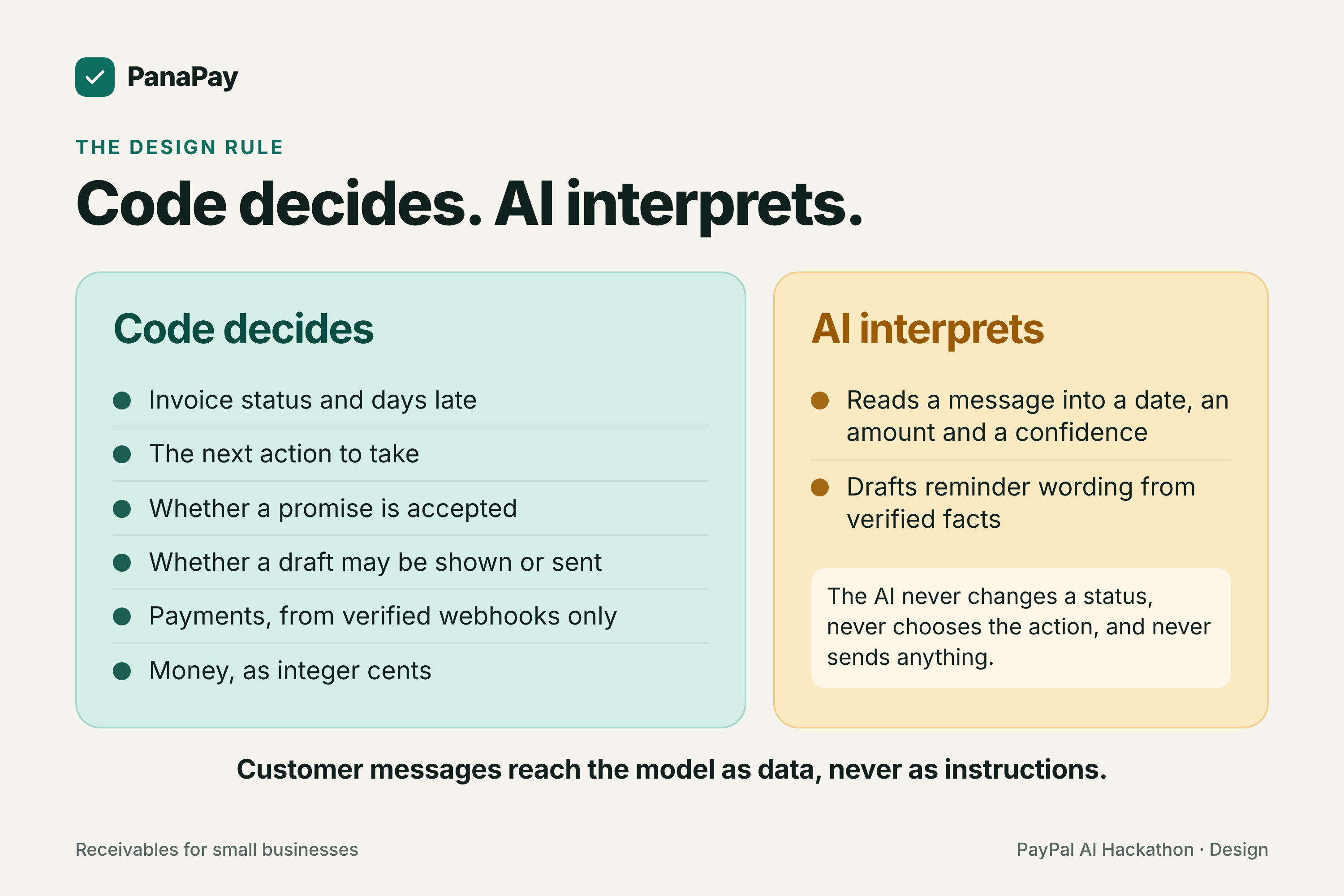
Code decides. AI interprets language and drafts messages. Code validates every AI output.
This separation ensures that financial decisions, invoice statuses, payment verification, and business rules remain deterministic and reliable, while AI handles tasks that benefit from natural-language understanding.
Other important implementation decisions include:
- Financial precision: All monetary values are stored as integer cents to avoid floating-point calculation errors.
- Timezone accuracy: The system uses the Chicago calendar day when determining whether an invoice is due today.
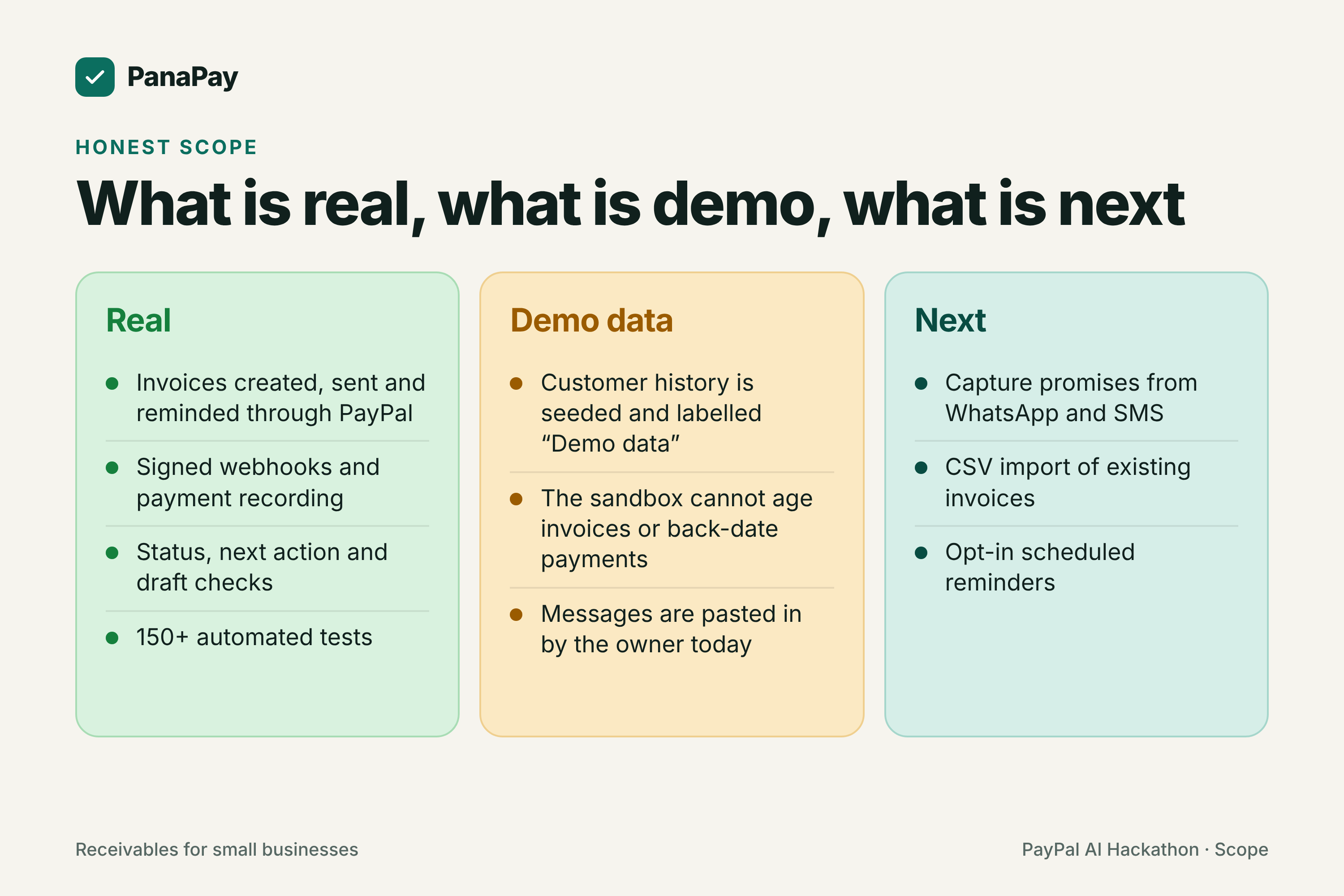
- Automated testing: The project includes more than 150 automated tests covering business rules, payment processing, AI output validation, and critical application workflows.
The result is a system that combines AI-powered convenience with rule-based financial accuracy and verifiable payment records.
Challenges
Building PanaPay came with several technical challenges that shaped how we designed the product.
AI Inconsistency: AI models are not deterministic. We found that the same ambiguous customer message could produce different interpretations across multiple runs. To address this, we introduced confidence thresholds, an Unconfirmed state, and human approval through Confirm or Reject actions rather than allowing AI to make financial decisions independently.
Time Zone Accuracy: Determining whether an invoice is Due Today is more complex than comparing timestamps. It must reflect the merchant's local calendar day, not UTC. We implemented timezone-aware date handling to ensure invoice statuses remain accurate.
PayPal Sandbox Limitations: The PayPal sandbox does not support artificially aging invoices to demonstrate overdue and historical payment scenarios. We therefore seeded the dashboard's historical invoice records and clearly labelled them as Demo Data. However, the live invoice creation, sandbox payment process, and signature-verified webhook integration are real and functional.
These challenges reinforced our approach to building financial technology: make AI useful, keep financial logic deterministic, and ensure every displayed payment status is supported by evidence.
What We Learned
We learned that AI doesn't need to make every decision to make a product intelligent. By giving AI a clearly defined role—interpreting customer messages and drafting payment communications—while keeping financial decisions and status updates under deterministic code, we made PanaPay more reliable, transparent, and easier to test.
This approach also reinforced an important lesson: in financial technology, trust comes not just from what AI can do, but from knowing exactly what it is allowed to do.
What's Next
We plan to make PanaPay even more seamless by reducing manual work and expanding its automation capabilities. Our next priorities include:
- WhatsApp and SMS Integration: Automatically capture customer payment commitments from WhatsApp and SMS conversations, eliminating the need for business owners to copy and paste messages manually.
- Bulk Invoice Import: Allow businesses to upload existing invoices through CSV files, making it easier to onboard and manage their current receivables.
- Scheduled Payment Reminders: Introduce automated reminders that follow up with customers at appropriate times based on invoice due dates and payment commitments.
Our long-term vision is to move PanaPay from a tool that helps businesses track payments into an intelligent receivables assistant that actively helps them manage and recover outstanding payments.
Built With
- ag-grid
- express.js
- gemini
- javascript
- node.js
- paypal
- paypal-invoicing-api
- paypal-webhook
- sqlite
- zod
