Inspiration
Panama is home to a remarkable diversity of snake species, including both venomous and non-venomous snakes. However, many people cannot identify them correctly, which can create fear, misinformation, unnecessary killing of wildlife, and dangerous decisions during an encounter.
I created Panama Snake Identifier to make snake identification more accessible through artificial intelligence. The project combines technology, biodiversity education, conservation, and public safety.
What it does
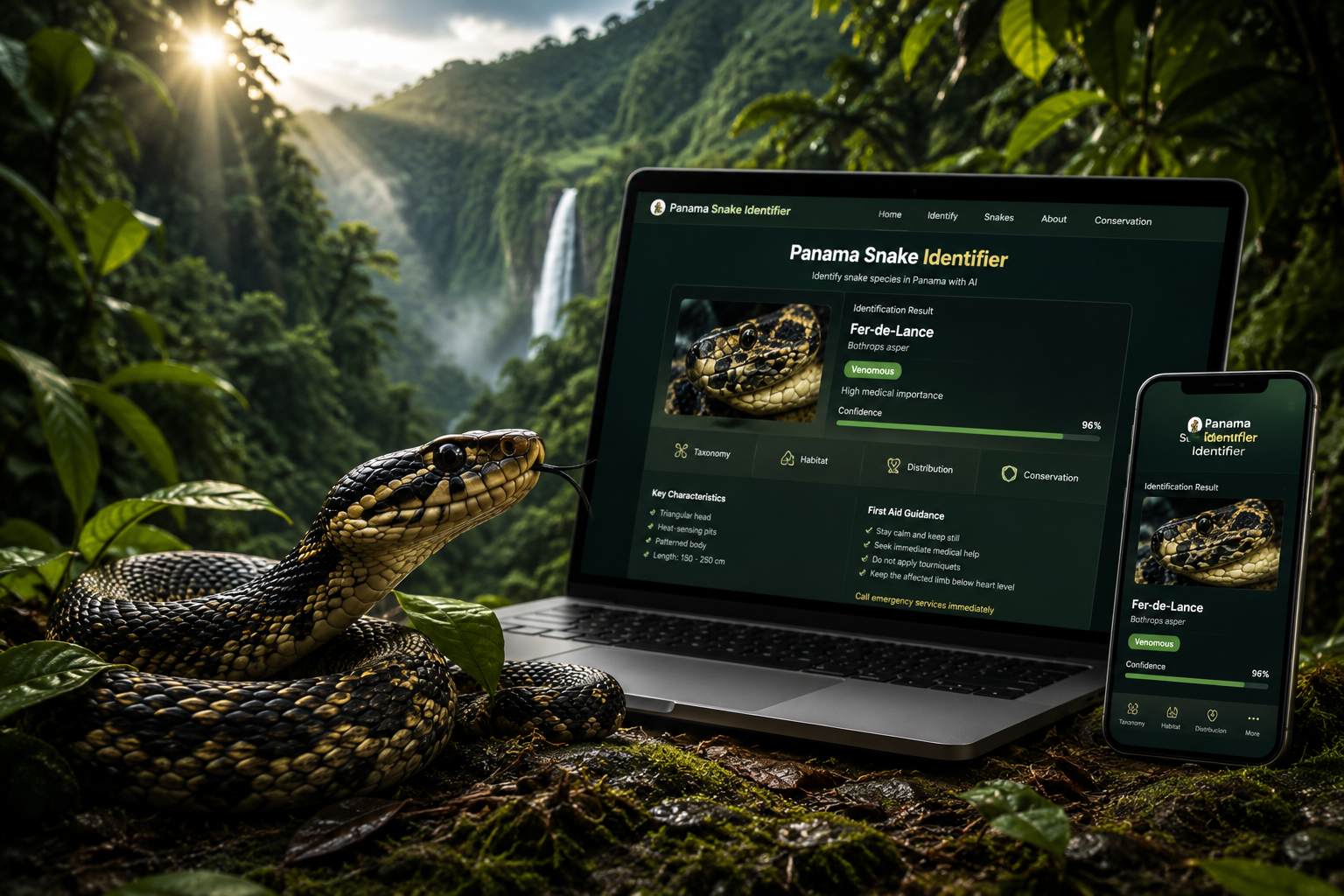
Panama Snake Identifier is an AI-powered web application that analyzes a photograph of a snake and suggests the most likely species found in Panama.
The application can display:
- Common name
- Scientific name
- Venomous or non-venomous status
- Taxonomy
- Physical characteristics
- Habitat
- Geographic distribution
- Conservation information
- Medical importance
- Basic first-aid and safety guidance
The application is designed as an educational and safety-support tool. It does not replace emergency services, medical professionals, or wildlife experts.
How I built it
I developed the project as a web application using Python, computer vision, machine learning, and a structured catalog of snake species found in Panama.
I used Codex throughout the development process to help organize the project, debug errors, improve the interface, connect the trained model with the application, and manage the snake dataset.
The image-classification model was trained with real snake photographs organized by species. When a user uploads an image, the system processes it, compares its visual patterns with the trained classes, and returns the most likely identification together with educational information.
GPT-5.6 is used to support clear explanations, safety guidance, and accessible educational content related to the identification results.
Challenges I faced
One of the biggest challenges was collecting enough reliable images for each snake species. Some species had very few available photographs, which affected the accuracy of the model.
Other challenges included:
- Organizing and cleaning the image dataset
- Avoiding incorrect or duplicated images
- Connecting the trained model to the web interface
- Improving predictions for visually similar species
- Managing limited development time and computing resources
- Making the application simple enough for non-technical users
Accomplishments
I am proud that I created a functional prototype capable of receiving a snake image, analyzing it, and displaying useful information about the possible species.
The project demonstrates how artificial intelligence can support environmental education, wildlife conservation, and public safety in Panama.
What I learned
Through this project, I learned how challenging real-world artificial intelligence development can be. A working interface is only one part of the solution; the quality, quantity, and organization of the training data are equally important.
I also improved my skills in Python, machine learning, computer vision, dataset preparation, debugging, web development, and the use of Codex as a development assistant.
What's next
The next steps are to:
- Expand the dataset with more verified photographs
- Add more snake species from Panama
- Improve model accuracy and confidence scoring
- Allow users to report incorrect predictions
- Add expert verification
- Improve mobile compatibility
- Include location and habitat context
- Develop Spanish and English versions
- Collaborate with biologists, universities, wildlife organizations, and emergency-response institutions
The long-term goal is to create a reliable educational platform that helps people understand snakes, respond more safely, and protect Panama’s biodiversity.
Built With
- api
- css
- gpt-5.6
- html
- javascript
- openai


Log in or sign up for Devpost to join the conversation.