Analysing Problem Statement
This is how the flow works at the ER.
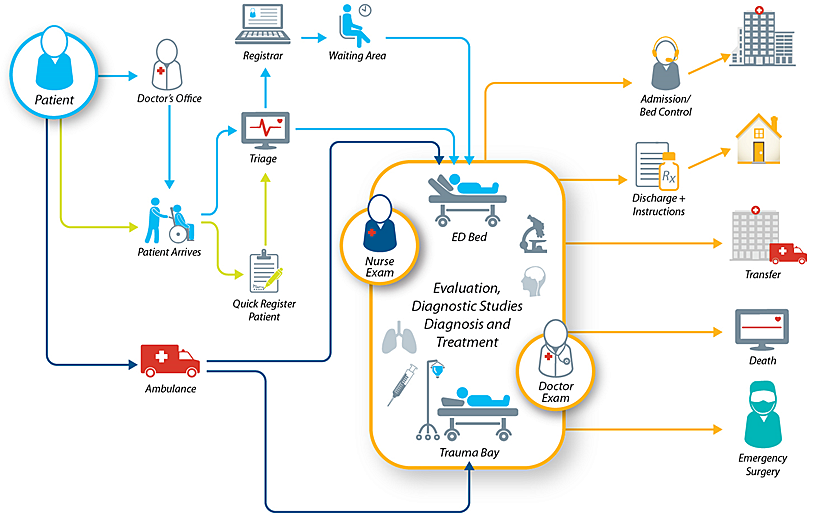 Source: centrak
Typical Patient Journey
The typical patient journey consists of getting picked up by ambulance, given the interim treatment before and while on transport, before getting transported to the closest hospital's Accident & Emergency Department (ED). Upon arrival, if the severity of patient condition is bad, in the observation ward at the ED
However, in recent years, there has been an increase in the bedtime wait - from when the ward
Paramedics would relay the nature of the incoming emergency case to the emergency department of the closest proximity
My Process
DONE - Combine both datasets (df3) - generate data for hospital and waittimes using randomization based on median waittime of each hospital (df1), combine data with the patient medical history dataset (df2)
- Clean up combined dataset
- Determining the severity of patient condition - split into four categories based on number of pre-existing medical conditions, can be overwritten by current vitals
Source: mediclinic
Other factors like what is relayed to the ED staff as well as the current staffing situation in the various wards and ED and current bed capacity at the "target ward" for admission of the current patient would also affect the wait time for the patient arriving at the ED.
Therefore, these a second dataset would also be required for training the data model, on top of the patient medical history, vitals and condition upon paramedics asessing the patient and letting ED know.
- ED staffing
- Bed capacity at Observing ward
- Bed capacity at Target ward
- Staffing at Target ward
Video
Please note that video submitted is a placeholder.

Log in or sign up for Devpost to join the conversation.