-
-

logo
-
thumbnail

Inspiration
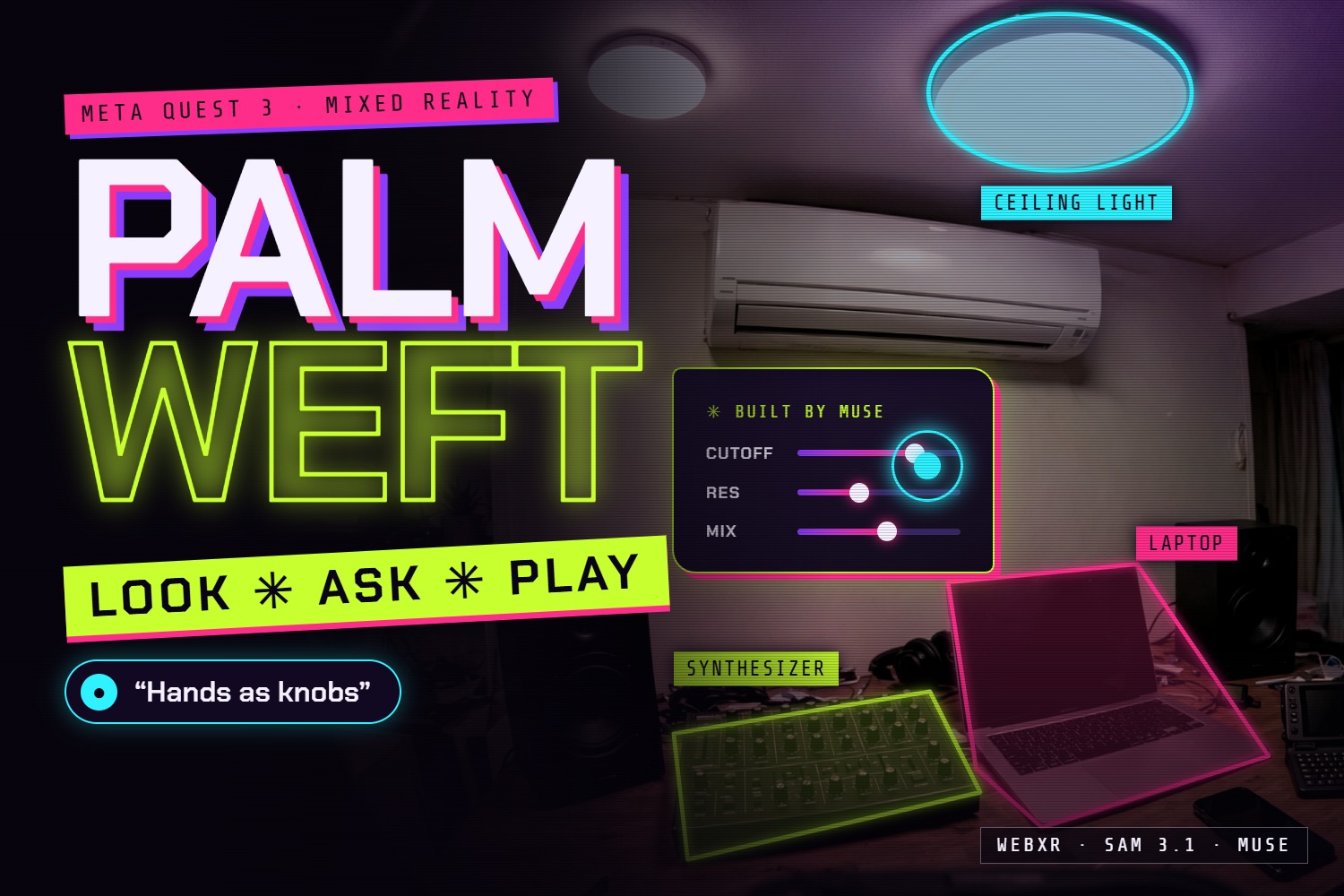
The room around us is full of things with their own remote, their own app, or no interface at all: a synth on the desk, a ceiling light, a laptop. Mixed reality already lets you see all of them at once. We wanted to be able to look at any one of them, say what we want, and get a working spatial control for it, without anyone pre-programming that device.
What it does
Palmweft runs in the Meta Quest 3 browser as a WebXR passthrough experience.
- Look. Point at a device. Frames from the Quest passthrough camera go to SAM 3.1, which outlines electronic devices, lights and synthesizers (never people). Muse Spark identifies what was selected and tags it in place. Tags persist with spatial anchors.
- Ask. Switch to Control and ask out loud (push-to-talk, transcribed by Muse Voice Transcribe) or type. A Muse coding agent on the server uses file, terminal, deploy and test tools to write a Node connector for that device, deploys it, and tests it.
- Interact. The agent returns a validated 3D instrument rendered next to the device, and/or a sandboxed hand program: code that maps your hand signals (height, push, pinch, fist, palm, fingertip touches on a calibrated screen) to the device's actions.
Nothing is pre-wired. Selecting an object or approving a pairing never authorizes device actions by itself, and both palms facing outward stops everything.
Physical devices are reached through a Chrome companion on the computer (Web MIDI and Web Serial), an IR node on an M5Stack Cardputer, or the computer itself. A simulated room and a phone/webcam reviewer page let anyone try the flow without a headset.
How we built it
- Headset app: TypeScript, three.js and WebXR
immersive-arwith hand tracking, hit testing and anchors. Quest Browser has no DOM overlay in immersive AR, so every pixel of UI is WebGL (pmndrs uikit with the Horizon kit, troika text). Input goes through Meta's Immersive Web SDK, and desktop development uses the Immersive Web Emulator (IWER). - Server: Node + Express + WebSockets. It pairs devices, runs the Meta model adapters (SAM 3.1, Muse Spark, Muse Voice Transcribe, Muse Image) and runs the Muse agent loop that writes, deploys and tests connectors.
- Safety rails: generated hand programs are size-limited, scanned for forbidden tokens, and dry-run in an empty
node:vmcontext over recorded hand traces before they reach the headset. On the headset they run in a Web Worker sandbox. Device writes are clamped to declared ranges and rate-capped. - Companion: a Chrome page for pairing plus MIDI/serial execution. Optional clients: a native iPhone app (Swift), a terminal client (Python), and Cardputer IR firmware (C++).
- Testing: Vitest unit tests, Playwright end-to-end scripts, and a fixture mode that replays recorded real model responses, each visibly labelled FIXTURE.
Challenges we ran into
- No DOM in immersive AR. Every panel, menu and code card had to be built in WebGL.
- Passthrough camera access. Getting the environment camera (not the avatar camera) needed exact
facingModeconstraints. The permission has to be granted before entering XR so no prompt interrupts the session. - Reliable hand input. Pinch uses hysteresis (closes under 2 cm, releases past 3.5 cm, two frames each) so tracking loss mid-pinch never creates a phantom click. The wrist menu only opens for a raised, flat, still palm facing the eyes, so a relaxed hand never triggers it.
- Letting an AI write device code safely. We had to keep it useful while making sure nothing runs until the wearer asks, and nothing unverified reaches a device.
Accomplishments that we're proud of
- A device you have never configured can go from "look at it" to "play it with your hands" in one spoken request.
- Hand programs are written live by Muse for the specific device and request, not picked from a fixed gesture table.
- The same flow works on Quest, in the desktop emulator, and on a phone or webcam.
What we learned
WebXR on Quest is capable enough for a full mixed-reality tool, but frame lifetimes, reference spaces and session re-entry need careful handling. Hands make a great controller only when every gesture is deliberate and has a clear stop.
What's next
More device families, sharing tagged rooms between headsets, and a hardened sandbox so the connector agent can run on more than a trusted local machine.
Built With
- c++
- express.js
- immersive-web-sdk
- iwer
- javascript
- meta-muse
- meta-quest-3
- meta-sam
- node.js
- playwright
- pmndrs-uikit
- python
- swift
- three.js
- typescript
- uikit-horizon
- vite
- vitest
- web-midi
- web-serial
- web-workers
- websockets
- webxr
- zod


