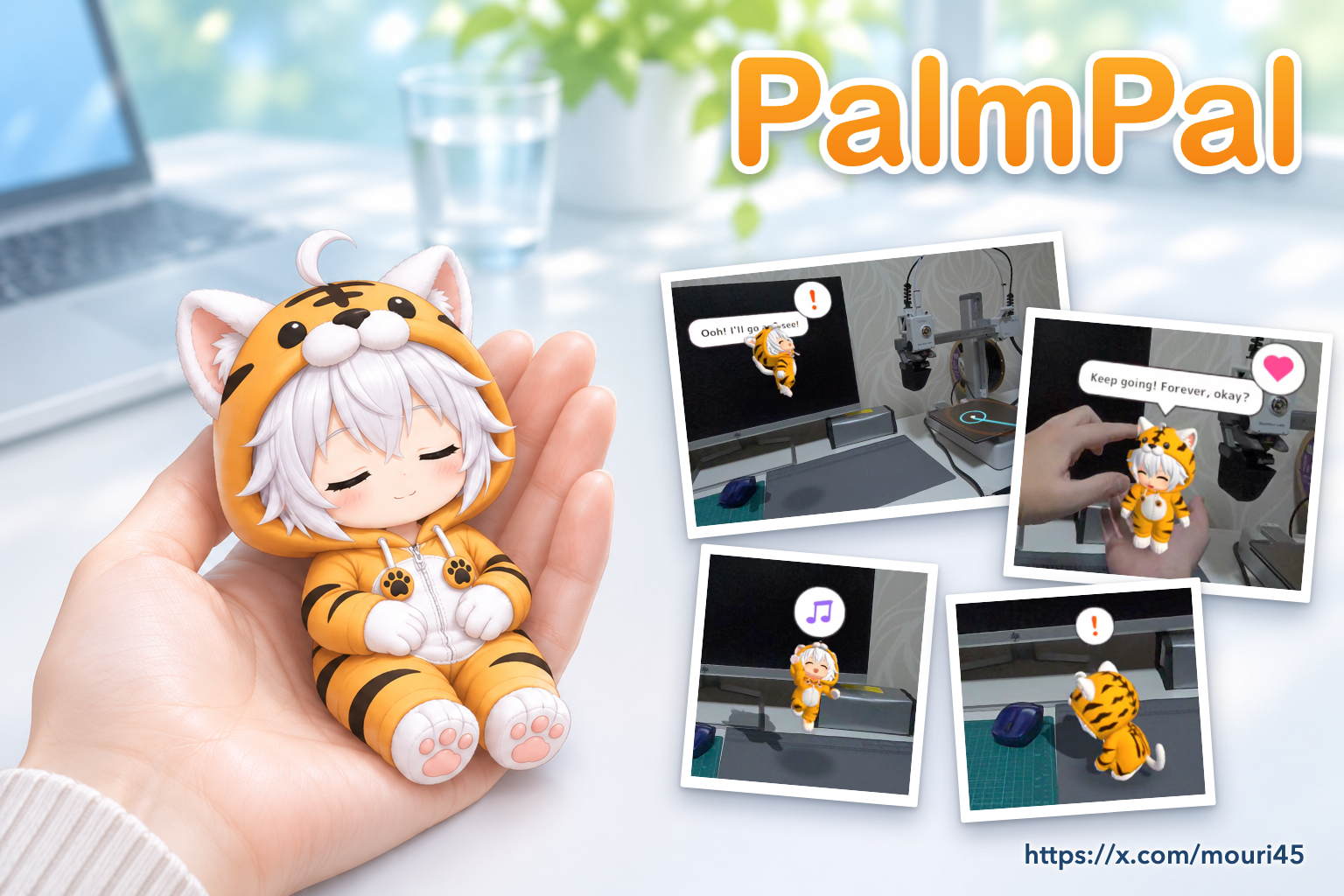
Inspiration
I wanted a virtual character who feels like she actually lives with you: not on a screen, but on your own desk, small enough to stand on your palm. Hands-first mixed reality makes that possible, because the most natural way to meet a tiny creature is to hold out your hand.
Torami is a 15 cm tall character in a tiger hood. She walks around your real table, hops onto your open palm, loves head pats and hates being poked.
What it does
- Your room is the stage. After a short room scan, Torami appears on the table in front of you, or on the floor. She walks, runs and jumps across real surfaces, and real objects in front of her hide her. Look away for a few seconds and she moves back into view.
- Your hands are the controller. Hold your palm up and still for about two seconds: she runs over and jumps on. Tilt your hand and she hops off. Flip it and she tumbles down, grumbling. Stroke her head slowly and she smiles. Keep poking her and she gets angry. Pet her to make up.
- Point at the real world. Turn your palm away from you and it becomes a laser pointer. Pinch once on something: she looks, often walks over, and talks about it. Pinch twice: she goes to that spot.
- Your voice is the conversation. Ask her to dance or go to sleep, or just chat. She answers out loud, with subtitles. She also starts conversations herself, and her scripted questions come with answer bubbles you can poke, so you can answer without speaking.
How I built it
PalmPal is built with Unity 6 on OpenXR, using hand tracking, passthrough, scene planes, the room mesh, environment depth and the passthrough camera.
By default, all AI runs on the headset: speech recognition (SenseVoice with sherpa-onnx), a small language model (Qwen3.5-0.8B with llama.cpp), text-to-speech (Supertonic) and object detection (YOLOv9t). Optional Cloud AI, chosen at launch or in the settings menu, sends your words as text, a few things Torami remembers or sees, and a camera image of the spot you tap through my relay server to Meta's Muse model and ElevenLabs voices, for faster, richer replies. Torami's voice is AI-generated synthetic speech.
Under the language model sits a hand-written layer, so she never feels broken: a behavior brain with 15 states, more than 650 conversation topics in English and Japanese, and keyword intents for quick reactions. If a model is slow or missing, she falls back to scripted lines.
All code and interaction design were built during the competition. Torami's motions come from a licensed animation pack.
What's next
- More to do together, and reasons to come back daily.
- A richer memory, so Torami can bring up past conversations.
- Letting users swap in their own avatar model.
Built With
- c#
- cloudflare
- elevenlabs
- llama.cpp
- onnx
- openxr
- unity


