-
-
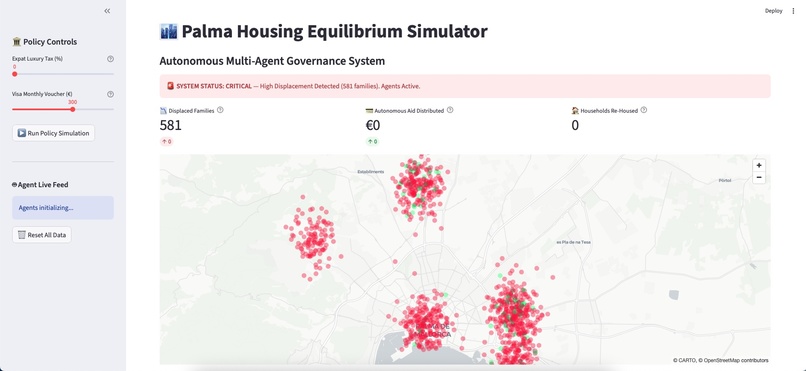
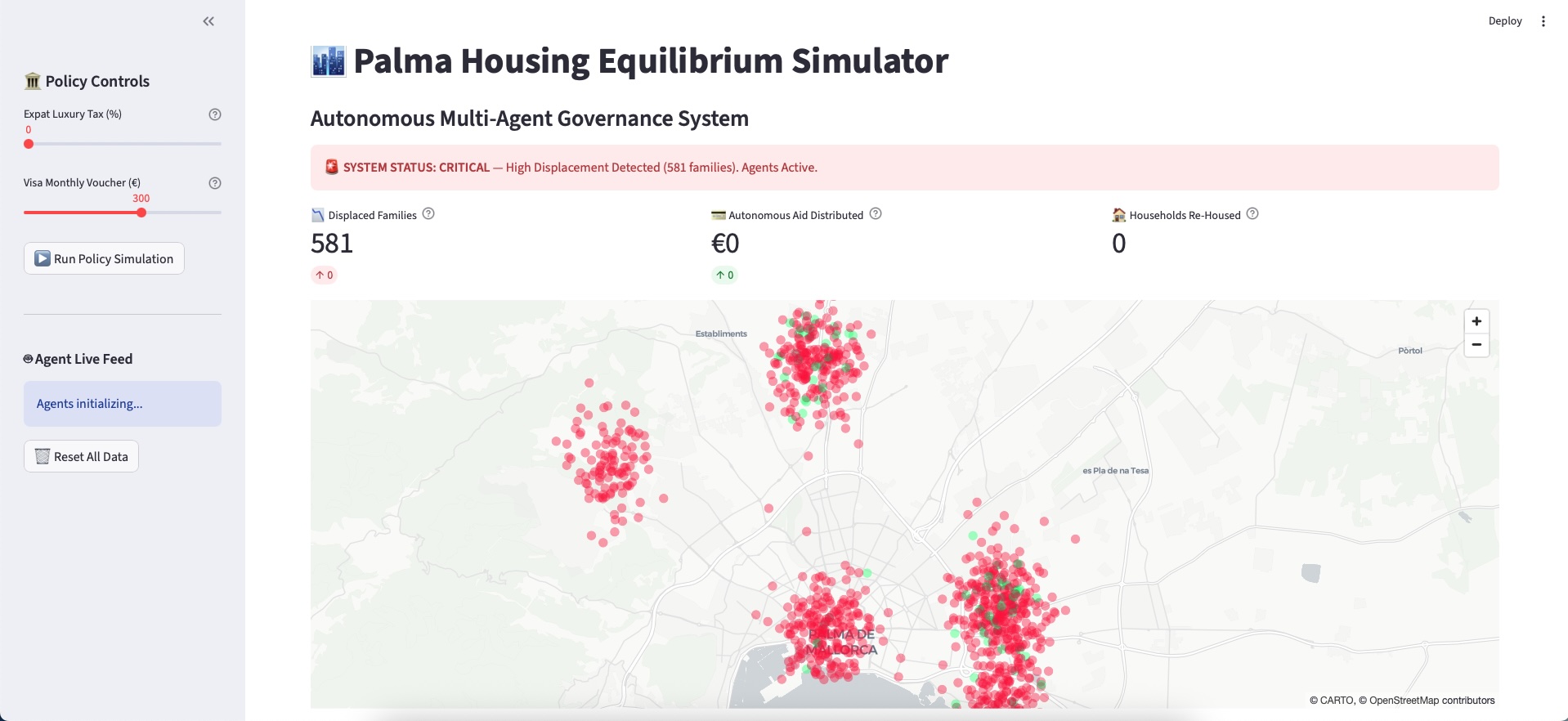
Initial State: 581 Displaced Families (Housing Crisis)
-
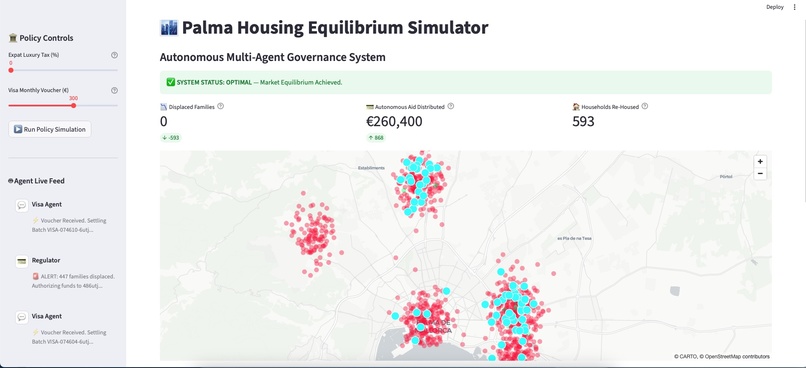
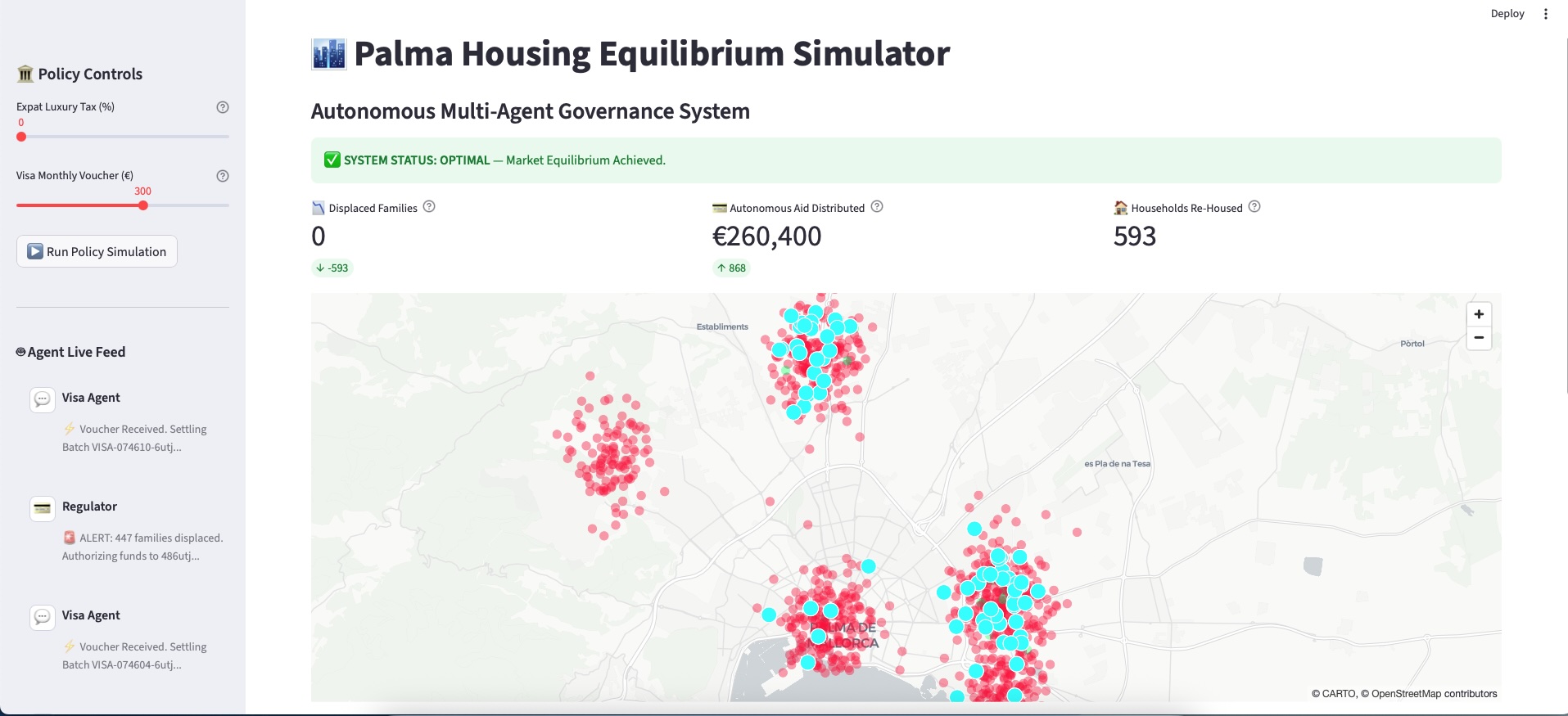
Final State: 0 Displaced Families (Autonomous Equilibrium).
Inspiration
I was born and raised in Palma de Mallorca, a city that is currently facing an existential threat. To the world, it is a vacation paradise; to locals, it is a closed door.
With rents rising 19% year-over-year and local wages stagnating at ~€23,000 (12% below the Spanish average), over 40% of the local workforce is now priced out of their own city. Traditional policy is too slow—by the time a subsidy is approved, families are already evicted.
With this project I wanted to ask: What if city governance was autonomous and worked real-time?
What it does
The project tries to be a Closed-Loop Economic Digital Twin of Palma that doesn't just simulate the crisis but solves it autonomously.
Simulates: A Walrasian Auction engine models the interaction between 1,100 synthetic agents (Locals vs. Expats) and 1,100 housing units across 5 real neighborhoods, anchored in 2026 INE (Spanish National Statistics Institute) wage/rent benchmarks.
Monitors: A Fetch.ai Regulator Agent runs infinitely in the background, auditing the market state every 5 seconds to simulate a real societal market.
Acts: If the families displaced hits a critical threshold (e.g., >300 families), the Regulator triggers a Visa Settlement Agent to inject targeted liquidity (vouchers) via a simulated payment rail to affected families.
Heals: The system creates a feedback loop where agent actions actively stabilize market prices in real-time, creating a dynamic equilibrium.
How I built it
We architected a Multi-Agent System (MAS) where economic theory meets decentralized infrastructure.
1. The Math: Walrasian Tâtonnement
At the core of my simulation is a solver that iteratively finds the market-clearing price vector $p$ for a set of zones $Z$. Each agent $i$ maximizes their utility function:
$$ U_i(z) = \alpha_i \cdot \text{Pref}_{i,z} - \beta_i \left( \frac{p_z \cdot \text{BasePrice}_z}{\text{Income}_i + \text{Subsidy}} \right) $$
Where $\alpha$ and $\beta$ represent the trade-off between location preference and budget constraints.
2. The Agency: Fetch.ai uAgents
I deployed two different identities as agents:
- The Regulator: An autonomous auditor that reads the simulation state.
- The Bank (Visa): A settlement agent that executes transactions.
They perform a cryptographic handshake to authorize funds without human intervention.
3. The Visuals: Streamlit & PyDeck
I built a 3D Geospatial Command Center that visualizes Effective Rent (what locals pay) vs. Market Rent. The map updates dynamically, showing "Red Zones" turning "Cyan" as the agents successfully intervene.
Challenges I ran into
The Inflationary Trap: Initially, injecting vouchers caused "Landlord Agents" to raise prices, negating aid. I had to implement "Market Entropy" and "Agent Stability Bonuses" to simulate a realistic tug-of-war between inflation and social liquidity.
Python 3.14/Pydantic V1 Conflict: The uagents framework faced type-evaluation issues with the newest Python 3.14 release. I resolved this by architecting a version-pinned, optimized Python 3.12 virtual environment.
Asynchronous Synchronization: Ensuring a Streamlit frontend could reflect real-time transactions occurring between two independent Fetch.ai agents required a custom JSON-based "Self-Healing Handshake" protocol.
Accomplishments that I am proud of
Closed-Loop MAS: Achieving a system where agent decisions mathematically alter the "physics" of the economic simulation in real-time.
The "Wobble": Successfully modeling market volatility, where displacement numbers realistically fluctuate based on landlord greed and external economic shocks.
100% Autonomous Settlement: Building a verifiable ledger where every subsidy batch is cryptographically authorized by the Regulator.
What I learned
I learned about dynamic equilibrium, making AI agents interact in a real world situation and the importance of high-frequency intervention in crisis.
What's next for Palma Housing Equilibrium: Autonomous Agentic Governance
Deploying the Visa Agent on Modal for serverless scaling and integrating real Fetch.ai Wallet transactions to allow citizens to receive actual stablecoin subsidies directly to their mobile devices. Extending the map to the whole Mallorca island and for global capabilities.

Log in or sign up for Devpost to join the conversation.