-
-
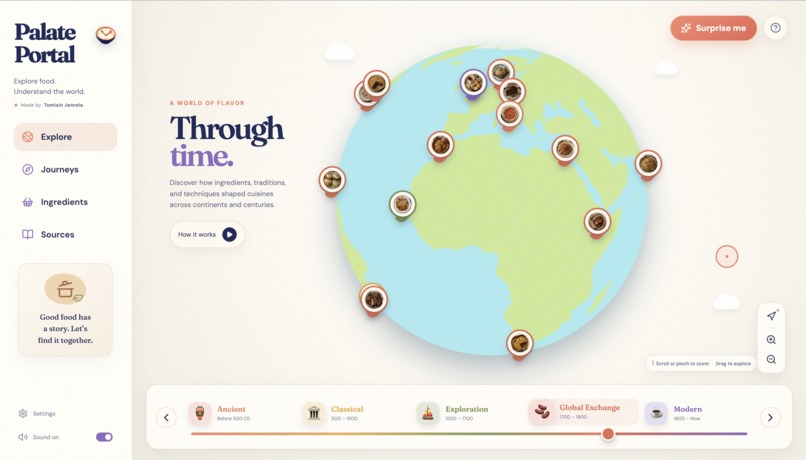
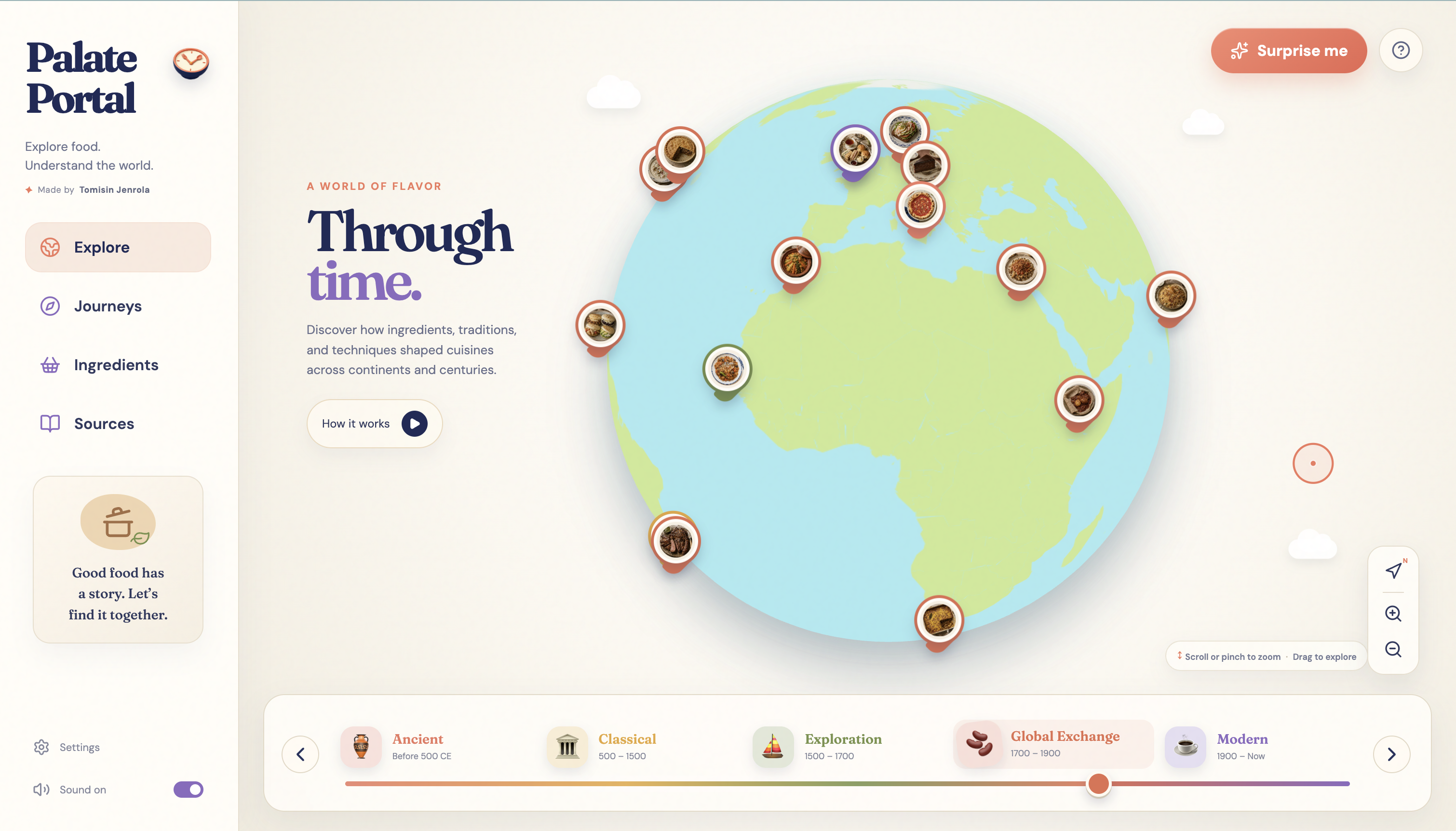
Overview when page first loads.
-
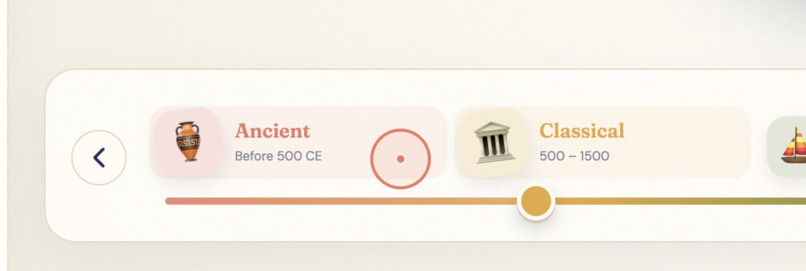
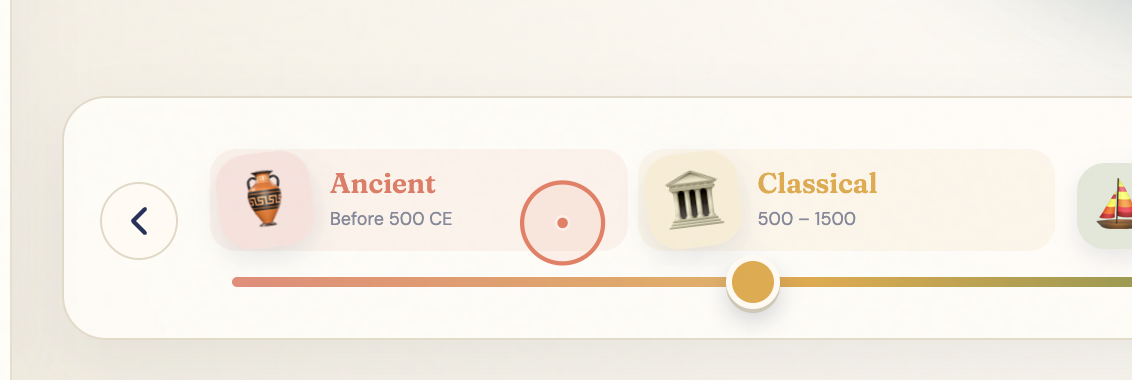
Select time period to see the meals in that era.
-
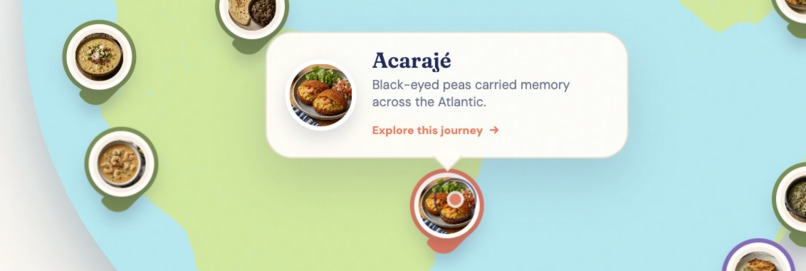
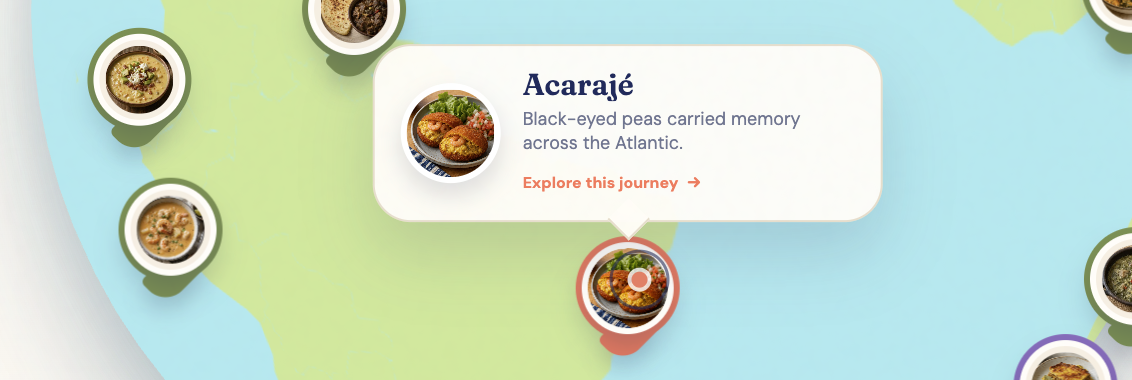
View quick details of meal on hover of food marker icon.
-
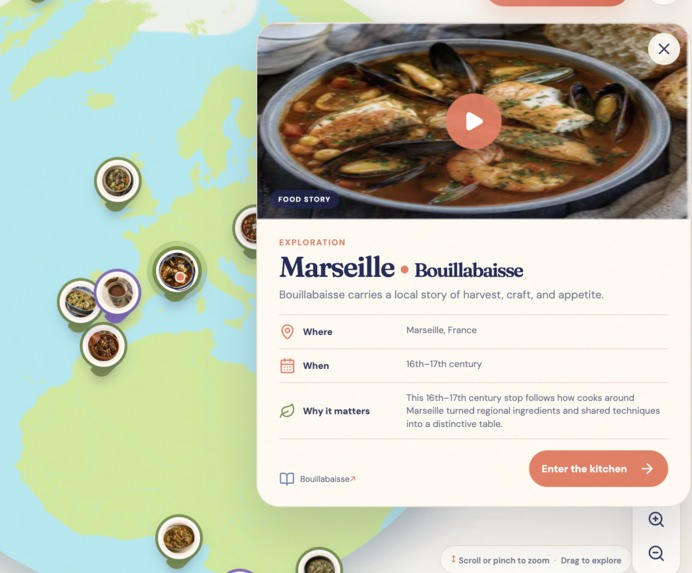
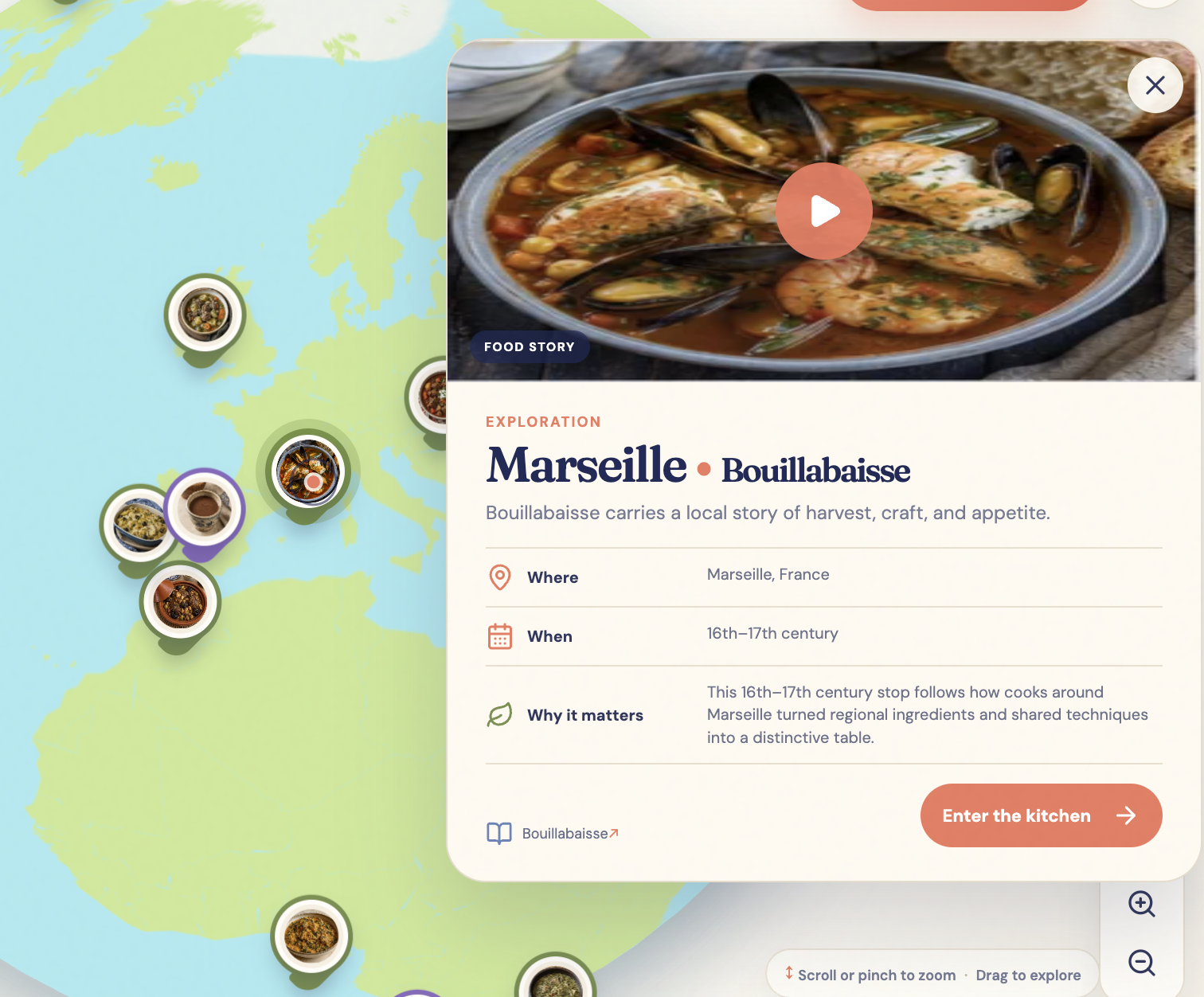
Modal that shows the details of a meal.
-
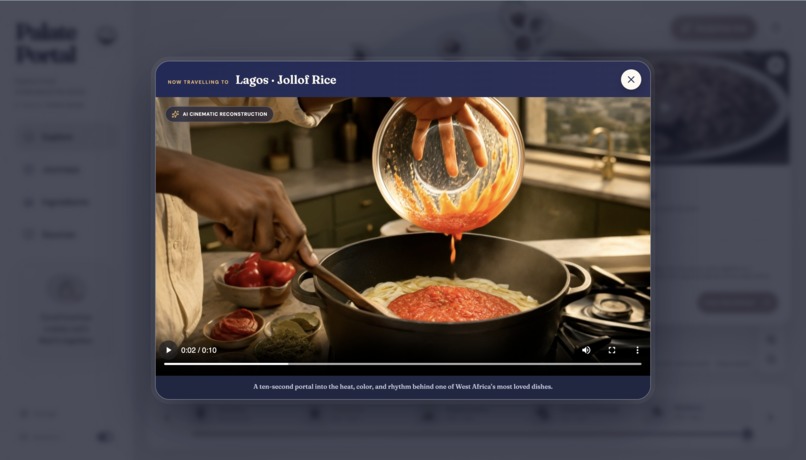
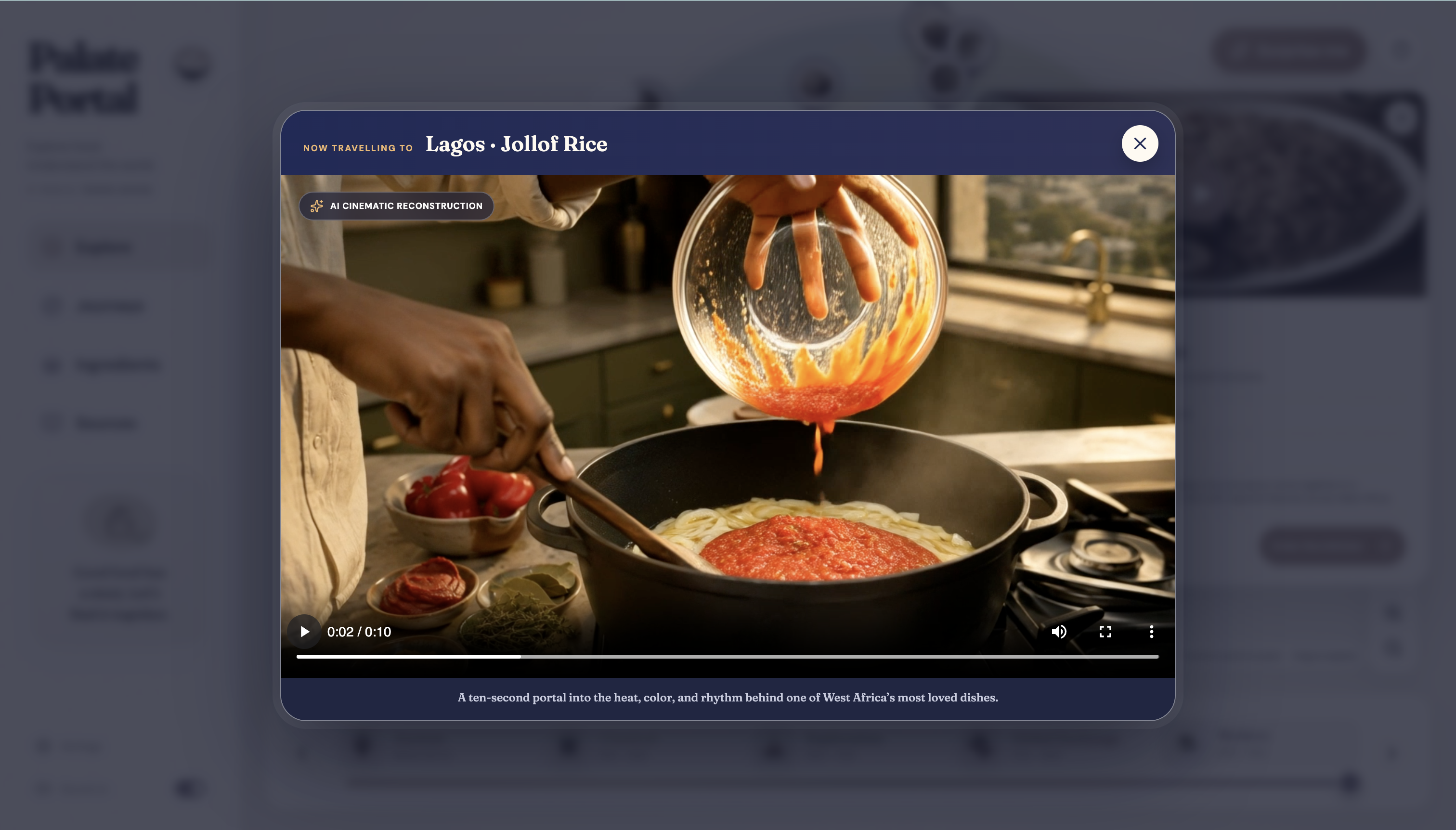
AI-generated video that shows.
-
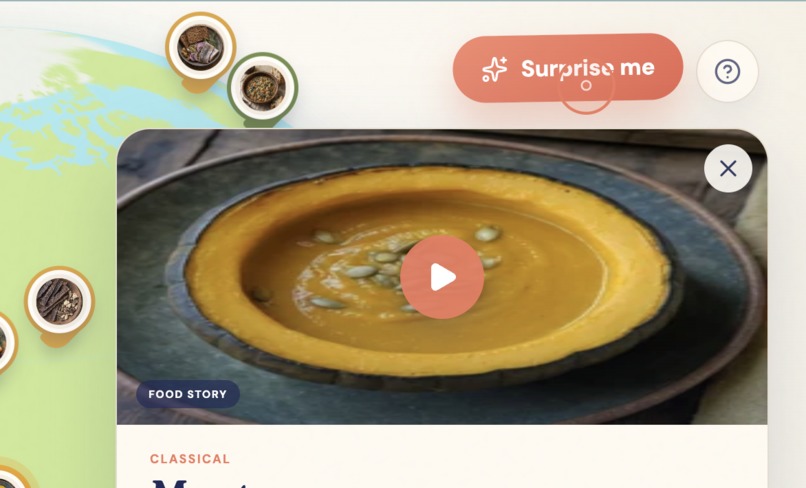
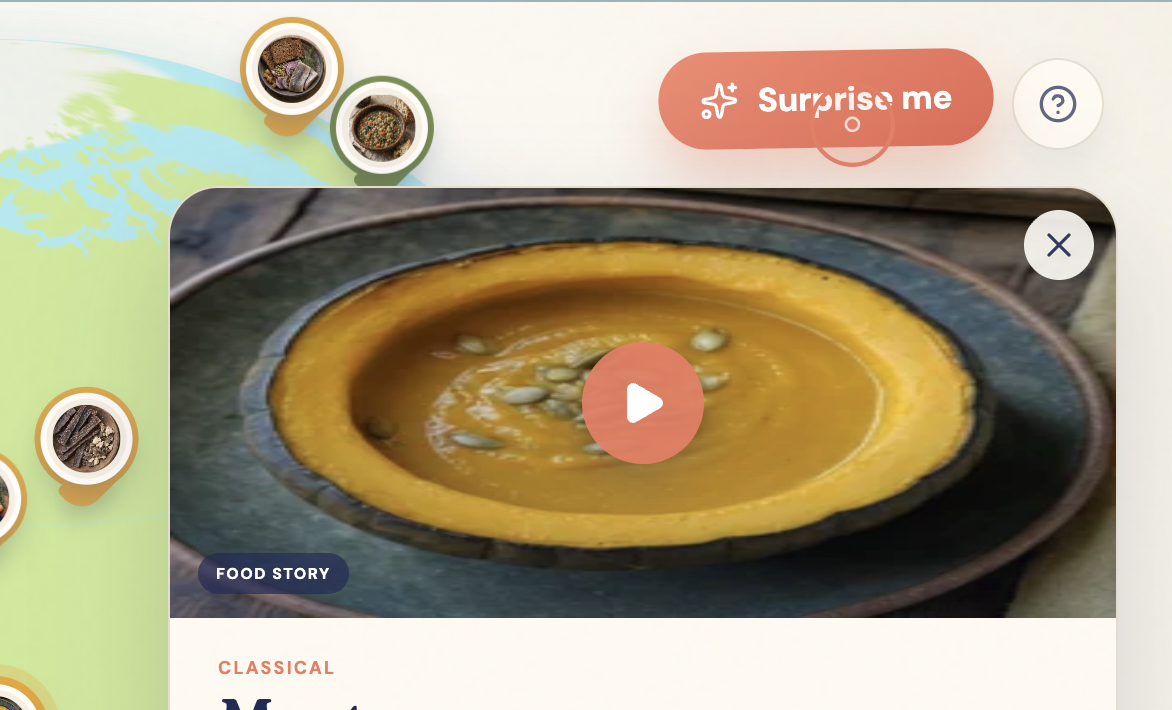
Select 'Surprise me' to view a random meal from any time period.
Palate Portal
Palate Portal makes history tangible through food. Travel through time, one shared meal at a time.
Inspiration
History is often taught through politics, empires, engineering, rulers and more. Food offers a different personal way in: everyone eats and every dish carries evidence of migration, trade, geography, invention, adaptation and survival.
I built Palate Portal to answer a simple question: what if exploring food history felt like spinning a globe rather than reading a boring textbook with lots of dates?
What it does
Palate Portal is an interactive culinary time machine. Visitors can:
- Spin and zoom around a tactile 3D globe
- Travel between five historical eras using an illustrated timeline
- Discover geographically distributed dishes from each period
- Open food markers to learn where and when a story took place
- Watch an AI-generated cinematic reconstruction of Jollof Rice preparation
- Follow real references for deeper exploration
- Use “Surprise me” to discover an unexpected food journey
Only dishes from the currently/actively selected era appear, transforming the globe into a changing view of how the world ate through time.
How I built it
I built Palate Portal with React, JavaScript, Vite, Three.js, and react-globe.gl. The experience includes custom globe styling, responsive layouts, projected food markers, touch gestures, timeline filtering, animations, audio interactions and accessible controls.
Codex, powered by GPT-5.6, was my primary product, design, research and engineering "teammate" while I worked solo. I used it to move rapidly from visual concepts to a working application, implement the globe and timeline, diagnose rendering and responsive-layout bugs, structure the food-story data, locate supporting references, generate visual assets and repeatedly refine the experience through browser testing using the inbuilt browser on Codex for Mac (latest version which is very mind blowing each time it took control and was able to actually use the web app to determine the bugs).
GPT-5.6 also directed the Jollof Rice reconstruction workflow. It developed the cinematic shot sequence, wrote consistent prompts for the opening and closing frames, and translated the concept into a precisely timed Kling 3.0 video prompt for Higgsfield. When Higgsfield initially rejected the original 6,986-character prompt, GPT-5.6 compressed it to fit the platform’s 2,500-character limit while preserving the essential shots, continuity, audio cues, and cultural context.
The resulting ten-second video was incorporated into the site as an immersive, picture-in-picture-style experience. Other meals don't have the AI-generated video due to both time and cost management.
Challenges
The hardest challenge was balancing personality with geographic credibility. Early versions felt playful and distinctive, but their simplified continents looked more like decorative blobs than a recognizable world. I iterated toward geographically credible coastlines while preserving the warm, tactile visual language.
Other challenges included positioning interactive markers on a rotating sphere, keeping hover cards above nearby markers, allowing visitors to move naturally from a marker into its preview, filtering stories by era, supporting mouse and touch gestures, adapting the full interface to smaller screens and making sound effects purposeful rather than distracting.
Historical food origins are rarely simple or uncontested. I avoided drawing historical political borders, treated locations as story anchors rather than claims of exclusive ownership and kept supporting references close to each story.
Accomplishments
I’m proud that Palate Portal feels like an experience rather than a database. The globe, timeline, food imagery, motion, selective sound, historical context and cinematic reconstruction work together to reward curiosity.
The prototype includes 150 food stories across five eras. Each era presents five stories from every inhabited continent, while showing only the period currently being explored.
I’m also proud that the I built the bulk of this in only a couple of hours on Saturday. It's an idea I've had for a while but never got around to work on it. I attended an OpenAI event in Vancouver, Canada and only then did I learn there was a hackathon going on with a nearby deadline!
What I learned
I learned how powerful AI-assisted development becomes when AI is treated as an iterative creative partner rather than a one-shot generator. GPT-5.6 helped me explore and implement ideas quickly, but the strongest results came from continuously testing, critiquing, and refining its output.
The Higgsfield workflow demonstrated this clearly: GPT-5.6 moved between creative direction, image prompting, timed video prompting, technical constraints, and prompt compression while preserving one coherent result.
I also learned that food is an unusually effective doorway into history. It can make enormous cultural changes feel immediate, human, and relatable.
I learnt that the user interface for Codex and ChatGPT have now been unified which is interesting because it lets me stay in one app without too much copy-paste. There are also a lot more tools than I realised. I will definitely be spending more time in Codex than I did before for my other side projects.
What’s next
Next, I want to add curated journeys that follow ingredients such as tomatoes, rice, cacao, and spices across time; more cinematic reconstructions; expert-reviewed institutional sources; educator-friendly lesson modes; and partnerships with cooks, historians, and artisans.
The long-term vision is to let people not only discover historical dishes, but recreate them through documented recipes, techniques, ingredients, materials, and cultural context. This means there would be a store from which visitors could buy recipes and ingredients that are as close as possible to the original meal in the desired time period. After that would be expanding beyond food to sports, clothing & textiles, furniture, architecture, art, literature and music. The name would have to evolve from Palate Portal to something more encompassing of various aspects of culture.

Log in or sign up for Devpost to join the conversation.