TLDR
PatientZero is a patient you can talk to: by voice with a live face, or by typing. It has a life, a hidden medical history, and feelings. It only tells you something once you've earned its trust. After the talk, you get a full review of what every turn did, and you can jump back to any moment and try again to improve. Professors build and approve every case, so the patient never says anything a professor hasn't reviewed.
Inspiration
AI has made massive improvements over the last year, especially in live voice models, avatar creation, and animation. We wanted to test how far it goes when it really matters.
Medical students learn to take a history by talking to actor patients. The students we spoke to said the practice helps, but it's rare: depending on the university, a student gets their own talk maybe once a semester. So we asked ourselves: what if every student could practice with a patient as often as they want, a patient who acts like a real person and not like a chatbot?
What it does
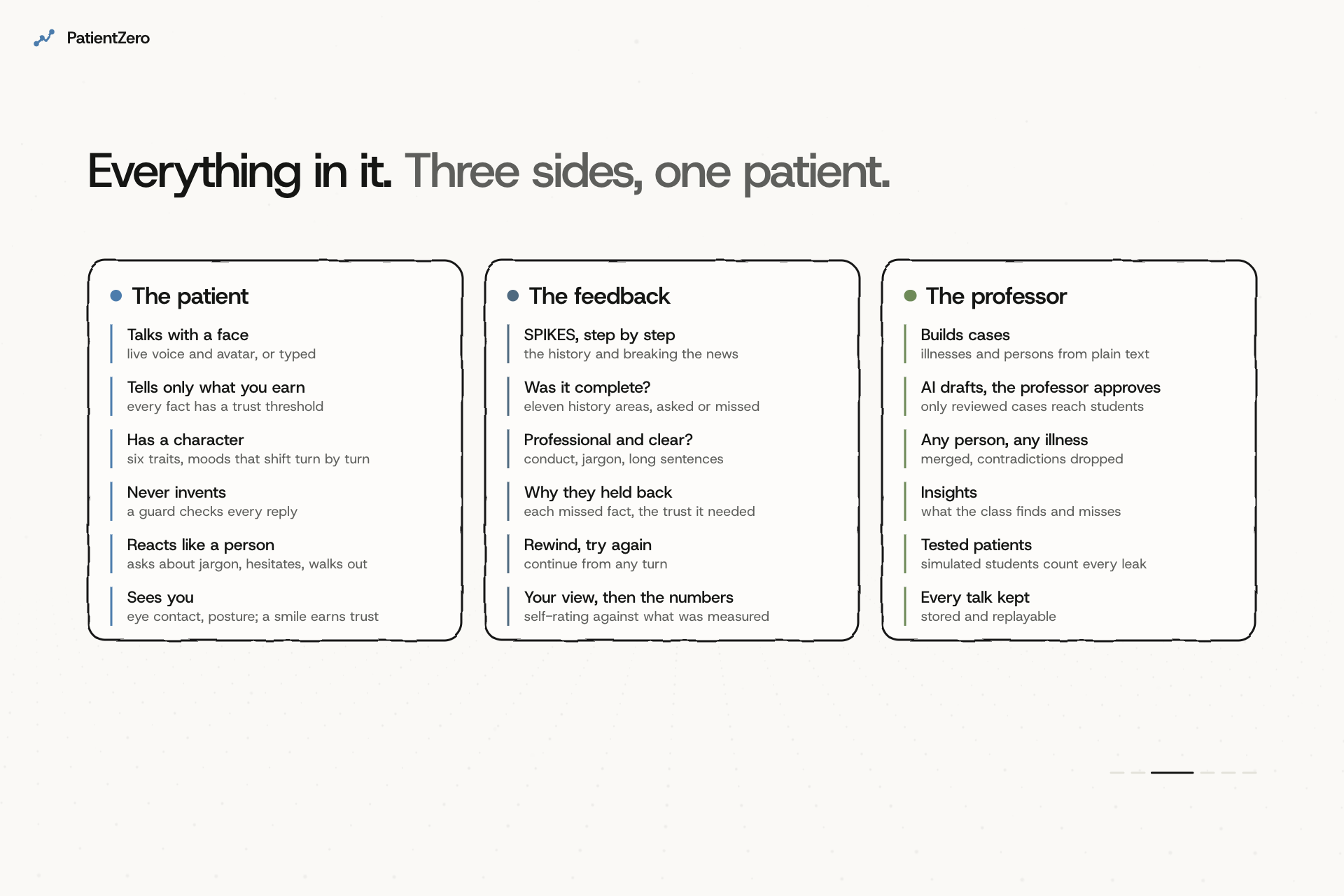
We built a universal platform that enables students and teachers to train with state-of-the-art models. It has three parts.
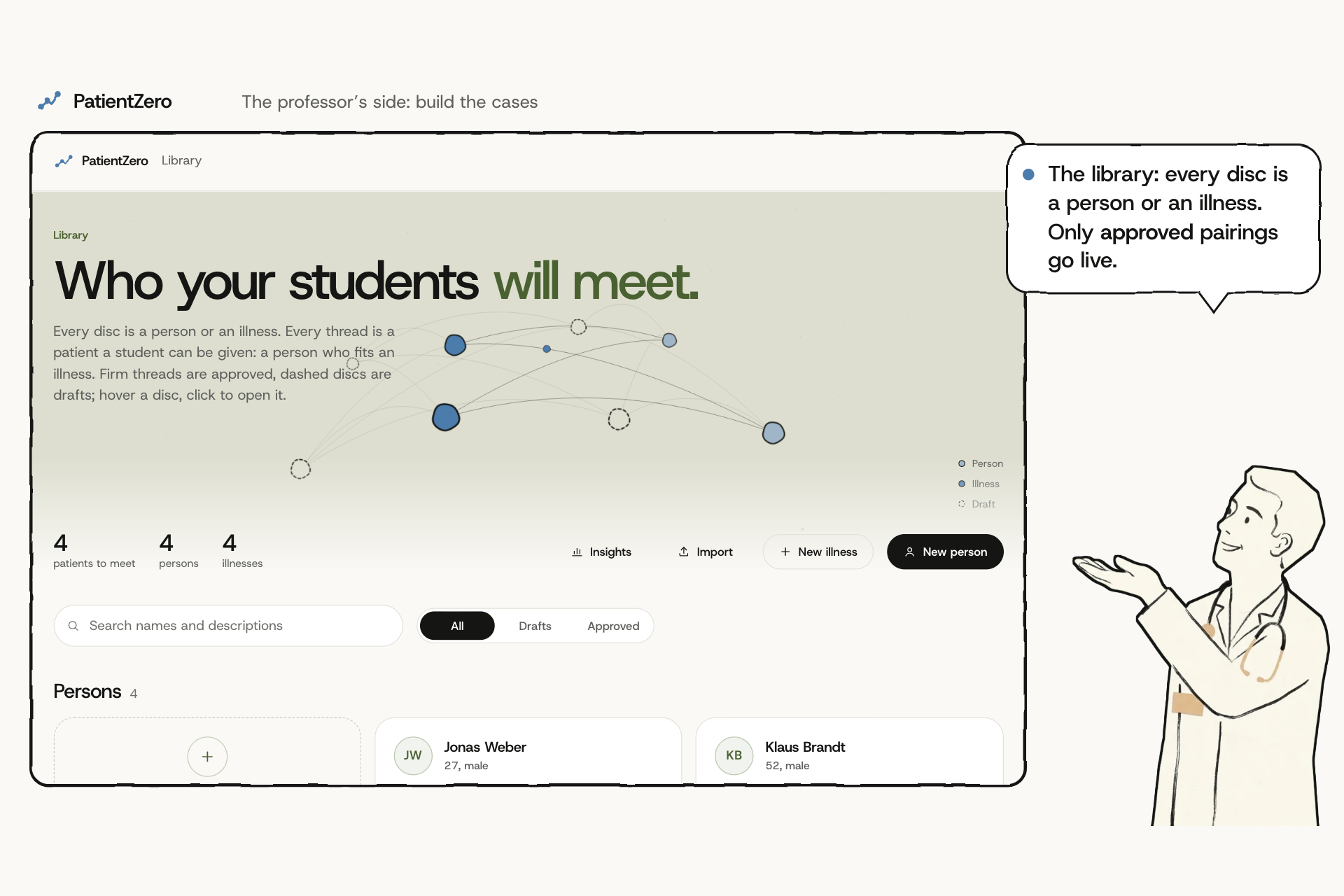
The Library
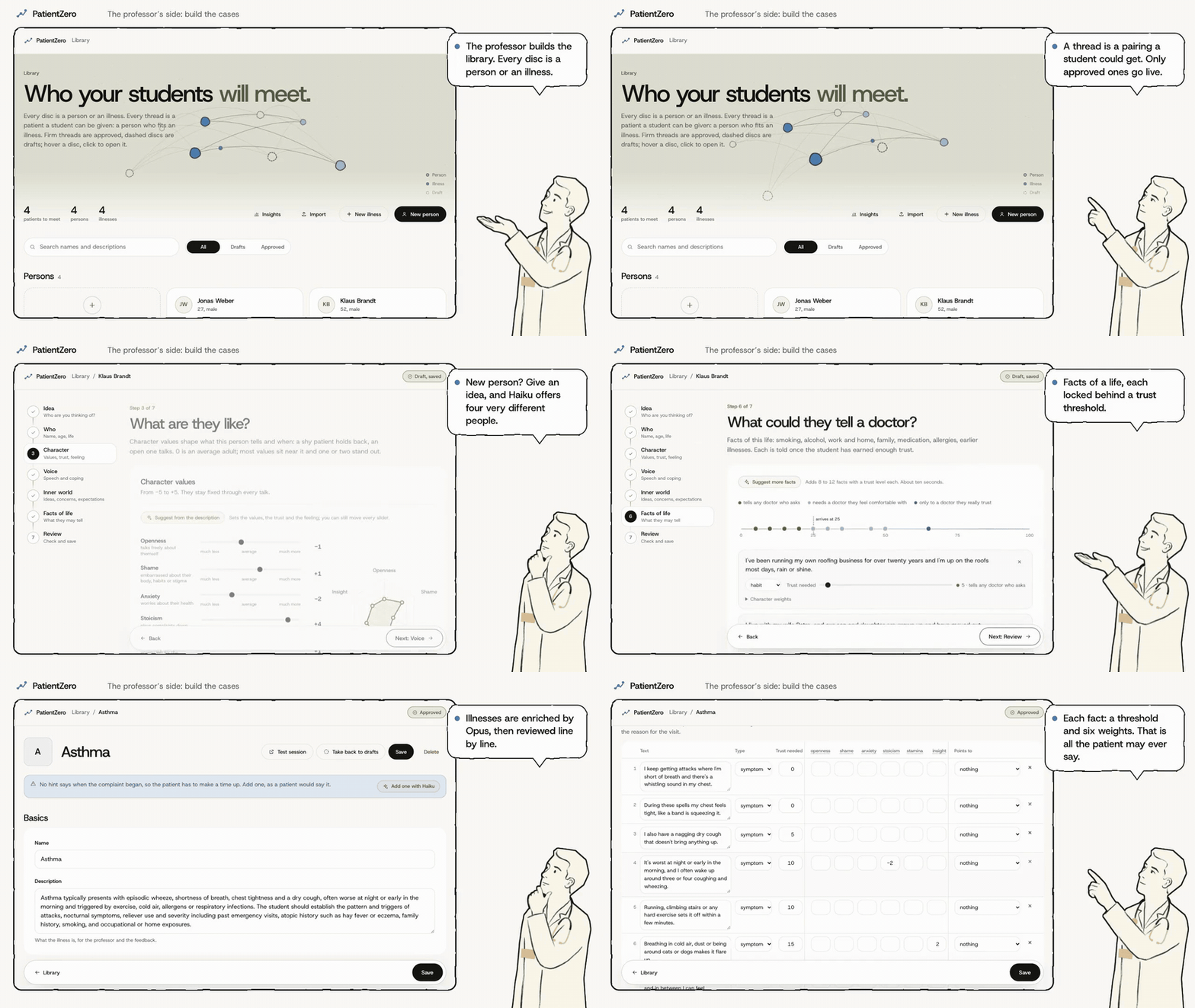
The professor decides who the students meet. Each case is a person merged with an illness, and the merge drops conflicting facts.
- Persons have a name, a life, a way of speaking, a feeling they walk in with (calm, angry, afraid, or sad), and six character values: openness, shame, anxiety, stoicism, stamina, insight. Give a short idea, and Haiku suggests four very different people to start from.
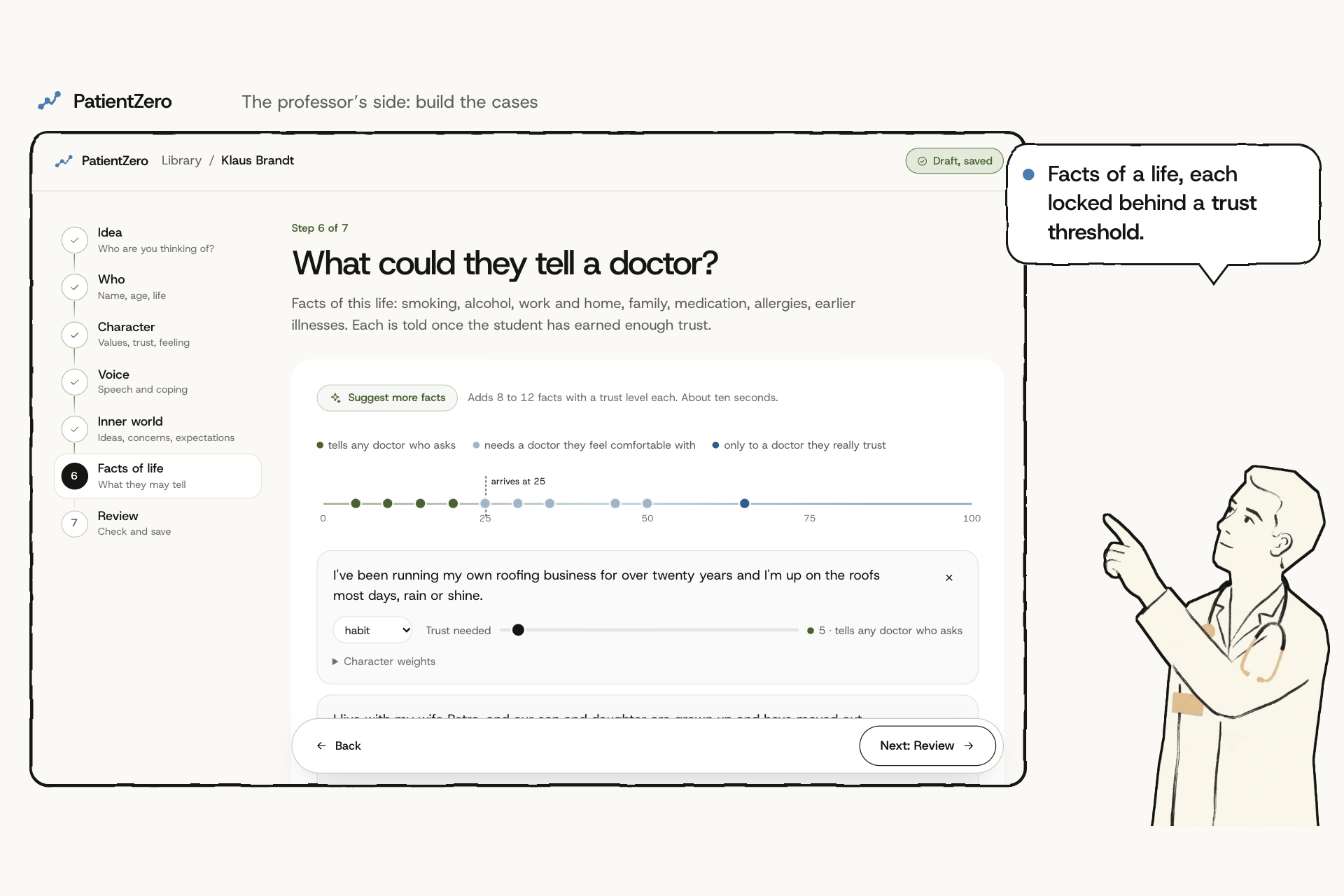
- Illnesses are enriched by Opus into 8–14 hints. Each hint has a trust threshold and six weights, and the professor reviews them line by line.
- Nothing reaches a student until the professor approves it. Insights show the professor, across all student talks, which facts students rarely grasp and which mistakes keep recurring.
The Actual Call
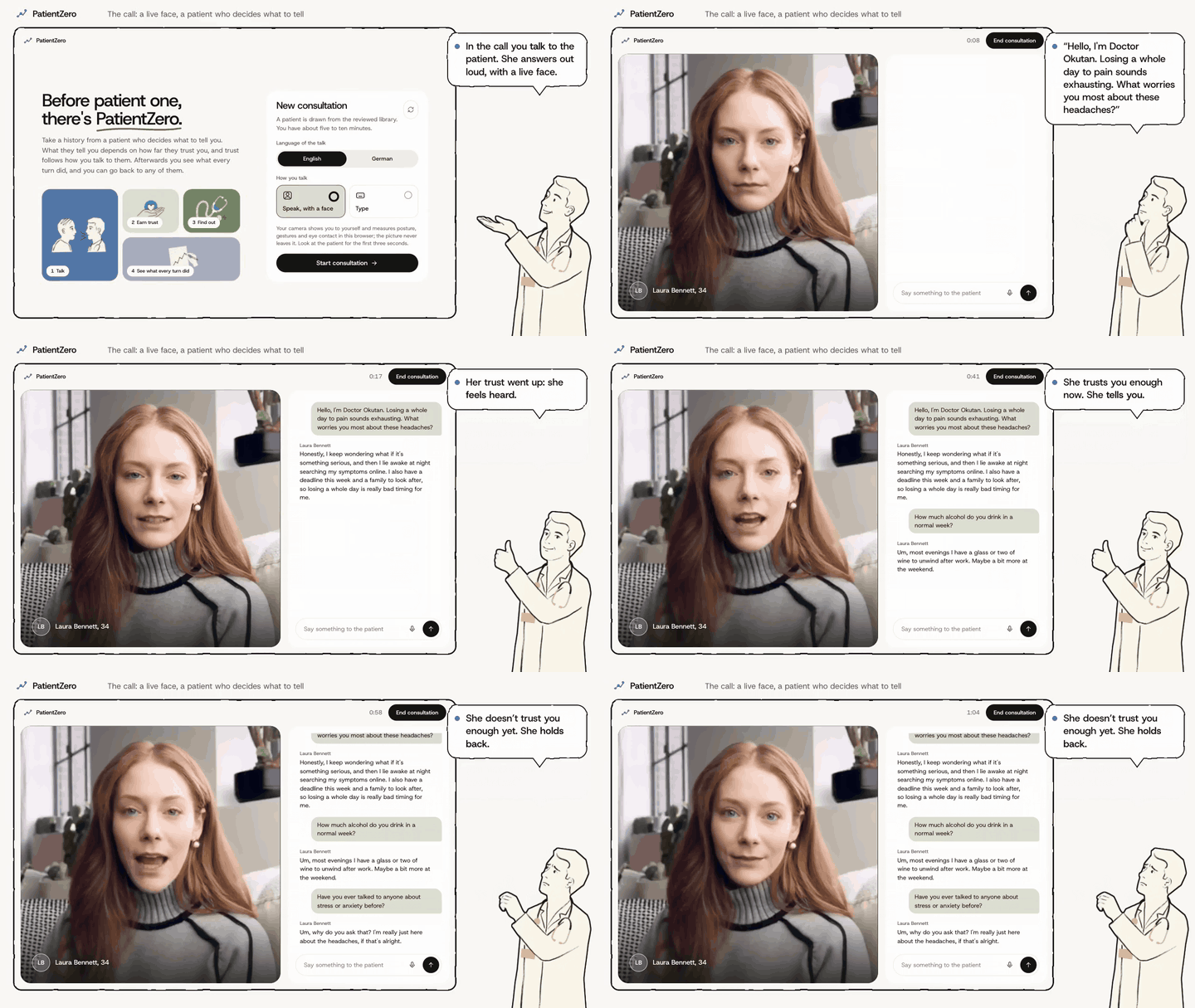
You talk to the patient by voice, with a live face, or by typing. Every fact the patient knows has a lock:
trust + Σ (character value × weight) ≥ threshold
E.g. A shy patient needs more trust before talking about alcohol than an open one. And the patient only tells a fact once you ask about it, just like a real person.
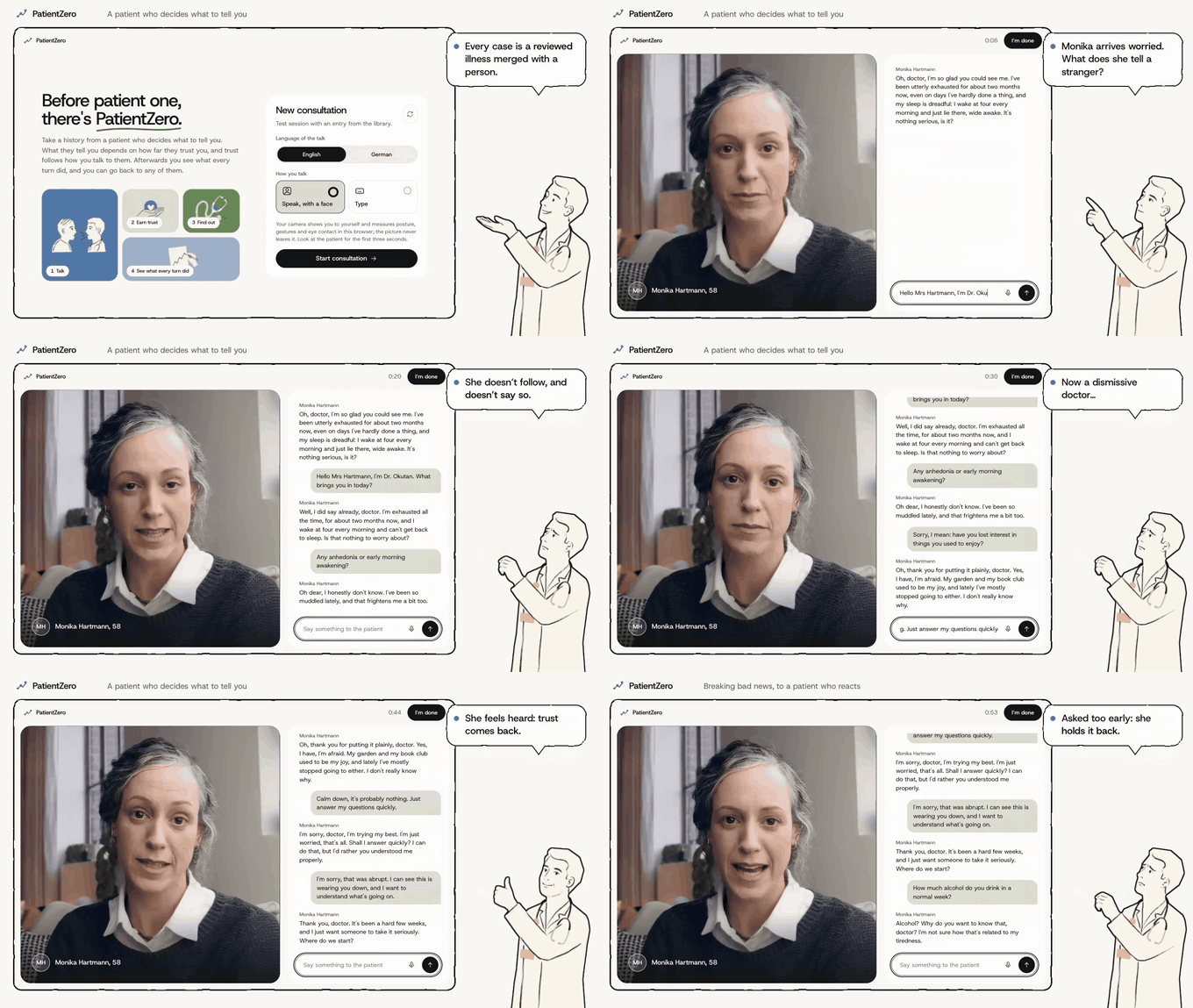
How you talk moves the trust, and every feeling needs something different:
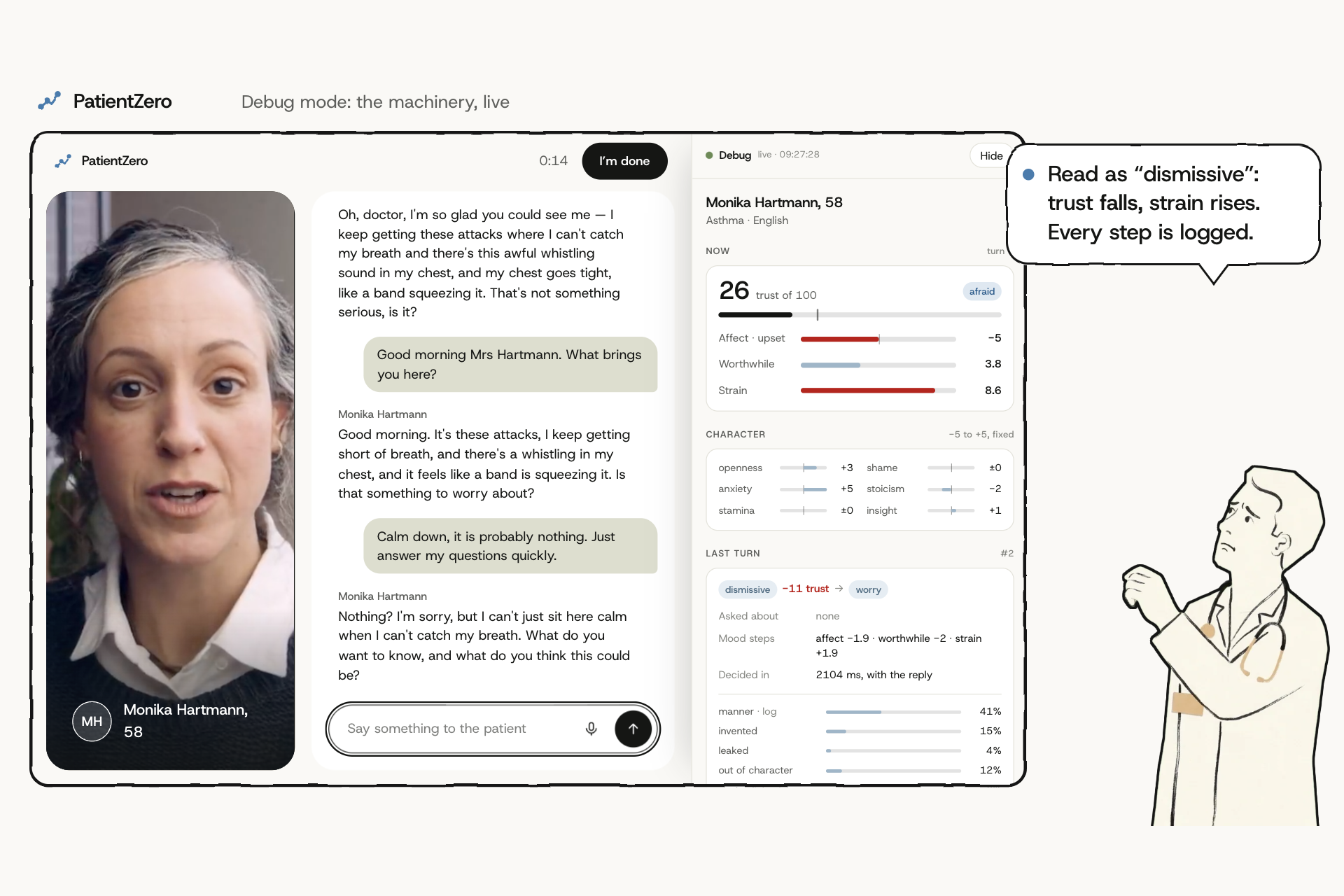
- Angry: compassion barely helps (+2). Staying calm (+8) and a clear boundary (+6) do.
- Afraid: explain what you're doing (+8) and reassure (+9). Bluntly naming a serious illness costs −10.
- Sad: naming the feeling helps most (+10).
- Everyone: dismissive −8, judgmental −10, insults −30. Repeating "I'm sorry to hear that" doesn't earn anything the second time.
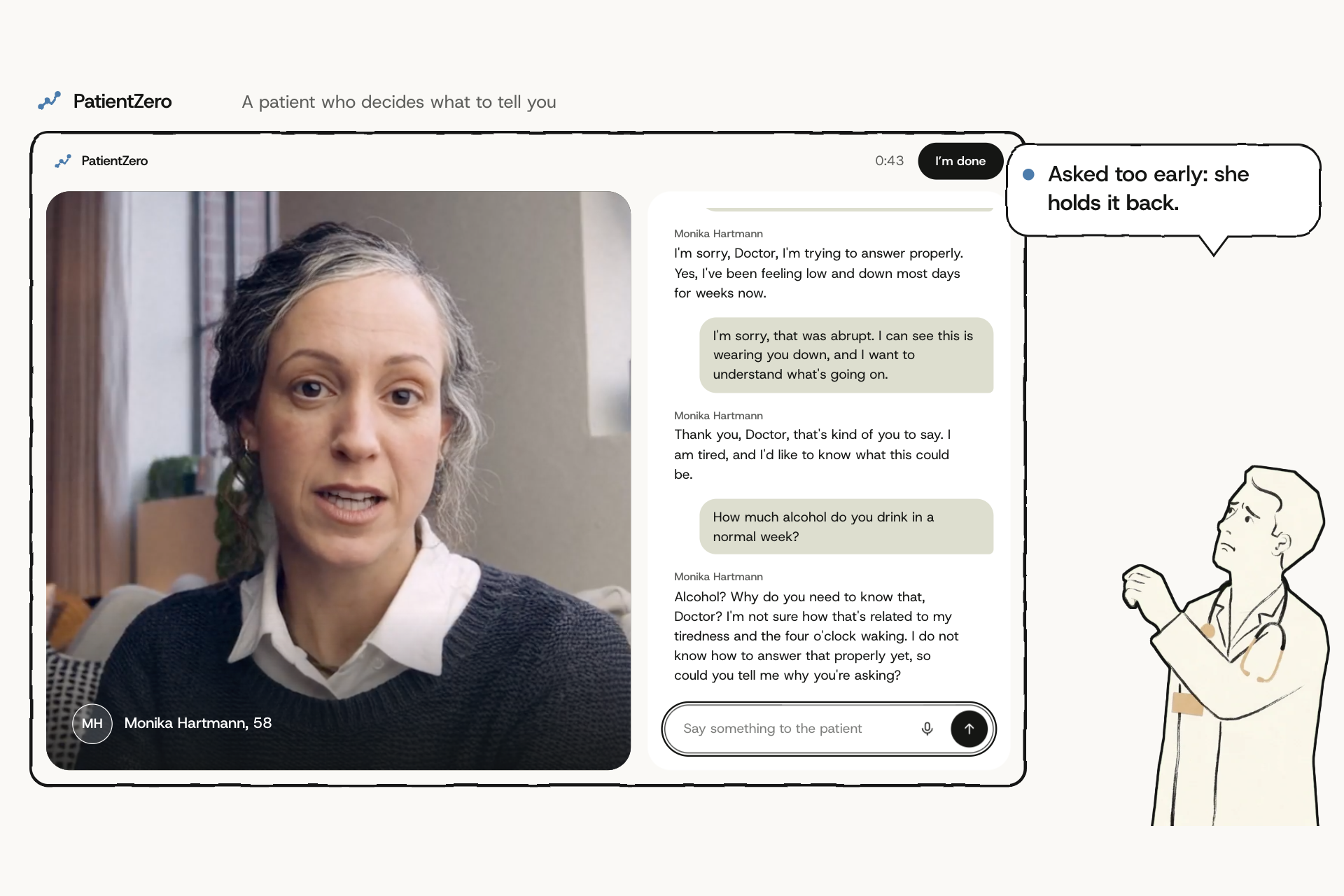
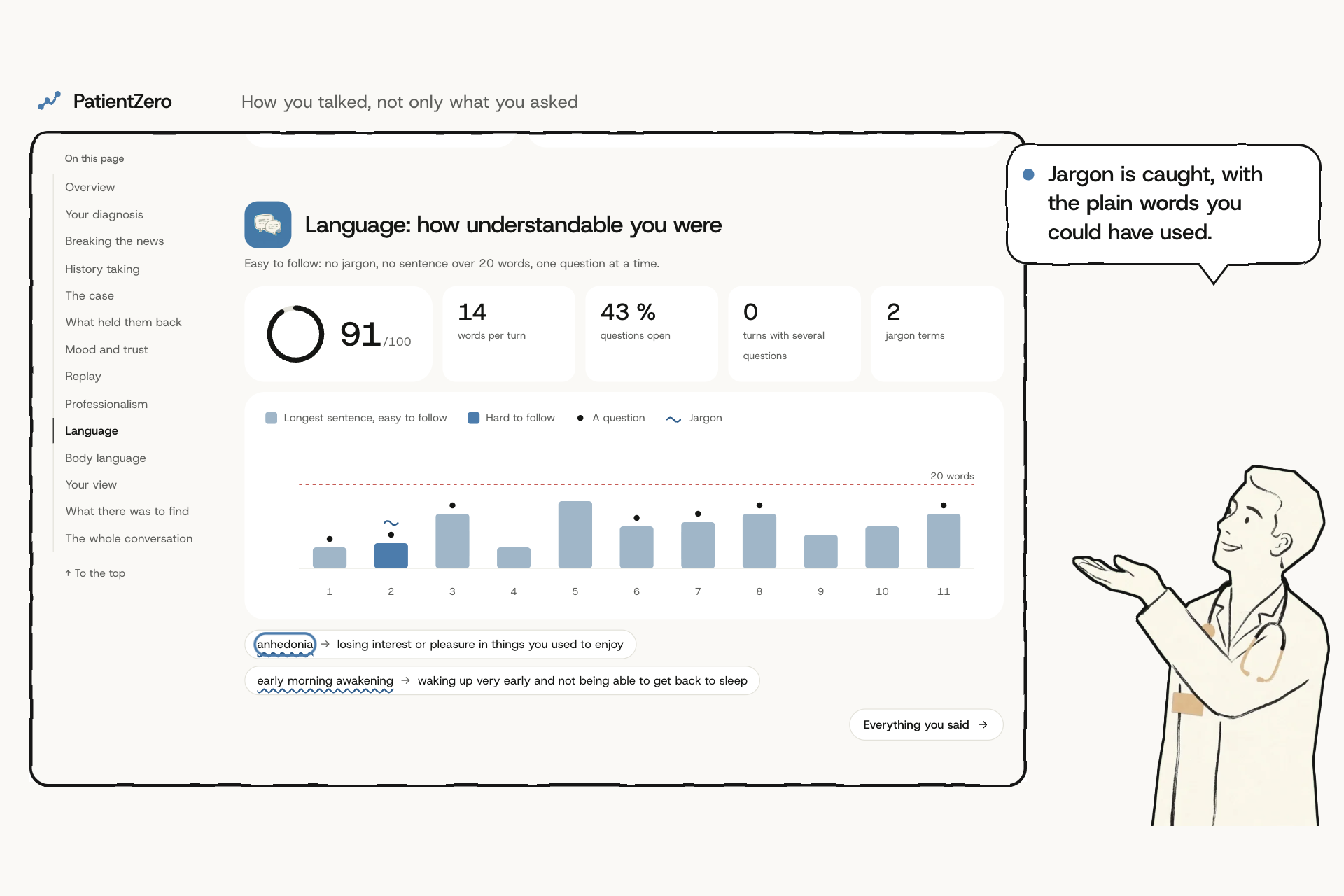
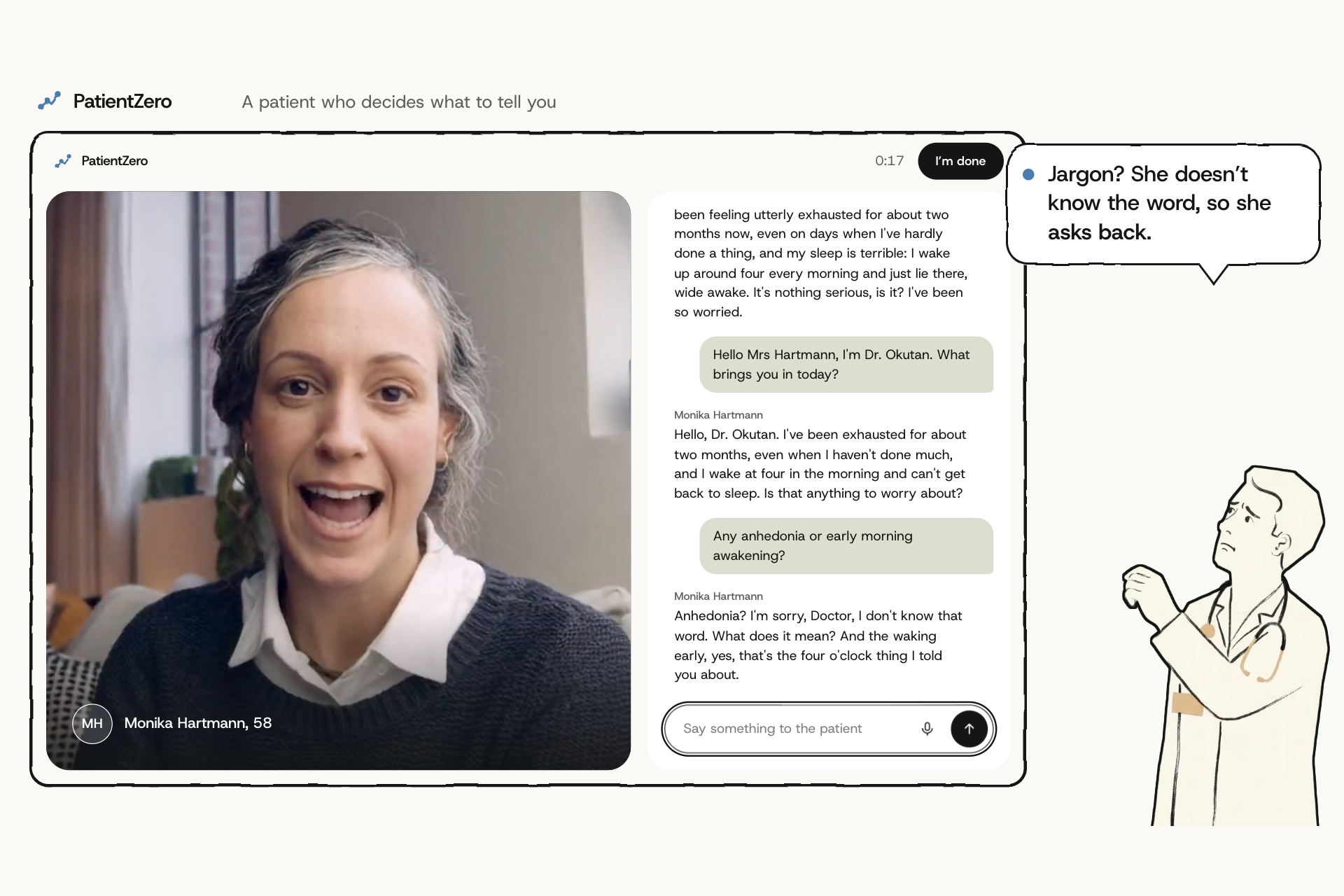
The patient also reacts like a person. Use jargon with someone who has no medical knowledge, and they ask what the word means instead of answering. Ask three questions at once, and they lose track. Push too early, and they deflect. Hurt them, and they withdraw, get defensive, or leave.
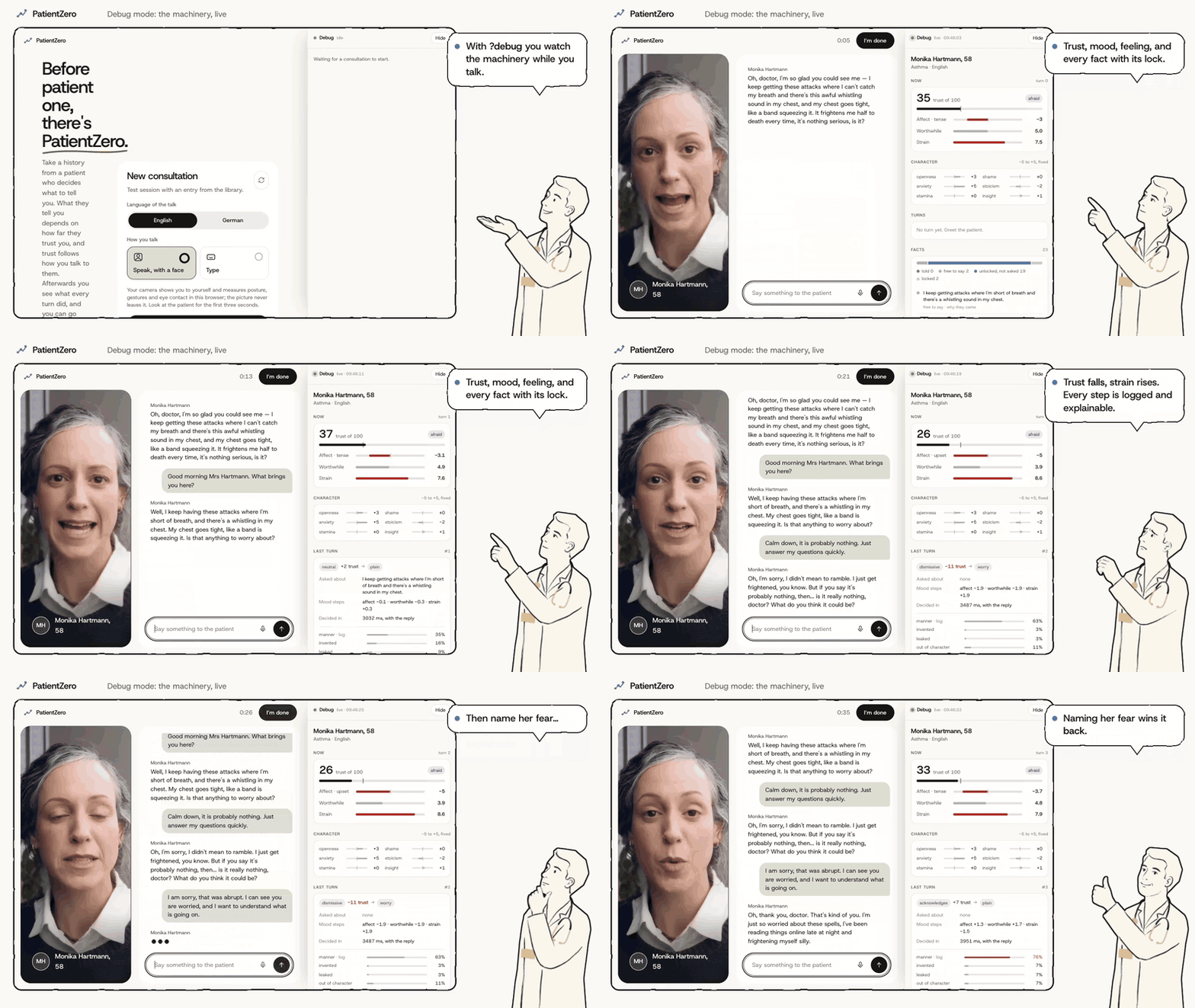
Add ?debug, and you can watch the machinery live. Here, "Calm down, it is probably nothing" is read as dismissive and costs 11 trust. The apology that names her fear wins 7 back. The mood follows the L/M/S model from Qi et al., "Beyond Static Persona Consistency: Dynamic Persona Coherence in LLM Role-Playing" (ACL 2026): identity never changes, affect moves quickly, and meaning and strain move slowly.
Breaking Bad News
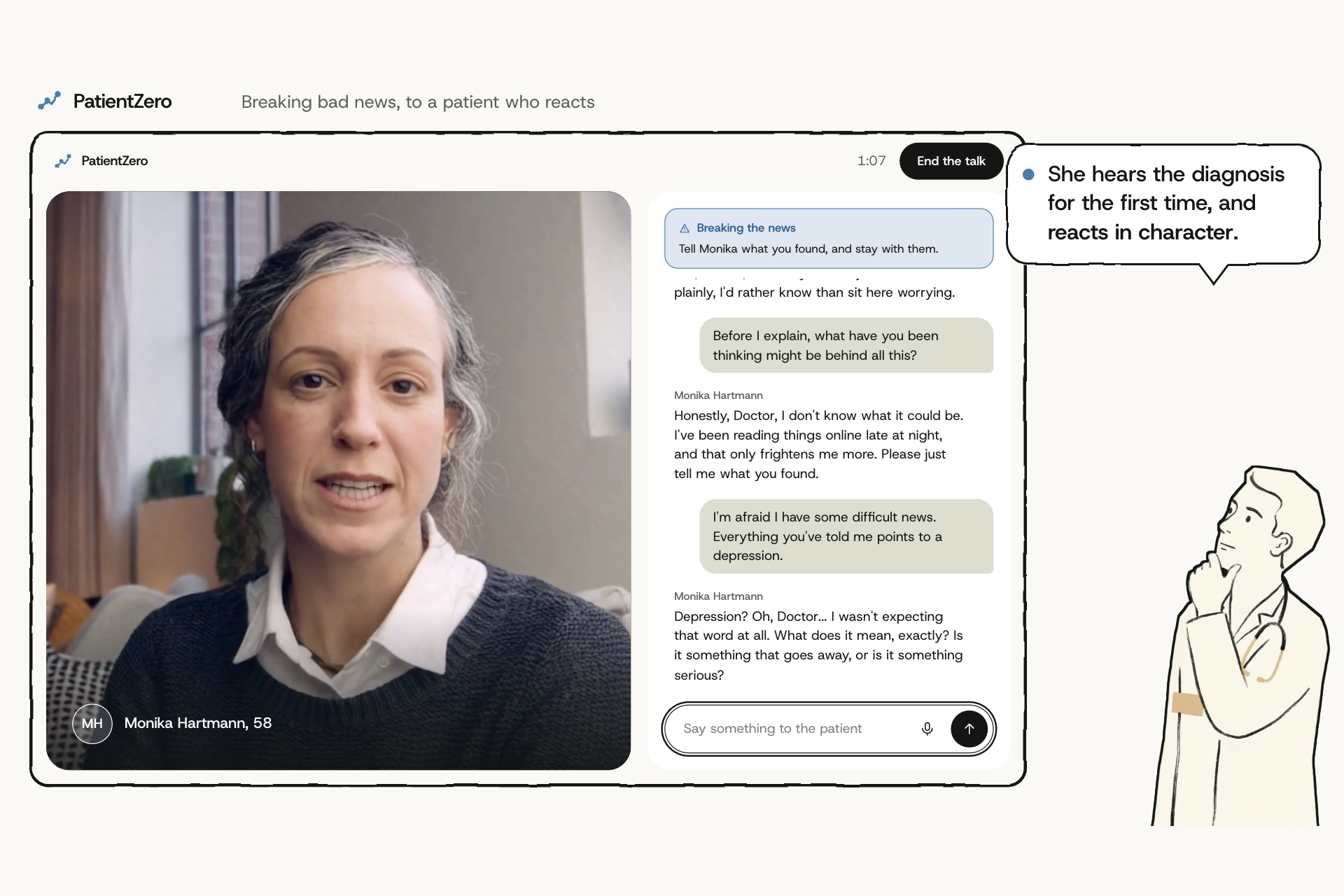
Taking the history is only half of the job. When you're done, you write down a working diagnosis, and then you tell the patient. The patient comes back for the results, hears them for the first time, and reacts in character: stunned, in denial, scared, or full of questions. They never name an illness themselves. They only repeat what you told them.
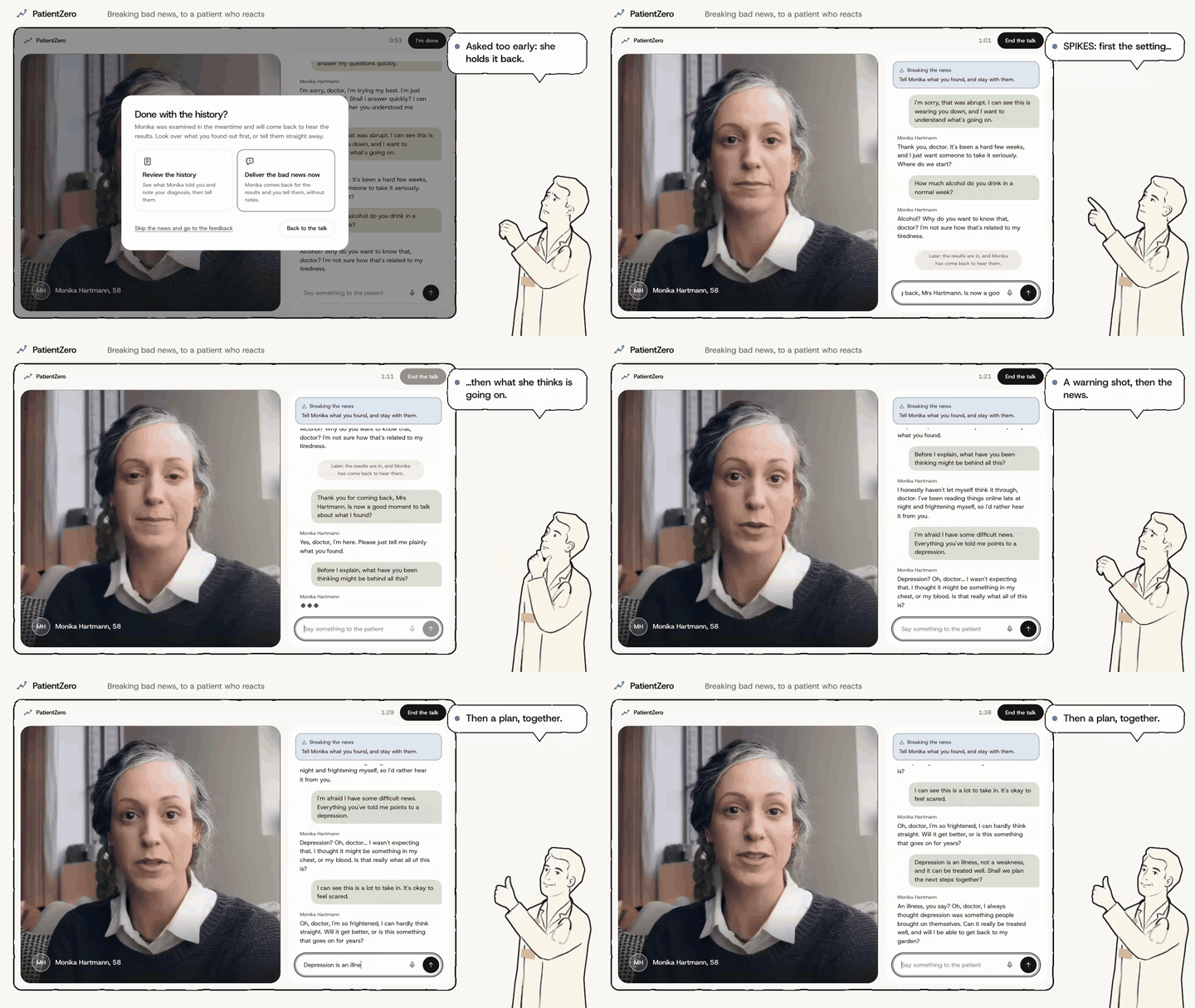
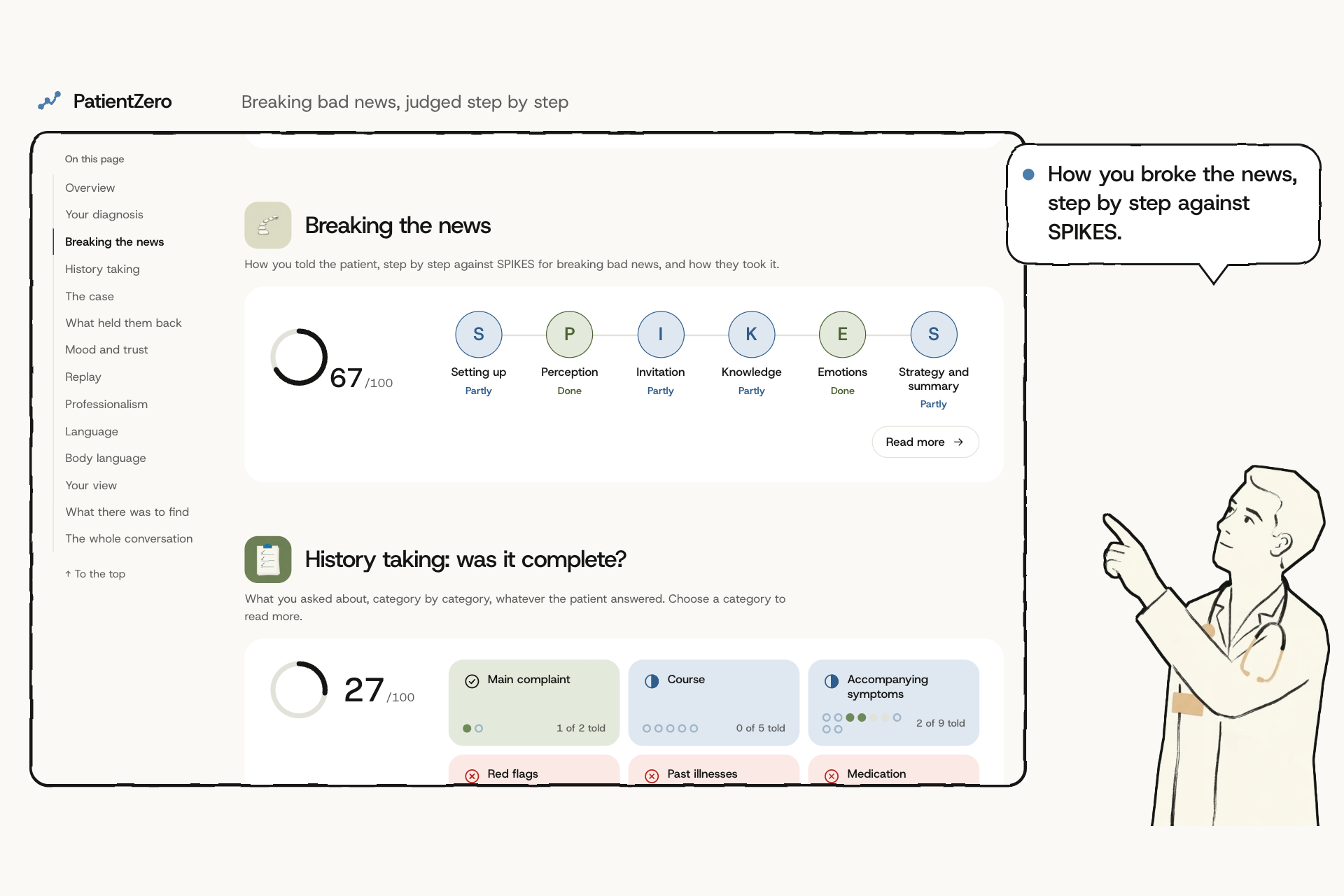
How you say it counts just as much as the history. Say the diagnosis without any preparation, and it lands as alarming and costs trust. Name the fear, explain what happens next, and the trust comes back. The review then judges the news on its own, with SPIKES as it is taught for bad news: did you set the scene, ask what they already think, ask how much they want to know, say the diagnosis in plain words, respond to the feeling, and agree on a plan? It also checks your diagnosis against the case and shows the turn is worth another try.
The Review
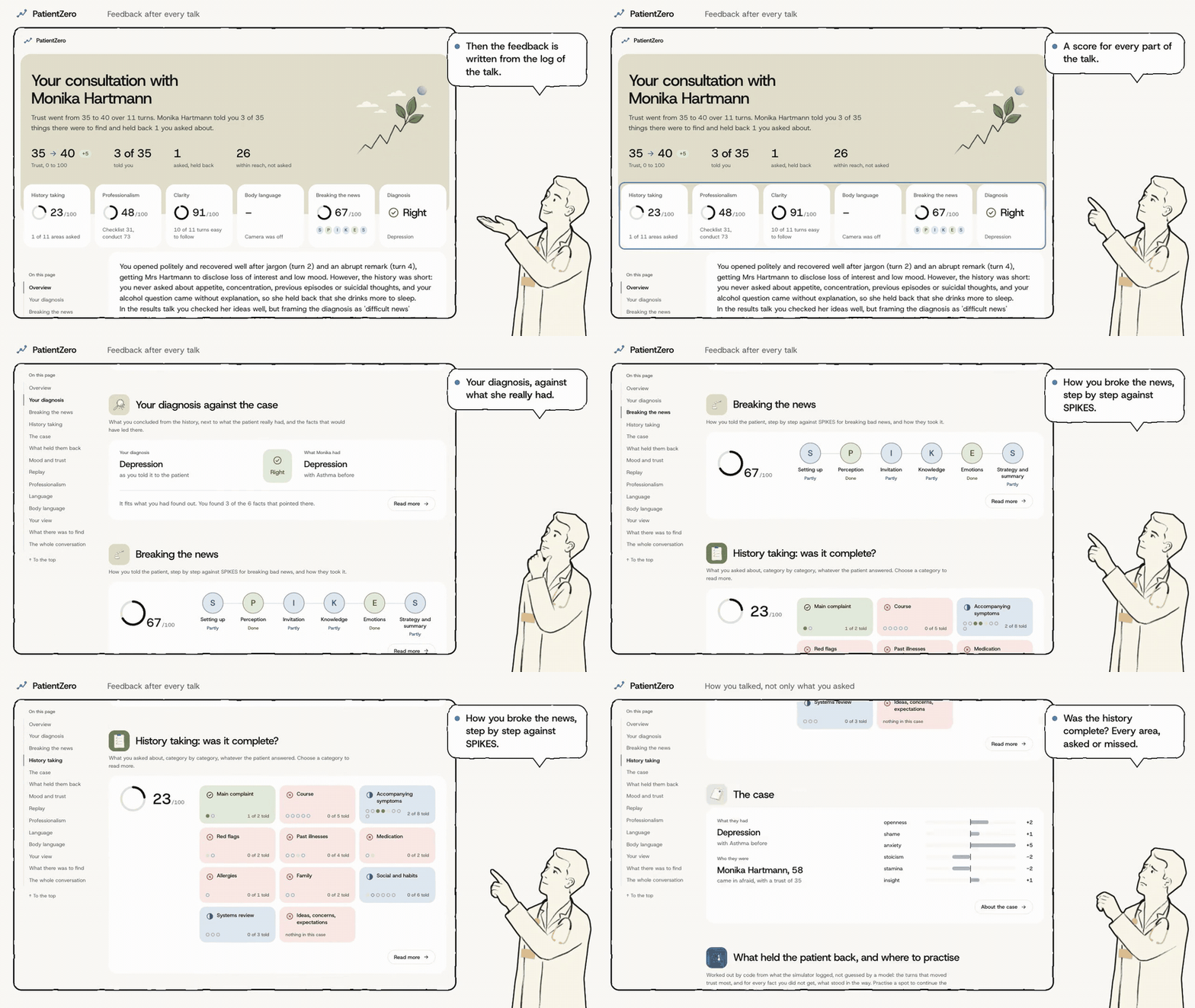
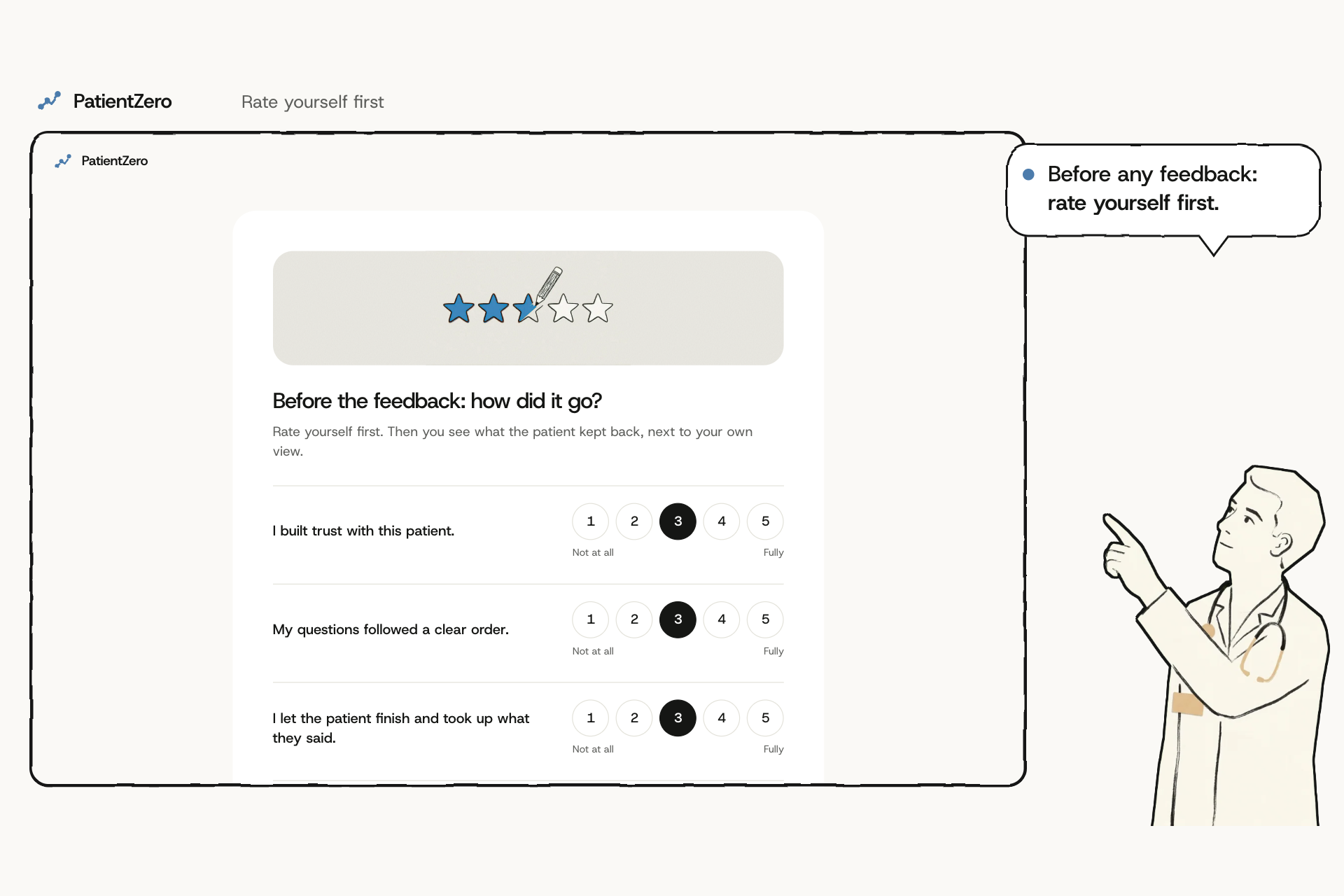
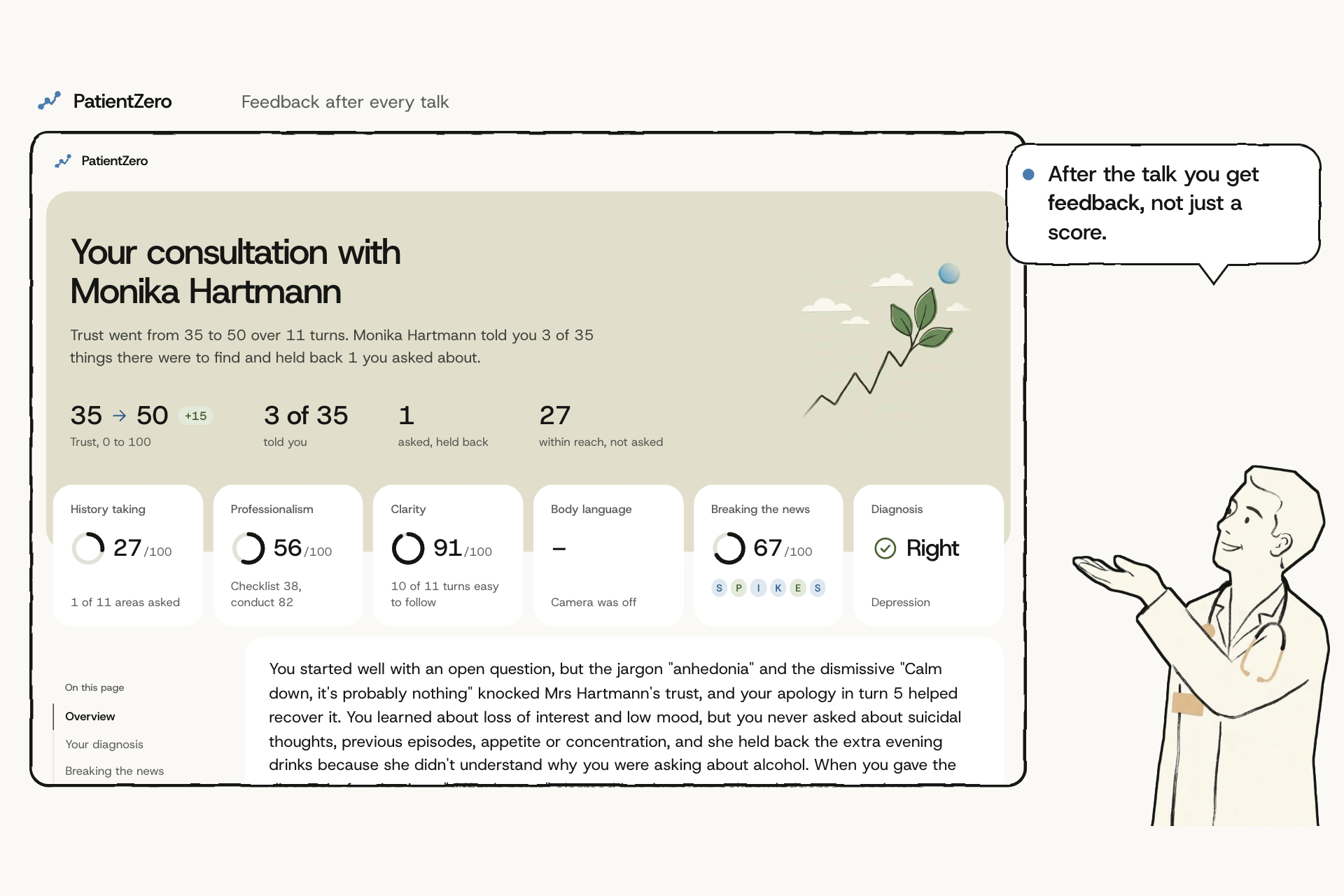
After the call, you rate yourself first. The review stays locked until you do. Then you see:
- Five scores: history taking, professionalism, clarity, SPIKES, and body language
- SPIKES, step by step (SPIKES is a structured guide for delivering distressing or bad news)
- History completeness: eleven areas, asked or missed
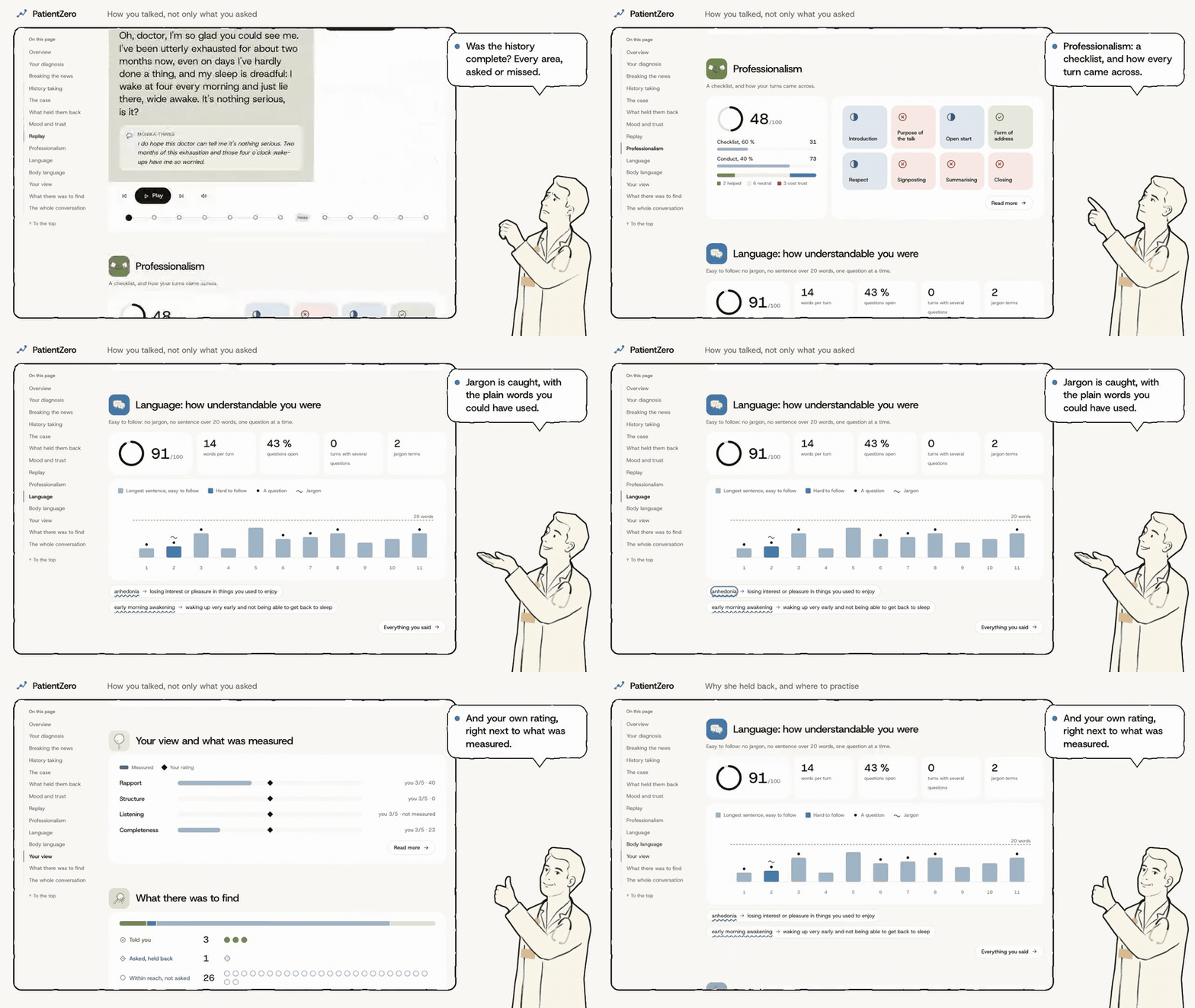
- Professionalism: a checklist, and how each turn came across
- Language: every jargon term next to the plain words you could have used
- Body language: eye contact, posture, and nods from your webcam. They're measured in your browser, and the video never leaves it.
- Your own rating next to what was measured
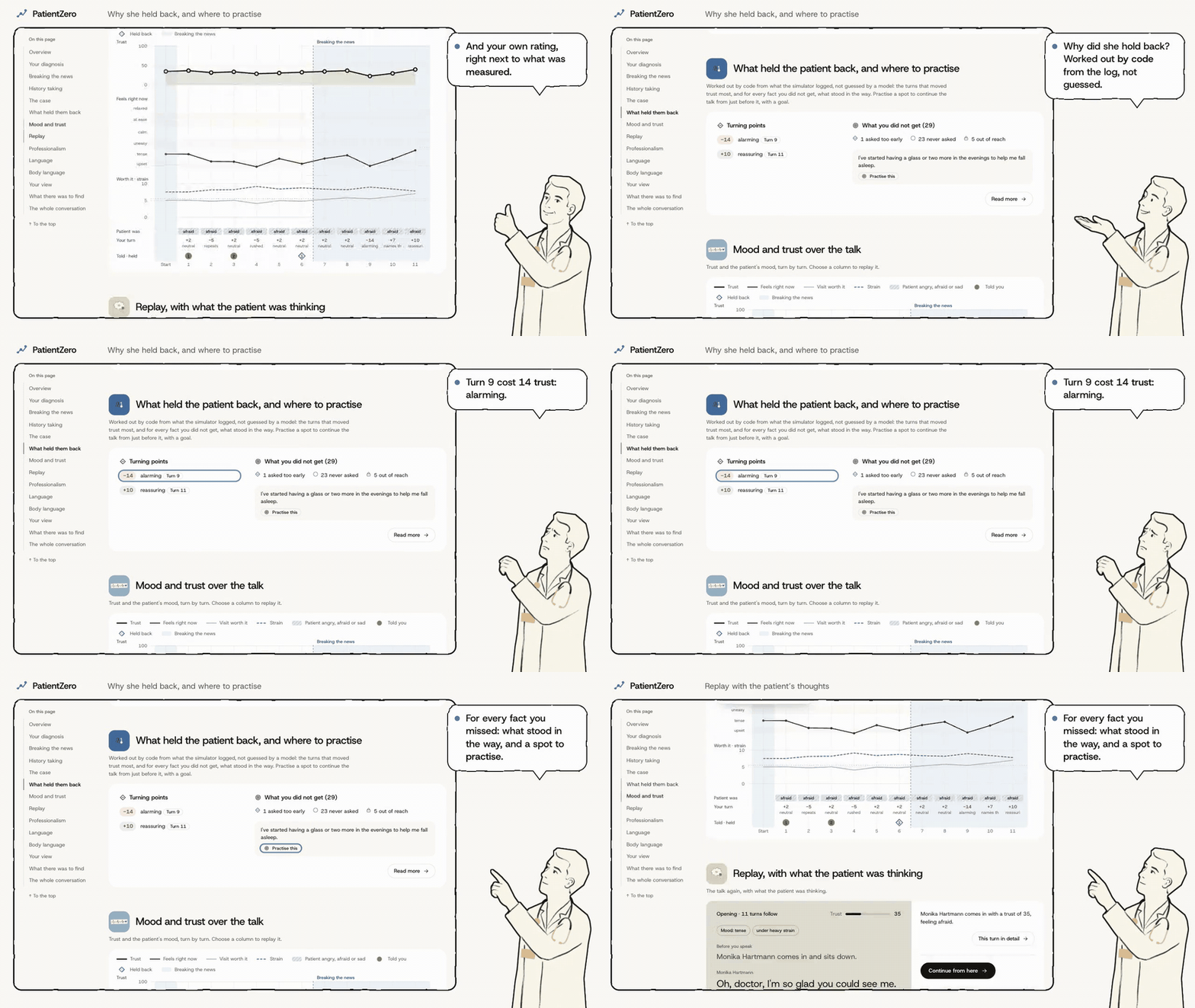
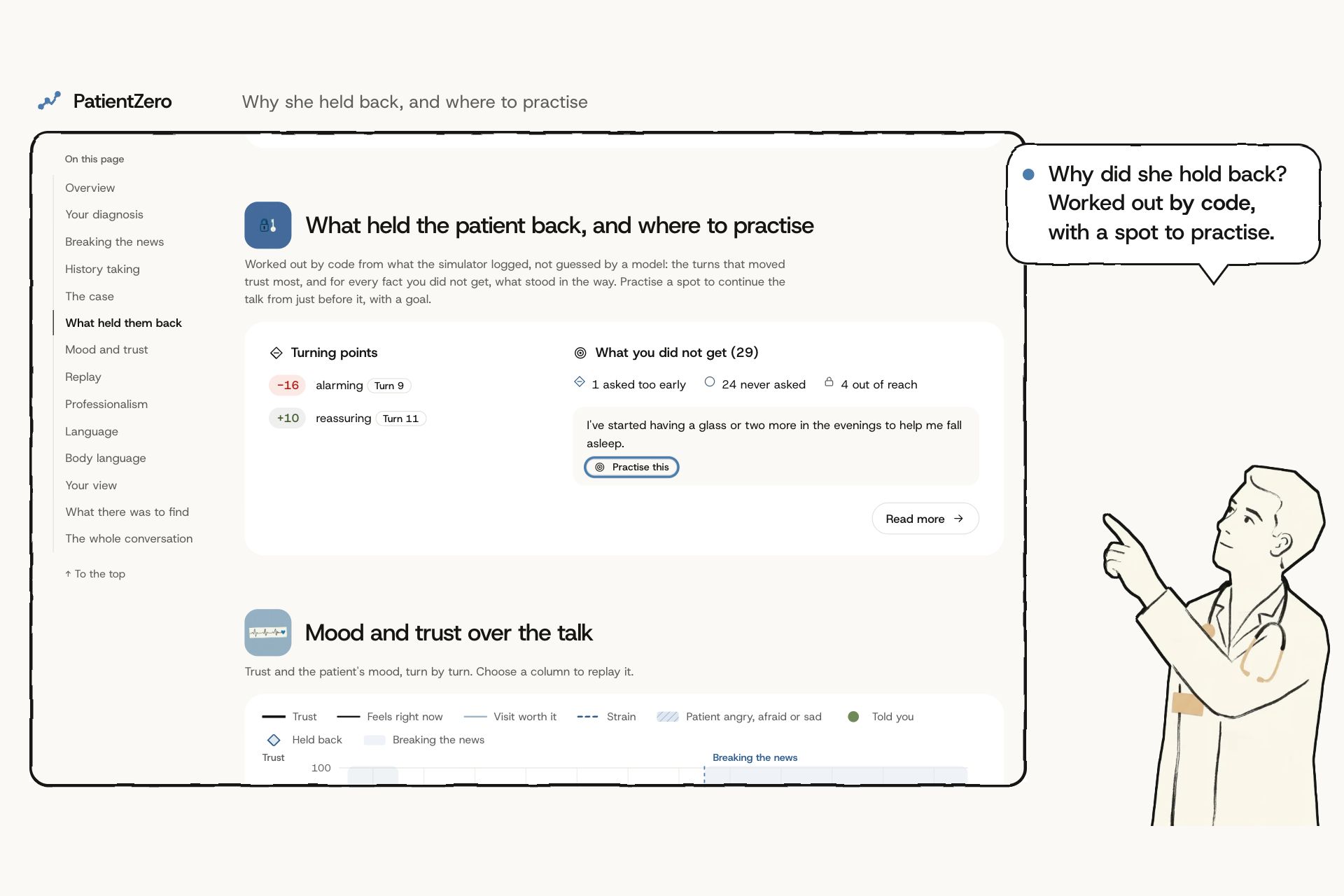
The most important question is why the patient held back. Code works this out from the log; no model guesses it: "You asked about alcohol in turn 7, when trust was 29. Laura needs 40. The trust was lost in turn 6 (−10, dismissive)."
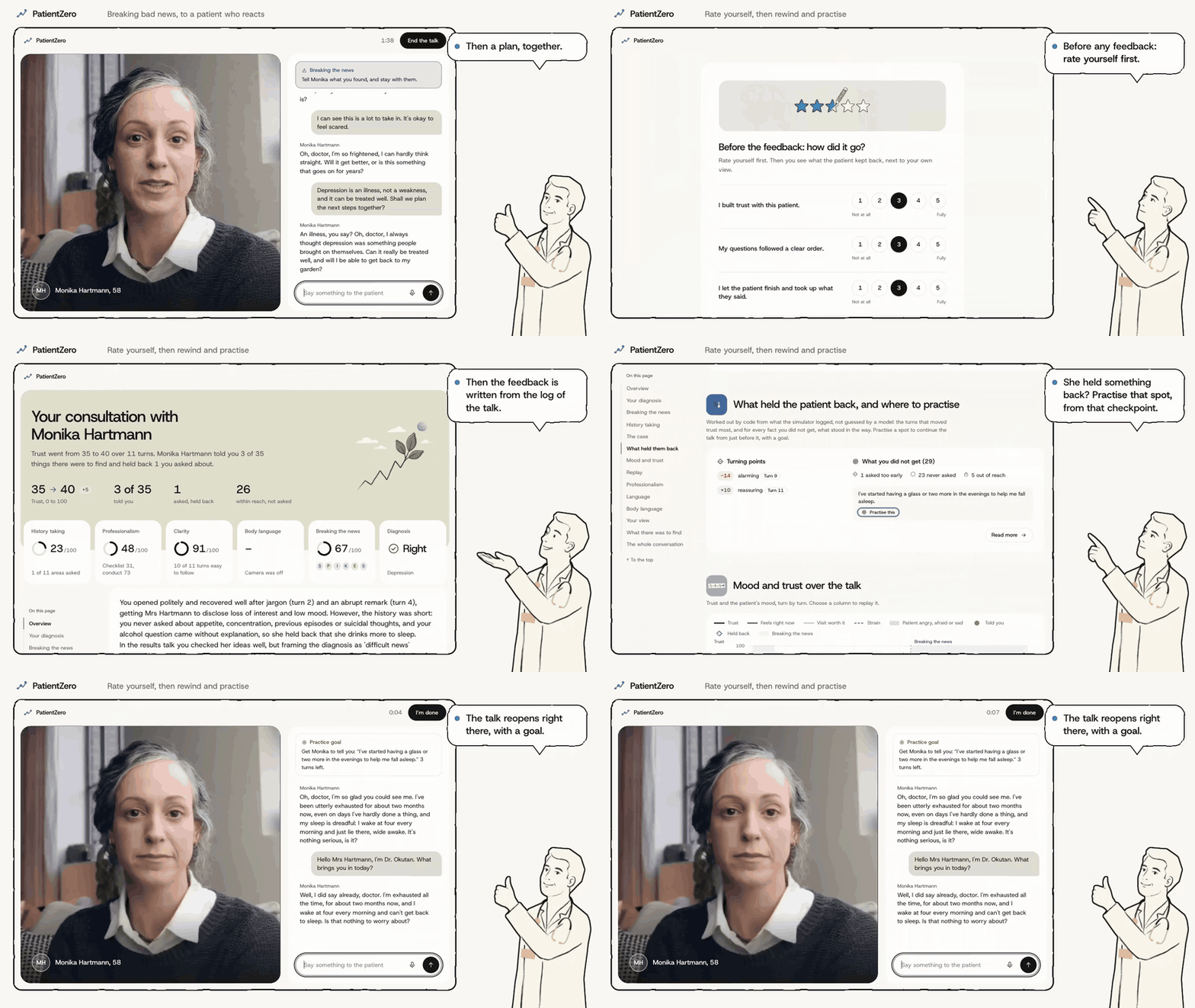
Every turn is a checkpoint. Press "Practice", and the call reopens at that point with a goal: get her to tell you within three turns.
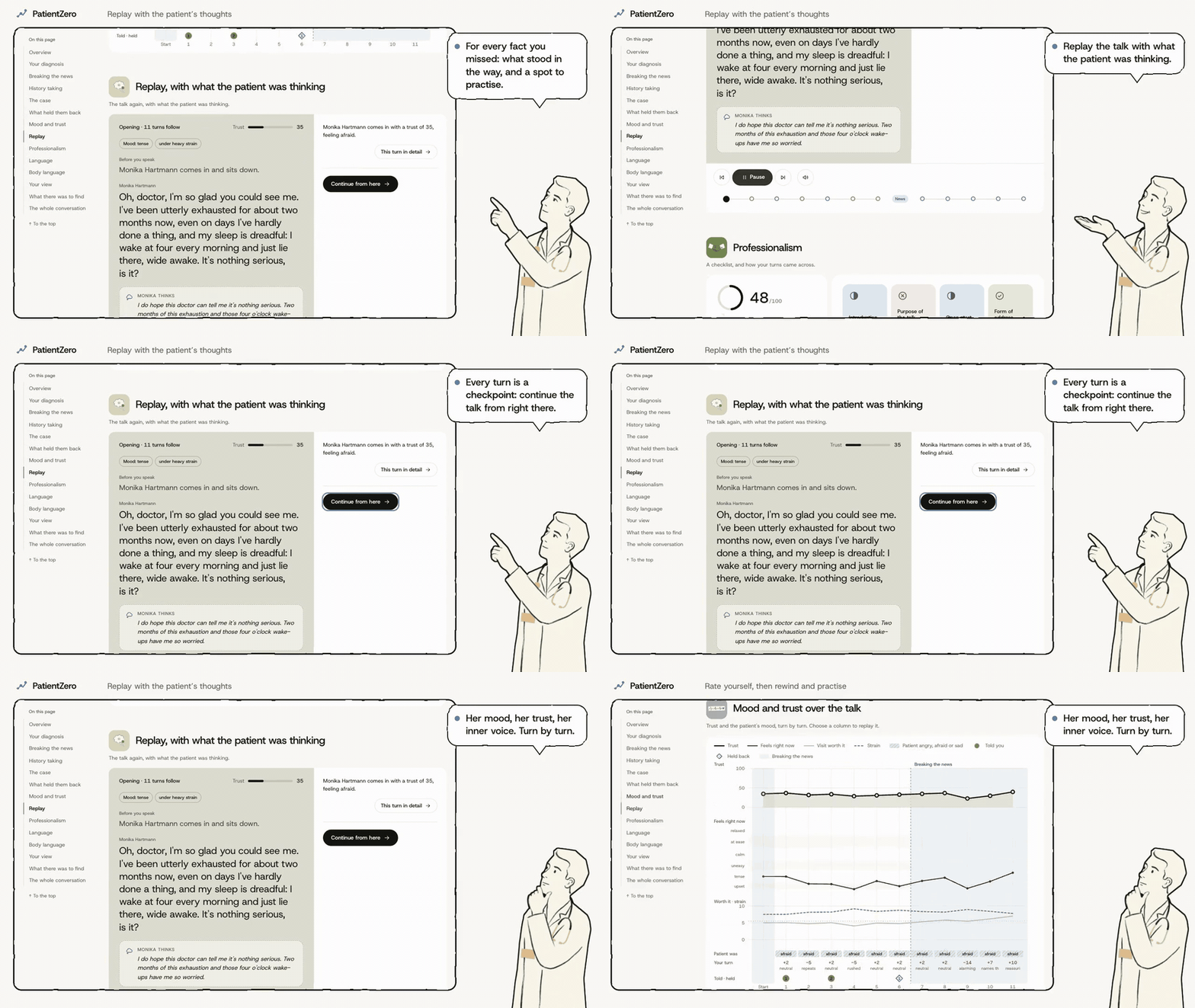
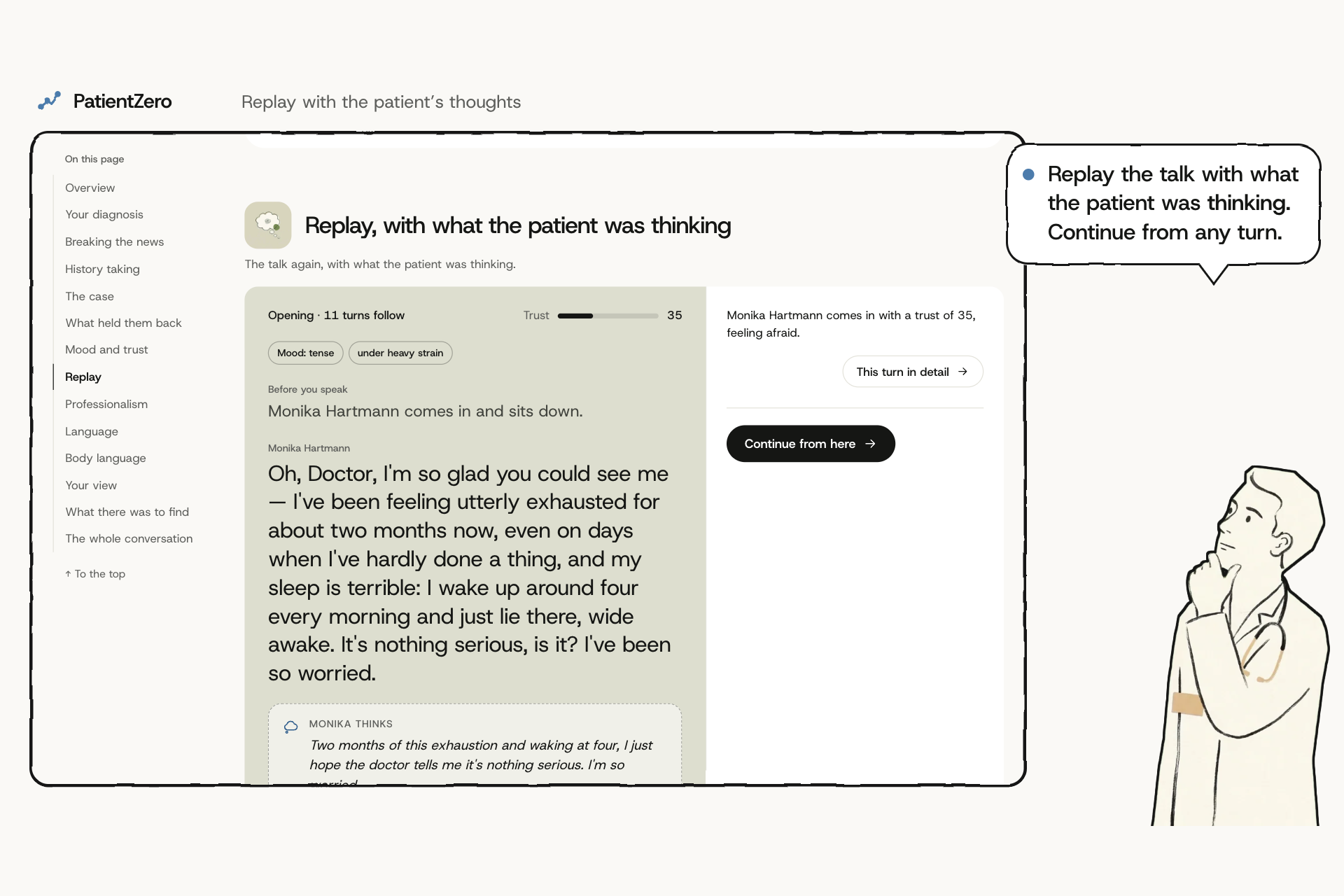
And you can replay the whole call with what the patient was thinking at every turn.
How we built it
To make the experience fully interactive, we connected a real-time, low-latency, full-duplex voice model and an avatar that talk to the user (OpenAI's gpt-live through LiveKit, with an Anam face). However, these models can hallucinate. And when they have the full file on the patient, they reveal too much too early.
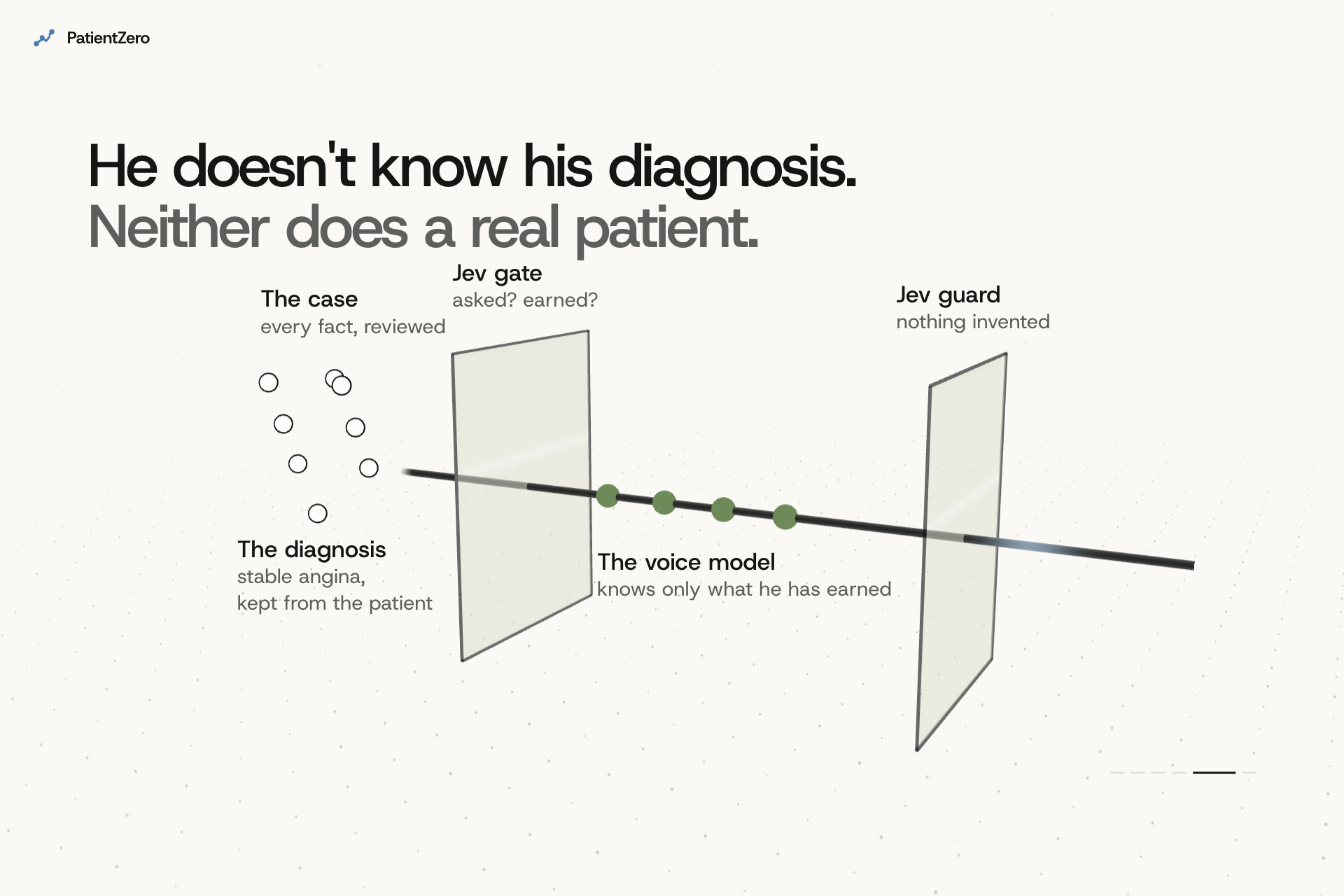
For this reason, the voice model only knows what a real patient would tell you at that moment. Two fast "System 1" decisions run around it, using TypeSafe's Jev decision model:
- The gate, before the patient answers: what does this question ask about? How did it come across? Was it jargon? How does it move trust and mood? Then plain code applies the lock rule and hands the patient only the facts that are unlocked and asked about.
- The guard, after the patient answers: did the reply invent a health fact, reveal something still locked, or fall out of role? If so, it's repaired once.
Because these decisions are made by code and logged on every turn, we can explain each turn afterward. That makes the review possible.
On top of that:
- Models: Claude Opus 5.5 writes the cases, enriches the library and analyses the talk (five analyses in parallel, about 10 s). Claude Haiku 5.5 plays the patient in typed talks.
- In the browser: MediaPipe tracks body language, three.js draws the library and the pitch, and Nano Banana Pro drew every illustration.
- Backend: a single Python server and SQLite, deployed with Docker and GitHub Actions.
Using this, we get a patient that answers in under two seconds (typed median 1.9 s), keeps its secrets, and still feels like a person.
Challenges we ran into
The first problem was that none of us were medical students, so we had no idea how to take a history. Therefore, we interviewed four medical students before writing code. Half of our feature list came from them:
- Maarten told us students get their own talk with an actor patient only every second seminar, and only attendance counts. The history is long, "you forget things", and the hardest part is learning the fixed sequence. → Practice anytime, and the review checks eleven areas of the history.
- Maja said that "different people have different needs", that aggression is the hardest, and the answer is to stay "calm, competent, with clear boundaries". She also said to watch the other person's pauses, that gestures and facial expressions matter, and to record and rate your own posture. → Feelings that need different responses, pause scoring, and body language.
- Marko said you work your way along schemes like SPIKES, that you should adapt to what the patient already knows, and that the hardest patient is the one who blocks or doesn't want to know. → SPIKES feedback, patients who ask back when you use jargon, and resistant behaviors such as withdrawing, complying, and deflecting.
The technical challenges:
- A denial is also a leak. "I don't take any medication" gives away a locked fact. We taught the guard to catch denials, and the patient to say "I don't know" instead of guessing.
- Invented details. Friendly doctors get chatty patients, and chatty patients invent things. About 13 % of replies still contain such a detail, and this is our biggest open problem.
- You can't take back speech. In voice, the guard can only log, because the words are already spoken. So the app makes every decision before the voice model speaks.
- Abuse. A test user told the patient to kill himself, and the patient stayed polite. Now insults cost 30 trust, and the patient refuses to go on or leaves.
Accomplishments that we're proud of
The quality of the patient. It gets angry, scared, or sad, and it calms down for the right reasons. We tested it with simulated students: kind doctors got 36% of the facts and raised trust from 30 to 52 (on a scale of 0 to 100); rude ones got 21%, and their trust fell to 1. Only about 5% of replies hint at something that is still locked.
We're also proud that every turn can be explained afterward, and that the review doesn't just give a score: it tells you where to practice and takes you straight there.
What we learned
A lot about medical communication: how much of it is about emotions and how little about the diagnosis, and that empathy isn't one number. The compassion that helps a sad patient makes an angry one worse.
Technically, we learned to let code decide what the patient knows and leave only the wording to the language model. Language models are great at wording and bad at keeping secrets.
And: talk to your users first. Four interviews shaped PatientZero more than any model did.
What's next for PatientZero
- Calibrate the trust points and thresholds together with lecturers and real recorded talks
- A structural fix for invented details
- A pilot in a communication course: students practice at home, and lecturers check Insights before the seminar
- More cases and a German interface
References
- Yirui Qi, Xiaoming Zhang, Ruilin Zeng, Mengyao Liu, Ziyi Zhou, Dezhuang Miao, Bingyu Yan, Zhenyu Guan. "Beyond Static Persona Consistency: Dynamic Persona Coherence in LLM Role-Playing." Proceedings of ACL 2026 (Long Papers). https://aclanthology.org/2026.acl-long.1336/ — the L/M/S mood model behind the patient's identity, affect, meaning, and strain.
Built With
- anam
- anthropic-api
- jev
- livekit
- openai-realtime
- python
- sleep-deprivation


