Inspiration
Money apps make you do the work: open the app, find the category, type the amount, add the note. For a student in India juggling UPI payments across five different apps, that friction kills the budget by week two. And deal-hunting lives in yet another app entirely — price alerts, wishlists, tabs you never check.
What if one voice-first agent did both? No forms, no typing: just talk, and stay in control of your money.
What it does
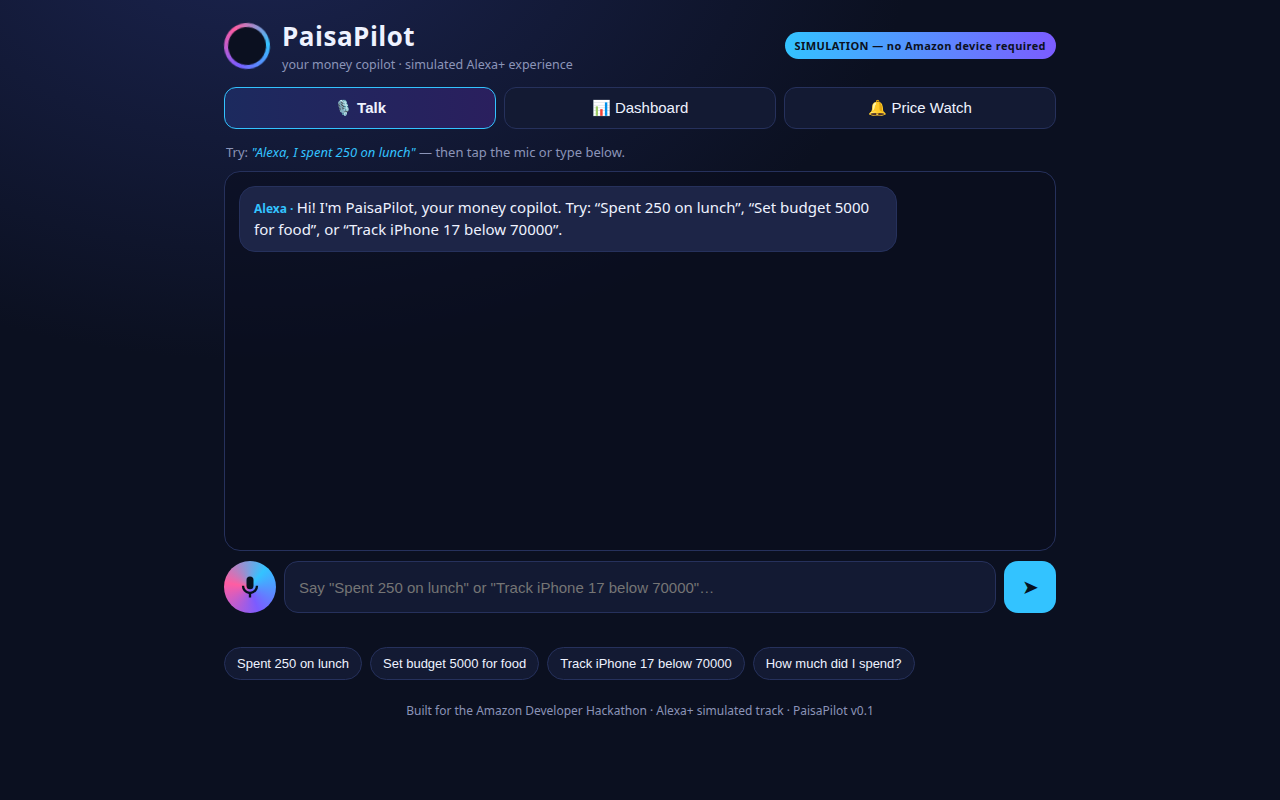
PaisaPilot is a simulated Alexa+ experience — a money copilot you talk to:
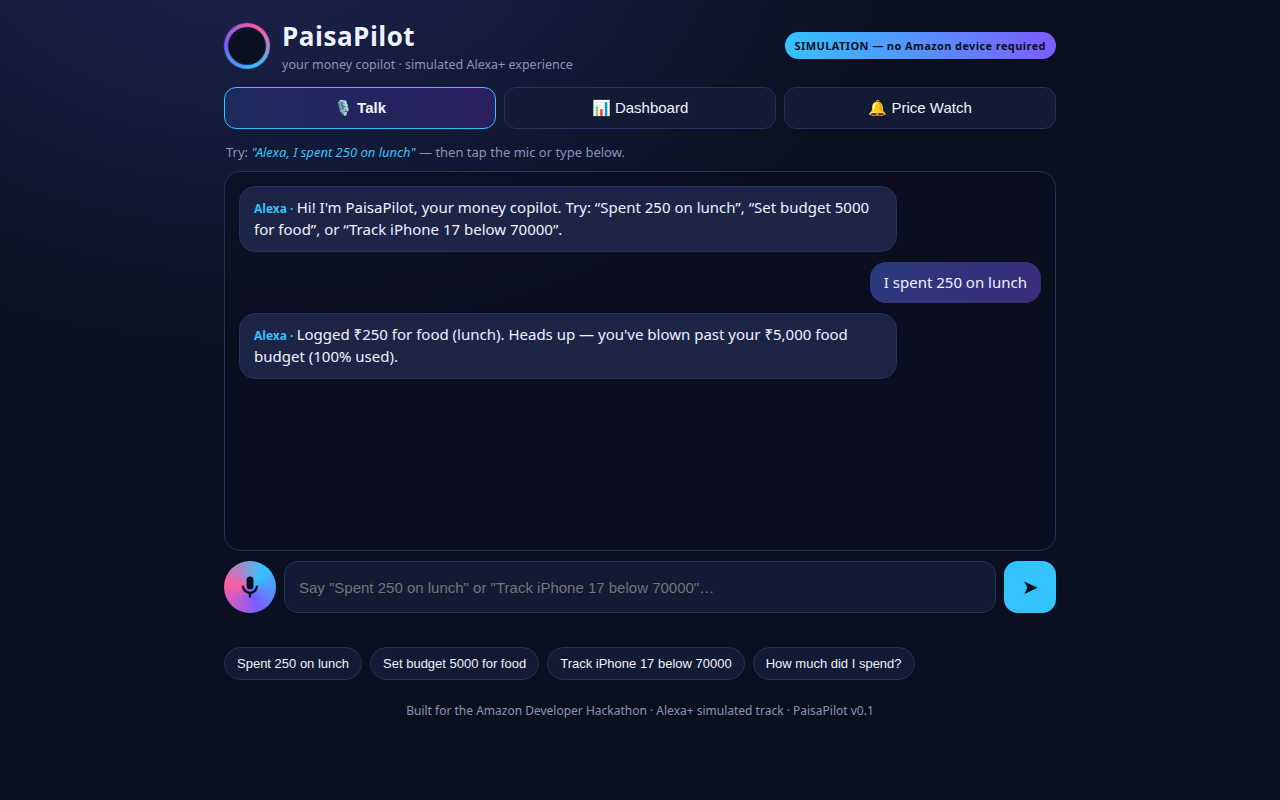
- Voice expense logging — “Alexa, I spent 250 on lunch.” The agent logs it, auto-detects the category (food, transport, shopping, bills, entertainment, health, education, travel), and talks back. Logging takes under five seconds.
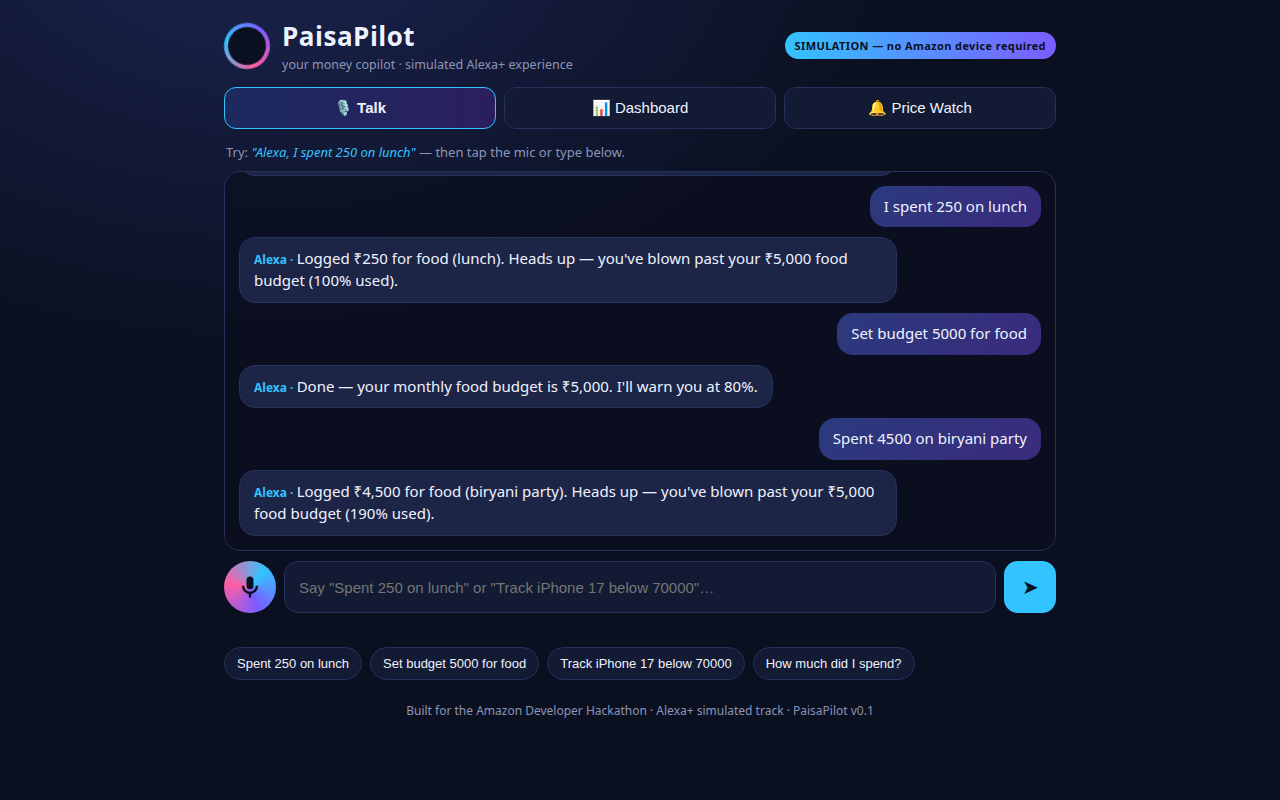
- Budgets that warn you first — “Set budget 5000 for food.” PaisaPilot tracks the month and warns at 80% and 100%: before the money is gone, not after.
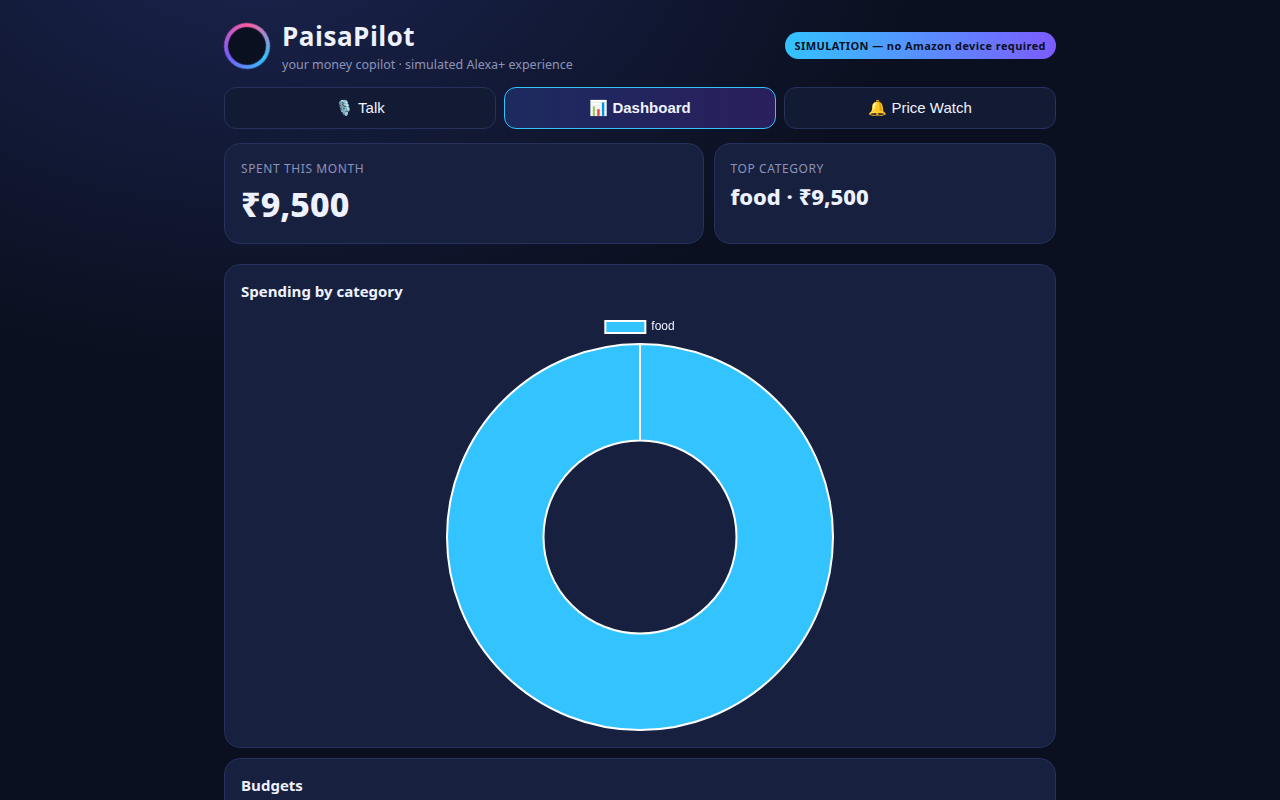
- A dashboard that tells the truth — spending by category, budget bars, recent expenses, all live.
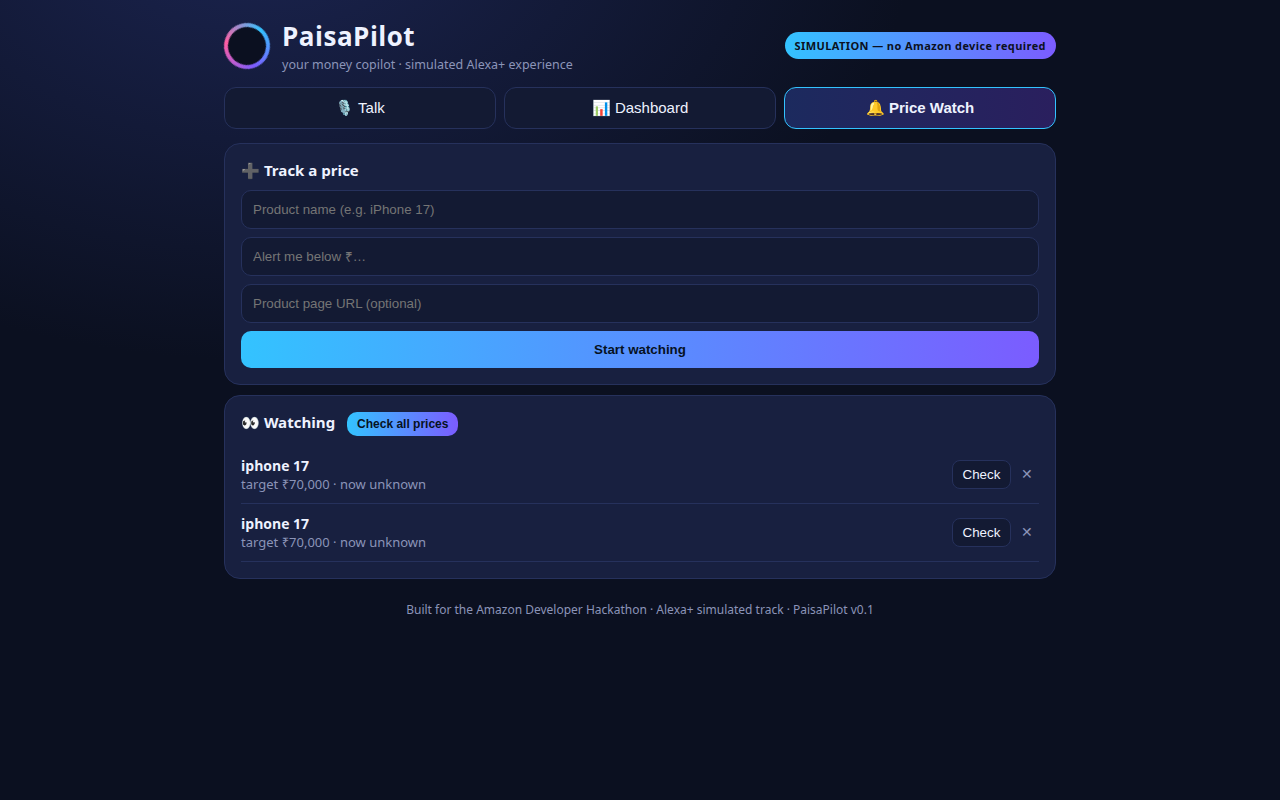
- Deal Watch — “Track iPhone 17 below 70000.” PaisaPilot watches the price and fires a voice + visual alert the moment it drops to your target. Budgeting and bargain-hunting, one agent.
How I built it
- Backend: Python Flask + SQLite.
agent.pyruns the intent pipeline: an Amazon Bedrock hook (llm.py,invoke_model) for LLM intent understanding, with a full offline heuristic fallback — so the demo never depends on a key. - Frontend: a single-page web app with an Alexa-style voice UI — Web Speech API for speech-to-text, speechSynthesis for replies — plus a Chart.js dashboard (vendored locally, works offline) and a price-watch tab.
- Price checks: best-effort extraction from JSON-LD / meta / ₹ patterns, with manual refresh and check-all.
- Demo pipeline: the entire 57-second narrated demo was captured headlessly — Playwright drives the scripted conversation, screenshots every beat, ffmpeg assembles, TTS narrates. Deterministic, re-runnable.
Challenges I ran into
- Web Speech API is Chromium-only and shaky on some accents — the #1 risk to a voice demo. Mitigation: every voice flow also works by typing, and the TTS replies are pre-generated, not live.
- Price extraction fails on JS-rendered retailer pages (most big Indian stores). Shipped with JSON-LD/meta parsing + manual price entry; a headless-browser fetcher is the planned upgrade.
- Demo determinism. A live voice demo is a chaos vector, so I scripted and screenshotted the whole flow headlessly instead of hoping for the best on stage.
Accomplishments that I'm proud of
- A working voice-first money agent, end to end, in a single day — from idea to submitted hackathon entry in one morning.
- Submitted three weeks early, with a public repo (MIT), a narrated demo video, and a friction log kept from the first command.
- The agent genuinely works: heuristic parsing handles real phrasings (“I spent ₹500 for groceries”), budgets warn at exactly the right moments, and the whole thing runs offline.
What I learned
- Voice beats forms for habit-forming tools. If logging an expense takes more than five seconds, the habit dies. Talking is the fastest input there is.
- Always ship an offline fallback for demo-critical paths. The Bedrock hook is the future; the heuristic parser is the present that never fails on stage.
- Friction logs are a feature, not a chore — writing down every snag made the build calmer and earned judging bonus points.
What's next for PaisaPilot
- Wire up Bedrock fully once the $150 hackathon AWS credits land — then enter the AWS Builder mini-challenge and update this submission.
- Headless-browser price fetcher for JS-rendered stores (Flipkart, Amazon.in).
- Real Alexa+ skill path — graduate the simulation into an MCP server / Agent Skill once the Alexa+ preview opens up.
- UPI autopilot — the dream: read-only SMS parsing to log spends automatically, with the user's explicit permission. Talk first, automate later.
Built With
- flask
- javascript
- python
- sqlite
- web-speech-api


Log in or sign up for Devpost to join the conversation.