\documentclass{article} \usepackage{graphicx} % Required for inserting images
\title{cadathon} \author{K Yogitha Sarayu, Sonam Lhamu} \date{13th September, 2026}
\usepackage[margin=1in]{geometry} \usepackage{times} \usepackage{titlesec} \usepackage{enumitem} \usepackage{hyperref} \usepackage{parskip}
\titleformat{\section}{\large\bfseries}{}{0em}{}[\titlerule] \titlespacing{\section}{0pt}{12pt}{6pt}
\title{\textbf{PaINtBud}\[4pt]\large A Wearable Forearm-Mounted Tool Holder for Accessible Painting and Sketching} \author{} \date{}
\begin{document}
\maketitle \vspace{-1.5cm}
\section*{Overview} PaintBud is a wearable forearm-mounted tool holder that reduces hand-grip demands, helping people with limited dexterity paint and sketch with greater comfort and independence.
\section{Inspiration}
Many people who love painting and sketching, including those with arthritis, tremors, limited grip strength, or other conditions affecting fine motor control, struggle to hold brushes, pencils, and other tools steady for extended periods. We were inspired by the idea that creative expression shouldn't be limited by hand strength or dexterity, and we wanted to design something that shifts the physical burden of gripping away from the hand and onto a more stable, supported structure.
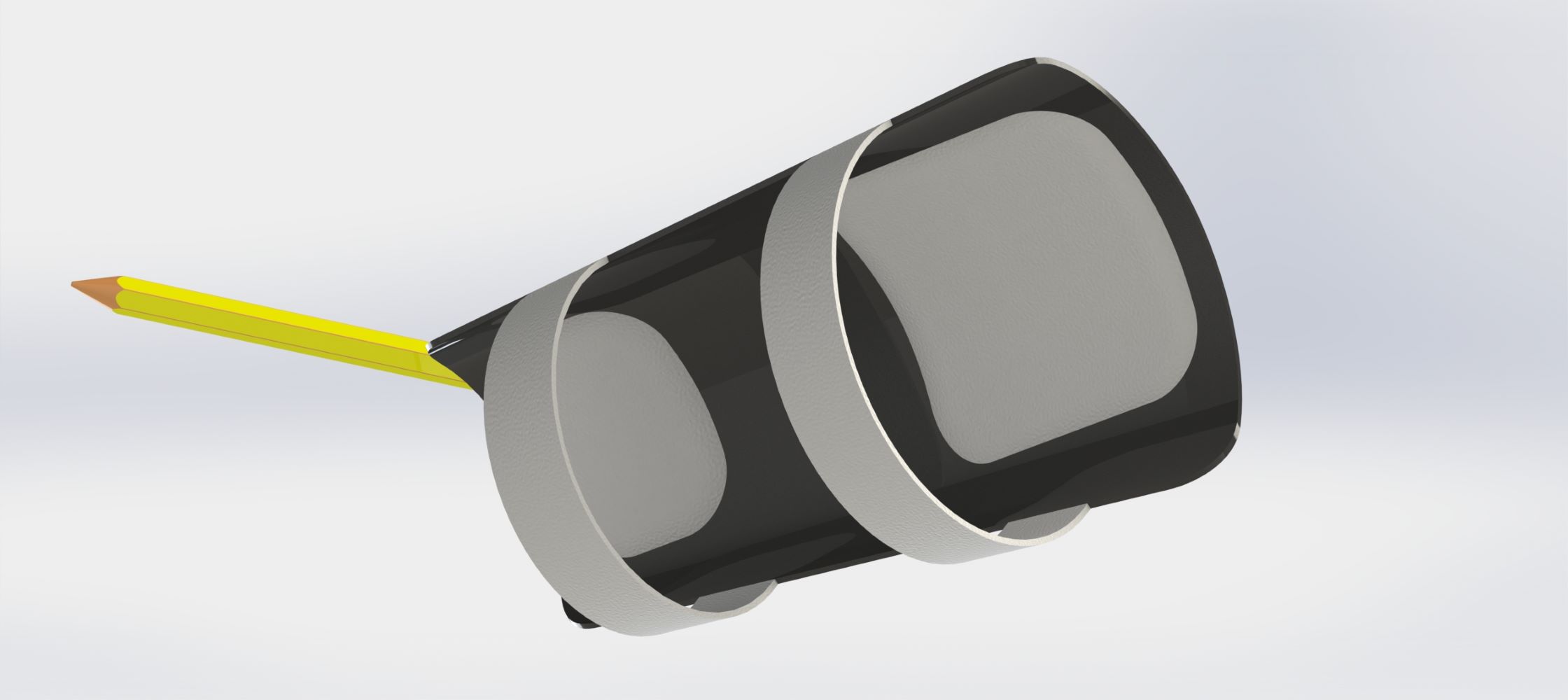
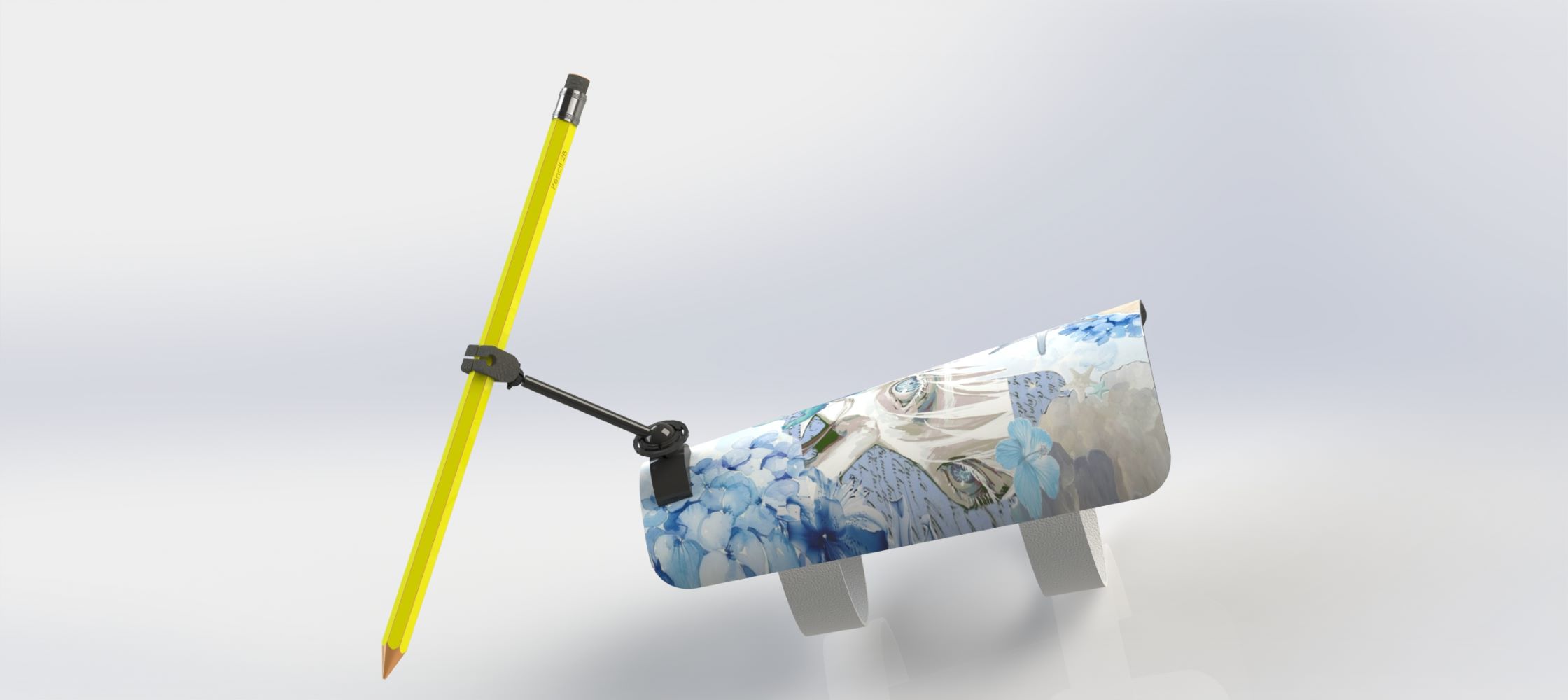
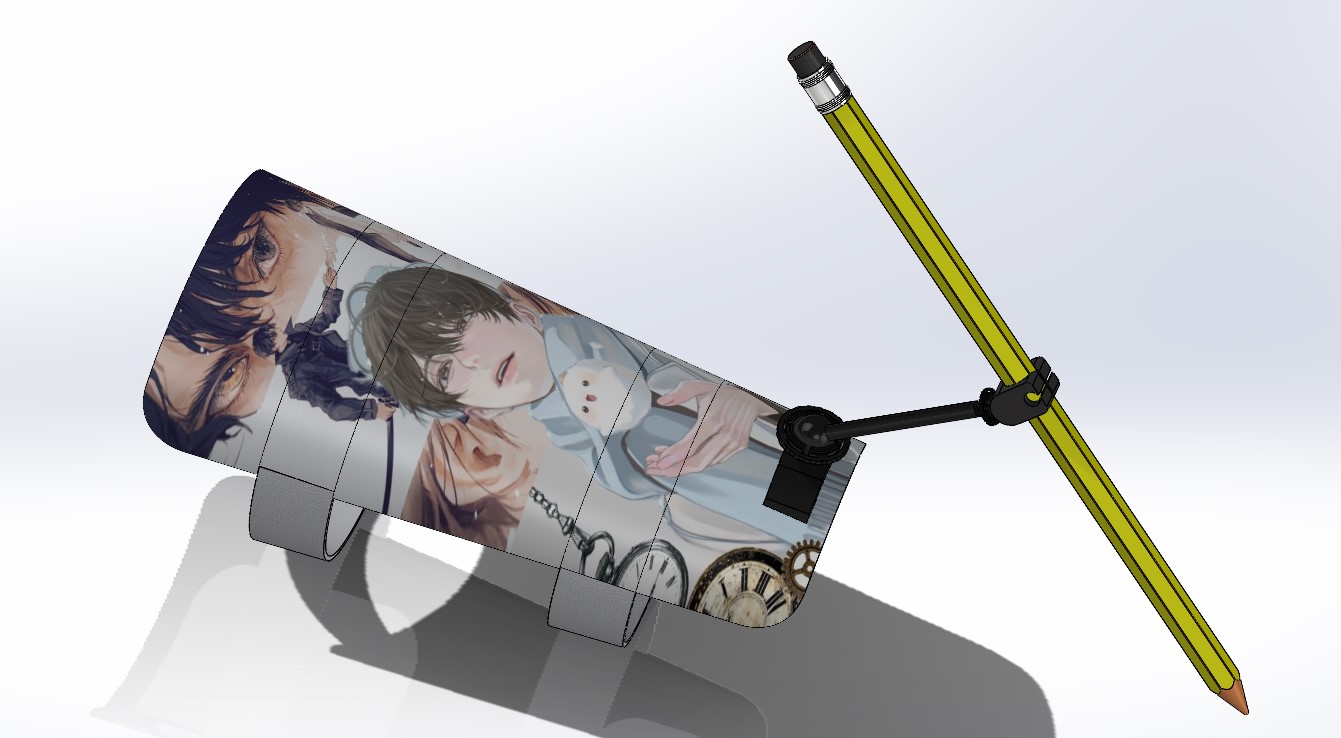
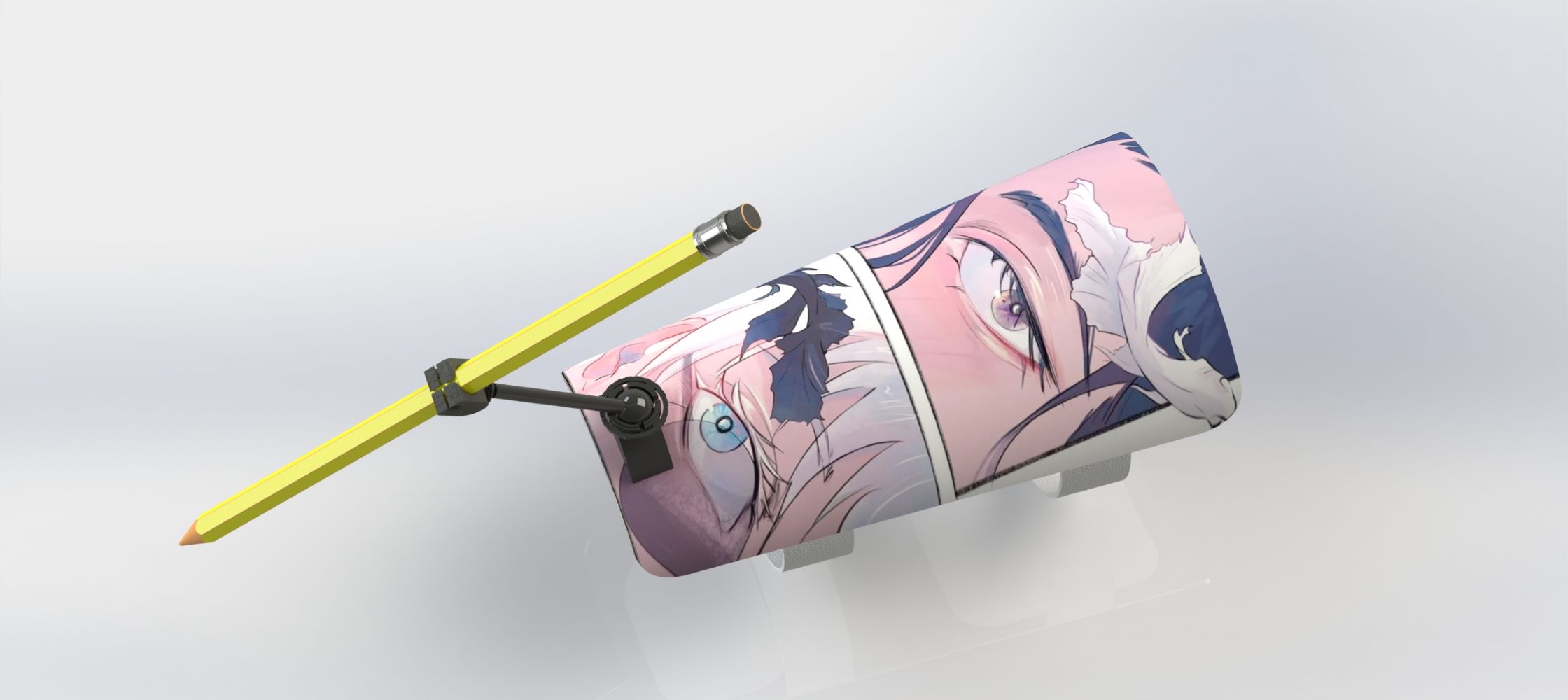
\section{What it does} PaintBud is worn on the forearm and holds painting and sketching tools in place, so the user does not need to maintain a tight or sustained grip to keep a brush or pencil steady. By redistributing the mechanical demand from the fingers and hand to the forearm, it allows users with limited dexterity to guide their tools with broader, more controllable arm movements rather than fine finger movements, making painting and sketching more comfortable and accessible.
\section{How we built it} % Fill in any additional materials, tools, and fabrication process details. \begin{itemize}[leftmargin=1.5em] \item Modelled the wearable holder, strap, and housing mechanism using 3D CAD design software to ensure precise fit and mechanical function before fabrication. \item Added a ball-and-ring fitted joint between the cuff and the tool mount, giving the holder a wide, smooth range of motion so users can angle and rotate the brush naturally without needing fine finger control. \item Lined the tool-mounting socket with rubber to grip the brush firmly, preventing slippage while still allowing tools to be inserted and swapped easily. \item Added cushioning inside the cuff to distribute pressure evenly across the forearm and keep the device comfortable during extended wear. \item Iterated on the tool-mounting mechanism to securely hold different tool diameters (brushes, pencils, markers). \item Tested fit, comfort, and range of motion through multiple prototype revisions. \end{itemize}
\section{Challenges we ran into} % Fill in the real obstacles your team faced. \begin{itemize}[leftmargin=1.5em] \item Balancing rigidity (to keep tools stable) with flexibility (to allow natural arm movement). \item Designing a strap/mounting system comfortable enough for extended wear. \item Accommodating a range of forearm sizes and tool types with a single adjustable design. \item Selecting the right joint type for each motion, matching joint kinematics to the movement needed, without adding unnecessary degrees of freedom that compromise tool stability. \end{itemize}
\section{Accomplishments that we're proud of}
\begin{itemize}[leftmargin=1.5em] \item Developed a complete, functional design that successfully reduces hand-grip effort during use. \item Created a design that is adjustable and comfortable across different users. \item Built a device that prioritises what matters most to users, not just function, but the freedom to keep doing something they love. \end{itemize}
\section{What we learned} % Fill in technical and non-technical takeaways. \begin{itemize}[leftmargin=1.5em] \item Gained hands-on experience with iterative prototyping and user-centred design. \item Learned how small ergonomic adjustments can significantly impact usability for people with limited dexterity. \item Deepened our understanding of accessible design principles. \end{itemize}
\section{What's next for PaintBud} % Fill in your roadmap. \begin{itemize}[leftmargin=1.5em] \item Refine the mounting mechanism to support a wider variety of tools and grip angles. \item Conduct broader user testing with occupational therapists and artists with limited dexterity. \item Explore lighter, more breathable materials for extended comfort during long sessions. \item Investigate adjustable angle/height features to support different painting and sketching styles. \end{itemize}
\end{document}
\begin{document}
\maketitle
\section{Introduction}
\end{document}
Built With
- photoview360
- solidworks

Log in or sign up for Devpost to join the conversation.