Inspiration
PainPath is a chronic pain platform. Patients paint their pain onto a body model in AR on a Meta Quest 3; physiotherapists review those sessions in a web portal, adjust an AI-generated exercise plan, and approve it.
The portal had a login. Email, password, the usual, and a credential store sitting behind it.
That store is the part that kept bothering me. A pain diary is not a low-stakes dataset. It says who is in pain, where, how badly, and for how long. If an attacker gets the credential table, they get the door to all of it, and the people behind that door are already having a bad time.
The safest credential database is the one that does not exist. Midnight is the first platform where "does not exist" is something you can actually implement rather than something you put on a slide.
What it does
A clinician logs into PainPath without a password, and without the server ever learning anything that could be used to impersonate them.
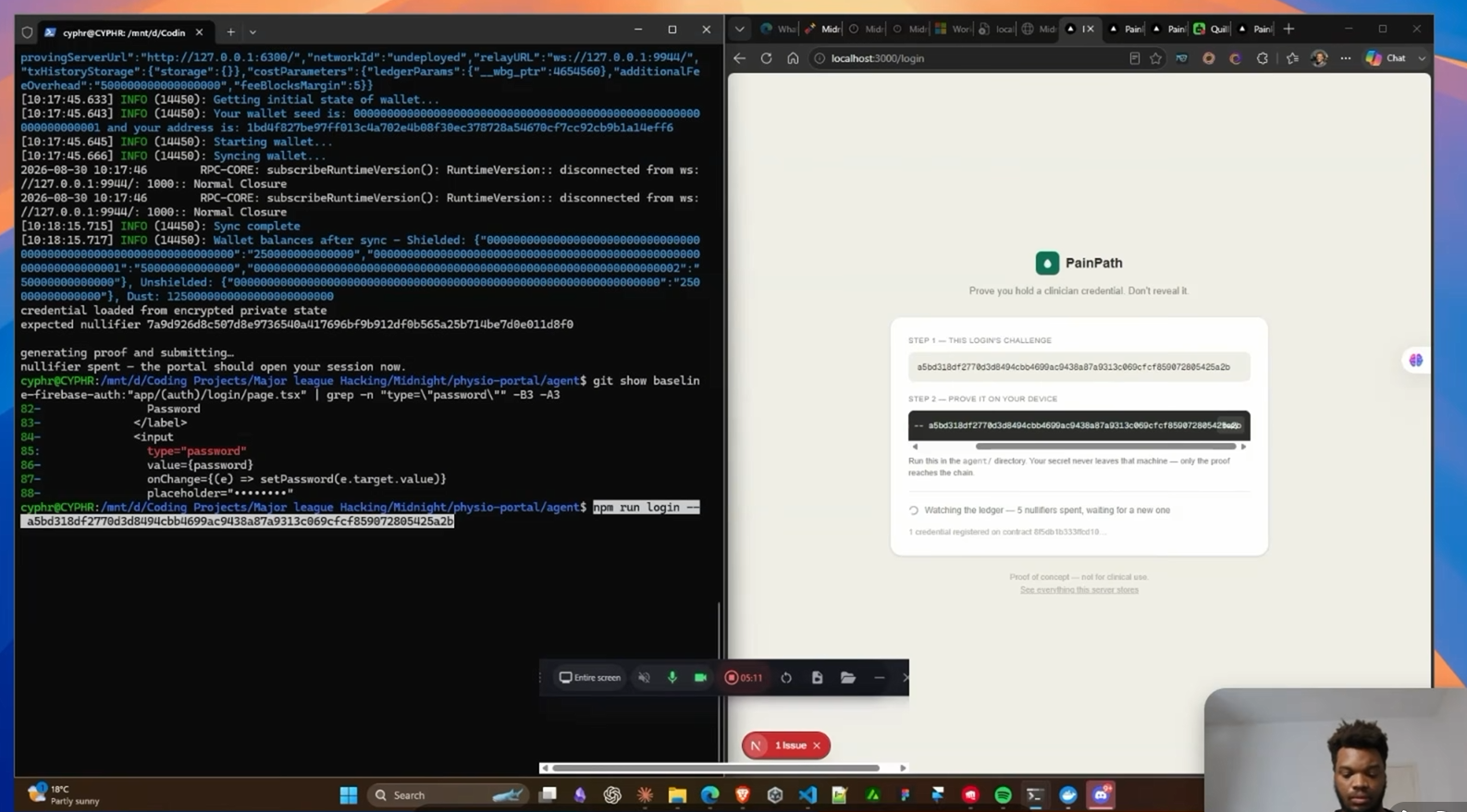
The clinician's device generates 256 bits of crypto-random entropy. It never leaves that machine. register hashes it with a domain-separated prefix and publishes only the commitment to the Midnight ledger. To log in, the portal issues a fresh random challenge. The clinician proves they know a secret whose commitment is in the registered set. The proof emits a nullifier bound to that challenge. The portal watches the ledger. A nullifier it has never seen appears, and only then does it open a session. What the server holds afterwards: no password, no hash, no salt, no secret. What the ledger holds: two sets of 32-byte hashes, neither invertible.
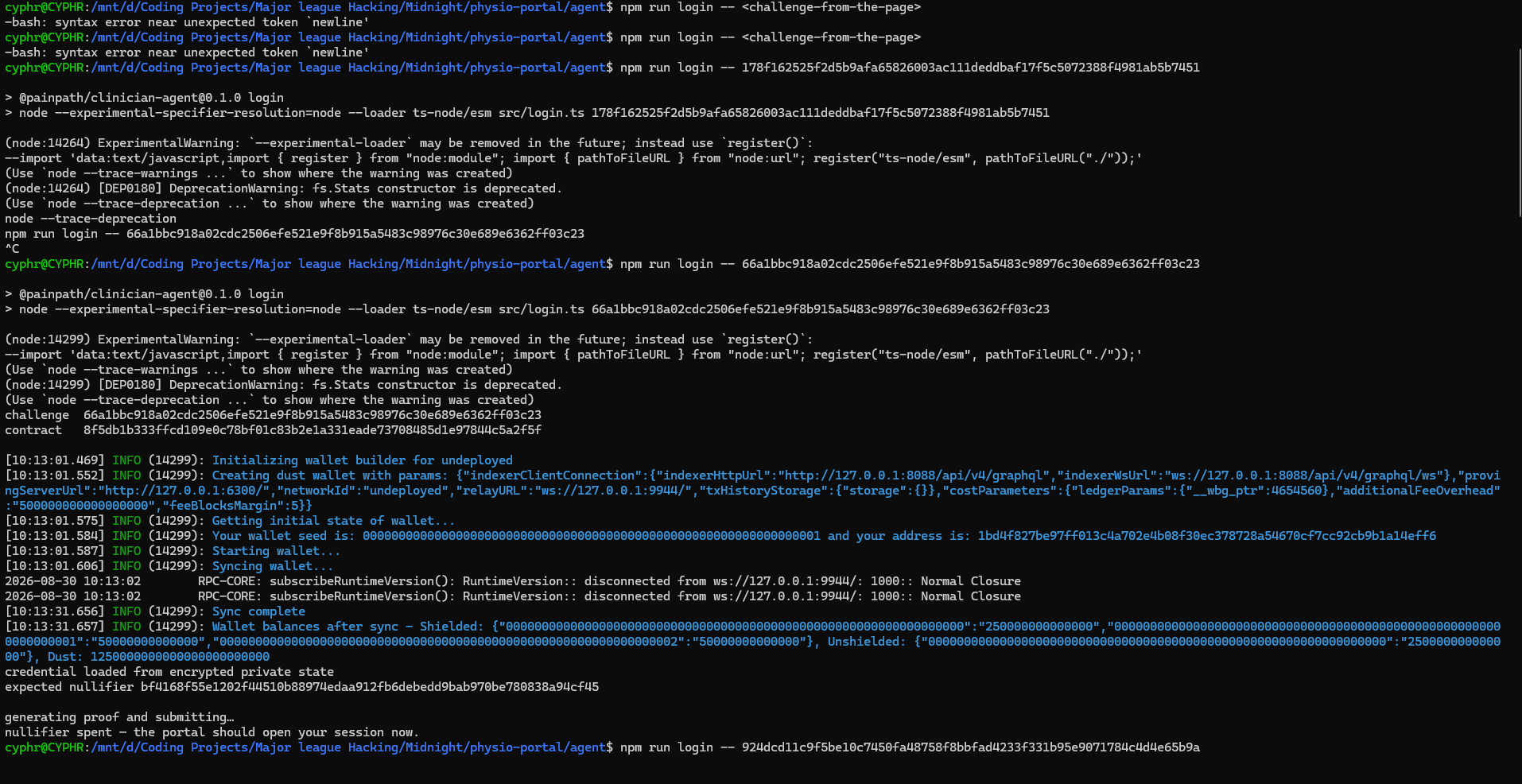
Replaying a captured proof fails, because the nullifier is already spent. A fresh login still works, because the next challenge produces a different one.
How we built it
Prior work, declared. The PainPath physio portal (Next.js, patient list, pain heatmap, AI assessment, plan editing, approval flow), the Meta Quest 3 Unity app, the Firestore schema and the Gemini-backed plan generation all predate this weekend. The exact pre-hackathon state is preserved at the git tag baseline-firebase-auth, committed untouched as the first commit, so the weekend's work reads as a clean diff.
Built this weekend: the Compact contract and its tests, the clinician agent, the local Midnight stack, the challenge/nullifier session gate, and the verifier panel. Firebase Auth, Firestore and the Quest ingest pipeline were removed.
The contract is Compact, forked from the bulletin board tutorial rather than started from an empty file:
export ledger commitments: Set>; export ledger nullifiers: Set>; witness localSecret(): Bytes<32>; export circuit credentialCommitment(sk: Bytes<32>): Bytes<32> { return persistentHash>>([pad(32, "painpath:cred:"), sk]); } export circuit sessionNullifier(challenge: Bytes<32>, sk: Bytes<32>): Bytes<32> { return persistentHash>>( [pad(32, "painpath:auth:"), challenge, sk] ); } register asserts the commitment is not already present, then inserts it. authenticate asserts set membership, derives the challenge-bound nullifier, asserts it is unspent, and spends it. Two distinct domain prefixes mean a nullifier can never be replayed as a commitment.
The compiler's own manifest is the leak check: register takes no public arguments at all. The secret exists only as a witness, and both ledger fields can hold nothing but 32-byte hashes.
Around it: the pre-existing Next.js portal, a local Midnight stack in Docker (node, indexer, proof server), and a clinician agent holding the secret in LevelPrivateStateProvider, which encrypts at rest.
Challenges we ran into
A design flaw we shipped and then caught. The obvious nullifier is H(domain, secret). We built that, then realised it makes every account single use, the second login finds its own nullifier already spent. Binding the nullifier to a per-login challenge fixes it: a replayed proof still collides because the challenge is unchanged, but a fresh login succeeds. There is a test asserting exactly that.
Three bugs, two of them the same disease. Duplicate module instances break identity checks, and the error messages actively mislead you. Three copies of compact-js meant three distinct Symbol() keys, so a contract lookup returned undefined and we got Cannot read properties of undefined (reading 'ctor'). Two copies of onchain-runtime-v3 meant StateValue failed instanceof across them. Both were fixed by making the repo an npm workspace with pinned overrides, which is exactly how the Midnight examples are structured, a detail that stays invisible until you copy their code into a differently shaped repo.
A path with a space in it. new URL(import.meta.url).pathname is percent-encoded. Our repo lives under Coding Projects, so the ZK config provider looked in /Coding%20Projects/..., found nothing, and reported Failed to read verifier key. The keys were on disk and correct the entire time.
Windows. Midnight has no native Windows support, so the toolchain lives in WSL. Turbopack cannot handle WASM plus top-level await, so the portal builds with --webpack and explicit asyncWebAssembly experiments. One node_modules cannot serve both platforms, so everything runs Linux-side.
Accomplishments that we're proud of
The replay is refused by the circuit, not by us. On a real node:
replay rejected: failed assert: this proof has already been used That string is the contract's own assert, fired on chain. We didn't catch it in application code and log something reassuring.
We closed our own bypass. For most of the build the portal's login was a placeholder that set a cookie unconditionally, the chain enforced the rule and the web app never asked it. Anyone could walk in. That gap is now shut: an unauthenticated request is redirected, a forged cookie matches no server-side session, and a session opens only when a nullifier appears that was not on the ledger when the challenge was issued.
The claim is checkable, not assertable. The verifier panel dumps every cookie, every environment variable name, the session store and every file on disk, right next to the ledger's contents. Server: four zeros. Chain: hashes. Anyone can open it, it is deliberately unauthenticated.
The contract compiled first try, and 14 tests cover registration, authentication, replay rejection, repeated login with a fresh challenge, unregistered secrets, cross-clinician isolation, domain separation, and that nothing but 32-byte hashes ever reaches the ledger.
What we learned
That "the server stores nothing" is a claim you have to be able to show. It is easy to say and almost impossible to believe without evidence, which is why the verifier panel exists and why it is open to anyone.
That the compiler is a real safety net. Compact refuses to let witness data reach the ledger without an explicit disclose(), and the generated manifest told us definitively that register has no public inputs at all, a stronger guarantee than reading our own code and hoping.
That witnesses are untrusted input. The docs are blunt about it: never assume a witness returns what your implementation returns. Every circuit asserts.
And that the honest version of a security claim is narrower than the exciting one, and worth considerably more.
What's next for Painpath portal with Midnight intergration
Deploy to preprod. The contract is network-agnostic and the same build targets testnet; we prioritised a working end-to-end round trip on a local node over a deployment.
Record challenge → nullifier in the contract. Today the portal checks that a new nullifier appeared, which means concurrent logins could bind a session to the wrong one. Storing the pairing on chain removes that caveat entirely.
Move the clinician's side into the browser. It currently runs as a local agent, because submitting a transaction needs a wallet and Lace only connects to its own networks. The security property is identical, the portal never sees the secret, but a browser tab is a better story than a process.
Social recovery, or a recovery commitment. Account recovery is unsolved: lose the secret, lose the account.
Clinician credential proofs. Prove you hold a valid professional registration without revealing which clinician you are, moving from "login" to "verify without revealing".
Built With
- compact
- compactc
- docker
- leveldb
- midnight
- midnight-js
- nextjs
- node.js
- react
- rxjs
- tailwindcss
- typescript
- vitest
- webpack
- wsl
- zero-knowledge-proofs
- zk-snarks


Log in or sign up for Devpost to join the conversation.