Inspiration
This project was born from conversations with people living with chronic pain, conditions that are deeply personal, difficult to explain, and nearly impossible to measure with existing tools. Again and again, we heard the same frustration: sitting in a doctor's office and being asked to rate pain on a scale of one to ten, or point to a face on an emoji chart. These tools haven't meaningfully evolved in decades, yet pain itself is anything but simple. Over 1.5 billion people worldwide live with chronic pain, making it the leading cause of disability globally. And yet, pain remains largely invisible; to healthcare providers, to caregivers, and often even to the people experiencing it. What struck us most wasn't just the suffering, but the silence around it: the absence of a real language to describe what's happening inside the body. That realization led us to one central question: what if people could actually see their pain?
What We Learned
Our research revealed that pain is processed through the nervous system via signals called nociception. Although the body is constantly detecting and transmitting these signals, most people only ever experience the end result; the sensation without any visibility into where it originates or how it changes over time. We also discovered that emotional and physical pain share overlapping neural pathways in the brain. This reshaped how we thought about pain entirely: not just as a symptom to be managed, but as a complex, dynamic signal that could potentially be captured, visualized, and understood. These insights gave us a design direction, a system that could translate invisible biological signals into something observable and meaningful.
How We Built It
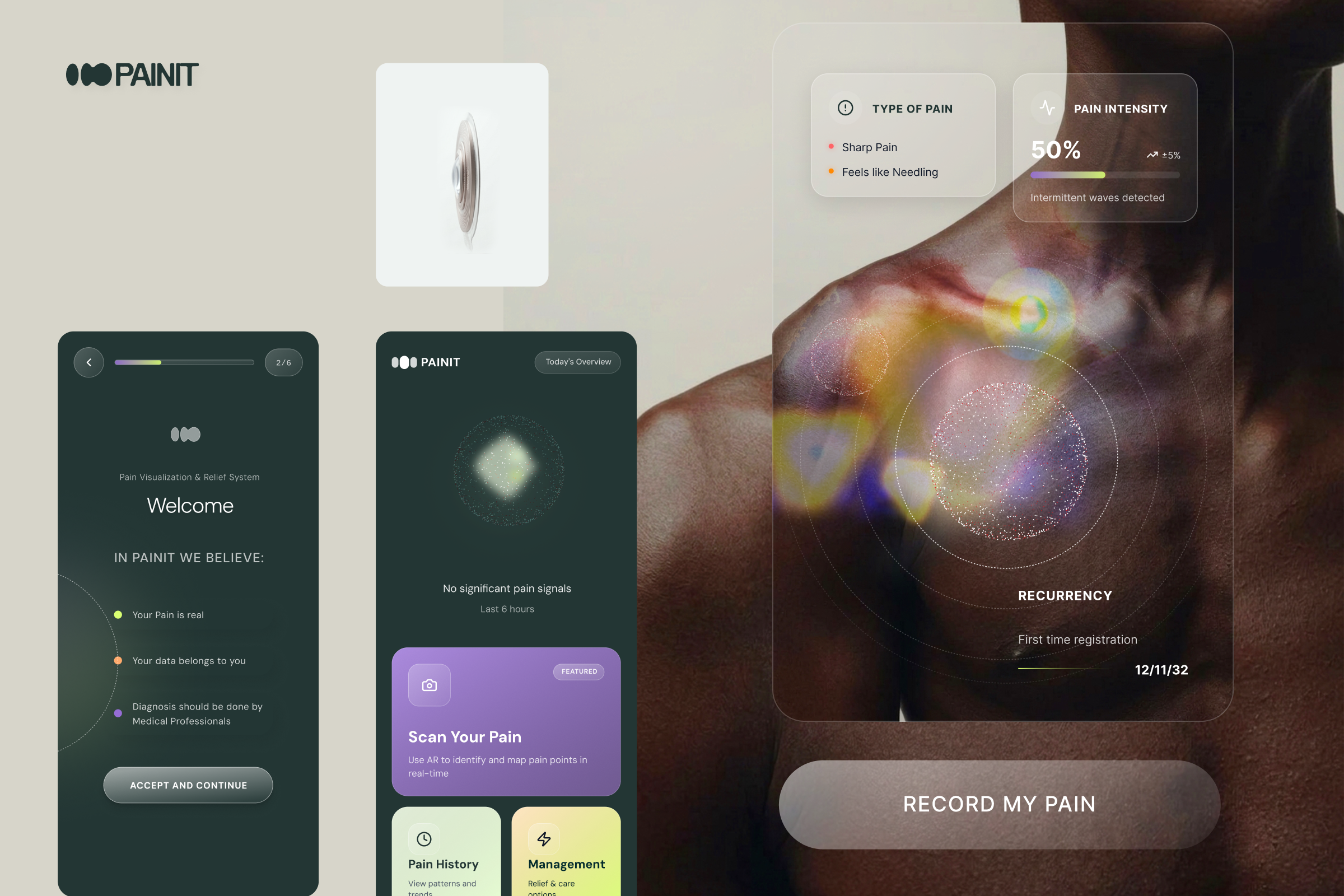
We created PAINIT: a speculative pain-visualization and relief system that combines wearable biosensing technology with augmented reality. The system is built around three core components: Biosensor Patches: Small, non-invasive patches placed on key areas of the body. They detect signals associated with pain and inflammation, and can also deliver gentle stimulation to help interrupt pain signals at the source. Mobile App: The app collects data from the patches and transforms it into a living visual map of the user's pain state. No numbers. No emoji. Instead, users see how their pain is distributed across their body, how it shifts and evolves, and what patterns emerge over time. Augmented Reality Experience: By pointing their phone camera at their body, users can see pain visualized directly on their skin in real time. Color and intensity represent different pain types and levels, giving users an intuitive way to understand location, severity, and change. The full user experience; including onboarding, AR scanning, pain visualization, relief activation, and doctor reporting was designed and prototyped in Figma.
Challenges We Faced
Designing around sensitive health information meant we had to be extremely intentional about tone. Pain is both physical and emotional, and an interface that feels clinical or alarming could make the experience worse, not better. Every design decision was made with calm, clarity, and emotional safety in mind. Representing pain visually was another significant challenge. Because pain is inherently subjective, we had to find ways to translate complex biological signals into visual patterns that felt both accurate and intuitively understandable, without oversimplifying what is actually a nuanced experience. We also wrestled with the ethical dimensions of the system: data privacy, ownership, and the risk of encouraging self-diagnosis. PAINIT is designed to help users understand and communicate their pain, not diagnose it, and users retain full control over their personal health data at all times.
Reflection
PAINIT is ultimately a project about translation, turning the invisible into the visible, and the unspeakable into something that can finally be shared. By giving people a clearer window into their own bodies, we hope to help them understand what they're experiencing, communicate it more effectively to the people who care for them, and advocate for themselves with greater confidence.
Built With
- capcut
- claude
- elevenlabs
- figma
- figmamake
- gemini


Log in or sign up for Devpost to join the conversation.