Cureo
Inspiration
Patients who are unable to speak, move, or communicate through gestures often face significant challenges expressing pain, discomfort, stress, or emotional distress in healthcare environments. This includes patients with paralysis, severe neurological disorders, sedation, stroke recovery, trauma, or critical illness. In many situations, caregivers must rely primarily on observation and physiological changes to understand a patient’s condition, which can delay intervention or cause important warning signs to go unnoticed.
We wanted to explore how AI and physiological sensing could help bridge this communication gap by transforming subtle biological signals into supportive, real-time insights for caregivers. Our goal was not to replace clinicians, but to create a system that helps vulnerable patients communicate when traditional communication methods are limited or impossible.
Why it matters
Patients who cannot communicate verbally or physically are often among the most vulnerable in healthcare settings. When someone cannot clearly express pain, fear, discomfort, or worsening symptoms, caregivers may have limited information to understand what the patient is experiencing in real time.
Some examples include:
- patients with paralysis or severe neurological disorders
- sedated or ICU patients
- stroke patients with impaired speech or movement
- individuals with ALS or locked-in syndrome
- patients recovering from major surgery or trauma
- non-verbal patients with developmental conditions
In these situations, physiological changes such as abnormal heart rate patterns, skin conductance changes, elevated stress responses, or facial muscle tension may provide important indicators of distress that are otherwise difficult to detect.
Cureo aims to help surface these hidden physiological signals so caregivers can respond faster, more consistently, and more compassionately.
What it does
Cureo is an AI-assisted communication and wellness monitoring platform designed for patients who cannot communicate verbally or physically. Using non-invasive biosensors and multimodal signal analysis, the system continuously monitors physiological patterns associated with stress, discomfort, fatigue, and emotional distress.
The platform analyzes signals such as:
- heart rate variability (HRV)
- skin conductance
- body temperature
- facial muscle activity
- movement patterns
- optional EEG-derived stress indicators
These signals are combined into a real-time wellness and distress index displayed on a color-coded caregiver dashboard.
The system also includes:
- emergency assistance alerts
- adaptive caregiver notifications
- accessibility-focused interfaces
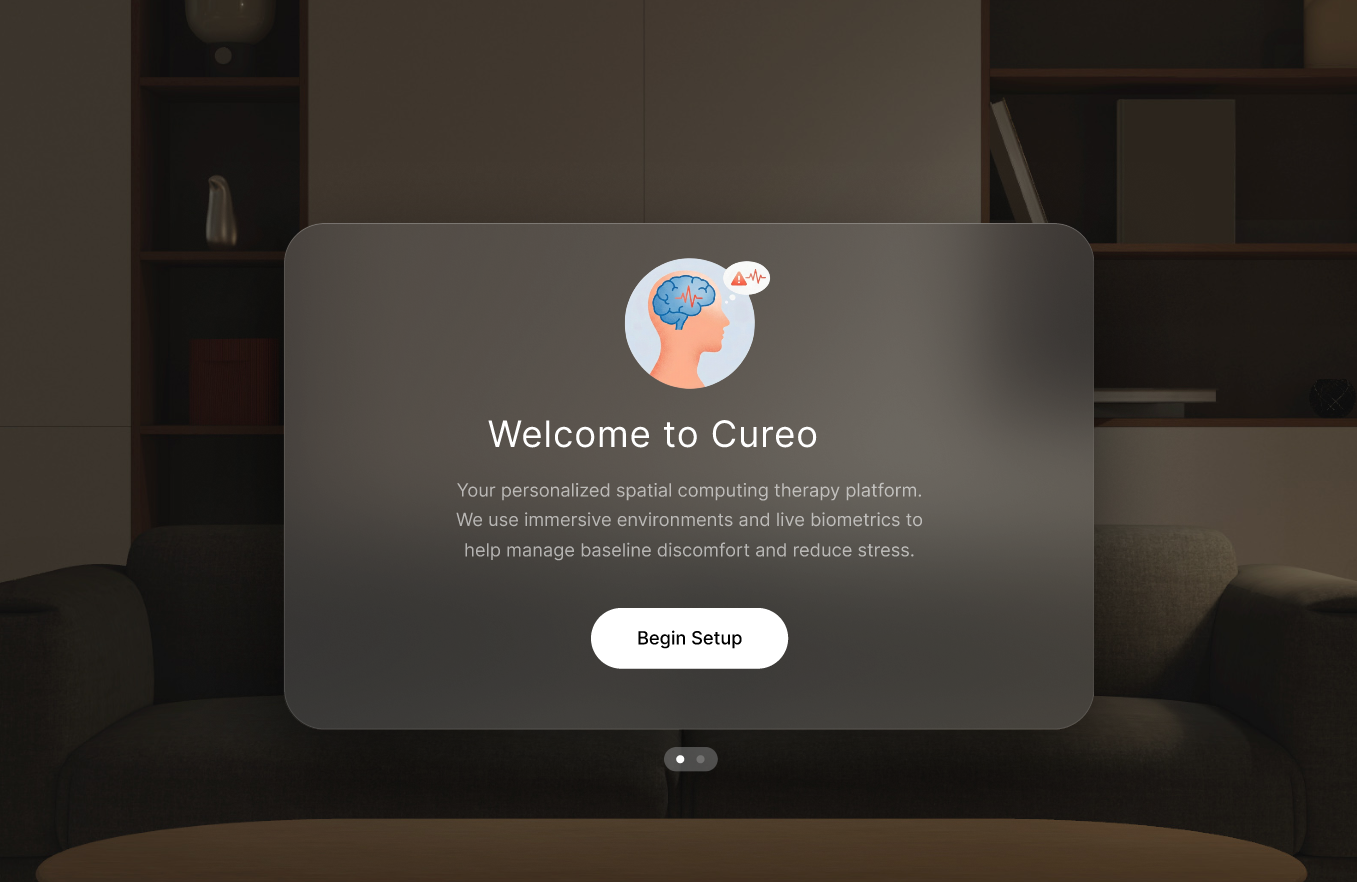
- optional VR/AR therapeutic environments that dynamically adapt to patient stress levels
Cureo is designed as a clinical support tool that enhances caregiver awareness while preserving human judgment and patient-centered care.
How we built it
We designed Cureo around a multimodal physiological monitoring pipeline:
- Wearable biosensors collect real-time physiological signals through wristbands, skin patches, and optional EEG headbands.
- Sensor streams are processed and normalized to reduce noise and improve signal consistency.
- AI models analyze patterns associated with autonomic nervous system responses and stress-related physiological activity.
- A real-time dashboard visualizes patient wellness indicators for caregivers across tablets and mobile devices.
- The VR/AR module dynamically adjusts environmental stimulation based on stress and engagement levels.
The system focuses on identifying meaningful physiological trends across multiple biosignals rather than relying on a single measurement alone.
Challenges we ran into
One of the biggest challenges was differentiating physiological responses associated with pain, stress, anxiety, sensory overload, or environmental stimulation, since these signals often overlap significantly.
We also faced challenges designing ethically for vulnerable populations who cannot easily provide direct feedback during testing. This forced us to think carefully about accessibility, interpretability, and responsible AI design.
Other challenges included:
- reducing sensor noise and motion artifacts
- avoiding excessive caregiver alert fatigue
- balancing real-time responsiveness with model stability
- maintaining privacy and secure handling of biometric data
- designing interfaces that remain readable and actionable in high-stress healthcare environments
Accomplishments that we're proud of
- Designing a communication-support system for patients with limited or no verbal/physical communication ability
- Creating a multimodal physiological monitoring framework that integrates multiple biosignals into one platform
- Building an adaptive caregiver dashboard focused on clarity rather than overwhelming data density
- Exploring VR/AR therapeutic integration that dynamically responds to patient stress levels
- Prioritizing ethical AI principles and positioning Cureo as a support tool rather than a replacement for medical professionals
What we learned
This project taught us that healthcare technology is not only a technical challenge, but also a deeply human-centered design problem.
We learned that:
- physiological signals are highly complex and context-dependent
- accessibility extends beyond visual design into communication and emotional understanding
- clinicians need interpretable signals and actionable insights rather than raw data overload
- designing for vulnerable populations requires careful ethical consideration and empathy
We also gained a deeper appreciation for how AI can support healthcare workflows when designed responsibly and collaboratively with human caregivers.
What's next for Cureo
In the future, we hope to:
- improve multimodal stress and discomfort modeling
- explore pilot testing in rehabilitation and recovery environments
- expand accessibility-focused communication support features
- investigate integration with assistive communication technologies (AAC systems)
- further refine adaptive VR therapy experiences
- continue researching ethical and privacy-safe healthcare AI systems
Our long-term vision is to create technology that helps caregivers better understand and support patients who cannot easily speak for themselves.
Built With
- figma
- figmamake

Log in or sign up for Devpost to join the conversation.