-
-
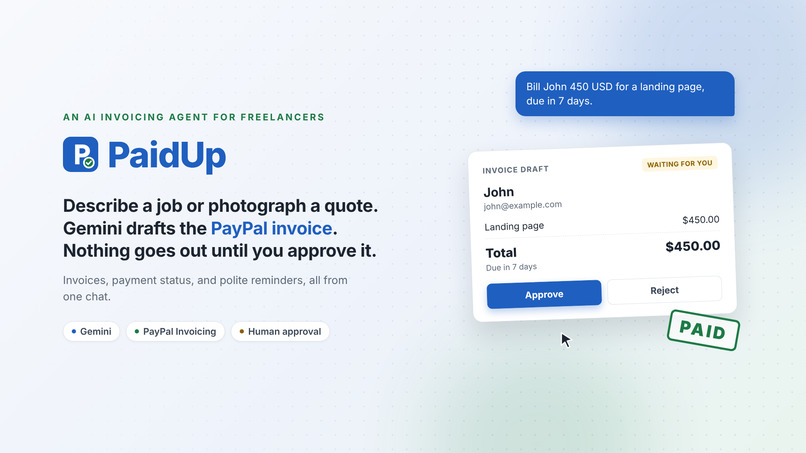
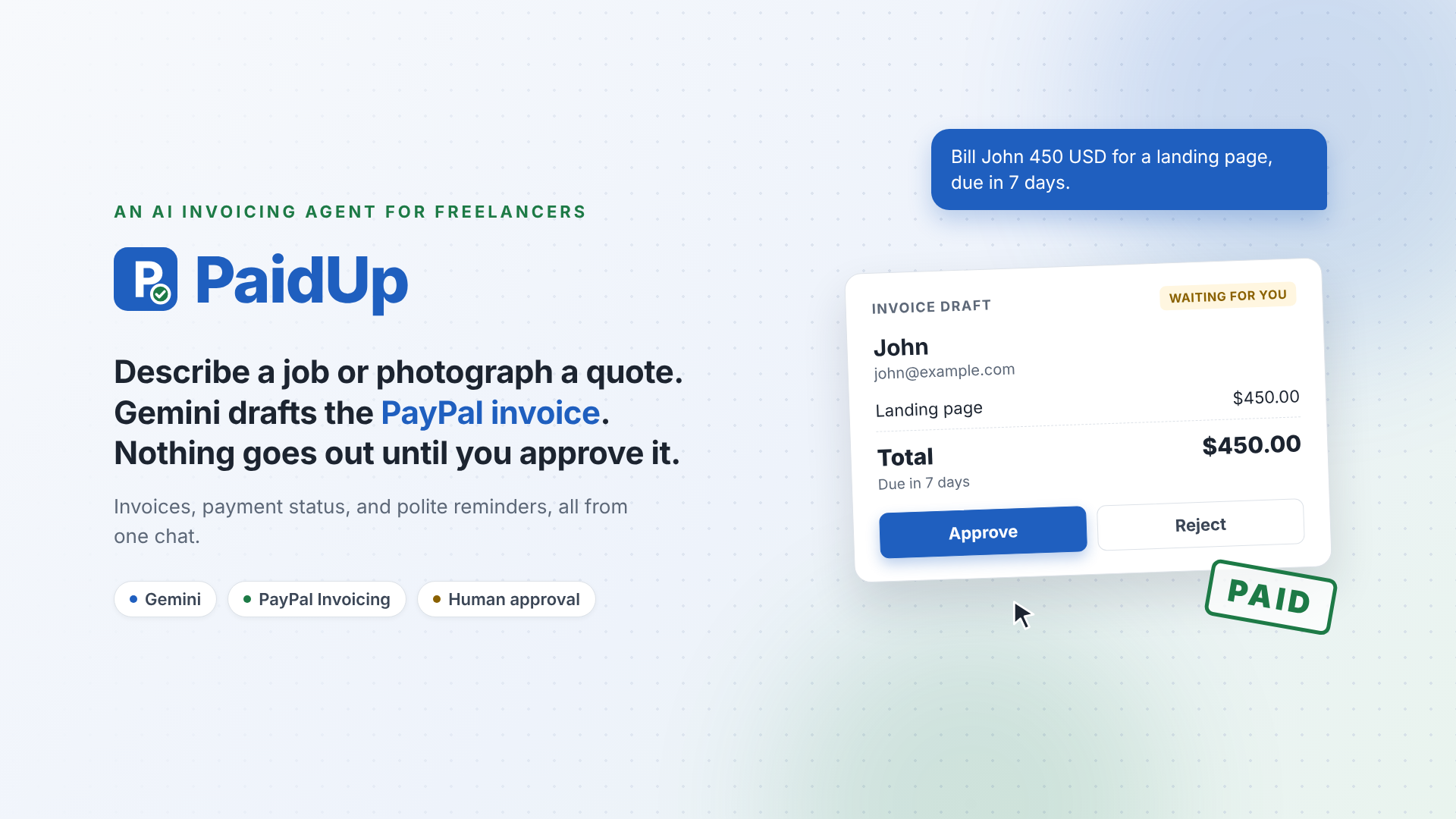
PaidUp: describe a job or photograph a quote, and Gemini drafts the PayPal invoice. Nothing is sent until you approve it.
-
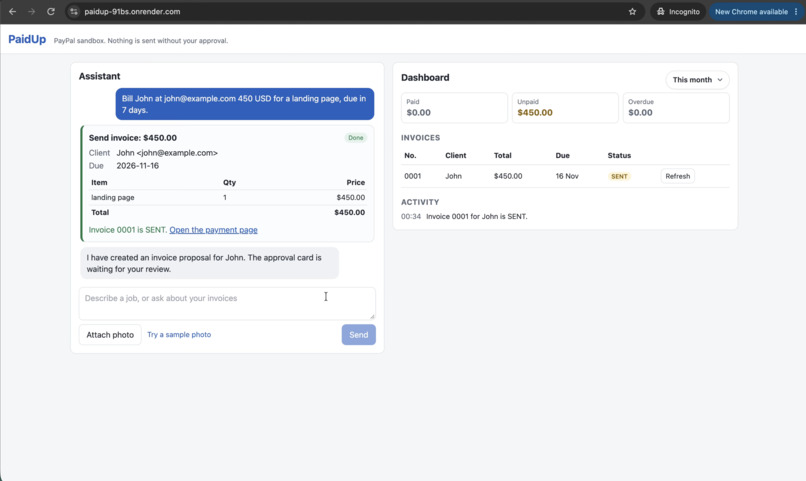
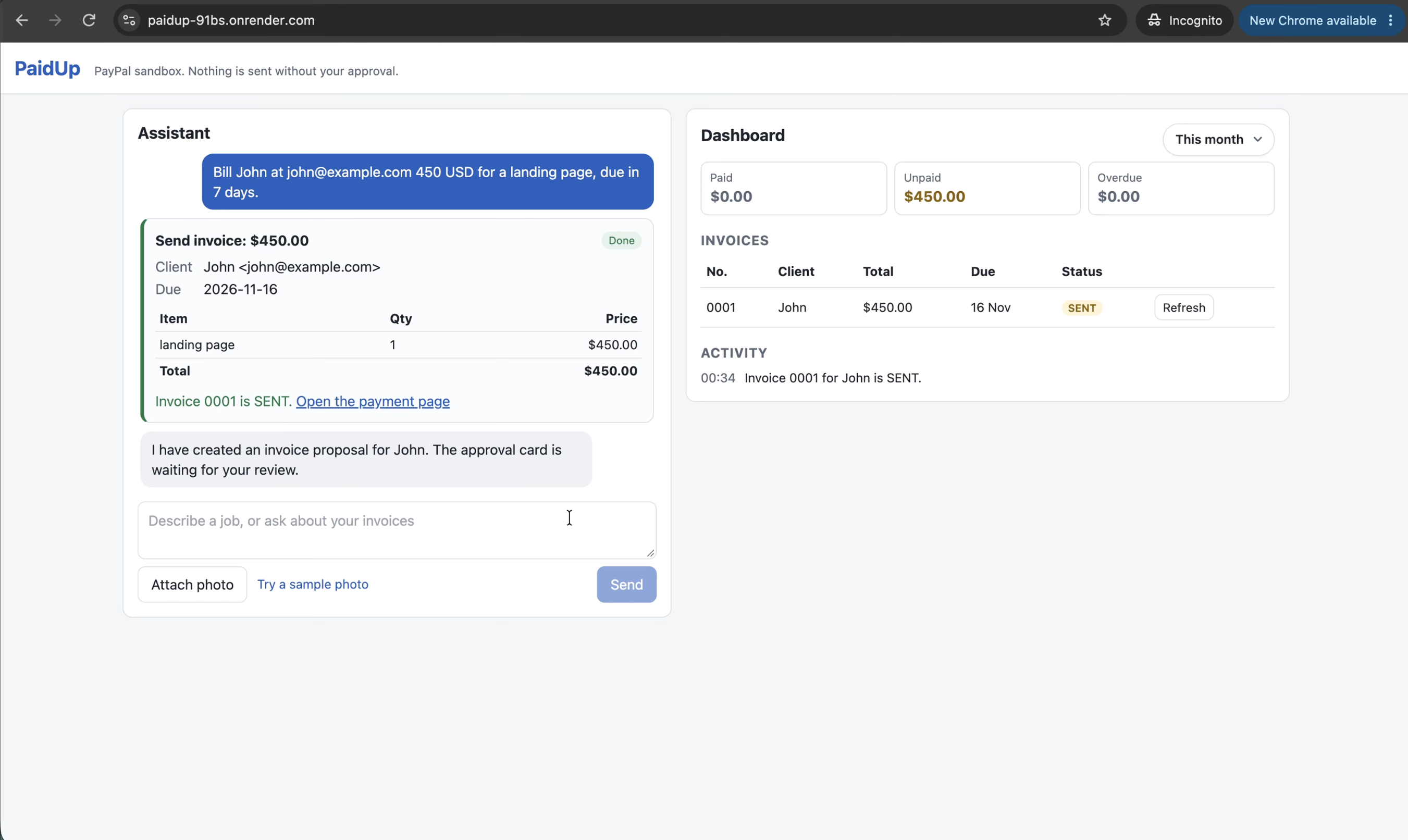
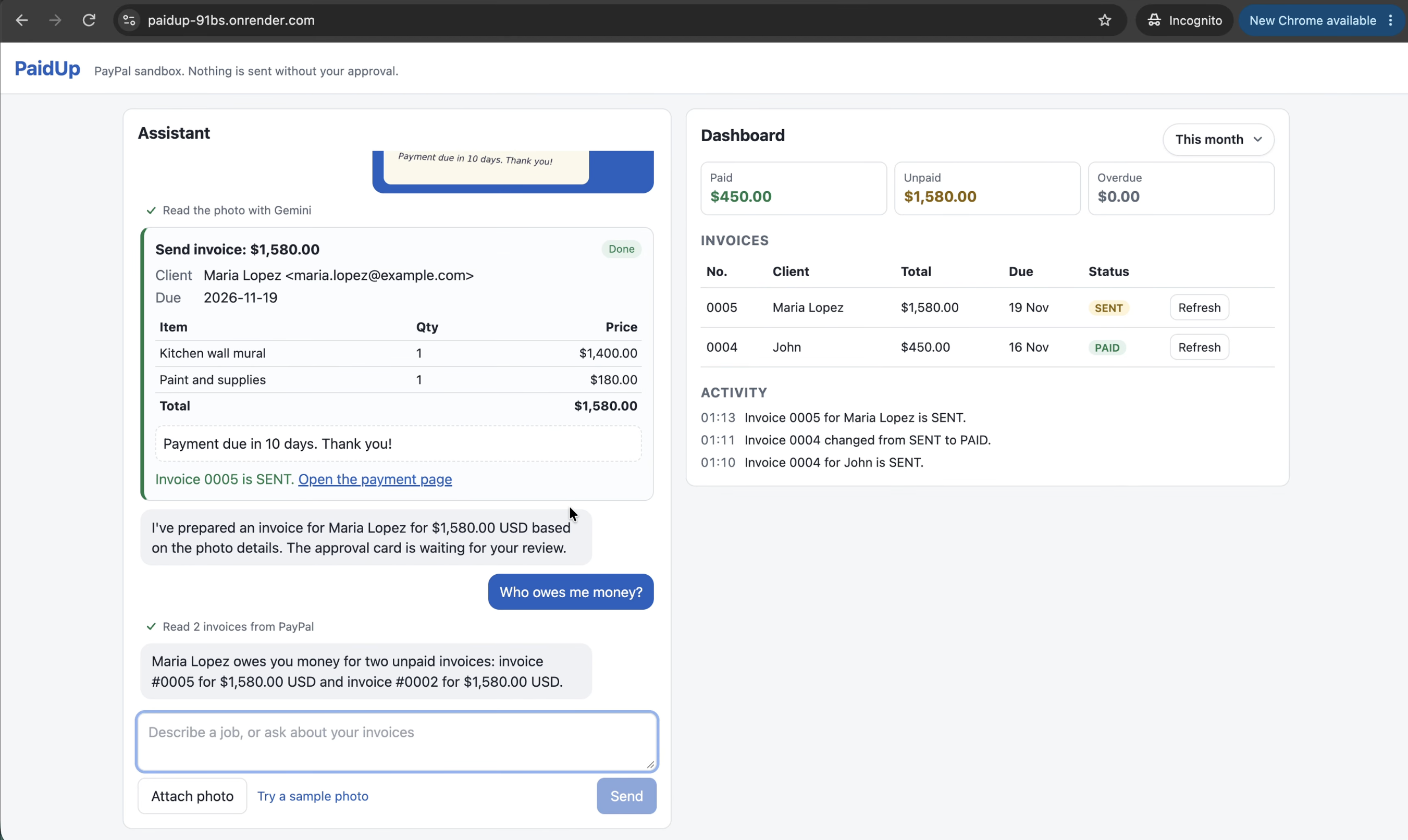
One sentence becomes an invoice card. After the click on Approve, PaidUp creates and sends the invoice in PayPal and shows the payer link.
-
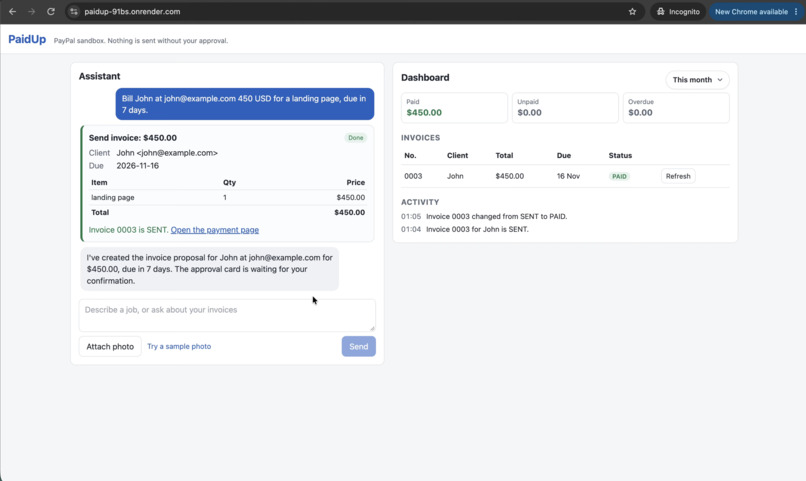
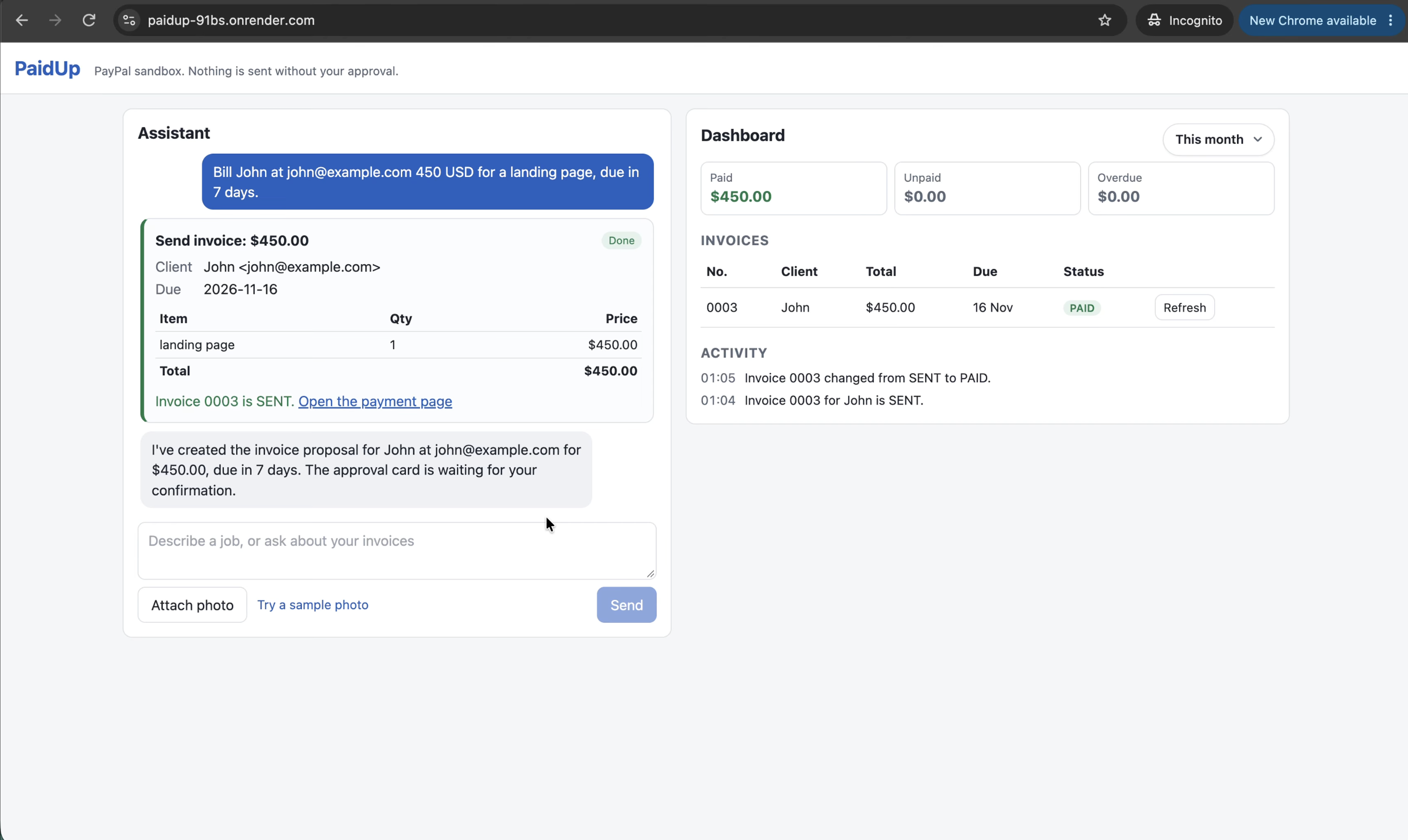
The client paid. A verified PayPal webhook turned the invoice PAID on the live dashboard, with no reload and no Refresh click.
-
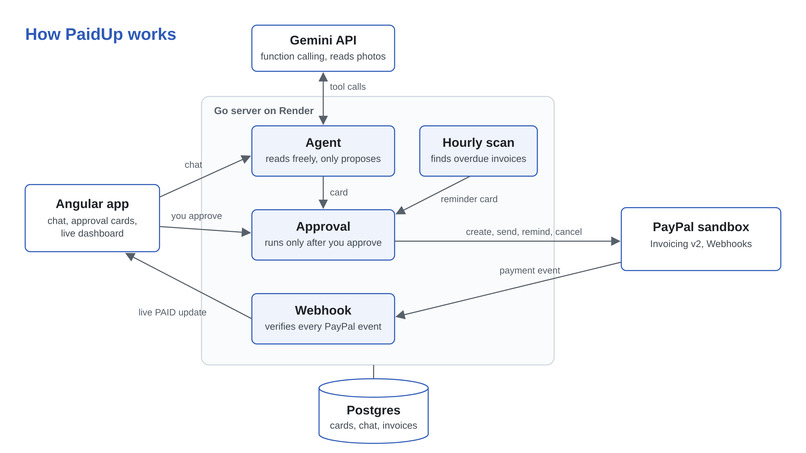
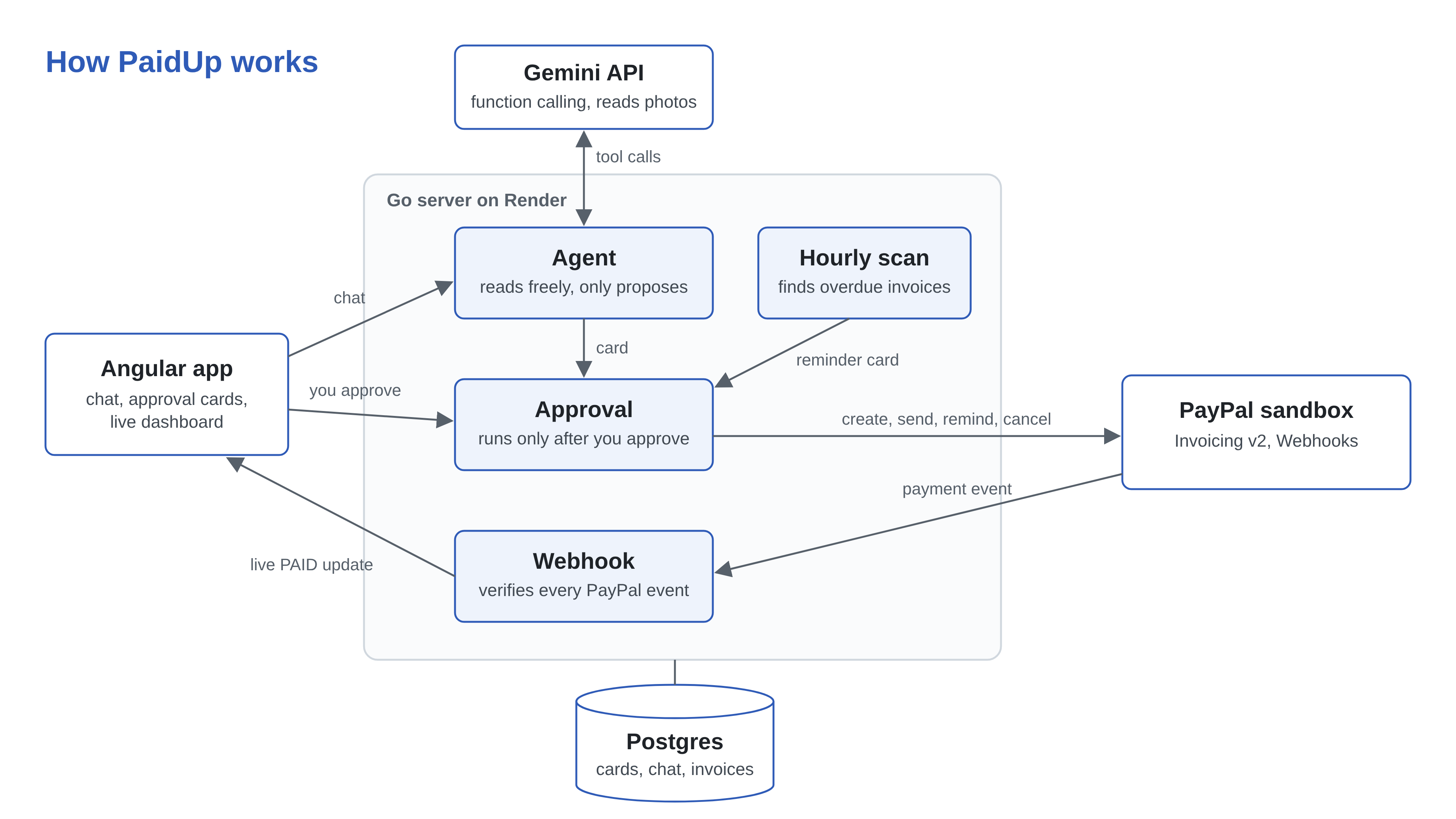
A Go server on Render: Gemini function calling for the agent, PayPal Invoicing and Webhooks APIs for invoices, and Postgres on Neon.
-
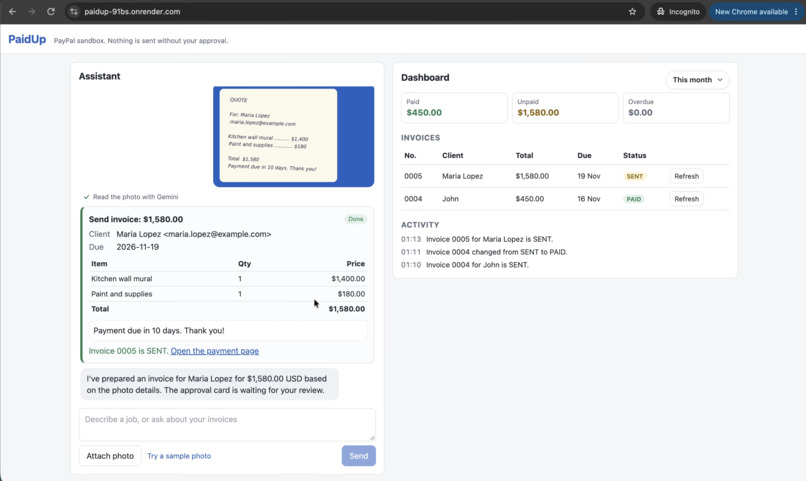
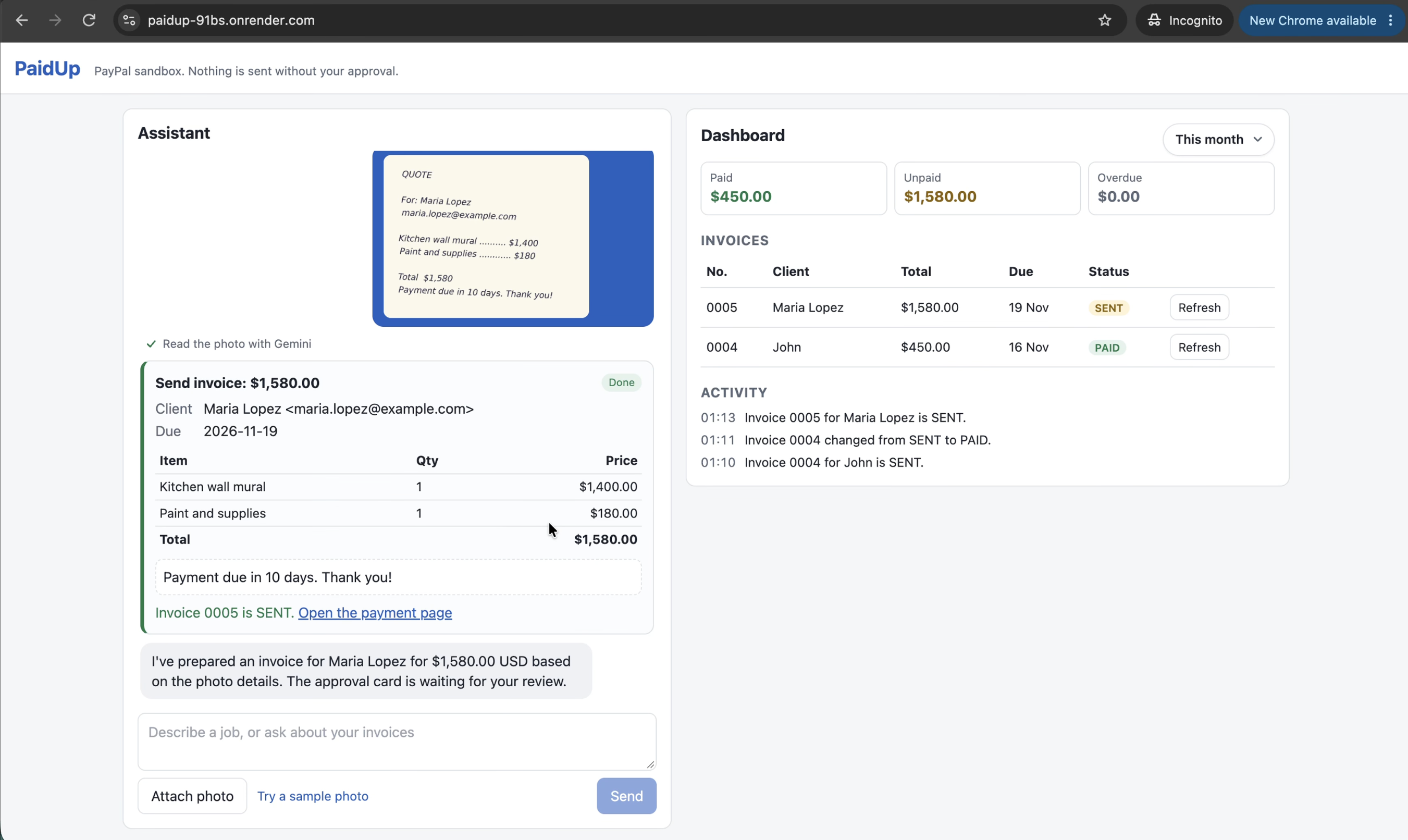
A photo of a handwritten quote becomes the same invoice card. Gemini reads the client, the items, and the prices with structured output.
-
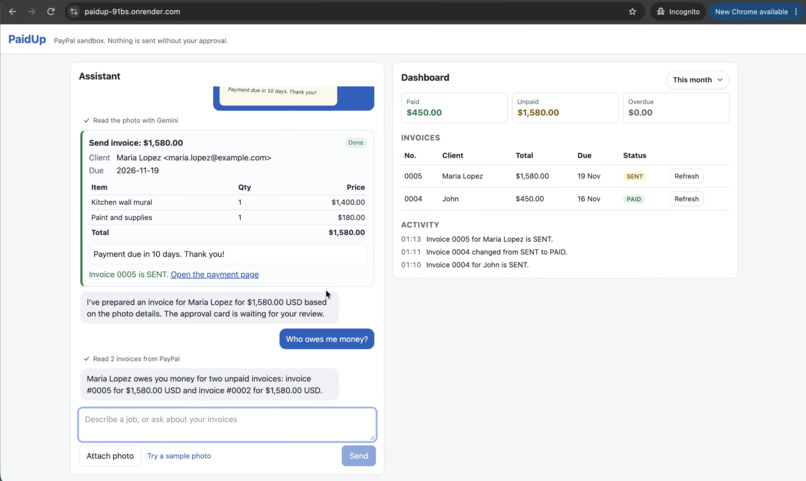
Ask "Who owes me money?" The line above the answer shows the agent read the invoices from PayPal first, so the answer uses real data.
-
Inspiration
A freelancer finishes a job and then does a second, unpaid job: the invoice. They type the client's details again, add up the items, pick a due date, and send it. Two weeks later they check whether it was paid, and then write the awkward reminder. None of it is hard. All of it is time that nobody pays for.
AI assistants can already write that invoice. The problem is trust. Nobody wants a model that can send money requests on its own, to the wrong client, for the wrong amount. PaidUp is built around that tension: Gemini does the typing and the remembering, and the freelancer keeps the final click.
What it does
PaidUp is a chat assistant for freelancers and very small businesses who bill through PayPal.
- Invoices from a sentence. Type "Bill John at [email protected] 450 USD for a landing page, due in 7 days." PaidUp shows an invoice card with the client, the items, the total, and the due date. Approve it, and PaidUp creates the invoice in PayPal, sends it, and shows the payer link.
- Invoices from a photo. Attach a photo of a handwritten quote, a receipt, or a sticky note. Gemini reads it into the same invoice card.
- Live payment status. When the client pays, a PayPal webhook updates the dashboard without a reload.
- Answers about money. "Who owes me money?" and "What did I get paid last month?" are answered from the PayPal invoices, not from the model's memory. A small line above each answer shows what the agent read from PayPal.
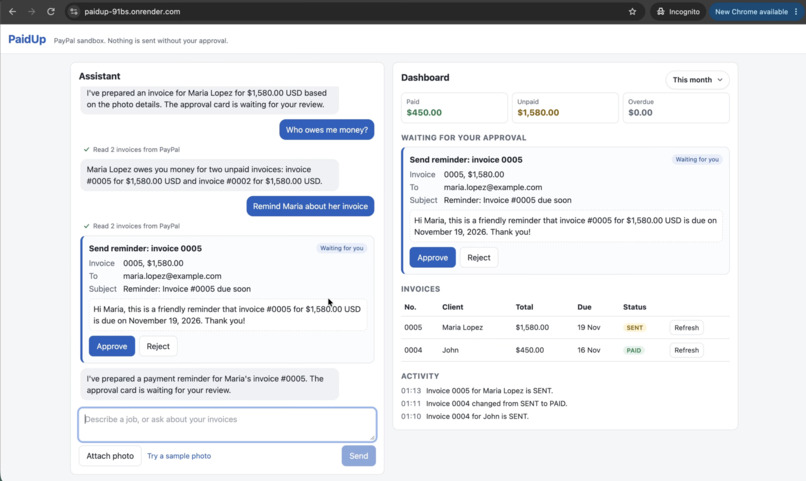
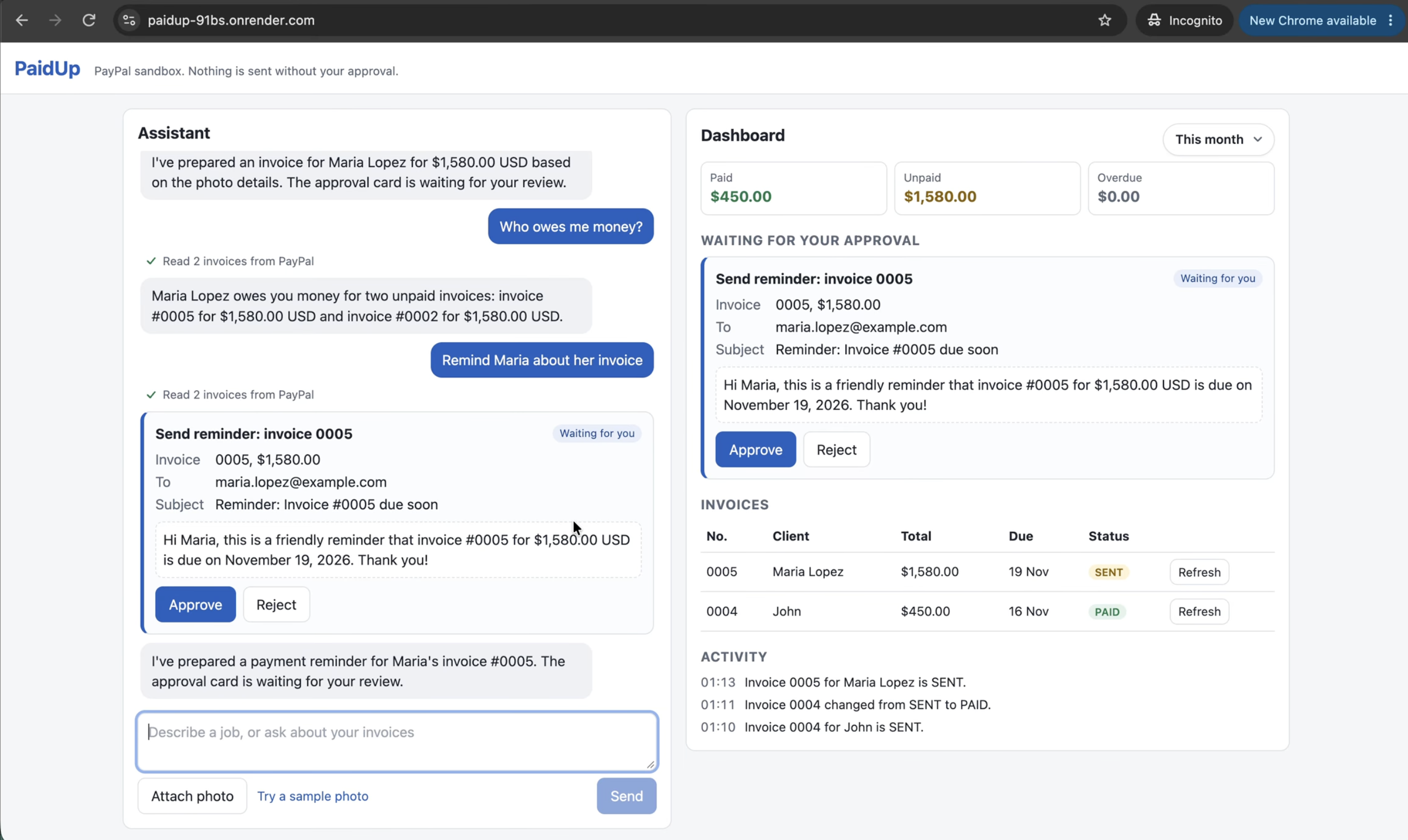
- Reminders. Ask "Remind Maria about her invoice", or let the hourly job find overdue invoices. Gemini writes a short, polite note, and the reminder waits as a card until the freelancer approves it.
Every action that changes something in PayPal goes through an approval card. Reading needs no approval. Writing needs a click.
How we built it
The backend is a single Go service. It serves a REST API, streams replies as Server-Sent Events, and serves the Angular frontend, so the demo has one URL. Postgres on Neon keeps sessions, approval cards, and a cache of invoices. The service runs on Render.
Gemini is the agent. It gets seven tools through function calling. Four read tools list, get, and search invoices and compute cash totals. Three write tools propose an invoice, a reminder, or a cancellation. A write tool never calls PayPal. It creates a pending card, and the server checks that card against fixed rules first. The currency must be allowed. The total must be above 0 and no more than 10,000.00. The due date must be 1 to 90 days away.
Gemini also reads photos with structured output (a JSON schema for the invoice draft) and writes the reminder notes.
PayPal is the system of record. PaidUp uses the Invoicing v2 API to create, send, remind, cancel, get, list, and search invoices. It uses the Webhooks API to verify each event signature before it trusts the event. After a webhook, PaidUp reads the invoice from PayPal again instead of trusting the event body.
Challenges we ran into
- Making approval safe, not just polite. A button is easy. A button that cannot send the same invoice twice from two browser tabs needs an atomic state change in the database. Every PayPal write also carries a
PayPal-Request-Id, so a network retry does not create a duplicate. - The free tier. The demo has to run on Gemini's free tier until the winners are announced on 21 December. A sliding-window limiter caps calls per minute. A busy model gets one retry, then a fallback model, then a clear "try again in one minute" message. Photo results are cached.
- Choosing REST over MCP. In October, a forum post reported a
create_invoiceerror on the PayPal sandbox MCP server. The demo has to stay up for weeks of judging, so PaidUp calls the PayPal REST APIs directly and gives Gemini its own tool definitions. - Streaming from a POST. The browser's
EventSourcesupports only GET. The chat and the approve calls are POSTs, so the frontend reads the event stream withfetch.
Accomplishments that we're proud of
The model can never move money on its own, and the code shows why: write tools only create cards, and only an approval starts a PayPal call. The full path, from one sentence to a paid invoice on a live dashboard, works in one screen.
The project also runs with no keys at all. Every service has an in-memory fake, so anyone can start the server or the frontend alone and see it work.
What we learned
Function calling is the easy part of an agent. The work is in what happens around the call. The server validates the model's arguments, keeps its thought signatures intact between turns, and decides which tools may only propose. PayPal webhooks taught a similar lesson. The event says something changed; the API says what is true now.
What's next for PaidUp
- Recurring invoices for retainer clients.
- More currencies, and partial payments.
- A weekly summary of money owed, sent by email.
- Live PayPal accounts after a security review.
Built With
- angular.js
- docker
- gemini-api
- go
- neon
- paypal-invoicing-api
- paypal-webhooks
- postgresql
- render
- server-sent-events
- typescript
