-
-
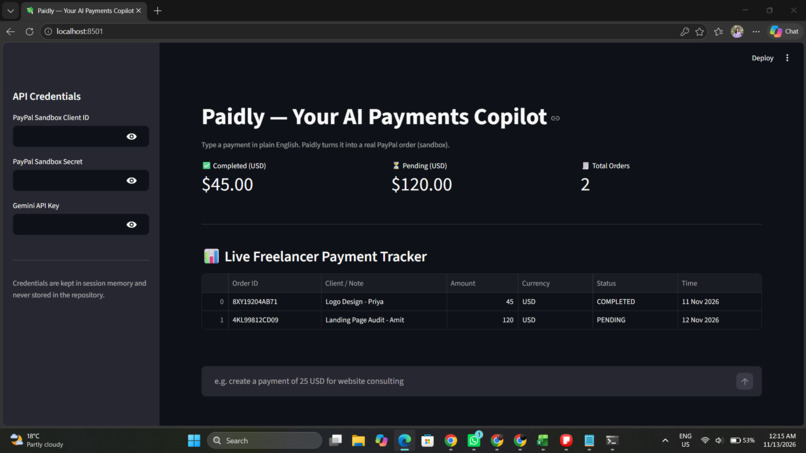
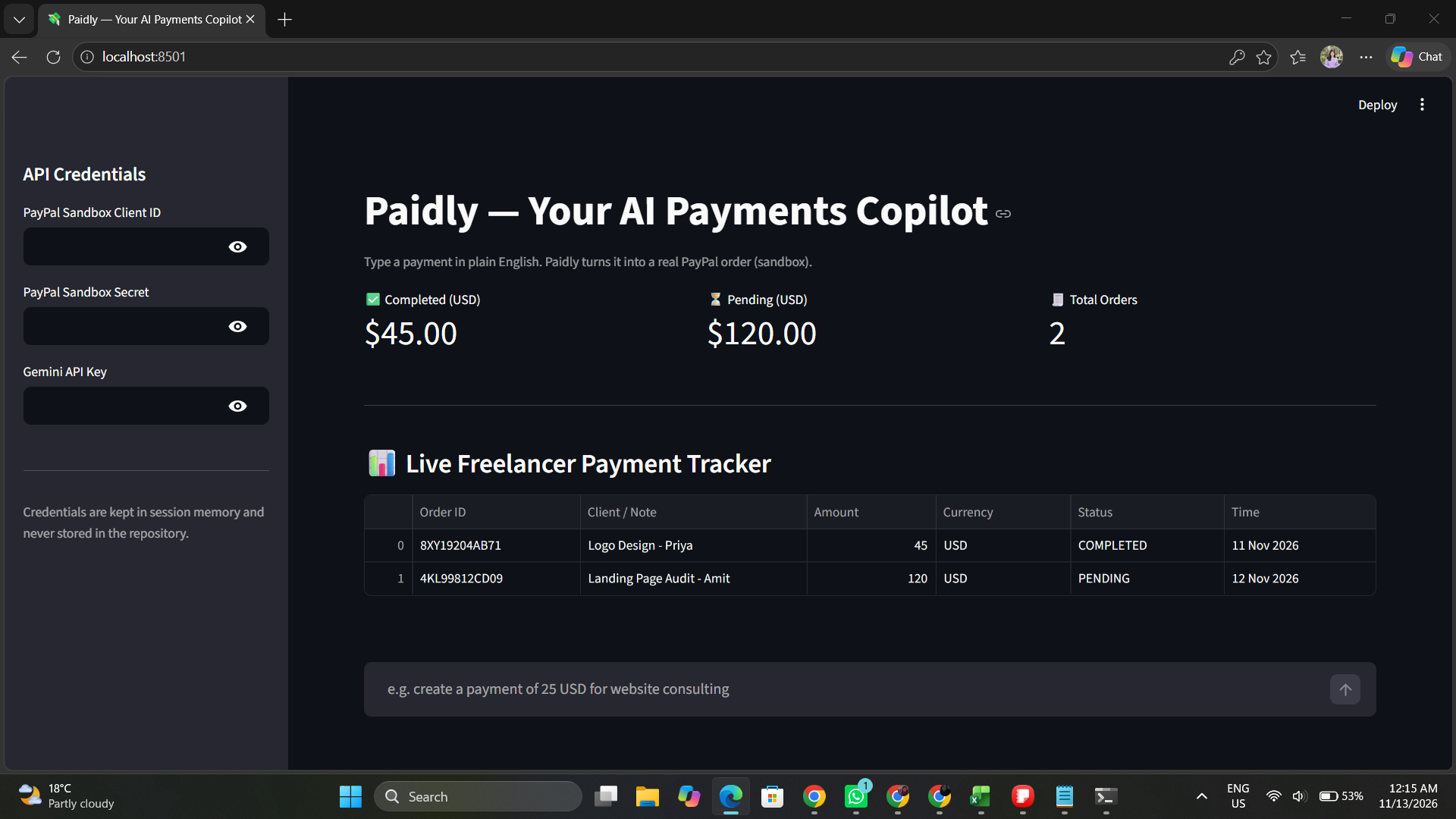
Paidly Dashboard & Live Freelancer Payment Tracker with secure session-only API credential inputs.
-
Inspiration
Freelancers and small businesses don't usually lose money because clients refuse to pay — they lose it because turning "please pay me" into an actual completed payment is slow and manual: drafting the request, sending it, chasing it, tracking it. As a student builder, I wanted to see whether a natural conversation could replace that whole chore. That question became Paidly.
What it does
Paidly is a conversational payments copilot. You type a payment request in plain English — for example, "create a payment of 25 USD for website consulting" — and Paidly:
-Uses Google Gemini to extract the amount, currency, and description from the sentence as clean structured data. -Calls PayPal's real Orders v2 REST API in the sandbox to create the order with OAuth 2.0 client-credentials authentication. -Generates the official PayPal sandbox approval link for the buyer and logs the transaction in a Live Freelancer Payment Tracker dashboard. -Captures the order via PayPal's Orders v2 capture endpoint and confirms completion live in the app.
How we built it
Python + Streamlit for the conversational interface and live payment tracker dashboard; Google Gemini (gemini-2.5-flash) via REST API for natural-language understanding and structured JSON extraction; PayPal Orders v2 REST API (create order + capture) on the PayPal developer sandbox, authenticated with OAuth 2.0. AI coding assistants were used during development, and every line was reviewed and tested by me against the sandbox environment.
Challenges we ran into
Getting the OAuth 2.0 token flow right and keeping credentials out of the repository; making the AI extraction reliable enough that free-form sentences turn into valid currency codes and amounts; and handling the order creation and capture flow smoothly inside a single conversational interface. The hackathon's tight window also meant ruthlessly cutting scope to what could be genuinely finished and working end-to-end.
Accomplishments that we're proud of
A working end-to-end payment flow: natural language in, a real PayPal sandbox order created and captured out, tracked live in the freelancer dashboard and demonstrated in the video. Credentials never touch the repository, and the app runs anywhere with three free API keys.
What we learned
How PayPal's Orders v2 API works under the hood — OAuth 2.0 token authentication, order creation, approval links, and order capture; how to design an AI layer that outputs strict structured JSON that a payments API can safely consume; and how much scope discipline matters in a hackathon.
What's next for Paidly — Your AI Payments Copilot
Extending the same conversation into the full invoice lifecycle — creating and sending PayPal invoices, automatic payment reminders, and recurring monthly invoice series — plus moving from sandbox to a hosted live deployment.

