-
-
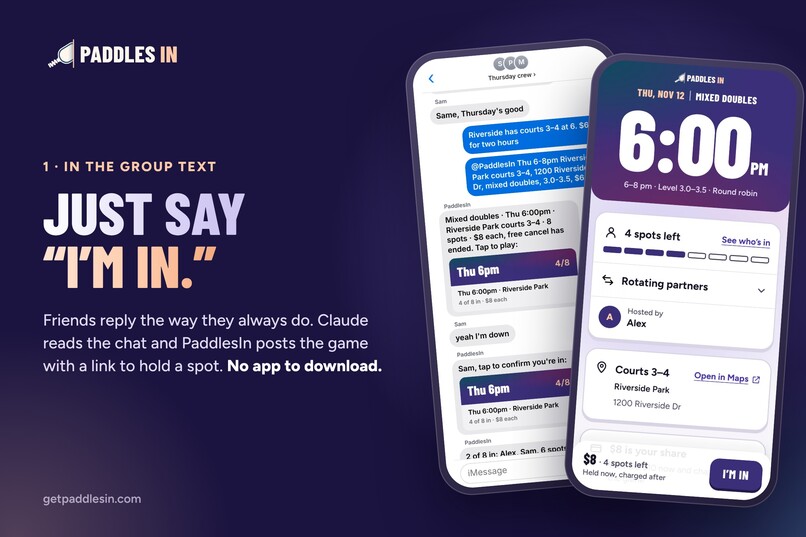
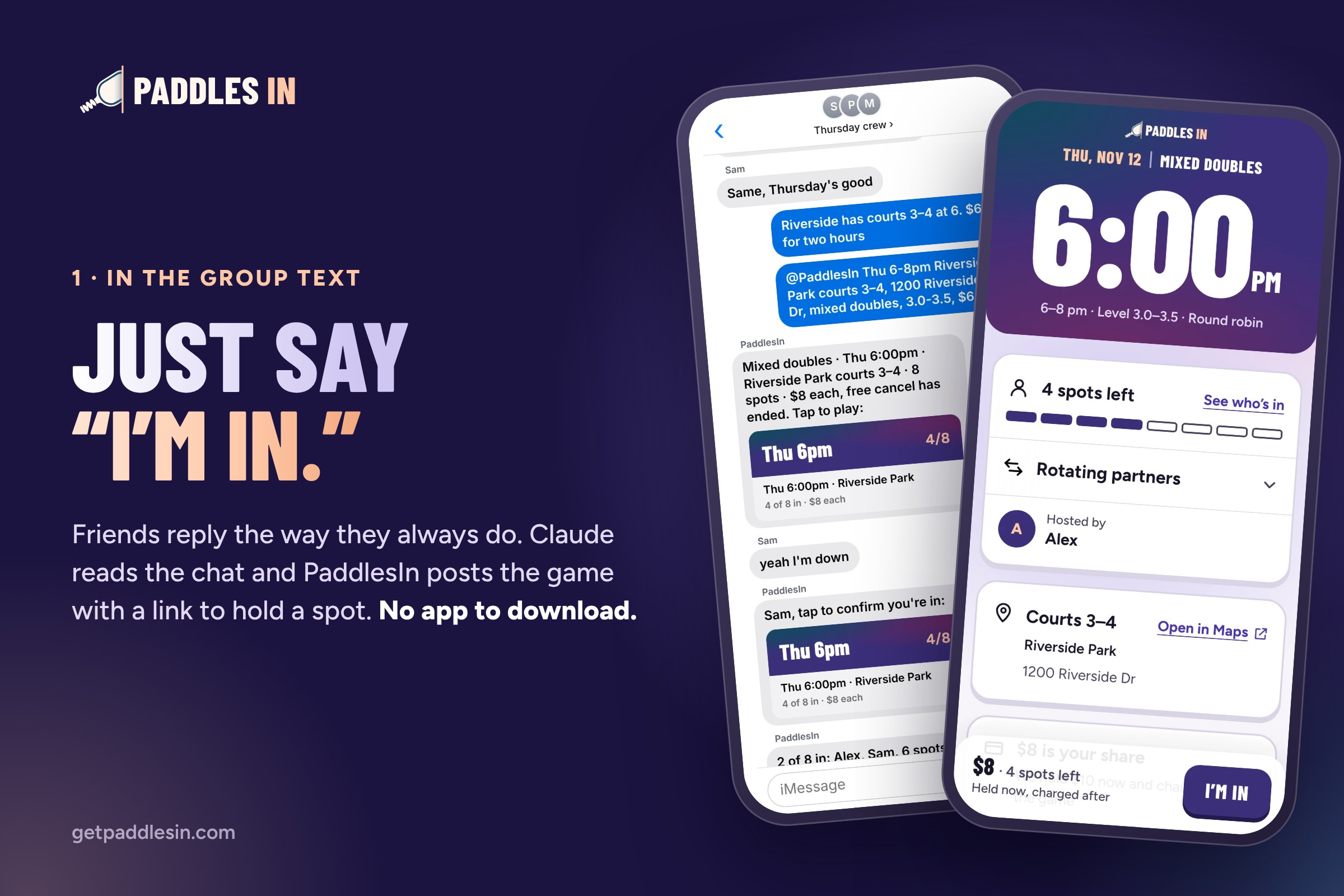
Friends reply the way they always do. Claude reads the chat and PaddlesIn posts the game with a link to hold a spot. No app needed.
-
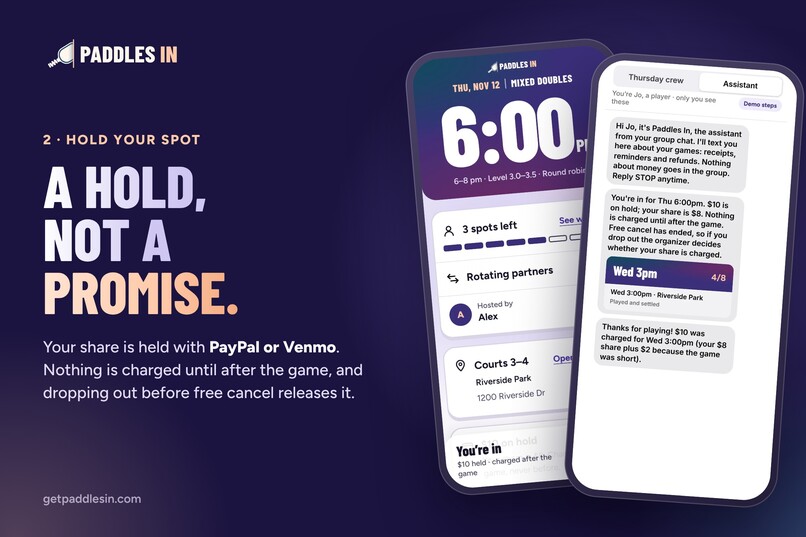
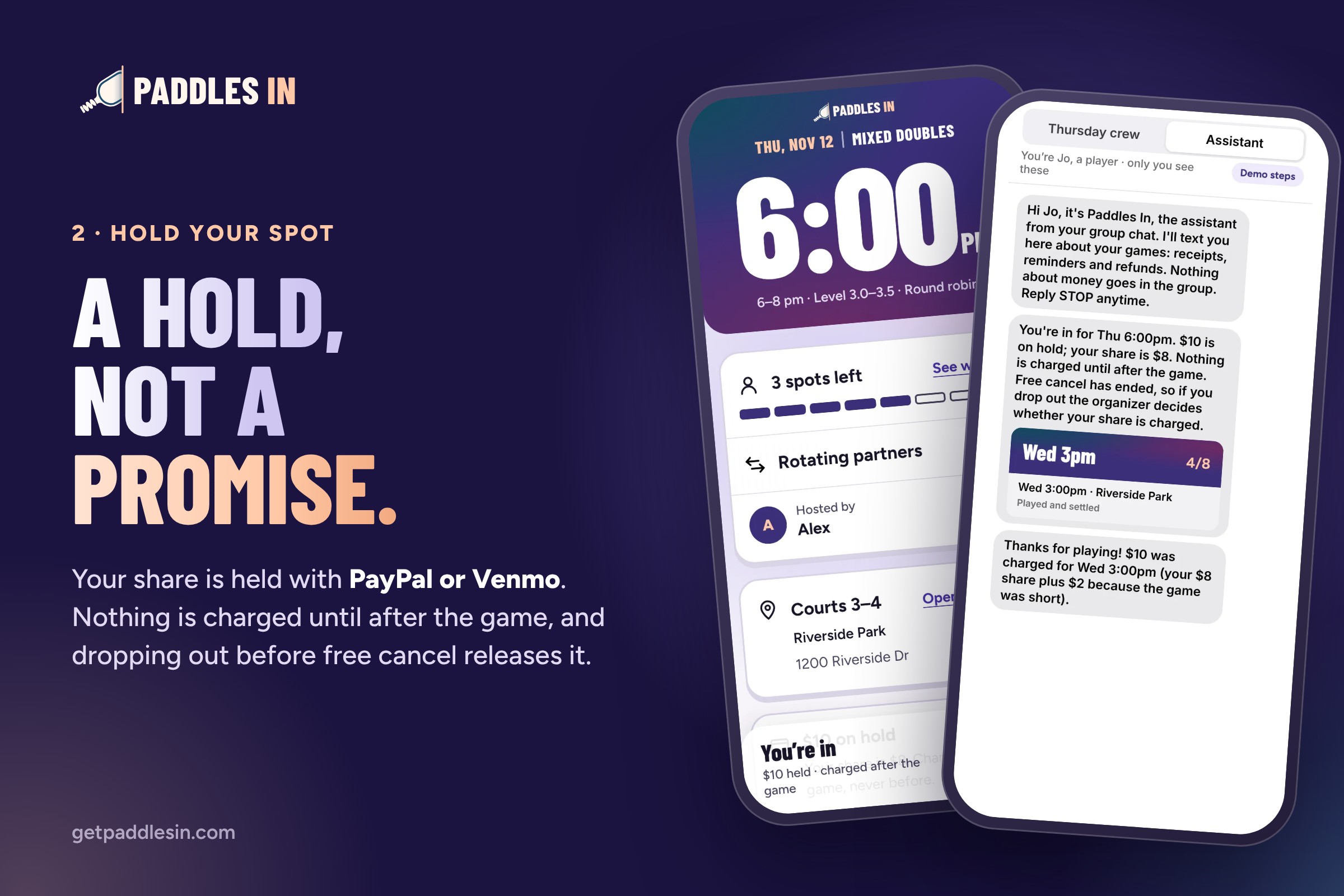
Joining puts a PayPal or Venmo hold on your share. Nothing is charged until after the game, and an early drop releases it.
-
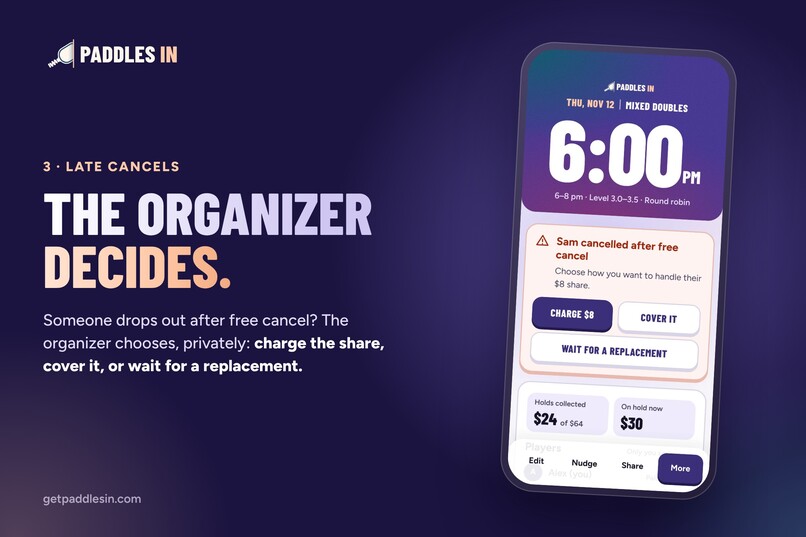
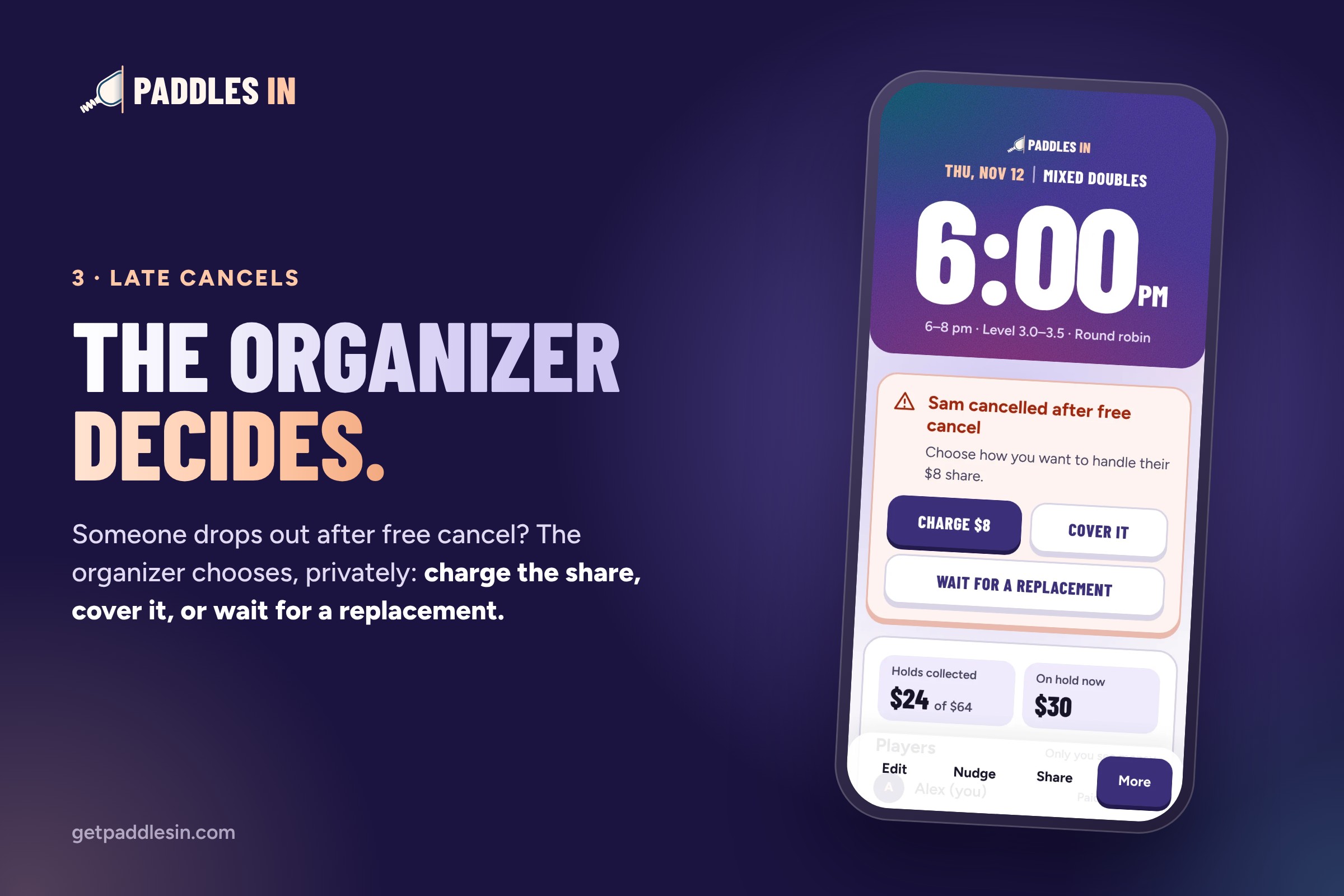
Someone cancels after free cancel? The organizer chooses privately: charge their share, cover it, or wait for a replacement.
-
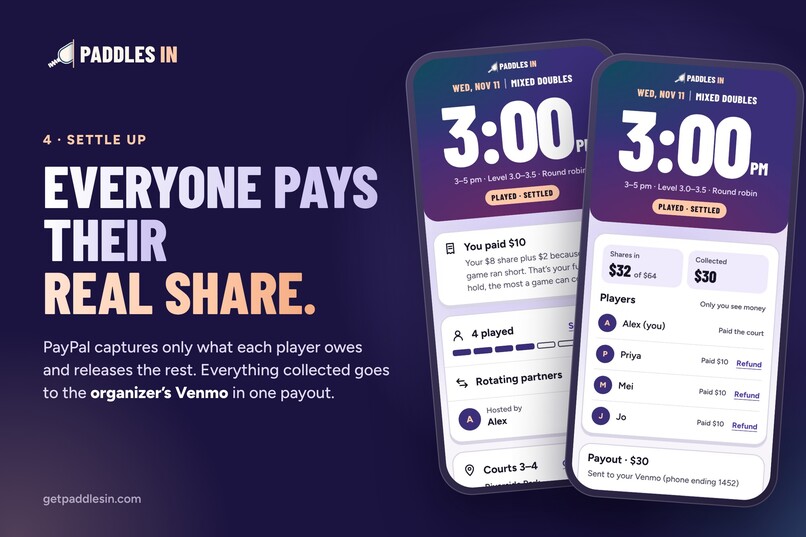
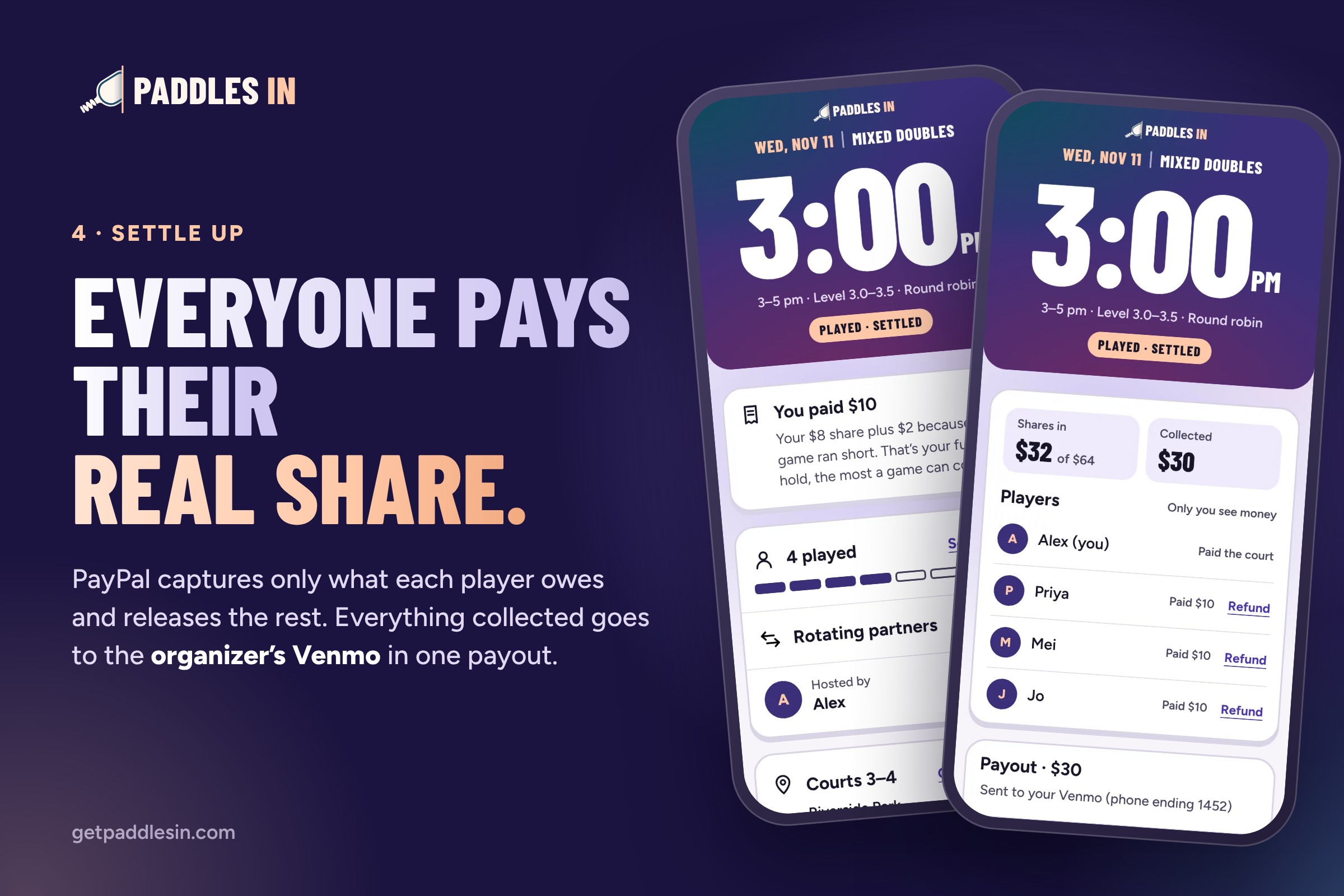
After the game, PayPal captures only each player’s real share and releases the rest. The organizer is paid back to Venmo.
-
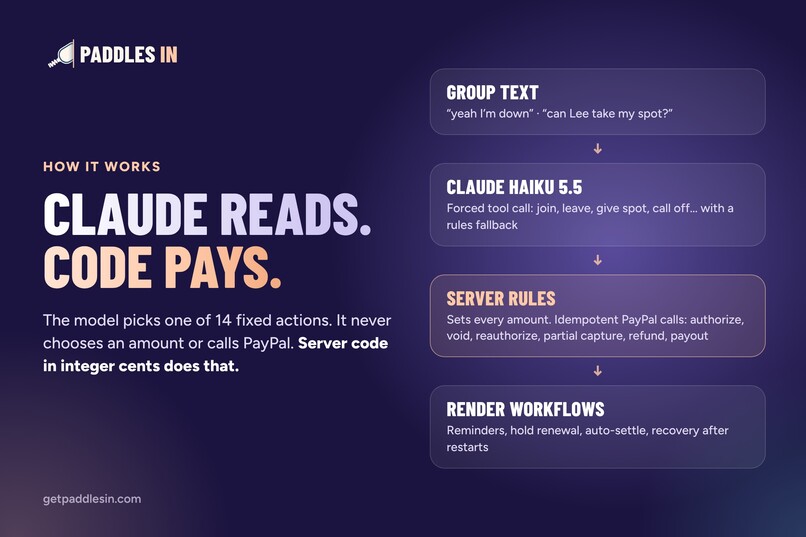
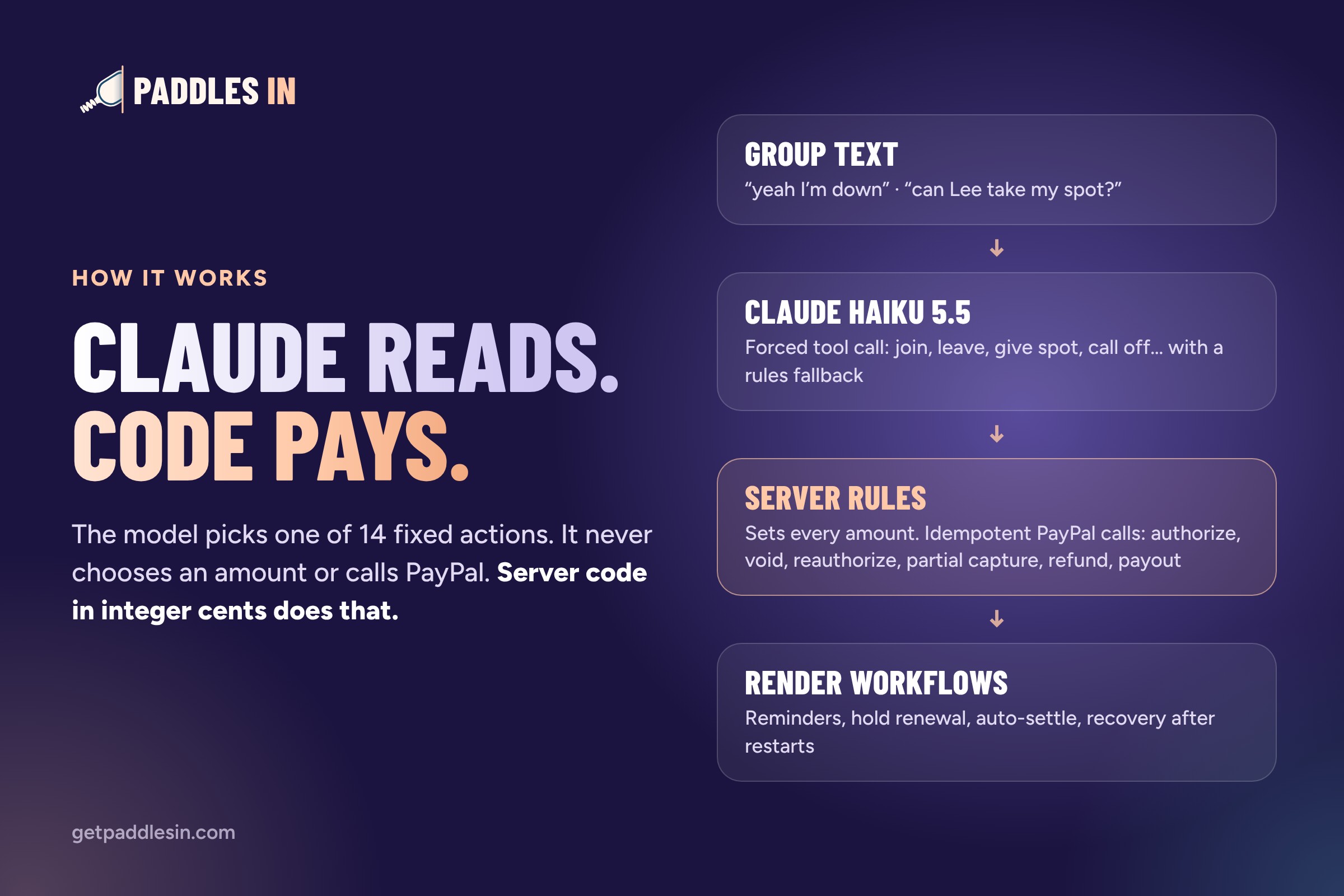
Claude picks one of 14 fixed actions. It never sets an amount or calls PayPal. Server code in integer cents handles all money.
-
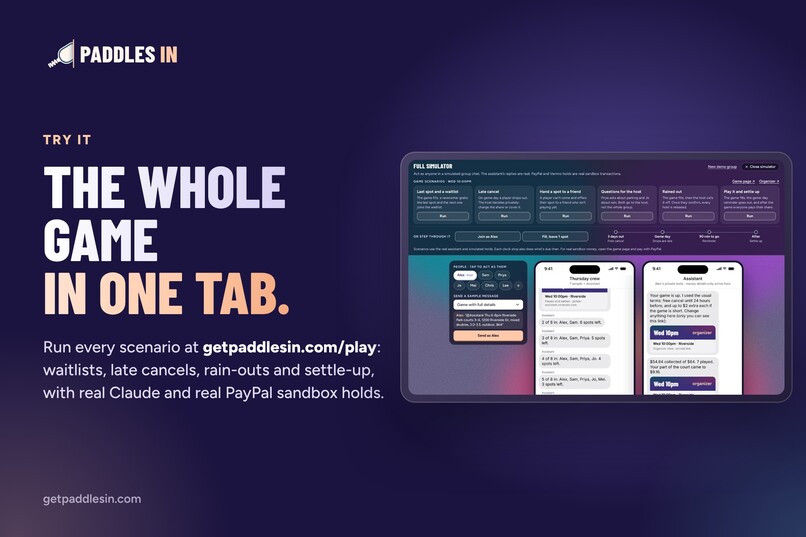
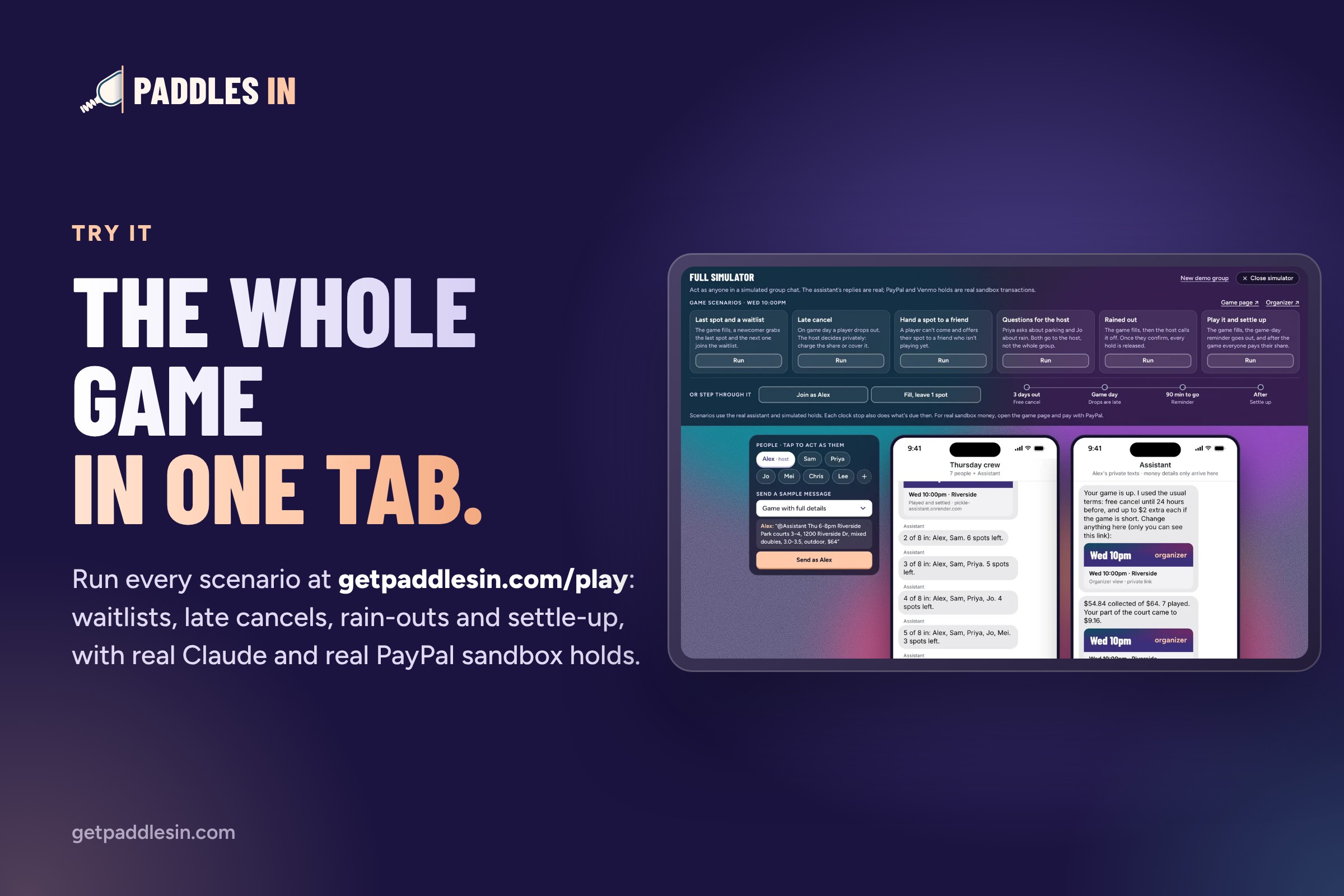
Try every scenario at getpaddlesin.com/play: waitlists, late cancels, rain-outs and settle-up, with real Claude and PayPal sandbox.
Inspiration
I picked up pickleball the way most people do: a friend dragged me to a court, and I was hooked after one game. One game a week turned into two, then three. Before long I was the one texting the group, "Thursday 6pm, who's in?"
That's when I learned the hard part of pickleball isn't the kitchen line. It's getting eight people to the same court at the same time. Courts book out early and cost real money, so someone has to commit and pay up front, and that someone was usually me. The group text would fill with "yeah I'm down" and thumbs-up emojis, and then the week would happen. One person forgot, one had to work late, and one dropped out an hour before the game. I'd show up with five players for a court I'd paid $64 for, and then spend the next week sending awkward "hey, you owe me $8" messages. Some people paid, and some I just let go, because chasing friends for money feels worse than losing it.
I didn't want to stop organizing. I wanted "I'm in" to actually mean something, without making anyone download an app or argue about money in front of the group. PayPal's authorize-then-capture turned out to be the right tool: a hold works like a deposit. Your spot is real, but nothing is spent until the game is over.
What it does
PaddlesIn lives in your group text. When someone posts a game, friends reply the way they always do ("yeah I'm down", "count me in"), and PaddlesIn sends each of them a link to hold their share with PayPal or Venmo.
- Drop out early: the hold is voided and you pay nothing.
- Drop out late: the organizer decides, privately, whether to charge your spot, cover it, or wait for a replacement.
- After the game: each player is charged only their real share. The rest of the hold is released, and everything collected goes to the organizer's Venmo or PayPal in one payout.
Money details are never posted to the group, only in private messages.
How we built it
- Claude (Haiku 5.5) reads every message with forced tool calls and picks one of 14 fixed actions: join, leave, maybe, give my spot to Lee, call off, and so on. It ignores small talk, and a rule-based fallback takes over if the model is unavailable.
- Claude reads, code pays. The model never outputs an amount or makes a PayPal call. Deterministic server code turns each action into money movement, in integer cents from end to end.
- PayPal: Orders v2 with
AUTHORIZE, then void, reauthorize, partial capture, refund, Payouts to Venmo, and verified webhooks. Every write sends aPayPal-Request-Idderived from the object it acts on, so a retry can never charge twice. - Render hosts the Next.js app and Postgres. Render Workflows handles the jobs nobody should have to remember: reminders, renewing holds, settling after the game, payout retries, and finishing anything a restart cut off.
- Sendblue sends and receives real text messages. The landing page's 3D phone is three.js.
The money rules
Each player's hold is their share plus a small cap they agree to up front, in case the game runs short:
$$ \text{share} = \left\lfloor \frac{\text{court}}{\text{spots}} \right\rfloor, \qquad \text{hold} = \text{share} + \text{cap} $$
If fewer people play than booked, the gap is split only among the players who showed, and never by more than the cap:
$$ \text{extra} = \min\left(\text{cap},\ \left\lfloor \frac{\text{share} \times \text{spots} - \text{share} \times (\text{played} + \text{paidLateCancels})}{\text{played}} \right\rfloor \right) $$
Each player then pays \( \text{share} + \text{extra} \le \text{hold} \). Rounding always goes down, so no player pays more than an exact split, and the leftover cents stay with the organizer. A late cancel the organizer charged counts toward the court, so the players who stay are never charged twice for that spot.
Challenges we ran into
- Holds don't last forever. PayPal's honor period is 3 days, and an authorization lasts 29. We added scheduled reauthorization, and we ask organizers to pick a nearer date for games more than 4 weeks out.
- Two things settling at once. The scheduled job and the organizer's "settle" button could both fire, so settling claims the game row first, and only one of them captures.
- One bad hold shouldn't block everyone. An expired or declined hold is skipped and the organizer is told, while everyone else still settles.
- Real people text messily. "can Lee take my spot?", "maybe", 🙌. Getting Claude to stay quiet during small talk and still catch every real intent took many rounds of testing.
- Demoing real money flows. PayPal's sandbox checkout doesn't run on phones, so the demo has you organize on your phone and approve the real sandbox hold on a computer, while simulated players fill the game in seconds.
Accomplishments that we're proud of
- Real money flows, end to end. Holds, voids, reauthorization, partial capture, refunds, Venmo payouts and verified webhooks all run against PayPal's sandbox, and
pnpm prooflists the real ids from a full game. - Every edge case has a rule. Waitlists, late cancels, short games, rain-outs, expired holds and failed payouts each have a written rule and the code that enforces it.
- The AI never touches the money. Claude makes the chat feel natural, and tested server code makes every financial decision.
- It recovers by itself. A restart mid-settle, a double tap on "settle" or a retried PayPal call can never charge anyone twice.
- A two-minute demo judges can run on their own phone, plus a one-tab simulator for every scenario.
What we learned
- Authorize-then-capture is a great commitment device, not just a checkout detail.
- The most useful line we drew was letting the AI understand people while plain, tested code handles the money.
- Idempotency keys and "claim before you charge" matter more than any feature once retries and restarts are real.
- Designing for a broad-age audience (17px+ text, 7:1 contrast, 56px buttons) made the app better for everyone.
What's next for Paddles In
Verifying phone numbers, turning on delayed holds (PayPal Vault saves your payment method at join, and the hold is placed 2 days before the game), and running a real group's season on it.
