-
-
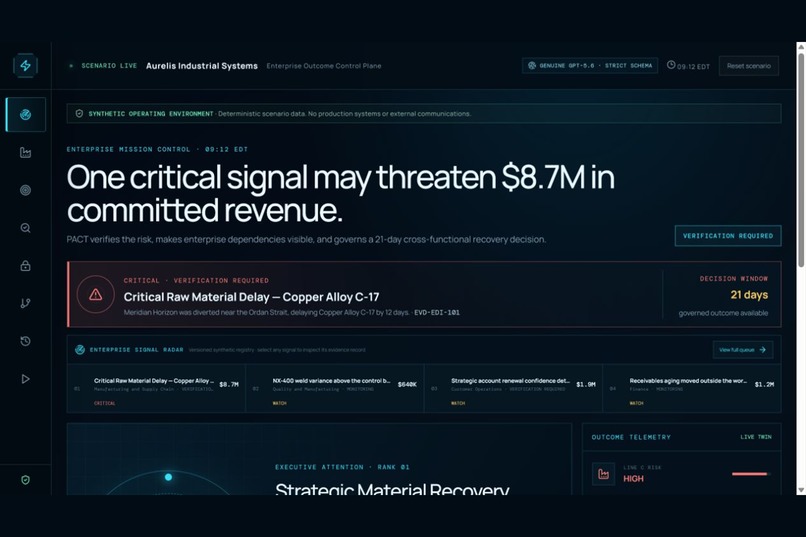
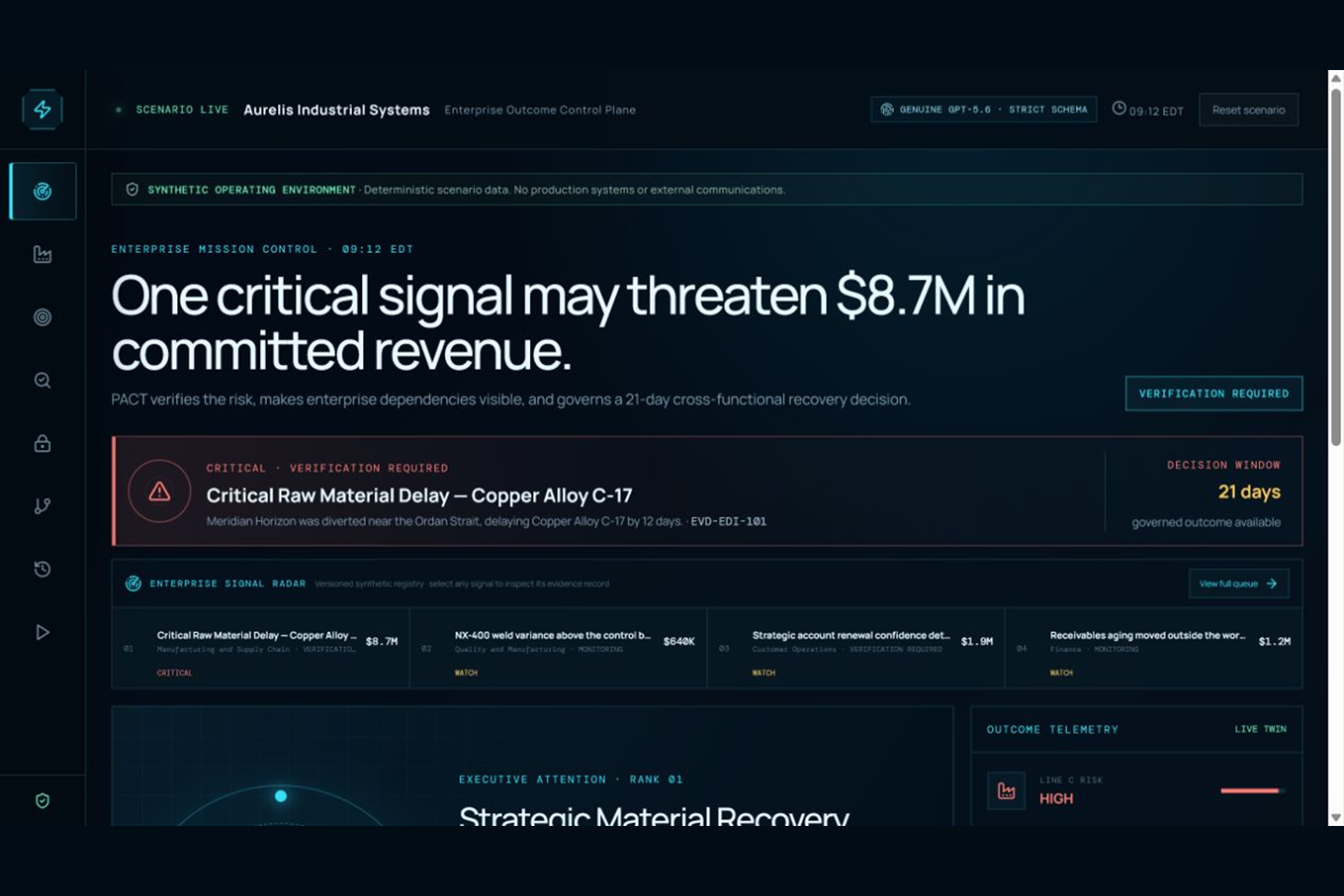
Mission Control ranks a critical enterprise signal, exposes $8.7M of potential value, and makes the governed decision explicit.
-
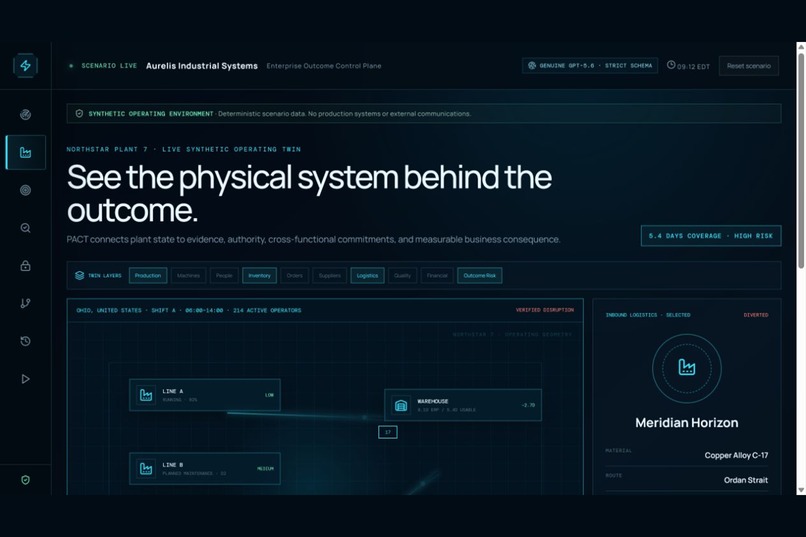
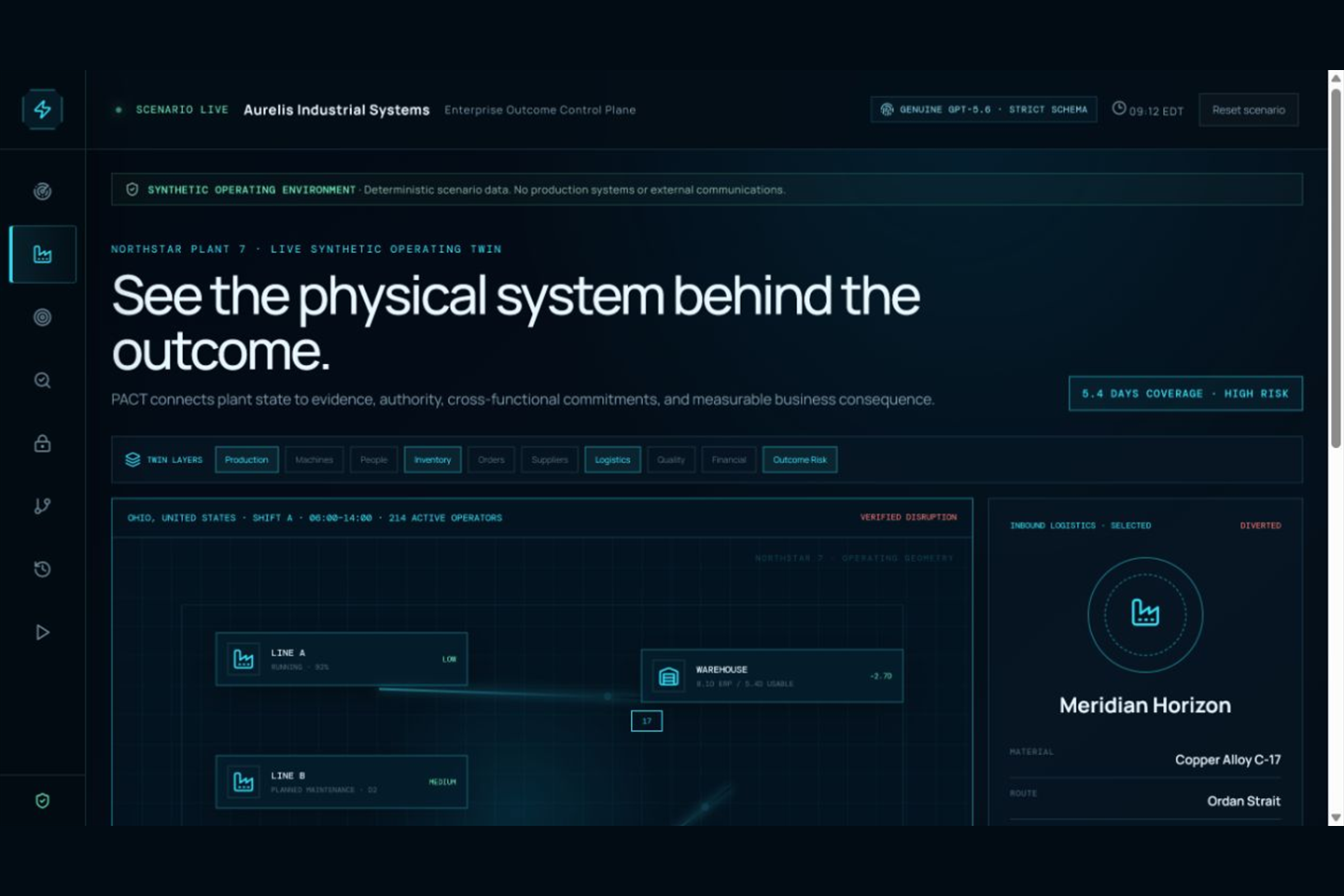
The synthetic operating twin connects material, inventory, production, orders, customers, and financial exposure.
-
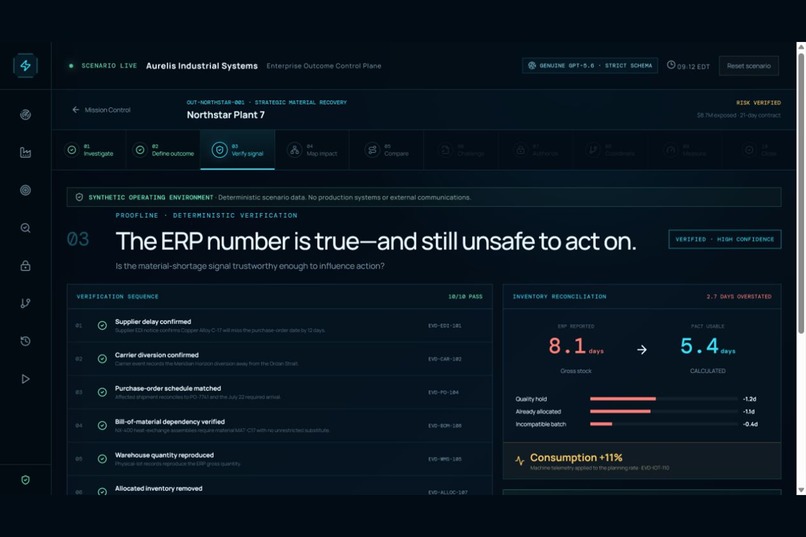
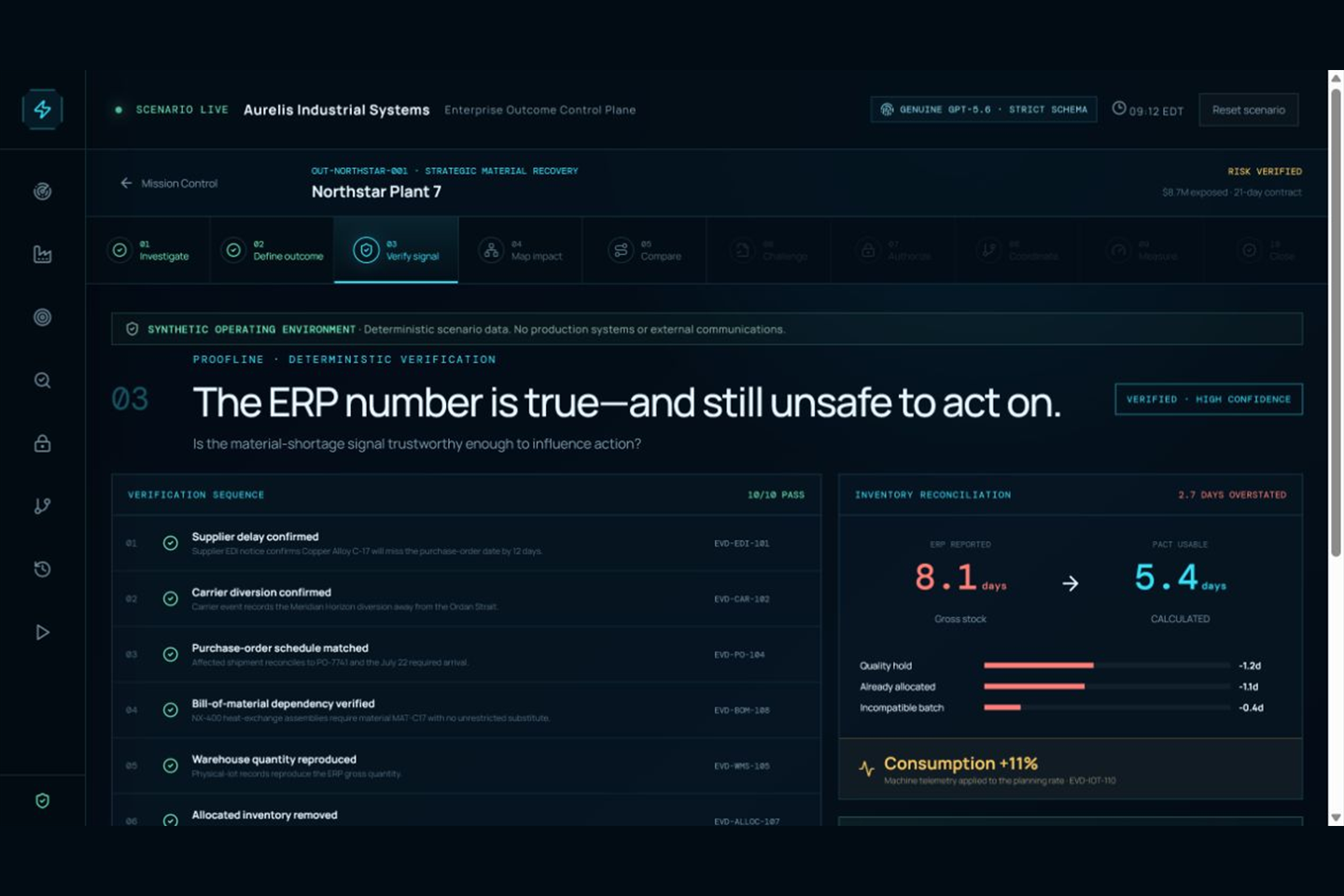
Proofline deterministically reconciles 8.1 ERP days to 5.4 usable days before planning can begin.
-
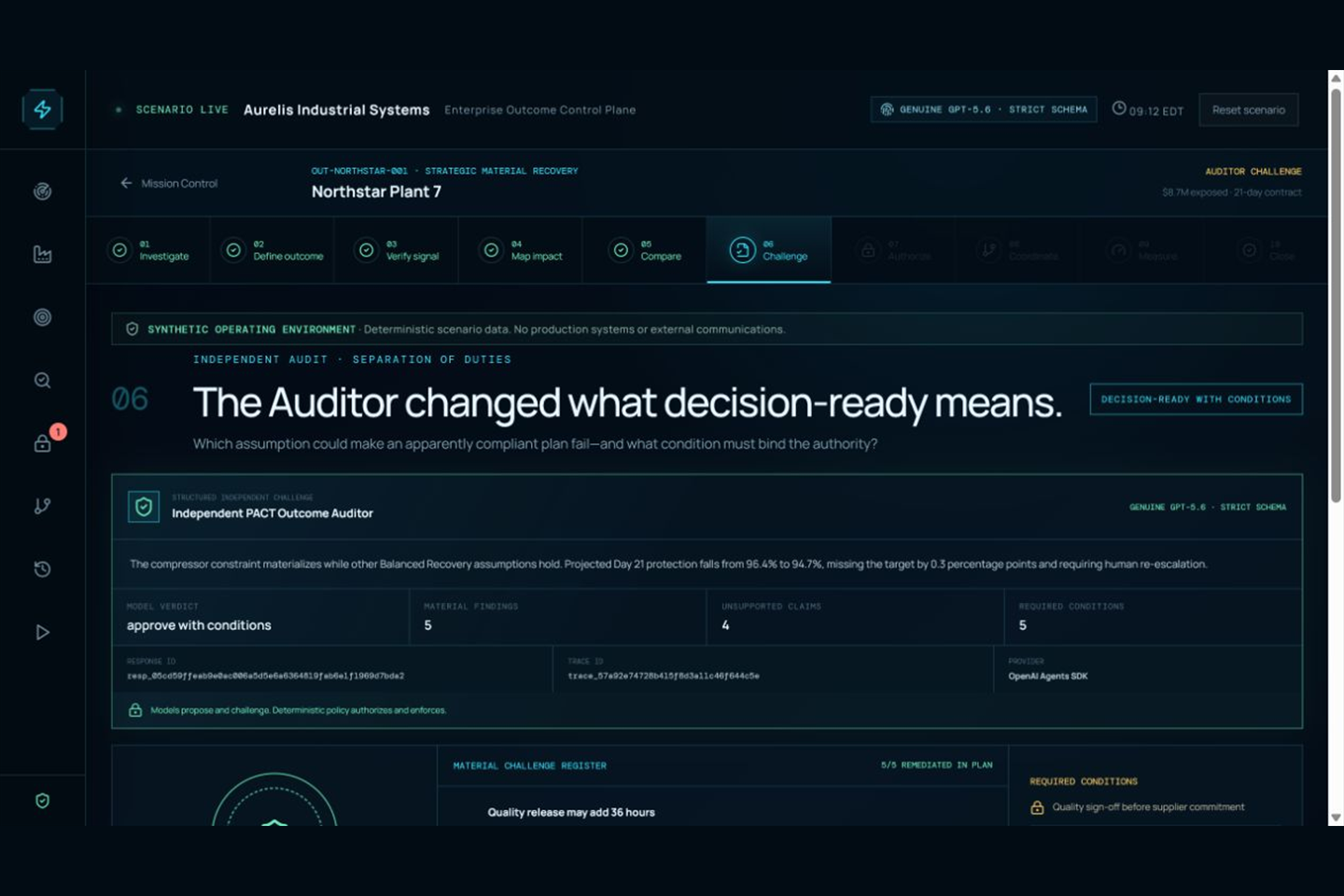
A separate GPT-5.6 Auditor challenges the structured plan and binds five conditions without tool authority.
-
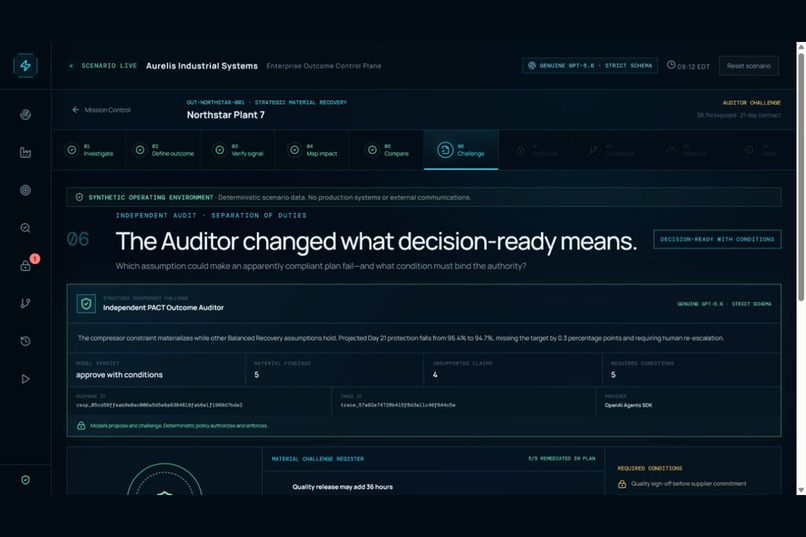
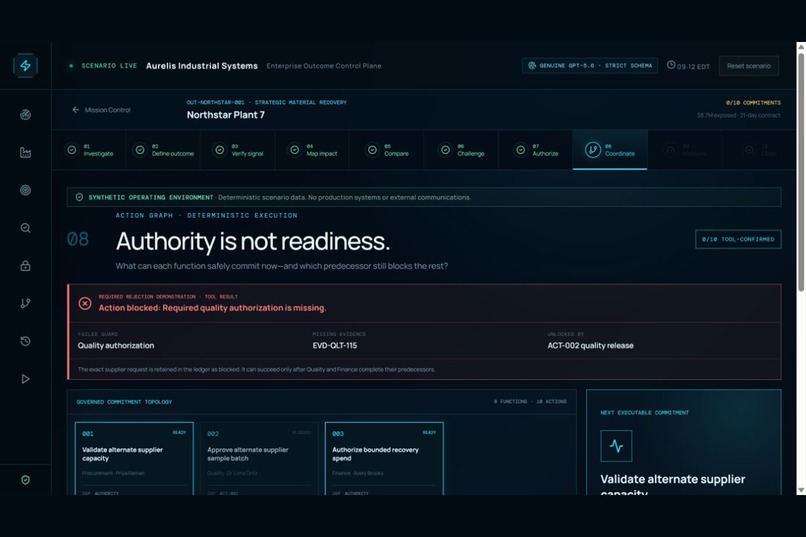
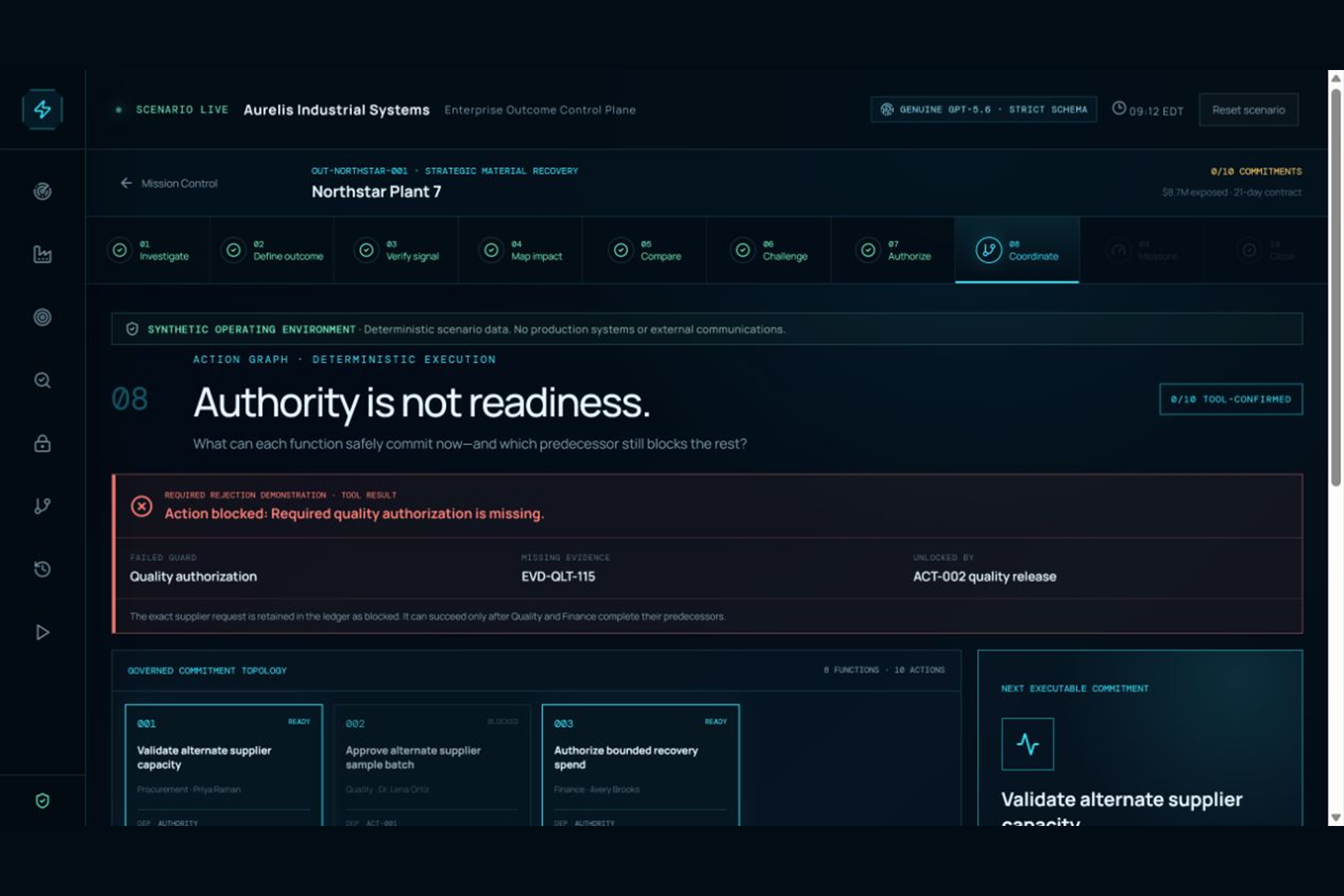
Deterministic policy rejects a premature supplier commitment even after human approval because quality authorization is missing.
-
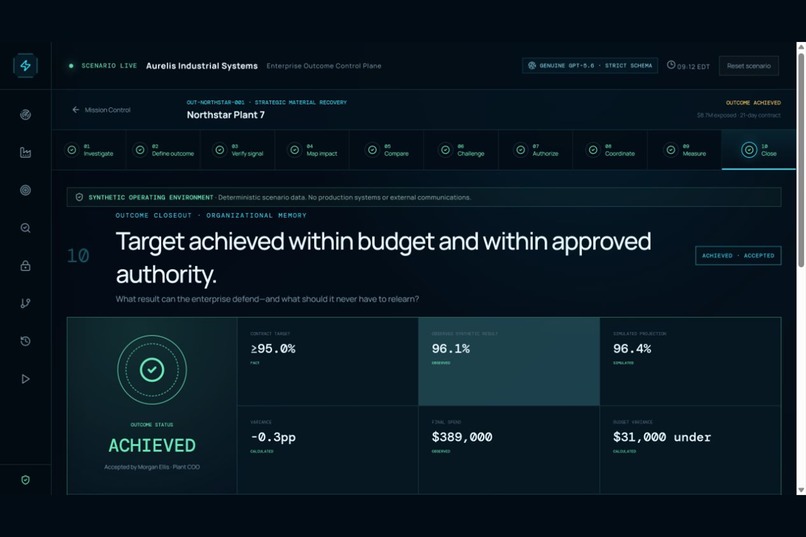
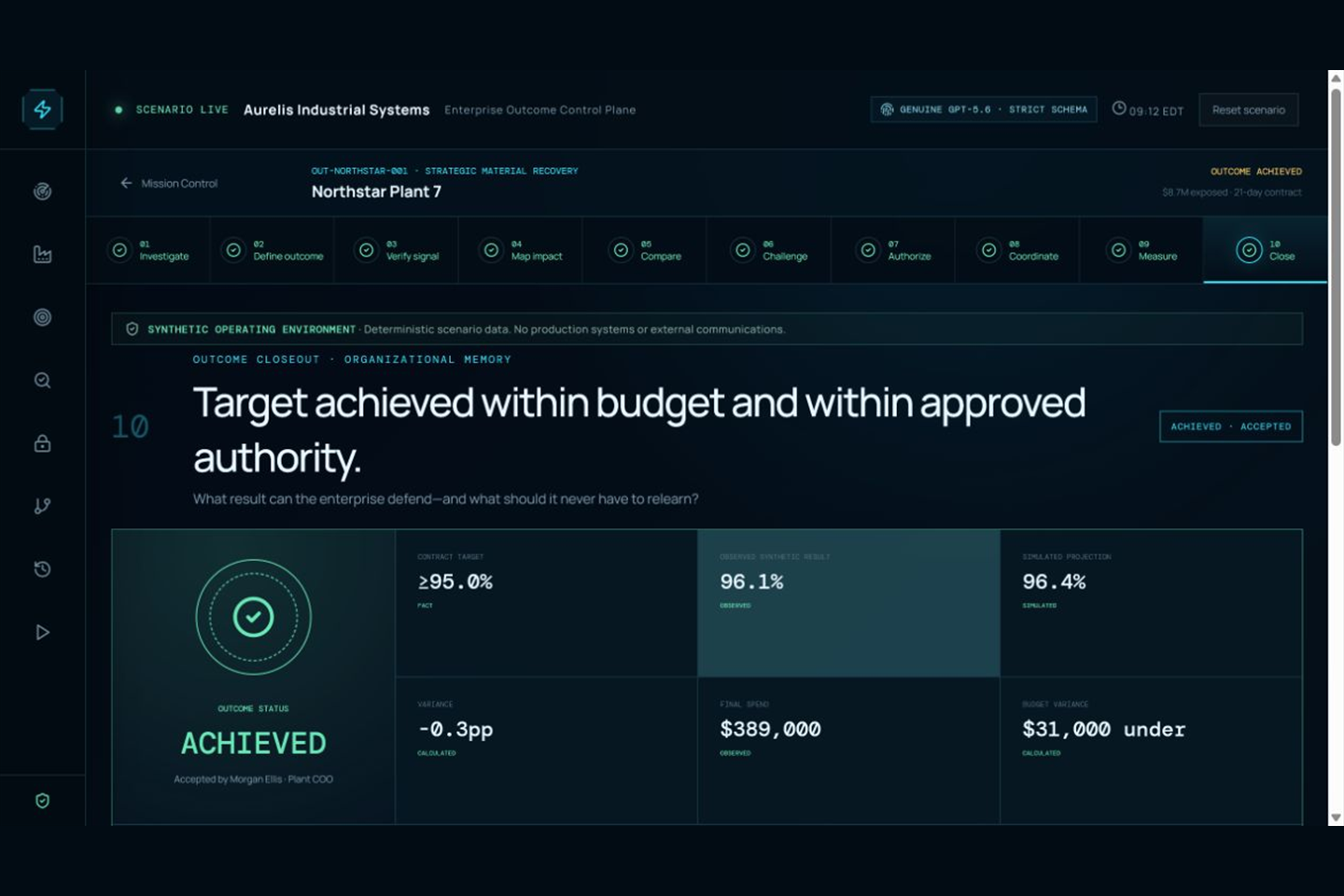
PACT closes the loop at 96.1% observed synthetic protection, $389K cost, and zero quality or authority violations.
PACT — Proof, Action, Coordination & Tracking
AI accountable for the business outcome—not just the answer.
Inspiration
Enterprise AI usually ends at an insight, recommendation, or task list. The hardest part begins after the answer: Is the signal real? Who has authority? Which teams must move first? What is safe to execute? Did the business outcome actually improve?
PACT was created to close that accountability gap. It is an Enterprise Outcome Operating System that connects a consequential signal to verified evidence, independent challenge, human authorization, coordinated action, and a measured result.
What it does
The flagship demonstration is Operation Northstar, a fully synthetic scenario involving fictional manufacturer Aurelis Industrial Systems.
A vessel carrying critical Copper Alloy C-17 is diverted near the fictional Ordan Strait, delaying delivery by 12 days. ERP reports 8.1 days of inventory coverage, but PACT's deterministic Proofline removes quality-held, allocated, and incompatible stock and reproduces only 5.4 usable days.
That shortage cascades through the synthetic plant twin to:
- 6 production cells and 3 manufacturing shifts
- 318 customer orders
- 42 strategic customers
- $1.6M potential penalty exposure
- $8.7M of committed revenue at risk
PACT then defines one governed outcome: protect at least 95% of committed NX-400 revenue within 21 days, spend no more than $420,000, preserve quality, and never bypass human authority.
The system compares three bounded recovery strategies. Balanced Recovery projects 96.4% protection at $386,000. A separate GPT-5.6 Auditor challenges the plan and adds five conditions. The Plant COO—not the model—approves a condition-bound Action Contract.
Then comes the moment that defines PACT: even after human approval, an attempted supplier commitment is rejected deterministically because the required quality authorization is still missing. Authority is not readiness.
Once predecessors are satisfied, PACT coordinates ten commitments across Procurement, Quality, Finance, Logistics, Manufacturing, Workforce Operations, Customer Operations, and the Outcome Lead. The synthetic outcome closes at:
- 96.1% observed protected revenue versus a 95.0% target
- $389,000 final response cost versus a $420,000 ceiling
- 317 orders protected
- zero strategic customers lost
- zero quality incidents
- zero unauthorized customer communications
The Outcome Ledger keeps the entire chain connected: signal, evidence, contract, strategy, dissent, approval, tool results, observations, closeout, and reusable learning.
How we built it
PACT is a React and TypeScript application backed by versioned scenario data and deterministic domain logic. Zod schemas validate contracts, GPT artifacts, workflow state, and tool arguments.
GPT-5.6 is used only where model judgment matters. Through the OpenAI Agents SDK:
- The PACT Outcome Lead synthesizes heterogeneous evidence, surfaces assumptions, compares cross-functional strategies, and proposes a bounded plan.
- The Independent PACT Auditor receives an immutable packet, challenges unsupported assumptions, records dissent, and classifies decision readiness.
Both agents use strict structured outputs, linked response and trace IDs, high reasoning effort, resumable checkpoints, and a hard cost budget. Neither agent has business tools, approval authority, or spending authority.
Deterministic code performs arithmetic, validates evidence, enforces budget and supplier scope, checks dependencies, protects quality and finance gates, and keeps customer communication draft-only. A local PACT MCP server exposes narrowly scoped synthetic business tools instead of dangerous generic actions.
Codex was our engineering partner across product framing, contracts, domain modeling, UI/UX, the plant twin, the two-agent workflow, MCP safety controls, the reusable PACT plugin and skill, tests, red-team review, and release gates. Repository-level rules preserve evidence labels and the complete signal-to-outcome loop throughout the codebase.
Challenges we ran into
The biggest challenge was avoiding three familiar traps: building another KPI dashboard, making human approval decorative, or using AI for deterministic work. We repeatedly red-teamed the architecture so models propose and challenge while policy authorizes and enforces.
We also had to make a complex enterprise workflow understandable in under three minutes. Mission Control, Proofline, the plant twin, Action Contract, Action Graph, blocked unsafe action, measurement, and Replay now tell one coherent story rather than competing for attention.
Accomplishments we are proud of
- A complete evidence-to-outcome product loop rather than a recommendation demo
- A meaningful two-agent separation-of-duties architecture
- Strict schema validation with transparent genuine, fixture, fallback, and fail-closed states
- Human authorization that unlocks specific action classes, not blanket autonomy
- Fifteen safe synthetic MCP tools with stateful deterministic guards
- A changing plant twin, executive Outcome Ledger, and twelve-stage Replay
- A verified 2:55 judge path and a comprehensive automated verification chain
What we learned
Trustworthy enterprise AI is not primarily about giving the model more authority. It is about making model judgment useful inside explicit evidence, dissent, authority, policy, and measurement boundaries. The most valuable AI system may be the one that knows exactly where its authority ends.
What's next
Next we would add governed adapters for enterprise systems, scenario authoring for additional business domains, identity-aware approval policies, portfolio-level outcome management, and pilot deployments with real organizations. Those future connectors would preserve the same contracts, evidence taxonomy, safety guards, and human decision boundaries demonstrated here.
Honest boundary
Operation Northstar is fictional and deterministic. All organizations, people, evidence, transactions, tool calls, and outcomes are synthetic. PACT is not connected to production ERP, manufacturing, customer, or geopolitical systems; it sends no external communications and claims no real-world causal or financial result.
Built With
- agents
- ai
- codex
- context
- digital
- enterprise
- mcp
- model
- multi-agent
- node.js
- openai
- react
- sdk
- typescript
- vite
- zod

Log in or sign up for Devpost to join the conversation.