-
-
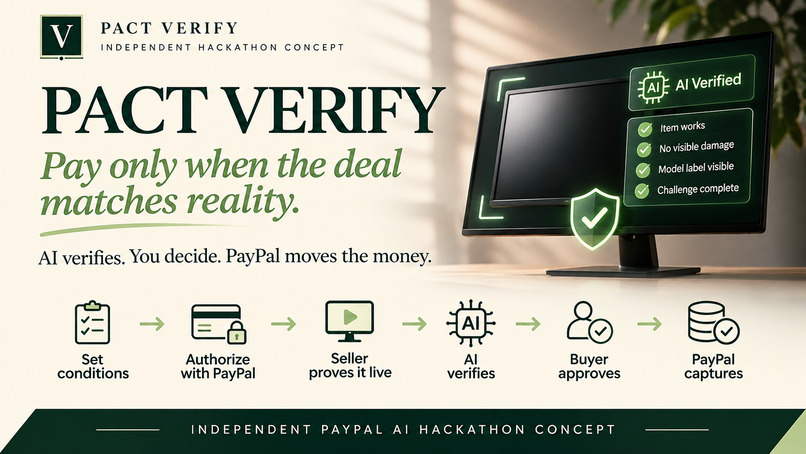
PACT Verify — AI-assisted proof before PayPal capture.
Inspiration
Online transactions often require trust before either side has enough evidence. A buyer may agree to purchase a physical item based on a description or photos, but by the time the money moves, the real item may not match what was promised.
PACT Verify explores a different approach: put verifiable evidence between the promise and the payment.
The idea became:
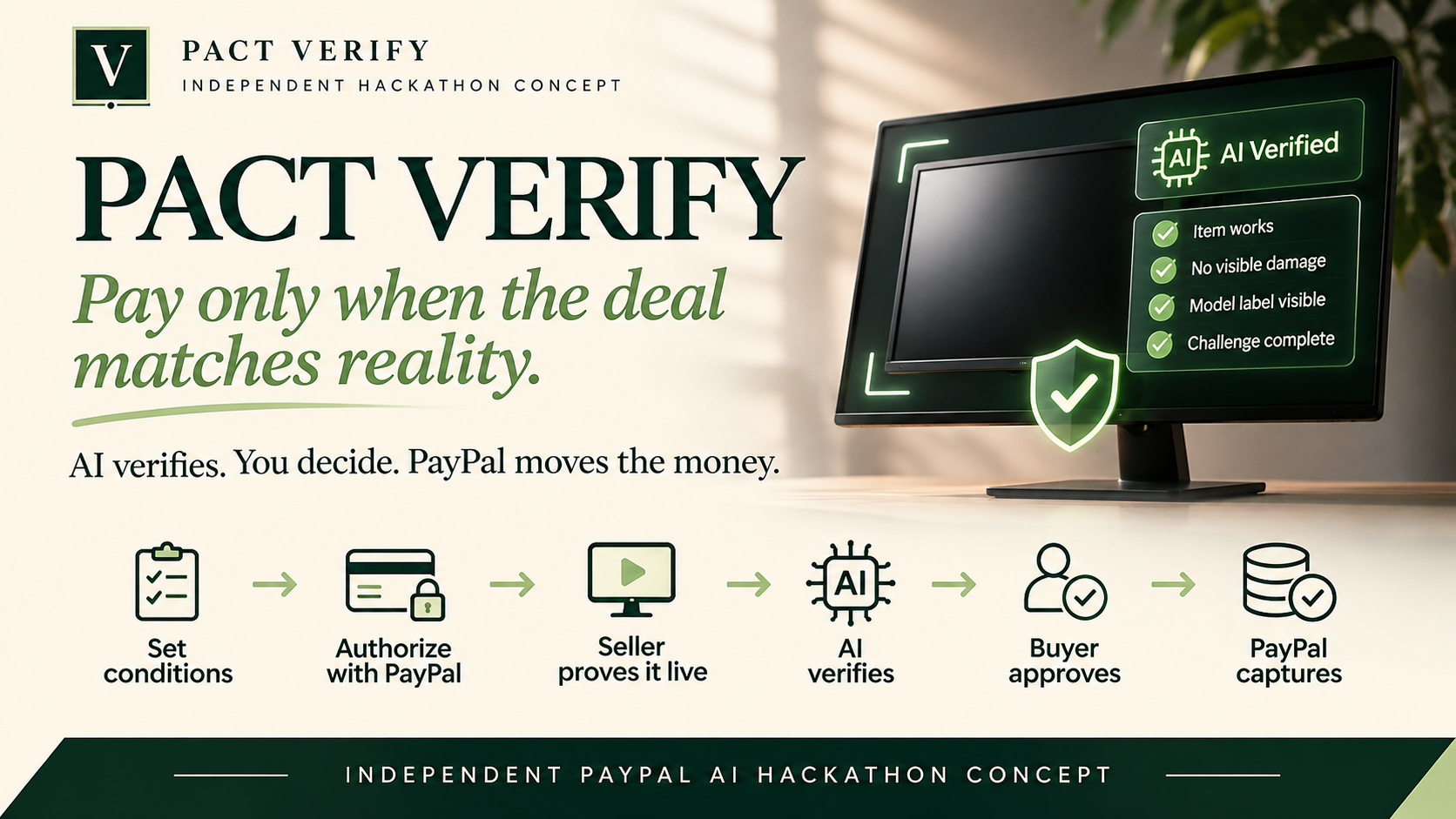
Pay only when the deal matches reality. AI verifies. You decide. PayPal moves the money.
What it does
PACT Verify lets a buyer define clear conditions for a physical item before payment is completed.
The flow is:
- The buyer defines the item, price, and conditions the seller must prove.
- PayPal Sandbox authorizes the amount without capturing it.
- The seller records live video proof of the item and a one-time verification challenge.
- Gemini analyzes the video against the buyer's conditions.
- The buyer reviews the AI findings.
- Only after the required checks pass and the buyer approves can PayPal capture the authorized payment.
AI is advisory rather than autonomous. A failed or uncertain condition results in NEEDS_REVIEW and prevents the payment flow from continuing.
How we built it
PACT Verify is built with Next.js and TypeScript.
PayPal Sandbox provides the authorization and capture flow. The application uses PayPal's developer APIs so money can first be authorized and only captured after the verification and buyer-decision stages.
Google Gemini 3.5 Flash Lite analyzes seller proof videos and returns structured findings for each buyer-defined condition as well as the one-time verification challenge.
The hosted application uses Supabase Postgres for case state and private Vercel Blob storage for seller proof videos. Sensitive PayPal, Gemini, database, and storage credentials remain server-side.
The public deployment runs on Vercel.
Verified results
We tested both the successful and blocked paths.
In a controlled positive-path test, Gemini analyzed a live video of a used monitor. The monitor powered on, had no obvious visible cracks, showed the required Dell label, and included the complete one-time verification challenge. After the buyer approved the passing report, PayPal Sandbox successfully captured the existing $100 authorization. A duplicate capture attempt was also blocked.
We separately tested the hosted safety path with a $10 authorization. The seller deliberately hid the monitor's model label. Gemini passed the other checks and the challenge but failed the missing-label condition. The overall result remained NEEDS_REVIEW, and PayPal recorded zero captures.
The completed $100 capture is archived evidence from the earlier controlled local flow. The hosted $10 case verifies the deployed Vercel/Supabase/private-Blob safety path. We clearly distinguish these results rather than presenting the local capture as a hosted capture.
Challenges we ran into
The biggest challenge was safely connecting AI verification to a financial action.
We did not want the AI itself to decide when money moves, so the system separates AI analysis, buyer approval, and PayPal capture into different stages.
Another challenge was handling seller video securely in a hosted environment. Browser-recorded videos are stored privately and accessed server-side for Gemini analysis rather than being exposed publicly.
We also had to carefully test authorization versus capture, duplicate-capture protection, failed proof, browser-bound buyer decisions, and the difference between locally verified and hosted results.
Accomplishments that we're proud of
We successfully demonstrated a complete controlled path from live seller proof to Gemini verification, buyer approval, and a real PayPal Sandbox capture.
We also demonstrated the opposite result: incomplete proof caused Gemini to return NEEDS_REVIEW, and the authorization remained uncaptured.
The project therefore demonstrates not only a successful payment path, but also the safety behavior that prevents money from moving when the evidence does not satisfy the buyer's conditions.
What we learned
We learned that AI works best here as an evidence layer rather than as the final financial decision-maker.
PayPal authorization and later capture make it possible to separate agreeing to a transaction from actually moving the money, while Gemini can help turn live seller evidence into structured information a buyer can review.
We also learned how important clear system boundaries are when combining AI, payments, private media, and user decisions.
What's next
Future work could include stronger identity and anti-spoofing controls, improved seller/buyer authentication, more advanced evidence verification, production-grade rate limiting, and broader support for different types of physical goods.
PACT Verify is an independent hackathon concept and is not an official PayPal product.
What it does
How we built it
Challenges we ran into
Accomplishments that we're proud of
What we learned
What's next for PACT Verify
Built With
- gemini-3.5-flash-lite
- google-gemini
- next.js
- node.js
- paypal
- paypal-js-sdk
- paypal-sandbox
- postgresql
- react
- supabase
- typescript
- vercel

