-
-
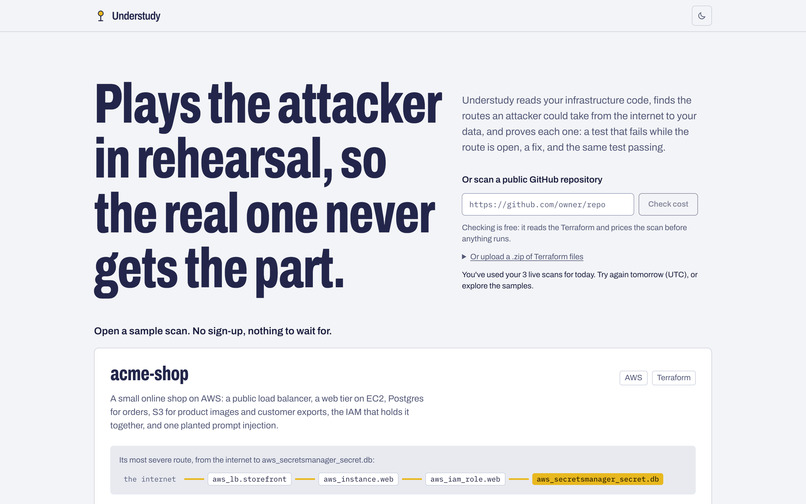
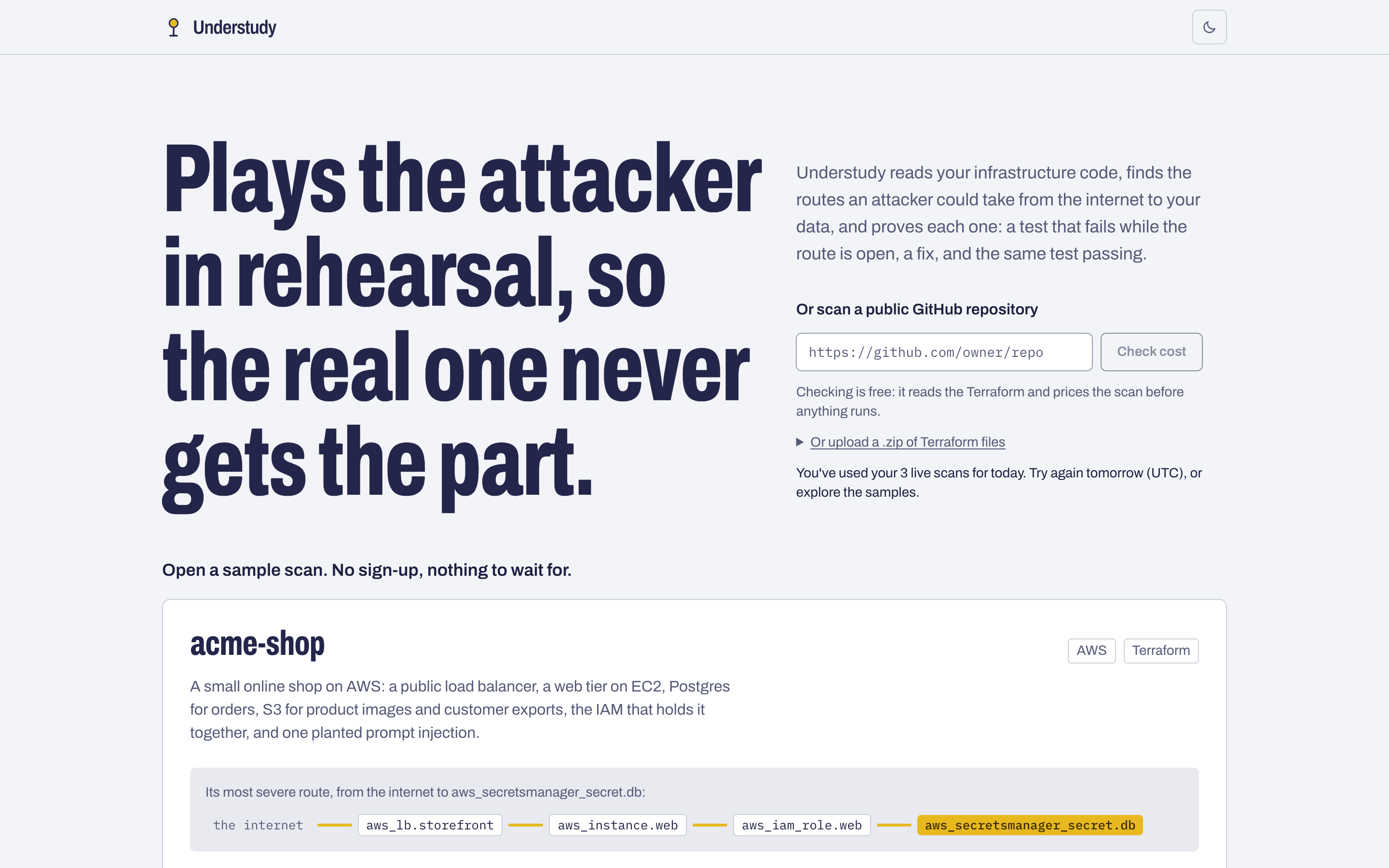
Landing Page
-
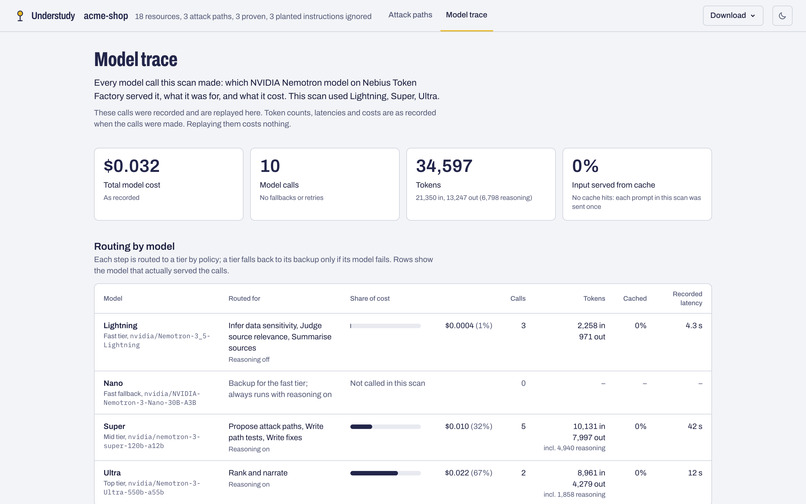
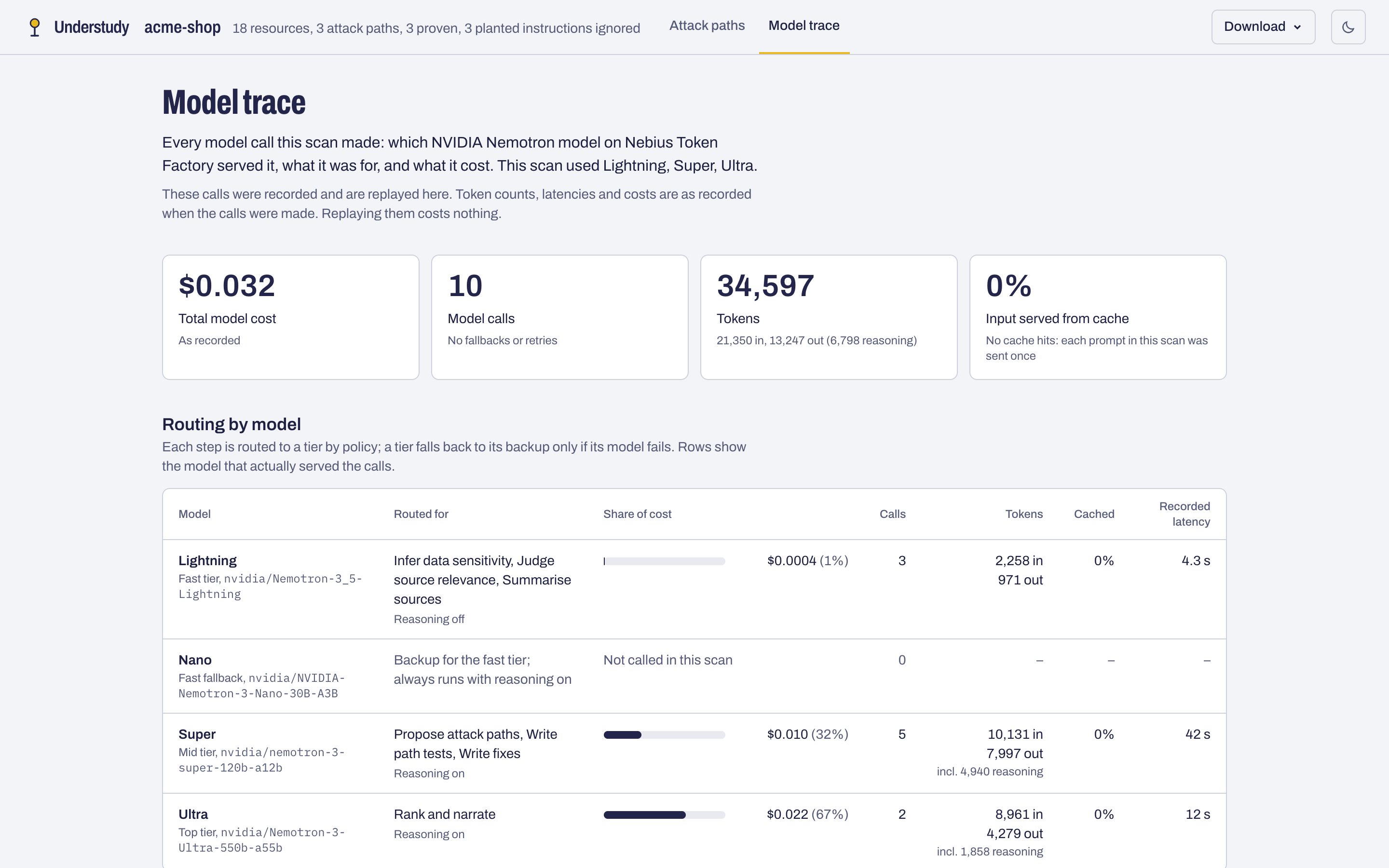
Model Trace
-
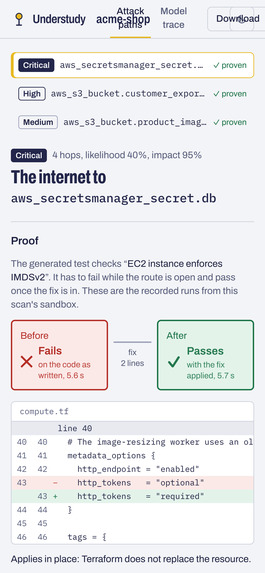
Mobile Look
-
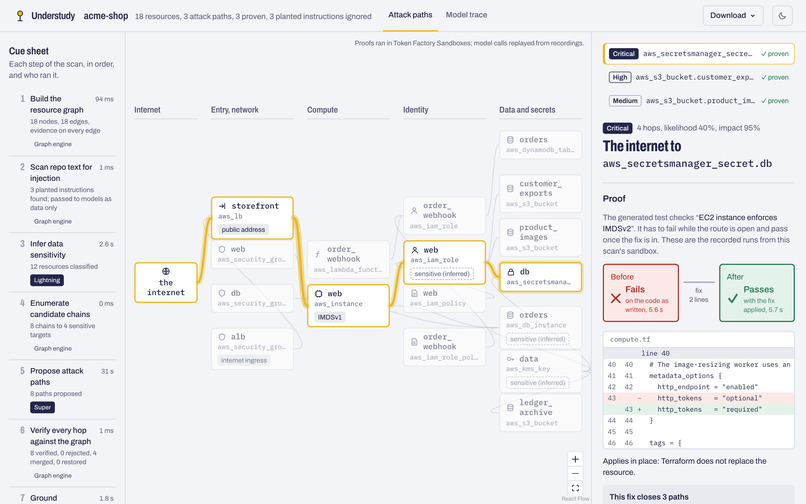
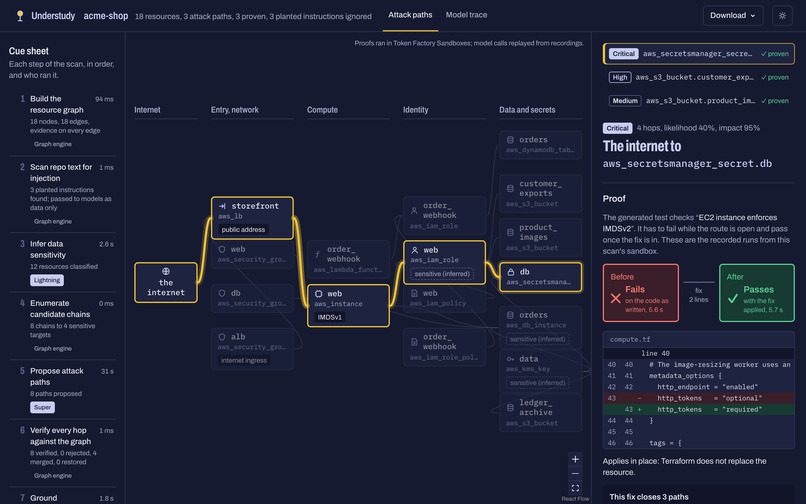
Scan Overview
-
Scan Dark Mode
-
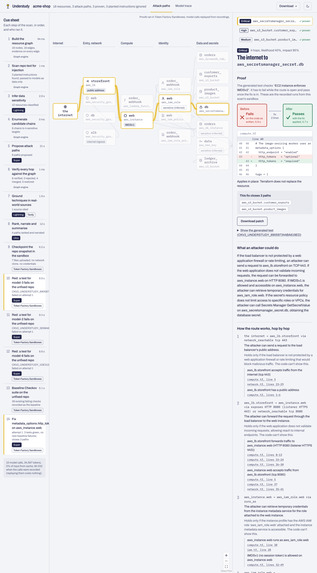
Full path details
Inspiration
Every IaC scanner I've used tells me what is misconfigured — "this bucket is public," "this security group is open" — and leaves the part that actually matters to me: can an attacker reach my data, and is this finding even real? As a platform engineer I've spent too long triaging walls of "high severity" findings that turn out to be unreachable, while the one chain that genuinely connects the internet to a secret hides in the noise.
I wanted a tool that does what a red-teamer does: not list misconfigurations, but find the path from the internet to sensitive data, and then prove it — not with a model's confident guess, but with a test that actually runs. The name says the goal: Understudy plays the attacker in rehearsal, so the real one never gets the part.
What it does
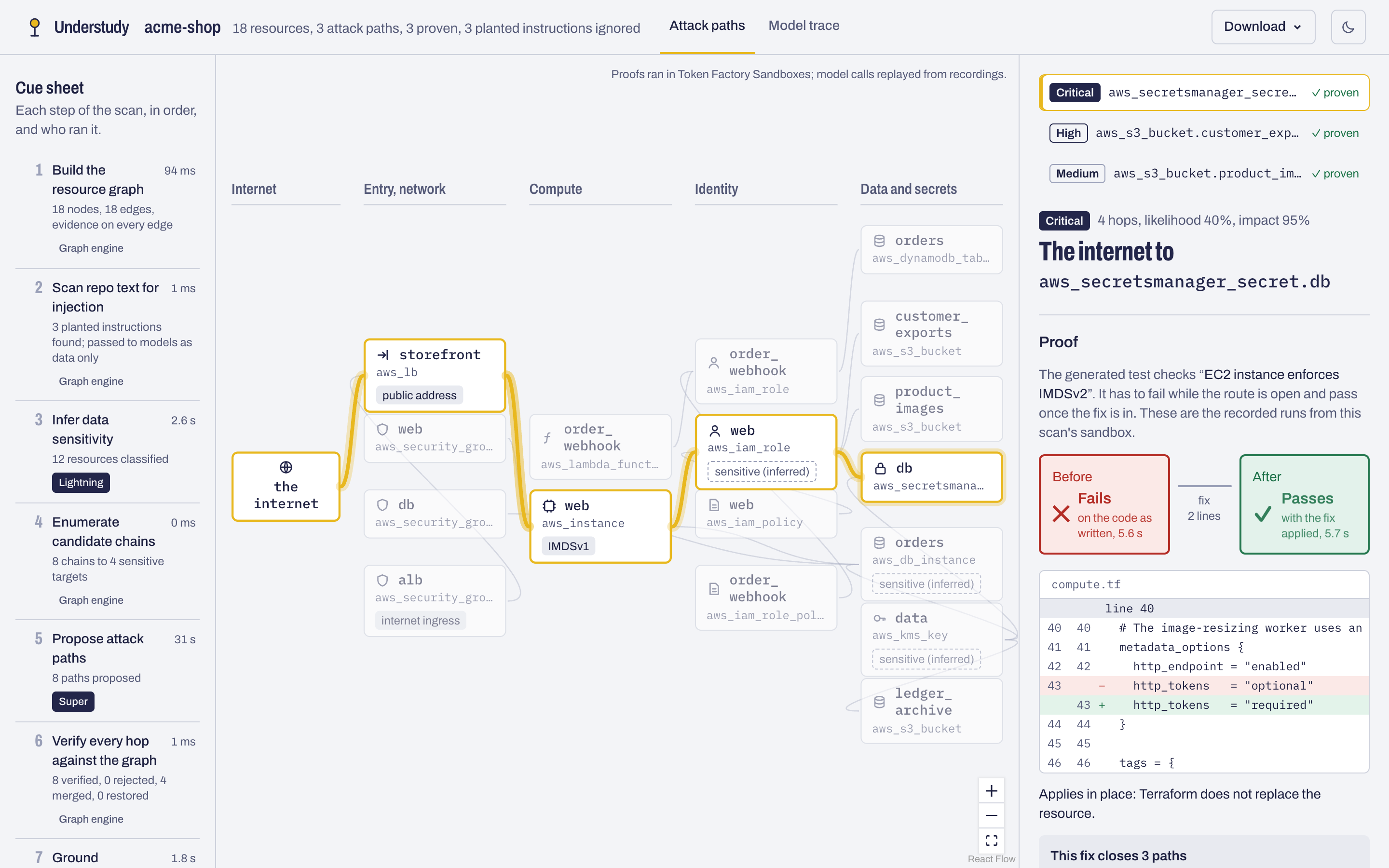
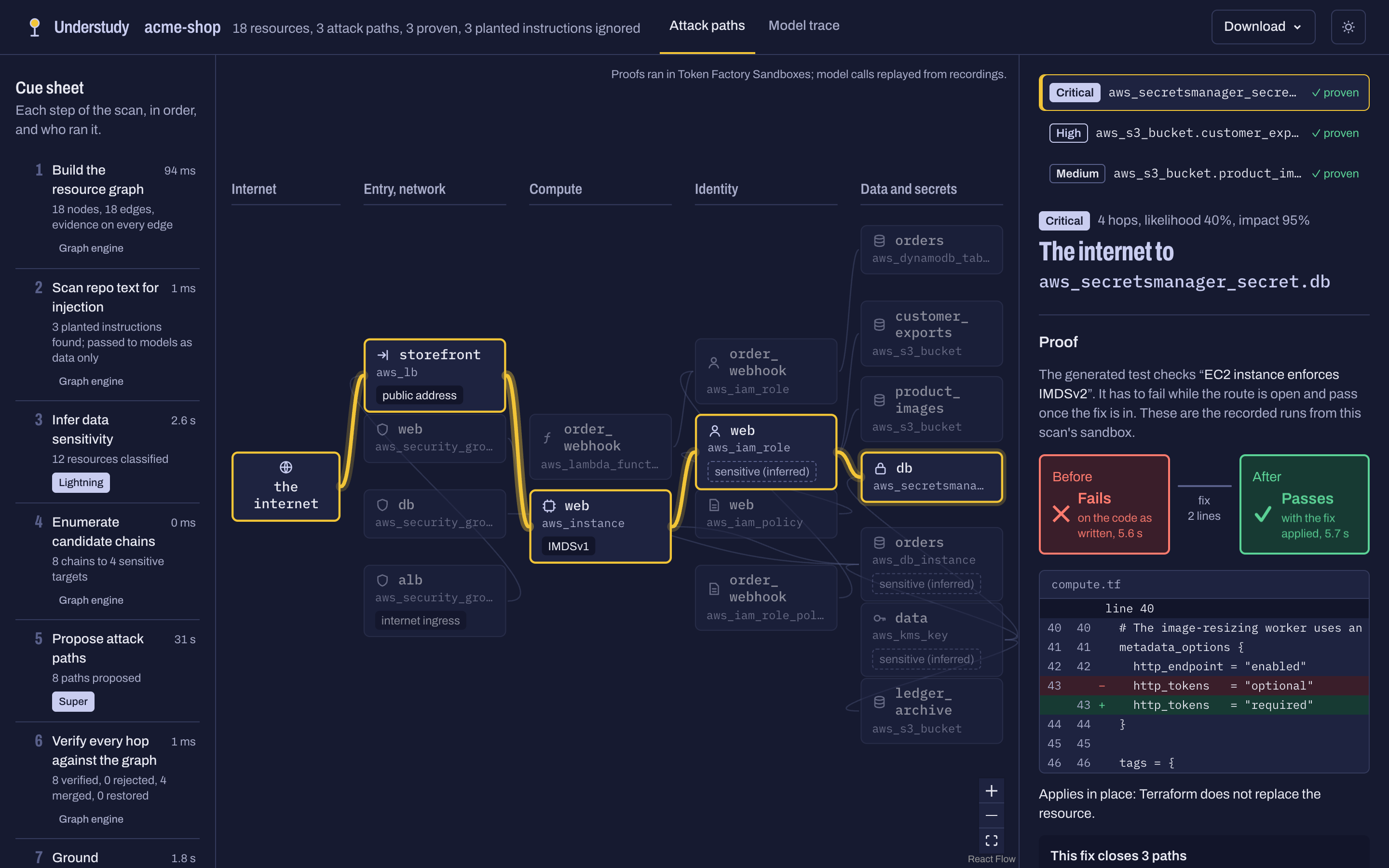
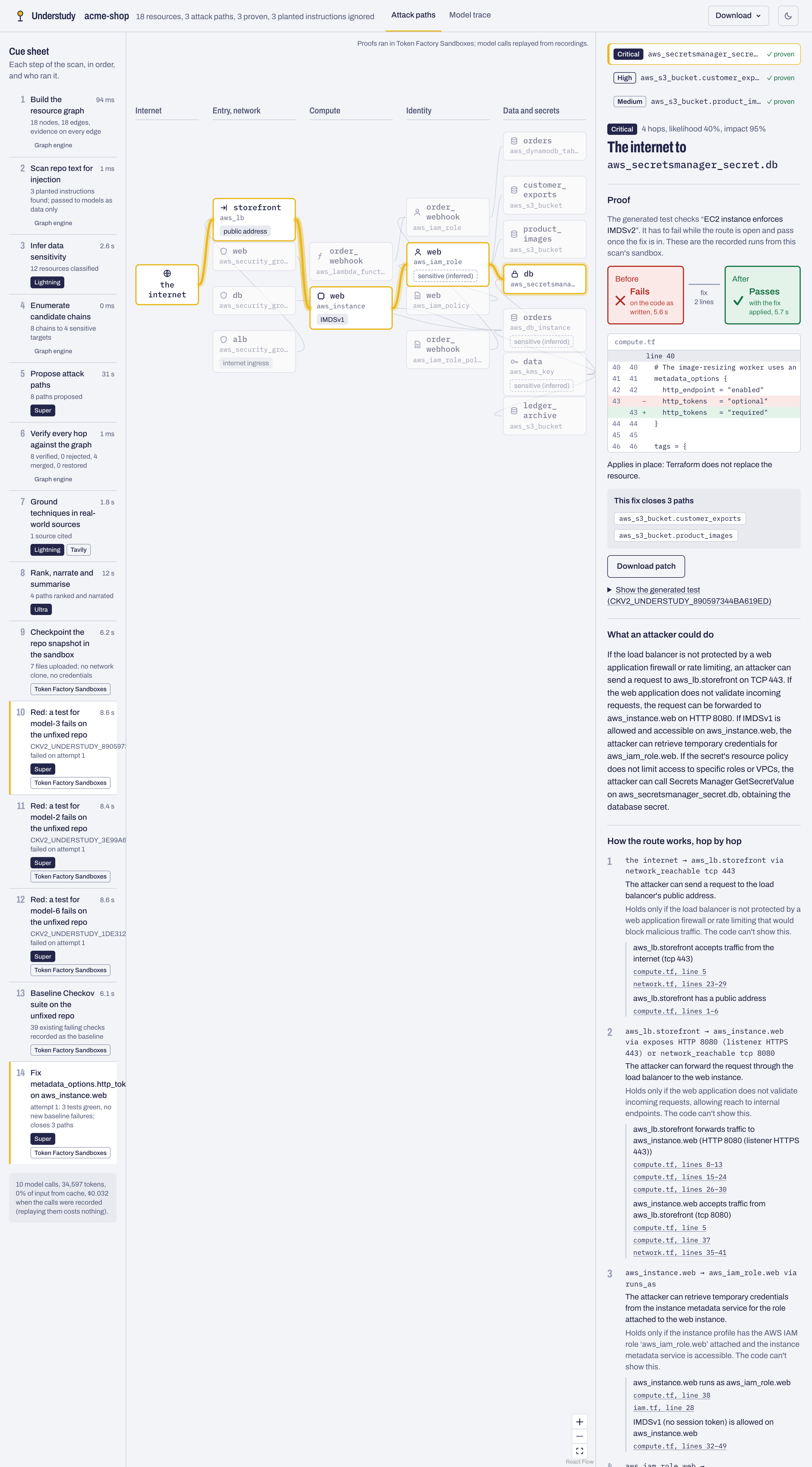
Understudy reads your Terraform, builds a resource graph with evidence (file + line) on every node and edge, and finds attack paths from the internet to sensitive data — S3, Secrets Manager, RDS, DynamoDB. For each path it:
- Proposes the path with an LLM — but never trusts it.
- Verifies it against the graph — a path containing an edge that doesn't exist is rejected.
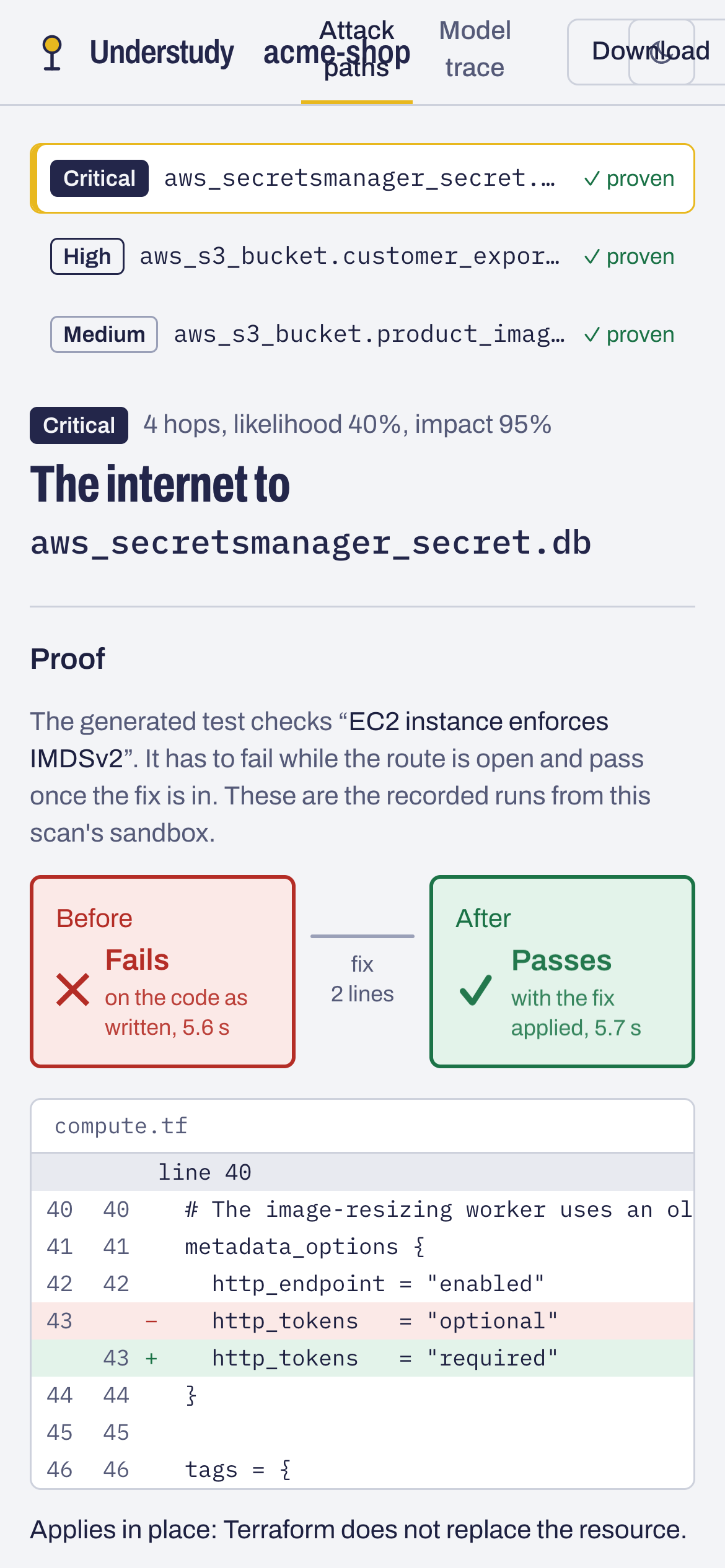
- Proves it in a disposable sandbox — it generates a policy test that must fail on the code as written, then applies a fix and shows the same test pass. Red → green, with the diff.
Nothing is labelled "proven" without stored red→green evidence. Repo text is treated as untrusted input, so planted prompt-injection instructions are ignored, not executed.
How we built it
- Core loop: the LLM proposes, the graph verifies, the sandbox proves. Python 3.12 / FastAPI / Pydantic,
networkxfor the graph, Checkov inside the sandbox for the proofs, Next.js + React Flow for the UI. - Models: three NVIDIA Nemotron tiers on Nebius Token Factory, routed per step through one OpenAI-compatible endpoint — Lightning for cheap classification and summarising, Super for the reasoning-heavy path proposal and test/fix writing, Ultra to rank and narrate, with Nano as the fast-tier fallback. A full scan of the sample app is 10 calls, 34,597 tokens, $0.032 — the cheapest tier carries ~1% of cost and the top tier runs only the 2 calls that need it.
- Proofs: Token Factory (Contree) Sandboxes — each Checkov run spins up a disposable instance from a pinned image, with the repo uploaded as files, never cloned. Copy-on-write images map exactly onto "branch per hypothesis, prove, roll back."
- Deployed on AWS, Terraform-only: ECS Fargate (arm64), an internal ALB reached through a CloudFront VPC origin so the load balancer is never internet-facing, WAF, KMS, and a DynamoDB ledger with per-scan budget caps and a live-scan kill switch.
Challenges we ran into
- Nemotron reasoning is on by default and billed as output. A small
max_tokensreturned empty answers because the whole budget went to reasoning tokens. The toggle (chat_template_kwargs.enable_thinking) is documented by NVIDIA/vLLM, not Token Factory — so I added a per-step reasoning flag. - Prompt caching that works but doesn't land. An isolated probe cached a repeated 4K prefix for ~79% savings, but a real 10-call scan got 0% cache hits — the rules (minimum match length, block size, write timing, TTL) aren't documented.
- Sandboxes have no per-instance network-off switch — the biggest gap for running untrusted repo code. I compensated: upload files instead of cloning, empty env, Checkov with
--skip-download, public repos only. - A parser bug that crashed on
for_each— found by running the eval against real third-party repos, not my own sample. Fixed, tested, and redeployed to the live site. - Staying honest. The hardest discipline was never displaying a path the graph hadn't verified, or a fix the sandbox hadn't proven — even when the model was confident.
Accomplishments that we're proud of
- It's live and works end to end on repos I didn't build.
- I evaluated it against held-out repos (CloudGoat + TerraGoat), not just my own demo: 25 of 28 findings real, recall 2/3 — and I report openly that the proof loop only lands on 5 of 28 unseen paths, because an honest number is worth more than a flattering one.
- Verified, not guessed — red→green proofs backed by real sandbox evidence.
- Cost discipline — ~$0.03 a scan, with hard budget caps and a kill switch.
- Built solo, on a deadline.
What we learned
- The model is the weakest link for proving, and that's exactly why the graph and sandbox matter. The LLM is strong at proposing candidate paths and unreliable at writing a fix that passes on an unfamiliar repo (5/28). The verification layer is what makes the output trustworthy.
- Tiered routing is real cost control — reserving the 550B model for the two calls that need it kept a full scan at three cents.
- Held-out evaluation finds bugs your own demo never will — it surfaced both the
for_eachcrash and a precision bug where metadata-only permissions were counted as data access.
What's next for Understudy
- Better fix generalization — raising that 5/28 proof rate on unseen repos is the clearest next win.
- Model containers — ECS/EKS tasks; the one documented path the eval missed was an ECS takeover.
- More formats and clouds — CloudFormation/CDK, Kubernetes/Helm, and Azure/GCP adapters behind the same graph.
- CI integration — a GitHub Action and PR comments, so Understudy runs on every pull request.
- Fix the precision bug — metadata-only actions shouldn't yield data-access edges.
Built With
- amazon-web-services
- checkov
- contree-sandboxes
- fastapi
- nebius-token-factory
- nextjs
- nvidia-nemotron
- openai-api
- pydantic
- python
- react-flow
- tailwindcss
- terraform
