
Inspiration
A single packing mistake can turn a successful online sale into a costly return. For small e-commerce businesses, sending the wrong product or forgetting an item means additional shipping, customer support, and lost trust.
We saw an opportunity to make order verification accessible through a simple camera above the packing table. PackProof’s goal is to help staff catch mistakes while they can still fix them—before the box is sealed.
What it does
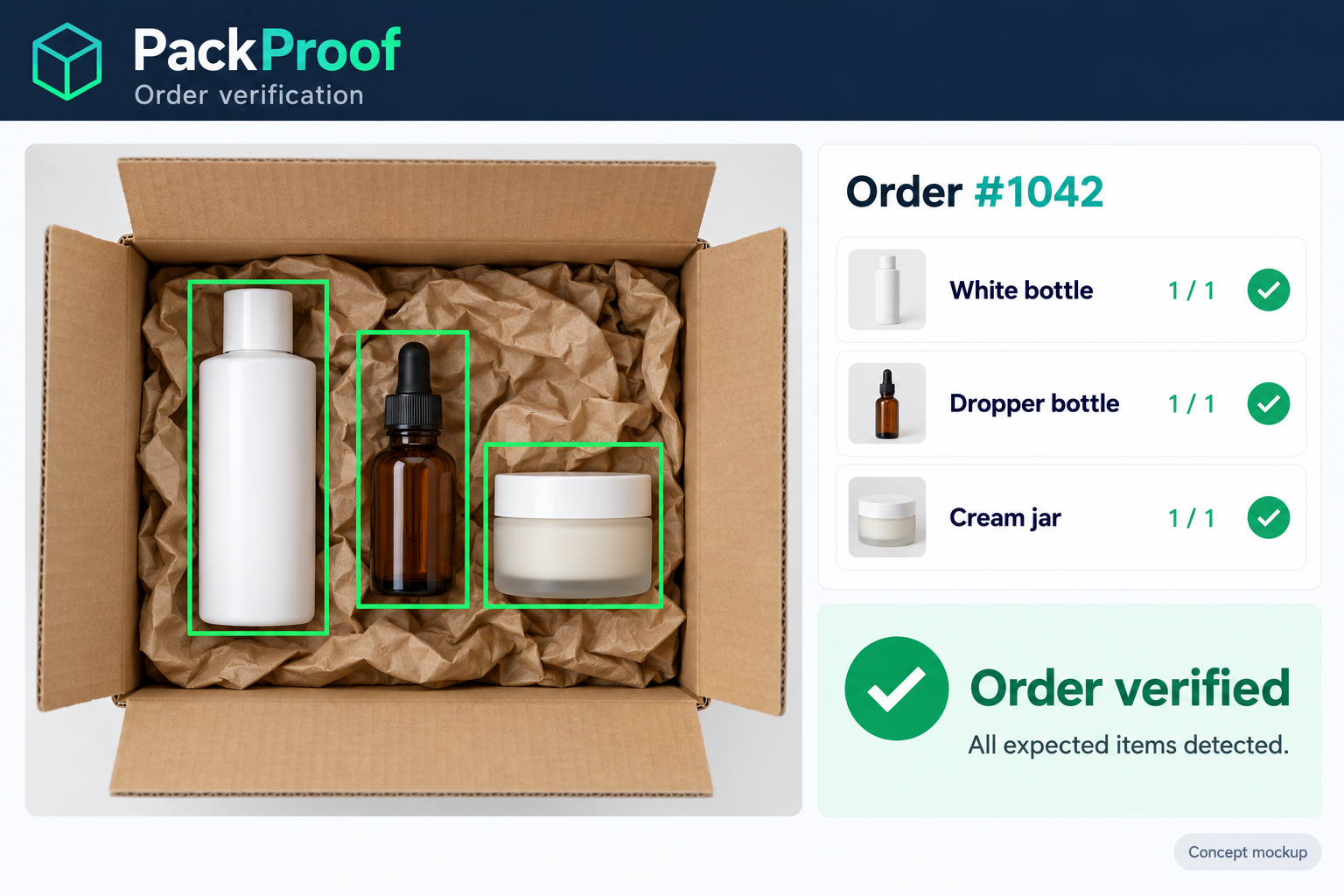
PackProof is an AI camera assistant designed to compare the items being packed with the customer’s order.
The planned workflow is simple:
- Load an order and its expected products.
- Track products as the packer places them into the box.
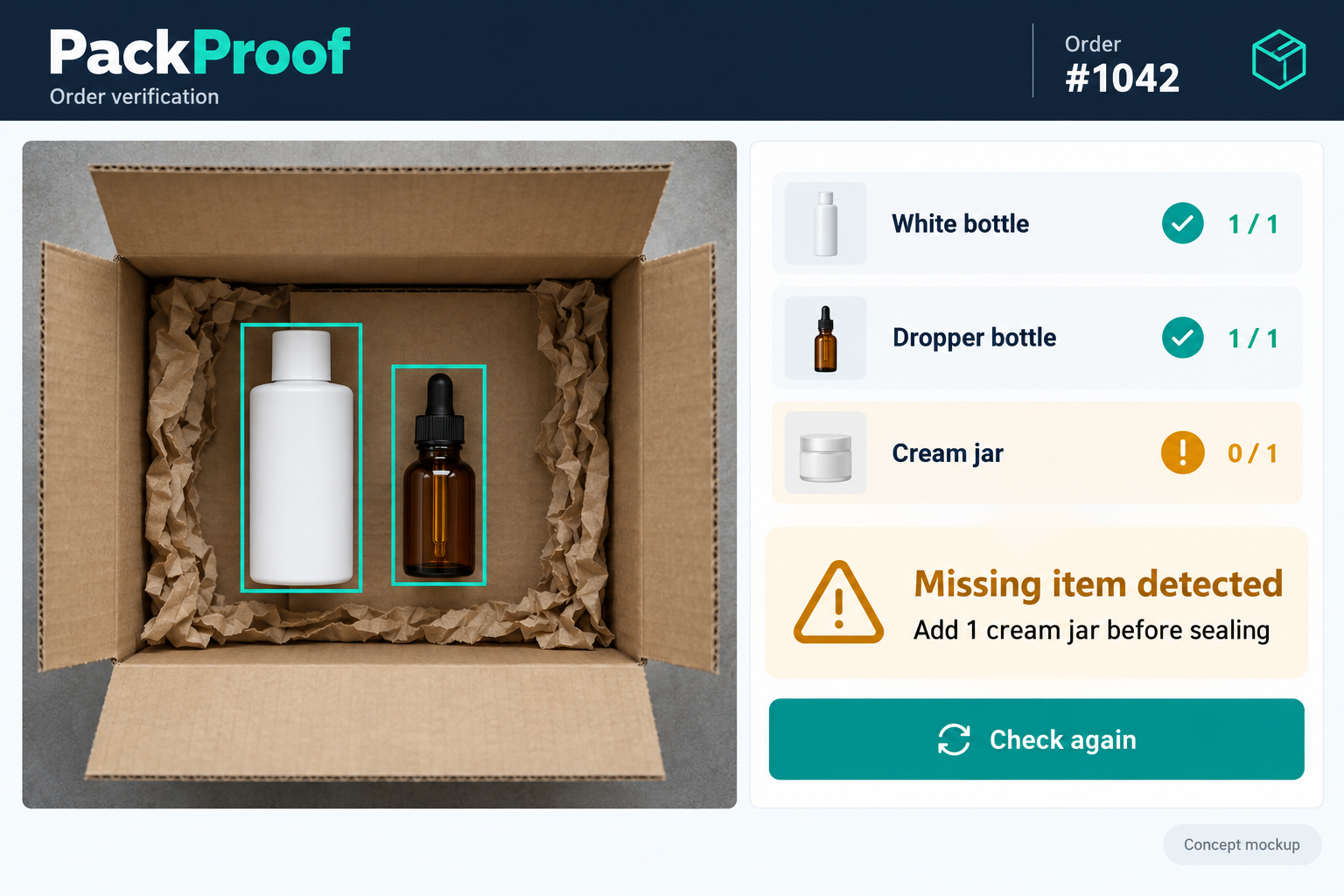
- Flag missing items, unexpected products, or incorrect quantities.
- Ask the packer to show a label or barcode when visual recognition is uncertain.
- Save a verification photo and record for the order.
The initial prototype will focus on 10–20 selected products with standardized packaging.
How we built it
Our proposed architecture combines a camera, OpenCV 5, product recognition, and AWS services.
OpenCV 5 will handle frame processing, packing-area detection, and object tracking. A recognition model will identify supported products, with barcode or label scanning providing additional evidence for similar variants.
An AWS-hosted service will compare detected items with the expected order. Amazon S3 will store verification images, while a database will maintain order details and inspection results.
A browser dashboard will show the expected items, detected products, and any issues requiring attention. When confidence is low, the system will request another view and use the new evidence to update its decision.
Challenges we ran into
At the concept stage, we identified several challenges that the prototype needs to address.
Similar packaging can make different product variants difficult to distinguish. Hands and overlapping items can obscure the camera’s view. Tracking must also distinguish between a new item and the same item appearing across multiple frames.
Another challenge is balancing accuracy with speed. A verification tool needs to catch mistakes without creating unnecessary interruptions for the packer.
Our planned approach combines visual tracking, barcode checks, and explicit requests for human confirmation when the available evidence is insufficient.
Accomplishments that we're proud of
Our strongest progress so far is defining a focused product concept with a clear user, workflow, and evaluation plan.
We have narrowed the first prototype to a manageable product catalog and three practical scenarios: a correct order, a missing item, and an incorrect product variant.
We also designed a workflow in which uncertainty leads to a useful next action: asking for a clearer view before making a verification decision.
What we learned
Our planning highlighted that product recognition is only one part of reliable order verification. The system also needs to track quantities, handle items being removed, and communicate uncertainty clearly.
We learned that a useful first version should solve a narrow problem well. Starting with a small, controlled catalog will make it easier to evaluate performance and understand failures before expanding.
We also identified the measurements that matter most: detected packing errors, false alerts, and the time added to each order.
What's next for PackProof — an AI camera that checks orders before they ship
Our next step is to build and evaluate the prototype using staged packing sessions with known errors.
We plan to:
- Collect product images and representative packing videos.
- Implement recognition, tracking, and order comparison.
- Measure performance under different lighting and occlusion conditions.
- Test the dashboard with people who pack orders.
- Run a pilot with a small online retailer.
Longer term, we aim to add e-commerce integrations, expand product coverage, and test a subscription model per packing station.
Our goal is straightforward: help retailers catch packing mistakes before their customers do.

Log in or sign up for Devpost to join the conversation.