-
-
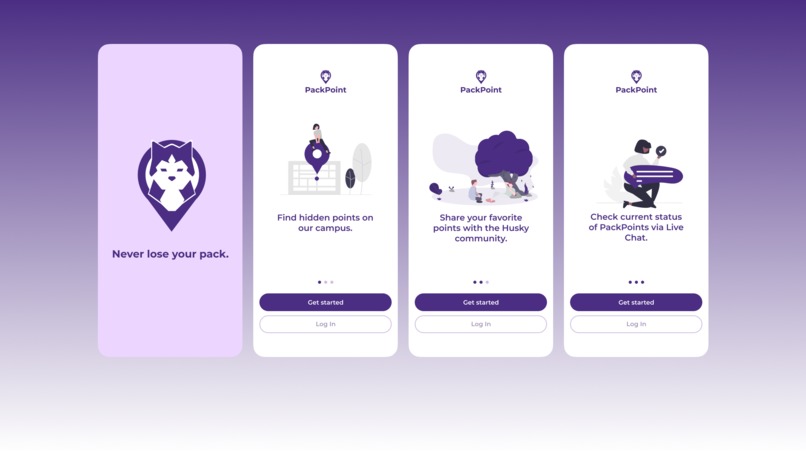
Onboarding
-
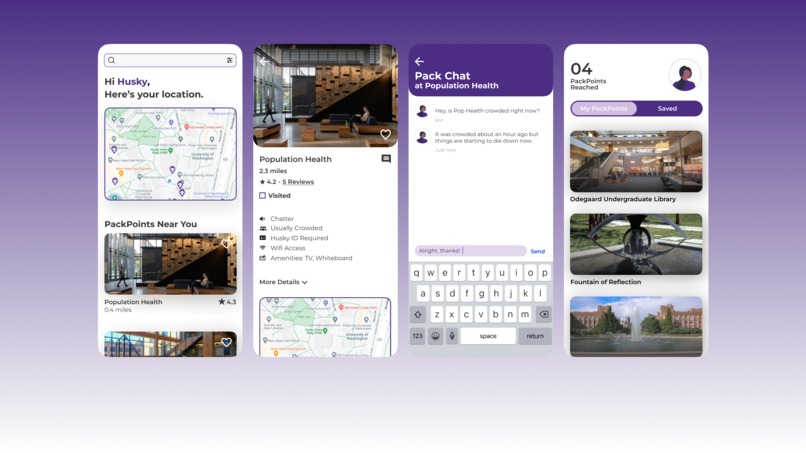
App Features


Inspiration
As college students, we know that we’re picky about the places that we choose to study in, to hangout between classes, and to destress. We realized that our experiences as first-year students were especially overwhelming because we knew nothing about our campus and didn’t know where to go for our different activities. Even as juniors and seniors now, we only know a handful of popular spots from our friends. We have difficulty in finding areas on campus that are not overcrowded and fit our preferences. We wanted to tackle these problems with PackPoint.
What it does
Packpoint is a community building app where students can discover and share new campus points with one another to find spots that meet their preferences, and in turn support one another’s productivity and mental wellness.
How we built the design
We conducted white paper research that showed the importance of our surroundings and environment on students’ mental well-being and productivity levels. We accordingly incorporated environmental conditions (such as crowd and noise level, amenities, etc.) that affect productivity to our search filters because these studies showed that different tasks called for different environmental conditions.
When surveying students, we found that (1) a majority of them choose and prefer to learn about campus spots via fellow students, (2) that they only know of the popular spots on campus, and (3) that these spots often fail to meet their preferences. We created Pack Chat and a sharing feature on our app so that students can share and learn about spots from one another directly.
How we built the app
To make our demo of PackPoint, we needed two things. First, we needed a design, and second we needed a working test version to get the backend working. Once we had a pretty good design down and most of the backend figured out, we spent the next 6 hours working on the front end starting completely from scratch. We used normal HTML, CSS, and JavaScript for the frontend, and ExpressJS and PostgreSQL for the backend. After getting the majority of the frontend done, we moved on to integrate the two with a database which was the most frustrating part of the process. We didnt get as far as we hoped but we got a simple demo and we are pretty happy about it.
Challenges we ran into
The biggest challenge was implementing the database. It took forever and kept having very confusing bugs that seemed to pop up at random. The backend in general was tough but we got that part mostly sorted out.
Accomplishments that we're proud of
We are proud that what we were able to finish on the front end and we're proud that it looks great! We were able to get some backend work done that was extremely daunting at first. However, getting to do it was really fun and a great learning experience. Especially when creating our presentation, we were able to recall the entire reasoning behind our work and it was rewarding to know that we were building something meaningful for our community.
What we learned
We learned a lot about Full Stack development and the entire process of developing one of these applications, including the research process and how the development of our features revolved around the user's wants and needs. We also learned to use plugins and the correct way to maximize components in Figma to prototype our app as best as we could.
What's next for PackPoint
As our product grows, we plan on actually implementing Pack Chat so that student users can feel more engaged and gain a more genuine user experience when interacting with not only the app, but with students on the other end as well. Most of all though, we want to develop it as an actual app as opposed to a web app.


Log in or sign up for Devpost to join the conversation.