-
-
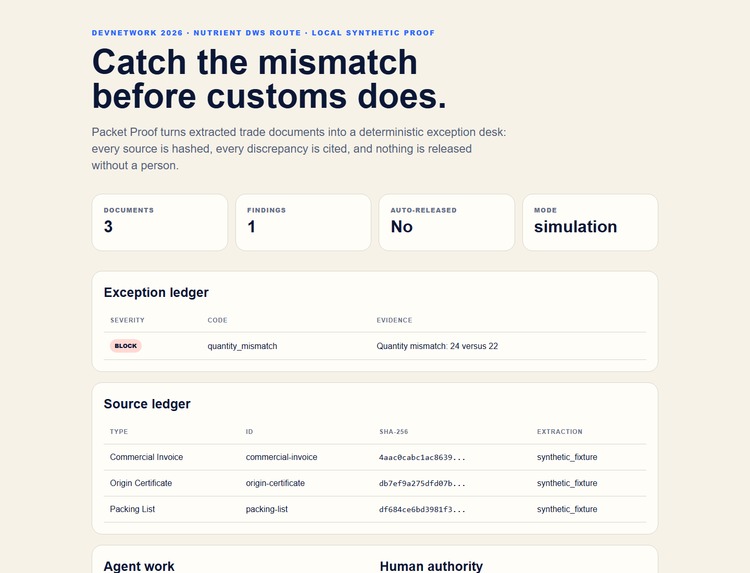
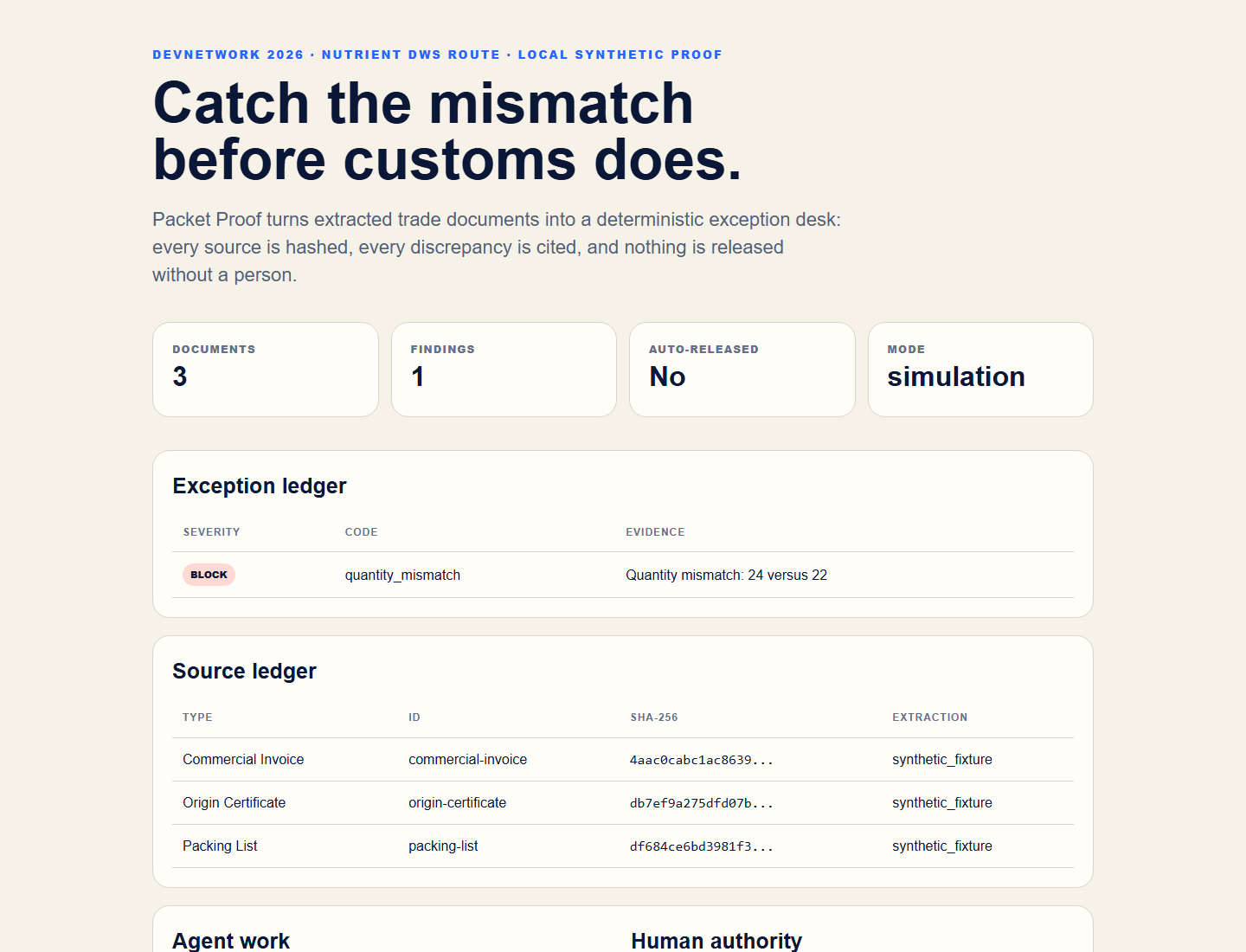
Packet Proof catches a blocking 24-versus-22 quantity mismatch and keeps the release decision with a human.
Inspiration
A shipment packet can look complete while its commercial invoice, packing list, and certificate of origin disagree on facts that determine release. Manual comparison is repetitive, errors surface late, and opaque automation is a poor fit for a compliance-sensitive decision.
What it does
Packet Proof turns three trade-document PDFs into a deterministic, evidence-linked exception ledger. It normalizes extracted fields, hashes every source, checks packet identity, supplier, SKU, quantity, origin, invoice arithmetic, and confidence, then produces both machine-readable JSON and a human review desk. The fictional scenario catches a blocking 24-versus-22 quantity mismatch and refuses to auto-release the packet.
How I built it
I built Packet Proof solo under Blaz Algo Systems. The live integration sends each PDF to Nutrient DWS Processor's official /build endpoint and requests structured JSON content, including plain text, structured text, key-value pairs, and tables. Packet Proof validates that response, normalizes the evidence, applies deterministic reconciliation rules, and renders a replayable report with page references, SHA-256 source hashes, and a stable audit hash.
The public repository also includes a clearly labeled network-free replay fixture so judges can reproduce the reconciliation and UI without credentials. Replay output is synthetic and is not presented as a live API response. I also completed an authorized live run against all three fictional PDFs. Sanitized DWS responses are retained in the repository without exposing an API key.
Nutrient DWS extracted structured JSON content from each source PDF; Packet Proof reconciled those extracted fields deterministically and reserved the release decision for a human.
Challenges I ran into
Document automation becomes dangerous when extraction uncertainty is silently treated as truth. I designed the pipeline to fail closed on malformed provider responses, preserve source evidence, surface low-confidence fields for review, and separate machine preparation from human release authority. I also made the audit output stable and reproducible across runs.
Accomplishments that I am proud of
- Meaningful Nutrient DWS integration around a focused sponsor use case
- A blocking mismatch traceable to exact document evidence
- Deterministic reconciliation rather than an unreviewable verdict
- Human release boundaries built into the product behavior
- An authorized three-document live DWS run with sanitized, replayable evidence
- 80 automated tests and 95.48% branch-aware coverage
- Fictional fixtures, replay instructions, security documentation, and an MIT-licensed public repository
What I learned
Extraction is only the first half of trustworthy document automation. The useful product is the boundary around it: validation, evidence preservation, deterministic rules, confidence handling, auditability, and a clear point where a person must decide.
What's next
Next steps are configurable customer rule packs, reviewer annotations, exception assignment, ERP and TMS connectors, signed review events, and additional document families. The same architecture can support purchase-order packets, bills of lading, inspection certificates, and regulated onboarding documents.
Built With
- data-extraction
- document-automation
- nutrient-dws
- pytest
- python
- rest-api

Log in or sign up for Devpost to join the conversation.