
PackBack
Inspiration
University life has a surprisingly simple problem: there is always something to remember.
A laptop for one class. A calculator for another. An assignment due tomorrow. A different classroom this week. An umbrella because it is going to rain. And after class, the charger you plugged into the wall and forgot to take home.
We realized that existing calendars and to-do lists still depend heavily on the student remembering to create, check, and manage reminders themselves.
That led us to PackBack.
PackBack is a student memory copilot designed around one idea: you should not have to remember to remind yourself.
Instead of being another static checklist, PackBack uses your timetable, class requirements, tasks, previous preferences, and contextual information to determine what matters for your day and remind you at the right moment.
What it does
PackBack organizes a student's day around three simple questions:
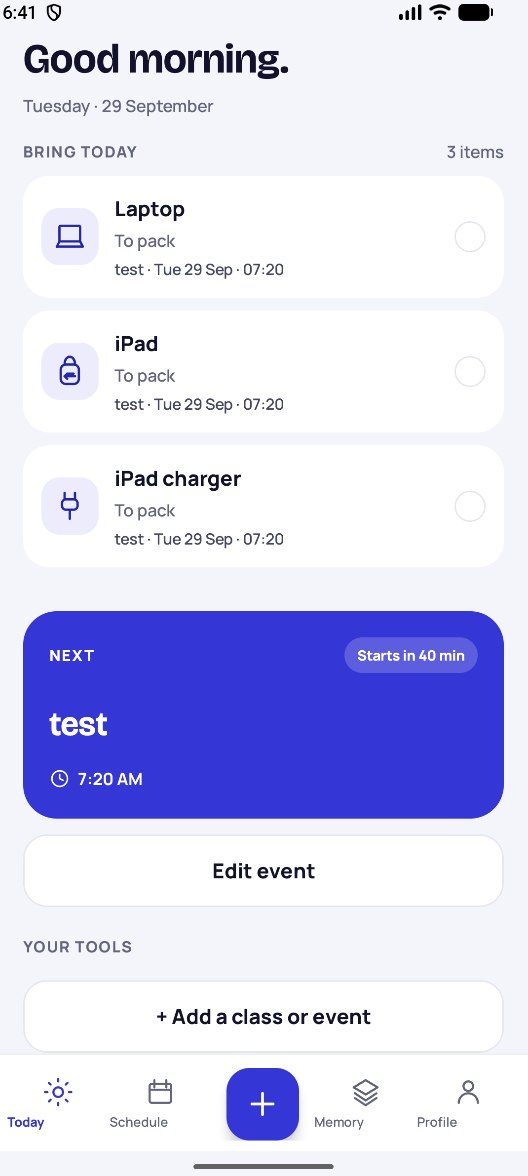
What do I need to bring?
What do I need to do?
What do I need to bring back?
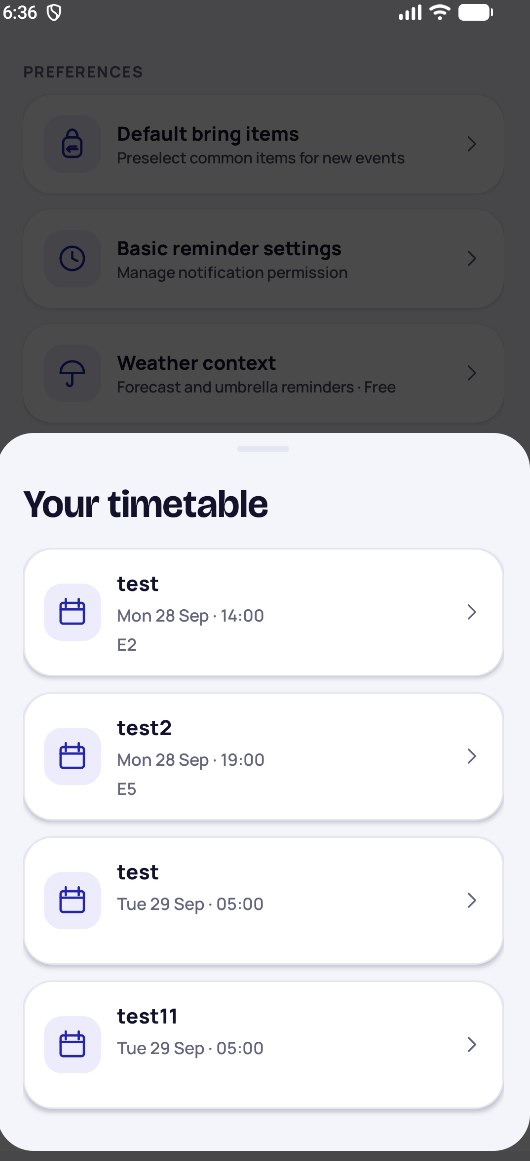
Students can import their timetable from a screenshot or create events manually. PackBack turns their schedule into a dynamic daily checklist containing the items and tasks relevant to each event.
Before an event, PackBack reminds the student where they need to go and what they need to bring.
After an event, PackBack switches context and reminds them to take their belongings with them, helping prevent chargers, calculators, bottles, and other items from being left behind.
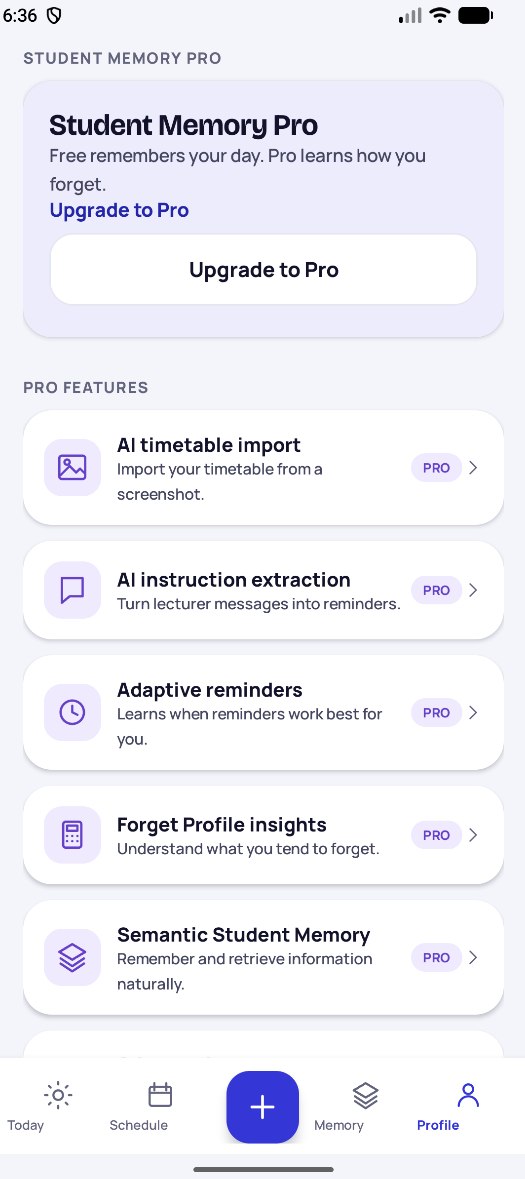
Students can also import lecturer instructions. AI extracts useful information such as required items, tasks, deadlines, and event details into structured information that the student can review before saving.
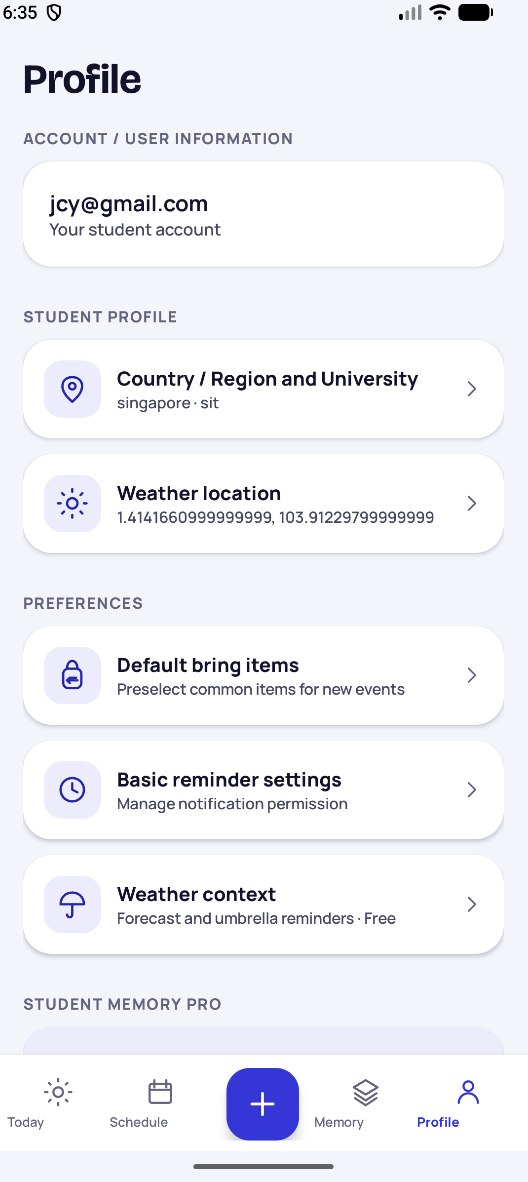
PackBack also uses contextual information such as weather. If rain is expected while the student is travelling between events, an umbrella can become part of that day's checklist automatically.
Over time, PackBack can remember recurring requirements and forgetting patterns. If a calculator is regularly needed for a particular class, for example, the student should not have to add it every single week.
The goal is not to build a chatbot that waits for the student to ask, "What am I forgetting?"
PackBack should tell them before they forget.
How we built it
PackBack is built as a native Android application with a C++ core responsible for the application's core domain logic and state transitions.
The Android layer provides the mobile interface, notifications, timetable management, imports, and integrations, while the shared core handles events, Bring/Do/Bring Back states, checklist behaviour, and reminder logic.
A backend provides services that are better suited to the server, including AI-powered extraction, contextual integrations, synchronization, and semantic memory capabilities.
For AI-assisted imports, screenshots and lecturer instructions are processed into structured data rather than allowing generated text to directly modify the user's schedule. The extracted information is shown to the student for confirmation before it becomes part of their timetable or checklist.
This gives us the convenience of AI while keeping important changes understandable and user-controlled.
We also integrated RevenueCat to support PackBack's monetization layer and premium functionality while keeping the core student-day experience useful.
Challenges we faced
One of our biggest design challenges was deciding where AI actually adds value.
It would have been easy to place a chatbot inside the app and call it an AI assistant. However, that conflicts with the problem we are trying to solve. A student who forgets to bring their charger may also forget to ask an assistant what they need.
We therefore focused on proactive assistance rather than prompt-first assistance.
Another challenge was separating structured information from semantic memory. Information such as "bring calculator to Math" is more reliable as structured checklist data than something that needs to be retrieved from a vector database every time. Semantic memory is therefore treated as a supporting capability for richer unstructured context rather than replacing deterministic reminder logic.
We also had to combine native Android functionality, C++ domain logic, backend services, AI extraction, external context, notifications, and monetization without making the everyday experience complicated.
That constraint shaped PackBack into something intentionally simple on the surface:
Bring it. Do it. Bring it back.
What we learned
Building PackBack taught us that adding intelligence to an application does not necessarily mean adding more interaction.
Sometimes the better intelligent experience is the one that requires the user to do less.
We learned to distinguish between information that should be handled deterministically and information where AI is genuinely useful. We also learned how to connect native mobile development, C++, backend APIs, structured AI outputs, contextual data, semantic retrieval, automated testing, and RevenueCat into a single product.
Most importantly, we learned to design around the moment when assistance is actually useful rather than simply exposing another feature for the user to find.
What's next
We want PackBack to become increasingly personalized without becoming increasingly complicated.
Future versions can learn which items an individual student tends to forget, improve reminder timing based on behaviour, understand more forms of university information, surface relevant long-term context automatically, and provide deeper insights into recurring forgetting patterns.
The long-term vision is simple:
PackBack remembers the small things so students can focus on the important ones.


Log in or sign up for Devpost to join the conversation.