See what you can afford. Get more time if you need it. A money assistant you text as a contact. It texts you before money gets tight, and with your OK, calls whoever you owe to fix it.
Inspiration
A checking balance tells you what you have today. It takes more work to figure out what you'll have left after rent, automatic payments and whatever else is due before payday. And if the timing doesn't work, you still have to work out what to move and make the call.
Most money apps stop at the chart. We wanted one that acts. So we built the dashboard, and an agent that acts on what the dashboard finds.
What it does
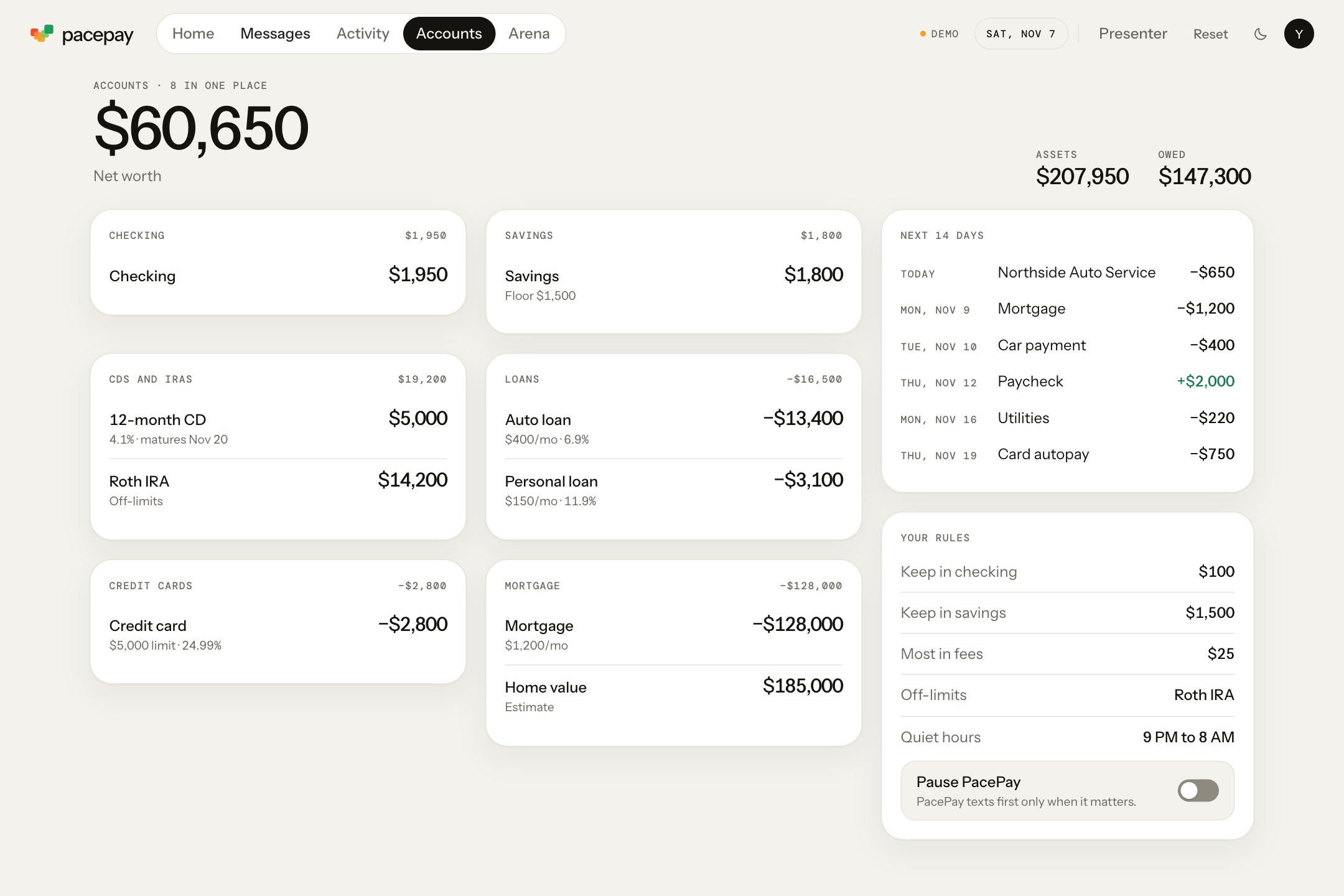
PacePay shows how a bill or purchase would affect your cash over the next 60 days, compares your options, and can call a lender on your behalf to ask for more time. You set the limits and approve the final terms by text.
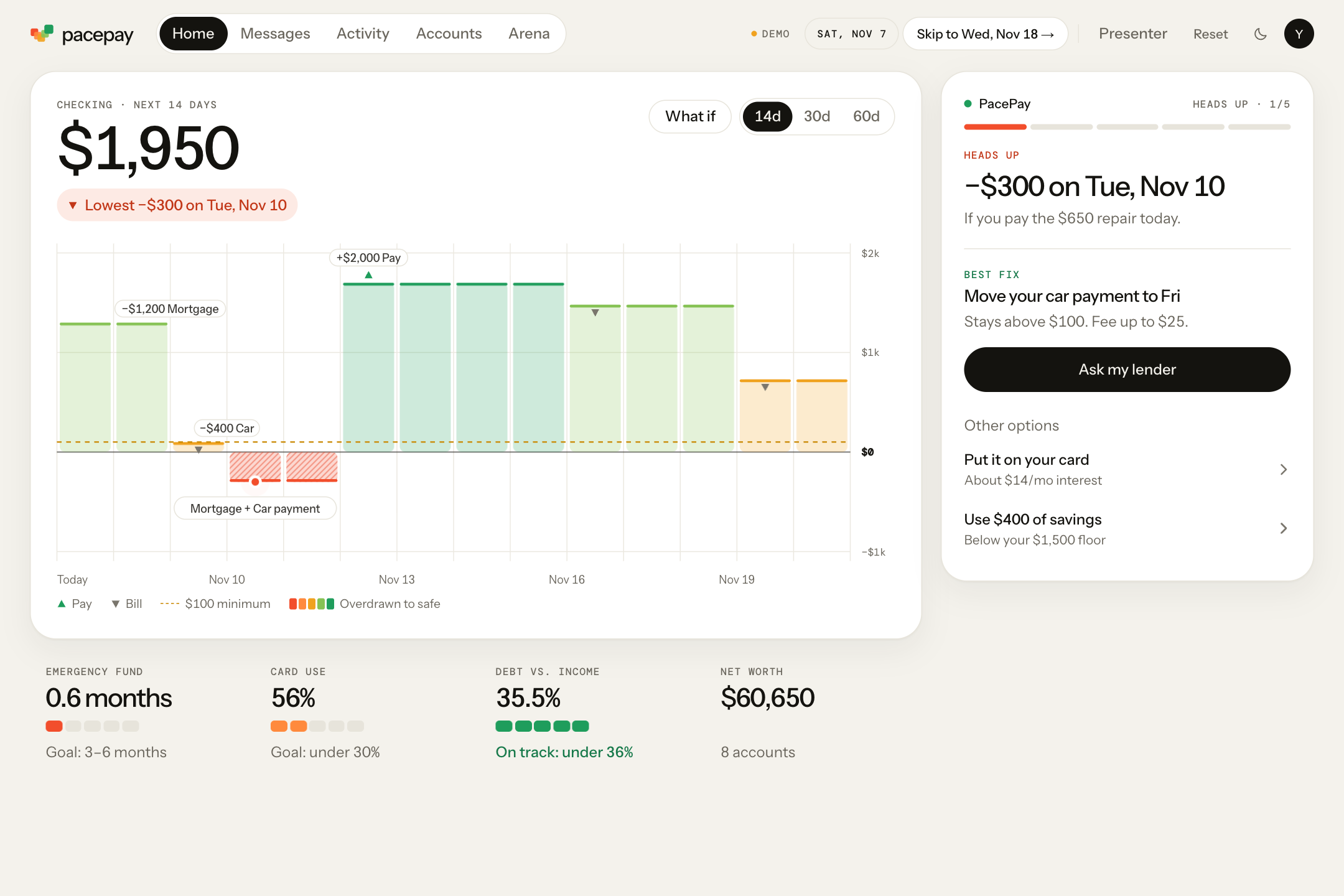
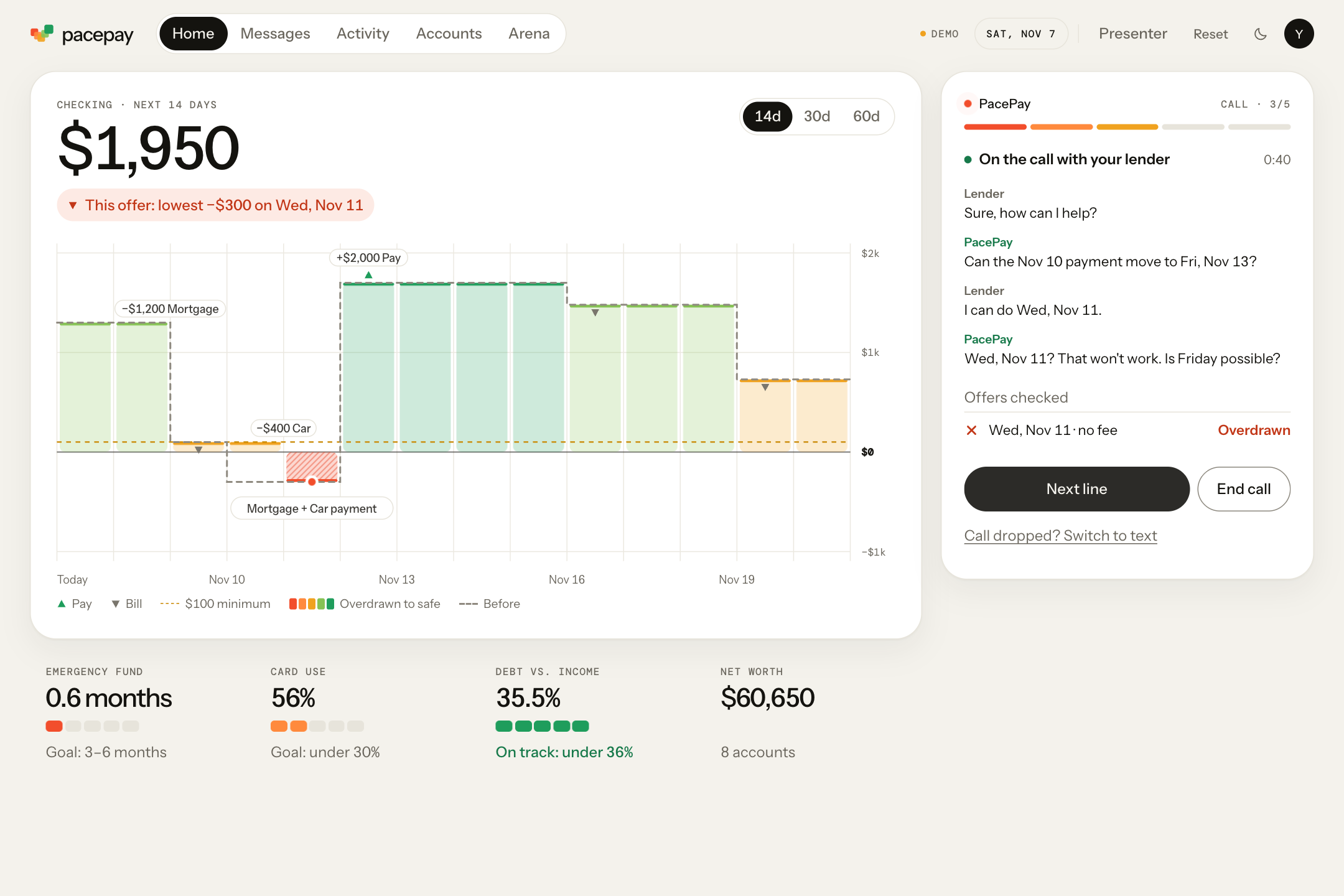
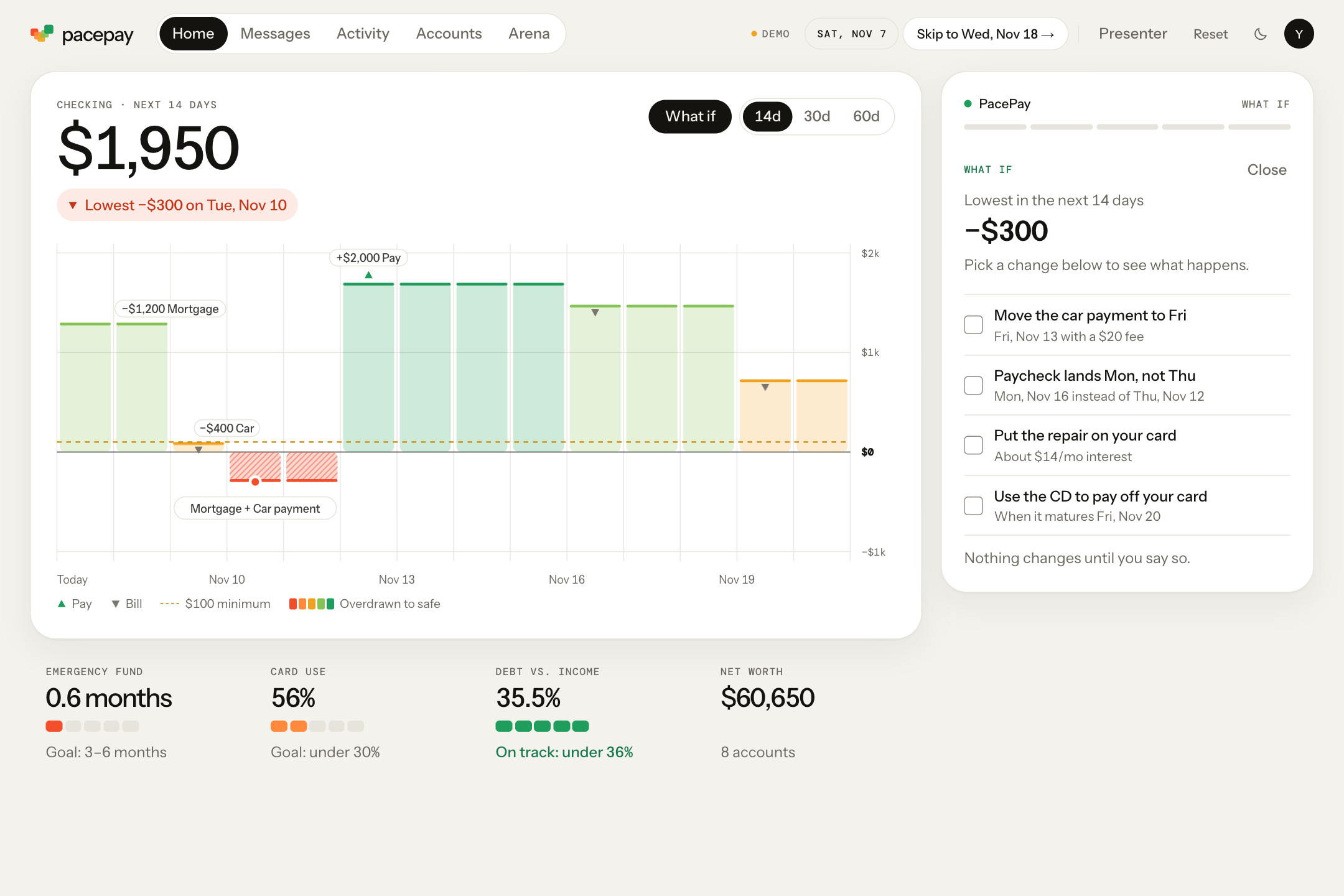
Know what happens after you pay. The dashboard shows your accounts, net worth and upcoming cash flow. Try a purchase before committing to it, see when your checking balance would hit its lowest point, and ask the coach what's driving the dip. Or just text PacePay a photo of a bill or quote: it reads the amount and checks it against your forecast. You might cover it from savings, put it on a credit card, or ask to move a payment. Each option shows how it changes the forecast, so you pick the trade-off.
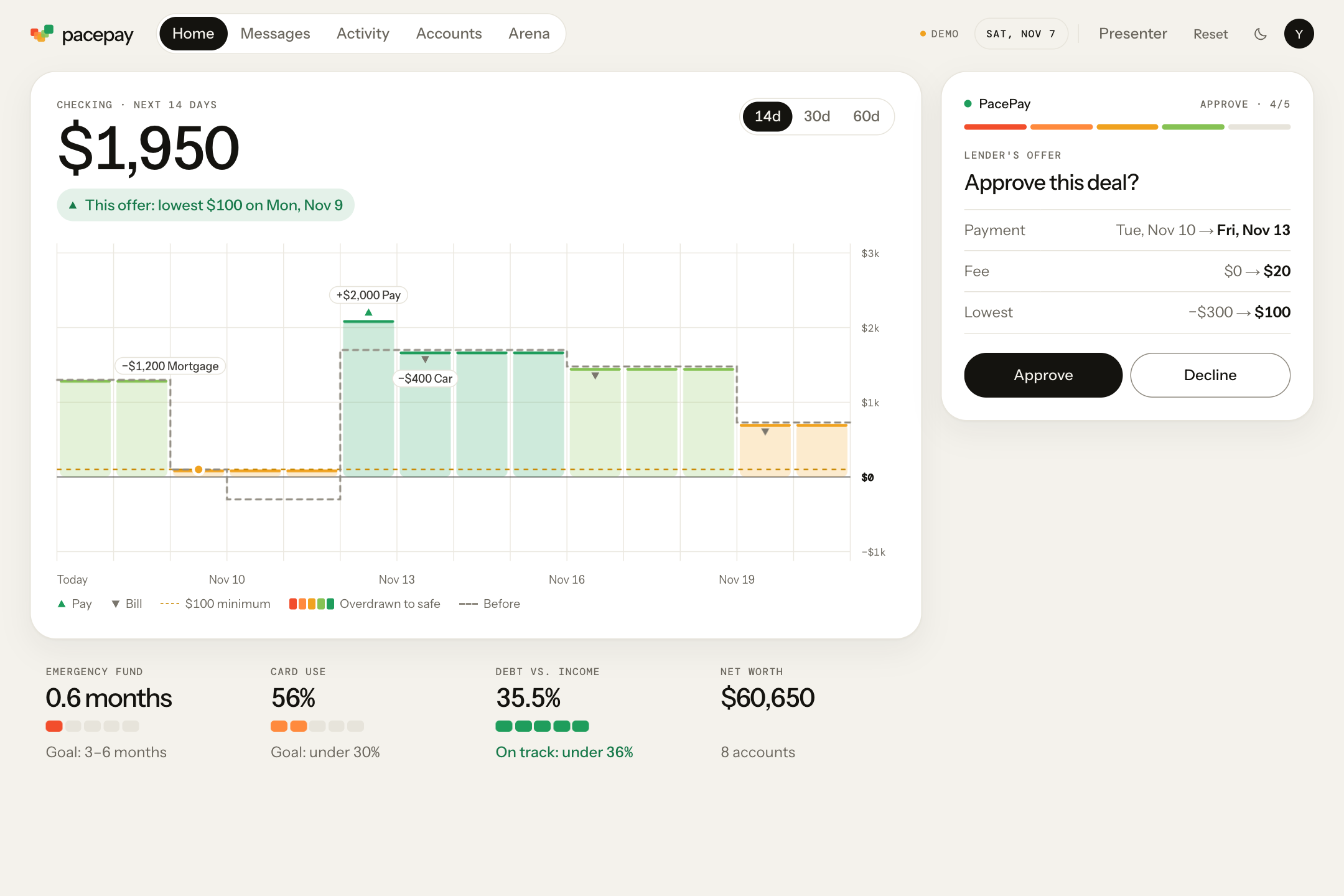
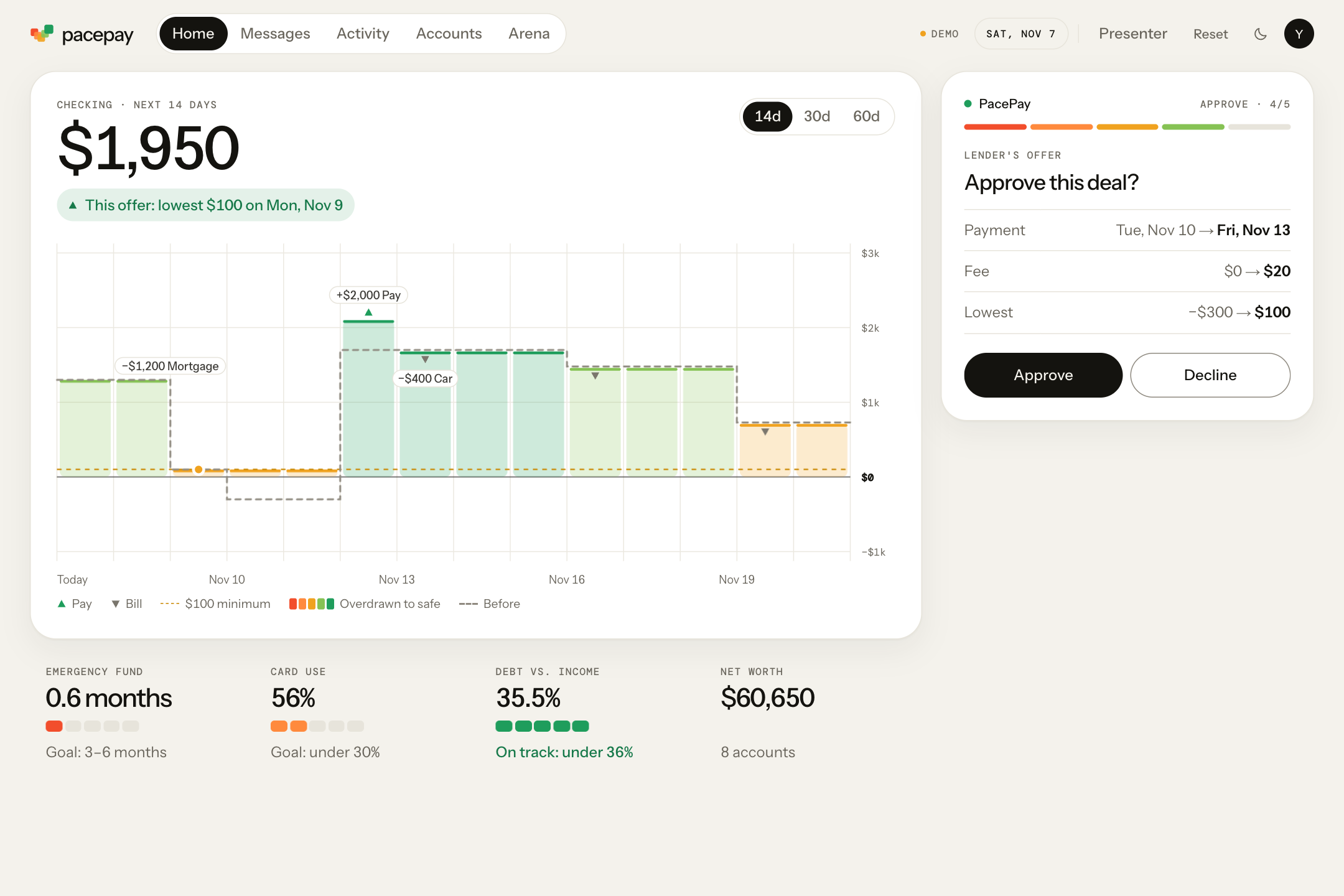
Ask for more time without making the call yourself. If you choose to negotiate, you approve who PacePay calls, what it asks for and the most you'll pay in fees. PacePay talks through dates and fees with the person on the line, checks each offer against your forecast and counters while keeping your balances and limits private. When an offer fits your limits, it texts you the exact terms while the lender is still on the line, and waits for your yes before confirming out loud.
The demo, start to finish
Yoshua is our demo household. He has eight accounts: checking, savings, a CD, a Roth IRA, a car loan, a personal loan, a credit card and a mortgage. His rules: keep $100 in checking, keep $1,500 in savings, pay no more than $25 in fees.
- The shop quotes $650 for brakes. Yoshua texts PacePay a photo of the quote, with no question.
- PacePay reads the bill, replies right away, and sends a chart of the week: checking hits −$300 on Tuesday if he pays today, because the mortgage and the car payment land before Thursday's paycheck.
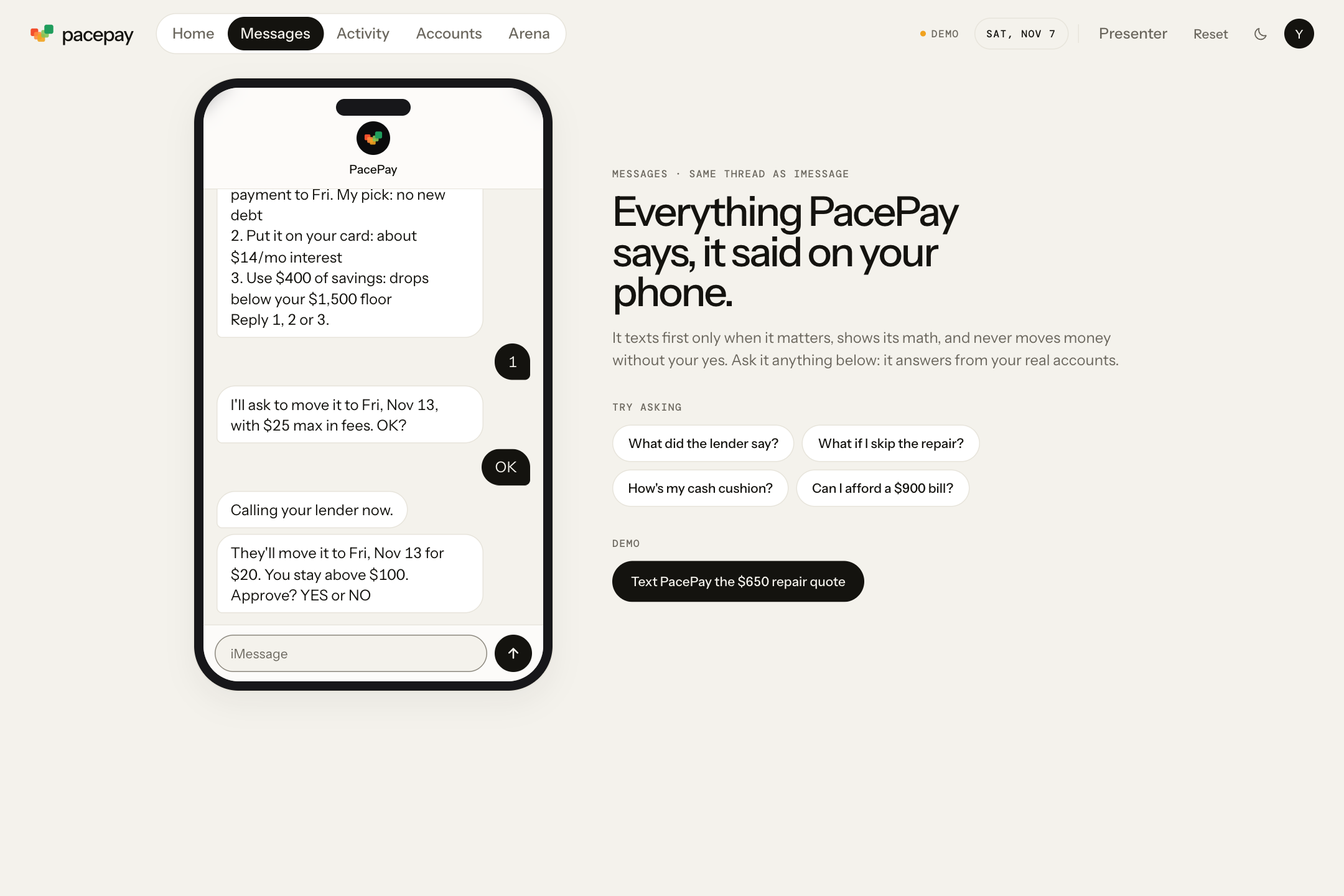
- It texts three options, with a pick and a reason. Yoshua replies "1": ask the lender to move the car payment to Friday.
- Yoshua OKs the limits. PacePay gets a second opinion on the plan from a different model family, then calls the lender.
- On the call it says it's an AI assistant calling with Yoshua's permission, and that the call is transcribed. The lender offers Wednesday. PacePay declines without giving a reason (Wednesday is still before payday) and asks for Friday. The lender offers Friday with a $35 fee. Checking would be fine, but $35 is over Yoshua's $25 limit, so PacePay pushes back without revealing the limit. They settle on Friday for $20.
- Mid-call, Yoshua's phone buzzes: "They'll move it to Fri, Nov 13 for $20. Approve?" He replies YES and PacePay confirms on the call.
- A done text lands in the thread. Checking stays at $100 or above and the forecast turns green.
- Unprompted, PacePay points out that Friday only works if Thursday's paycheck lands (if it's late, checking hits −$320 on Friday) and offers to watch for it. When Yoshua says the paycheck really is late, it recalculates and shows the options again, call first.
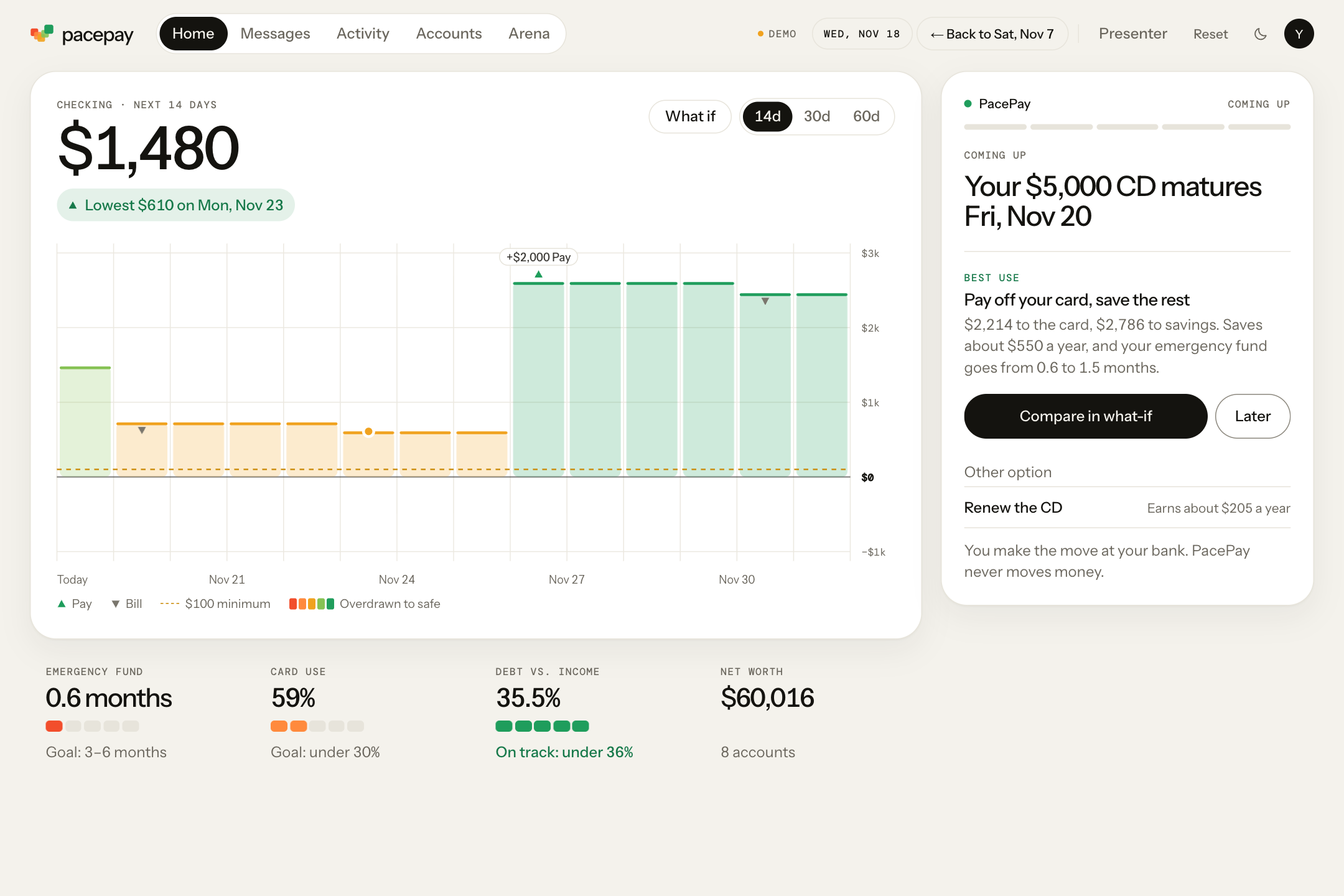
- Later, also unprompted: the $5,000 CD matures Fri, Nov 20. PacePay compares paying off the card ($2,214) and moving the other $2,786 to savings against renewing. Paying off the card saves about $550 a year.
PacePay never moves money or agrees to anything final without Yoshua's yes.
How we built it
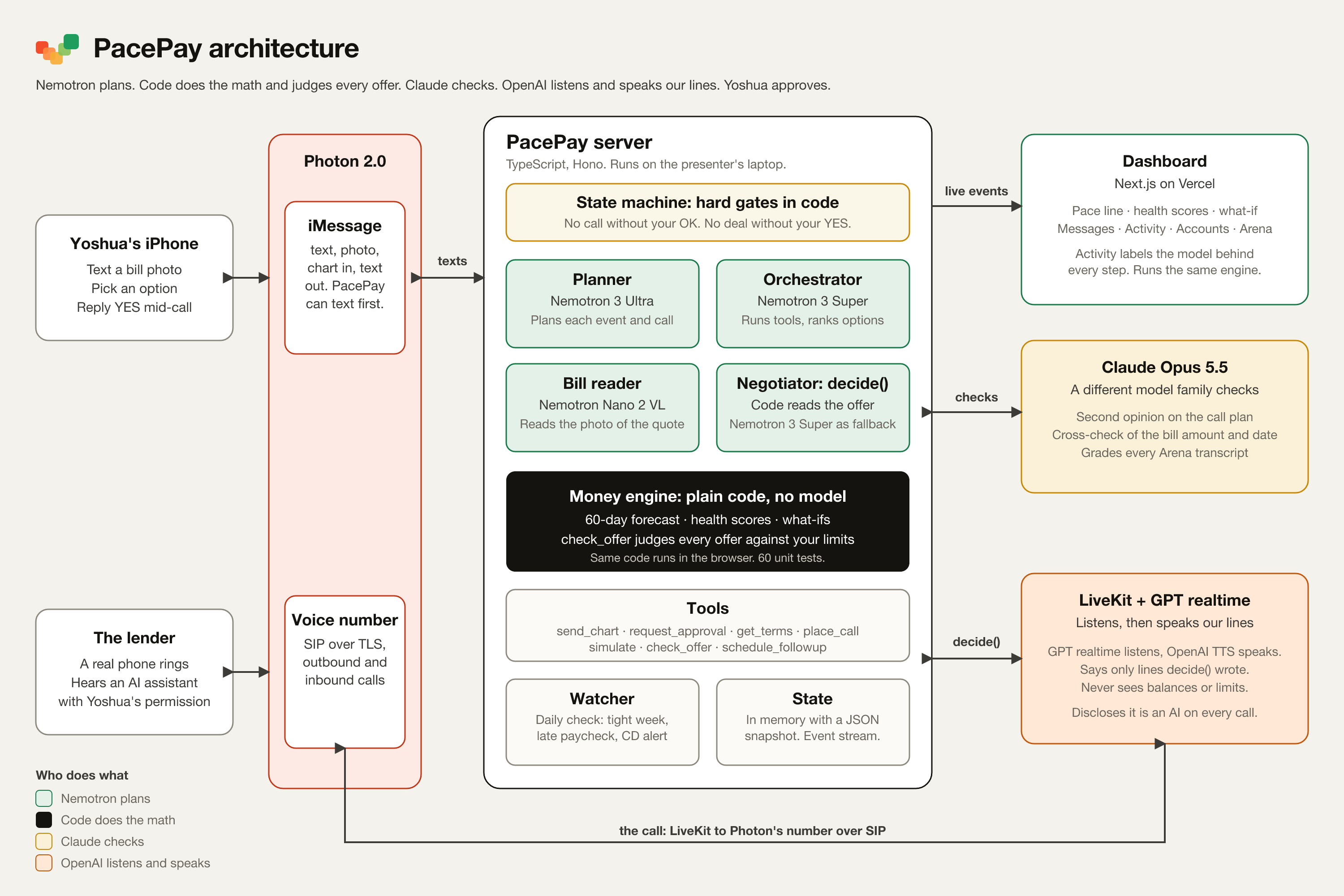
The dashboard, coach and negotiator share one TypeScript money engine. It calculates projected balances, scores and what-ifs, and checks every offer against the user's limits. It is plain code with 60 unit tests, and it also runs in the browser, so the what-if panel updates instantly. No model ever calculates a number. Models read things in (a photo, what a lender said) and decide what to do; the engine does the math.
| Piece | Model or tool | What it does |
|---|---|---|
| Money engine | None. Plain code. | Daily balances, health scores, what-ifs, check_offer. Deterministic and unit-tested. |
| Planner | Nemotron 3 Ultra | Writes the step plan for each event, plans calls, writes the CD advice |
| Orchestrator | Nemotron 3 Super | Carries out the plan with tools and ranks the options |
| Call decisions | Code first, Nemotron 3 Super as a fallback | Code reads most lender lines (yes, no, which day, what fee) in milliseconds and picks the reply from check_offer. A line code can't read goes to Nemotron Super, capped at 2.5 seconds with a code fallback. Code always sets the day and the fee. |
| Bill reader | Nemotron Nano 2 VL | Reads bill photos. Claude cross-checks the amount and due date. |
| Second opinion | Claude Opus 5.5 | A different model family checks the call plan against Yoshua's rules before PacePay dials |
| Arena grader | Claude Opus 5.5 | Grades every simulated negotiation transcript |
| Simulated lenders | Nemotron 3 Ultra | Plays 50 lender personalities |
| Call voice | OpenAI GPT realtime (gpt-realtime-2.1) listens (turn detection, transcription). OpenAI TTS (gpt-4o-mini-tts, voice marin) speaks lines our negotiator code writes. Via LiveKit, on a Photon number |
Hearing and speaking, with code writing every word |
| Messaging | Photon 2.0 (REST API, shared iMessage line, brand contact card) | iMessage texts, options, approvals, chart images, bill photos |
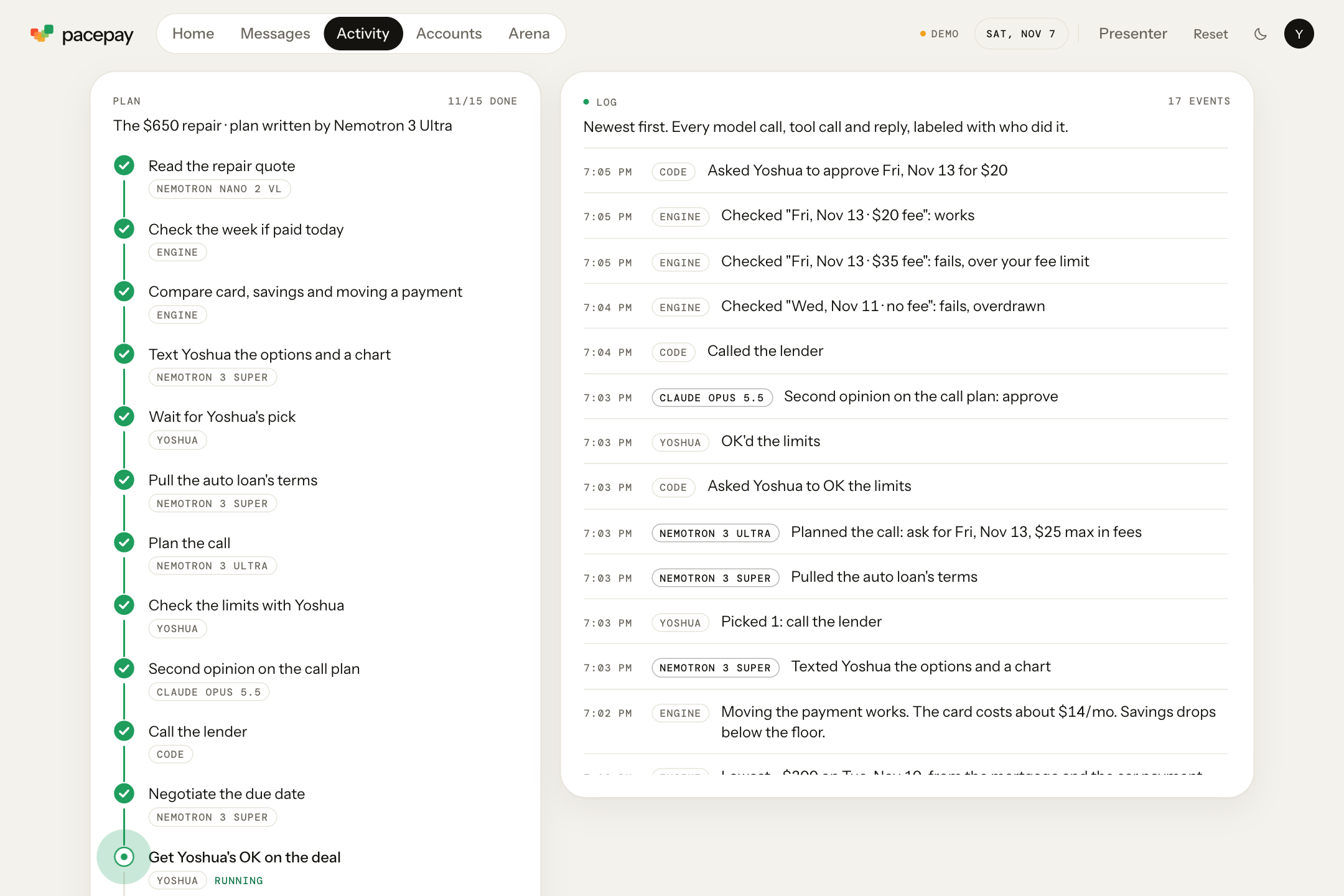
| Dashboard | Next.js, Radix UI, visx | Live updates over server-sent events. Activity tab shows which model or tool did each step. |
| Charts in texts | Rendered from engine data | Never AI-generated, because numbers in a picture have to be exact |
Nemotron plans and runs the tools. Claude checks and grades. On calls, GPT only listens and a text-to-speech voice reads lines our negotiator code wrote. Code does the math and judges every offer.
On lender calls the voice never sees balances or limits. Every line PacePay says is written by our negotiator code (Nemotron Super only as a capped fallback for an unusual lender line) and spoken by OpenAI TTS, a whole line at a time. The voice can't improvise or leak, because it only says lines code handed it.
PacePay never agrees to anything but exactly what Yoshua approved. If the lender changes the terms afterward, the approval is void: PacePay restates the approved terms, asks Yoshua again if the change is within his limits, and otherwise tells Yoshua no deal was made. The Done text goes out only after the call ends with an undisputed deal, and a hang-up gets a text saying so.
Code enforces the hard gates: no call without Yoshua's pick and his OK on the limits, no deal without his yes, and every offer goes through check_offer. A payment on payday counts as risky by rule, because the deposit might land after the payment.
PNC: 360° Financial Health Navigator
| PNC asks for | How PacePay does it |
|---|---|
| The whole picture | One household with all eight accounts and net worth |
| 3+ health indicators | Four scores (cash cushion, emergency fund, credit use, debt-to-income), each with a goal, a one-line reason and how to improve |
| Forecast balances and obligations | 60-day daily forecast with every bill and paycheck |
| A "what if" simulator | What-if panel in the dashboard, and what-ifs by text |
| A conversational coach | The same assistant in iMessage, on calls and in the dashboard |
| Confidence in the next move | Options with trade-offs across accounts, a pick with a reason, approval before anything happens |
| Something no one has thought of | PacePay negotiates the due date on a real call and checks each offer live |
NVIDIA: Use Nemotron Beyond a Chatbot
| NVIDIA requires | How PacePay does it |
|---|---|
| Use Nemotron | Ultra plans and plays the lenders, Super runs the plan, answers questions and reads any lender line code can't, Nano 2 VL reads bills. Every Activity step is labeled with its model. |
| Beyond a chatbot | It acts on events, not prompts: a bill photo with no question, a daily check that catches the maturing CD, a watch on a late paycheck. It places real phone calls. |
| Multi-step workflows | For the repair: shortfall → options → pick → loan terms → call plan → limits OK → second opinion → call → judge each offer → mid-call approval → confirm → update forecast → follow-up |
| Tool integration | Photon, LiveKit, GPT realtime and OpenAI TTS, the forecast engine, a TrueFoundry gateway, Claude, a scheduler |
| Real-world applicability | Overdrafts and late fees are common, and lenders do move due dates |
Patterns covered: multi-agent (planner, orchestrator, negotiator, bill reader, lender simulator, reviewer), agentic RAG (the planner decides whether it needs a loan's fine print), ReAct (the negotiator calls check_offer and picks its reply from the result), multimodal (bill photos), and simulation and eval (the Arena).
Photon: Build a messaging agent on Photon 2.0
| Photon rewards | How PacePay does it |
|---|---|
| Live on a Photon channel | An iMessage line for texts and a Photon number for calls |
| Best Voice Agent | PacePay places real calls to the lender over LiveKit through the Photon number. Inbound calls are PIN-gated and must come from Yoshua's number: numbers are read out only after the caller's PIN, and answers to the common questions (what the lender said, lowest balance, can I afford a bill, next paycheck, what if it's late, how am I doing) are built from the money engine in code. |
| Human-in-the-loop | Yoshua picks the option, OKs the limits before the call, and approves the deal mid-call by text |
| Context across time and channels | The call summary lands in the thread, and PacePay keeps rules, past decisions and the late-paycheck watch in context |
| A delightful default | Quiet unless the forecast crosses a floor, one-word replies, a chart instead of a wall of text |
| Safety and fallbacks | AI disclosure on every call, offers read back, a 60-second approval timeout, a reference number for the lender's records, and a text mode if a call fails |
Arena results
We ran simulated lenders (cooperative, fee-pushing, stubborn on dates, vague, flat refusal, identity check, chatty). Nemotron 3 Ultra played each lender, PacePay's negotiator answered over text, and Claude graded every transcript.
| Result | Value |
|---|---|
| Runs | 50 |
| Deals reached | 78% (39 of 50) |
| Limit violations | 0 |
| Balance or limit disclosures | 0 |
| Offers read back | 92% |
Flat refusals and identity checks end without a deal by design. Limits of this test: it's text, not voice; the simulated lenders are also Nemotron; and the grader is an AI. Every transcript is published in docs/arena-transcripts.md and clickable in the dashboard's Arena tab.
Bill reader accuracy
We generated 30 test bill photos with known amounts and due dates (phone photos at an angle, crumpled, low light, thermal receipts) and measured the reader against the answers. We drew the same 30 bills two ways, with code and with an AI image model. Amounts were right on 60 of 60 photos, and due dates on 59 of 60. The one miss was a "due at pickup" receipt with no printed date, which the reader took as due today. Claude's cross-check agreed on every amount, and PacePay asked Yoshua to confirm only 1 time in 60. Reading a photo takes about 11 to 12 seconds including the cross-check. Results are in docs/eval.
Challenges
- No model does math. Every number comes from the engine. Models only read numbers in, and PacePay confirms each one with Yoshua.
- Real calls are noisy. On our first real call, background noise could sound like a reply, and the call could end before the goodbye finished. We made the agent state the ask up front, ignore line noise, and wait for the goodbye before hanging up.
- Two conversations at once. The agent has to keep the lender on the line while giving Yoshua time to read the terms and answer. We settled on a short, varied filler only when a lookup is slow, and a 60-second approval window.
- Payday timing. Whether a Thursday payment posts before or after that morning's deposit depends on the bank. The engine counts deposits first, but still rejects any payday offer as risky by rule, so both Wednesday and Thursday get pushed back to Friday.
- Keeping secrets on a call. The voice can't leak a balance it never receives: it only speaks lines our code wrote.
- A $35 fee is affordable but not allowed. PacePay pushes back without revealing the limit.
Accomplishments
- Real texts and real phone calls on a Photon number, driven by the same engine as the dashboard
- A dashboard and an agent on the same data and the same calculator
- Charts in iMessage that are exact, because they come from the engine
- Every offer on a call is judged by code, and the lender never learns a balance
- 50 simulated negotiations with published transcripts: 0 limit violations and 0 disclosures
- A call stress test with 363 adversarial lender personas in 11 categories (noisy lines, hostile callers, social engineering, phone menus), run through the real call loop
What we learned
- Keep models off the hot path. On a call, code reads most lender lines in milliseconds (median 14 ms per turn in our stress runs), and the model handles only what code can't. Real call latency is mostly speech-to-text and text-to-speech.
- We put the calling rules in a state machine instead of a prompt, so a model can't skip a step.
- Claude, a different model family, checks the plan and grades the Arena, so Nemotron never grades its own work.
- We kept texts short, with a pick and a reason, so a reply can be one word.
What's next
The prototype uses a sample household with eight accounts.
- Real accounts: connect a bank with permission through Plaid, and verify that an agreed payment change actually shows up on the account. If a payment is still scheduled for the original date, PacePay could flag it before the money comes out.
- Household mode: a partner gets the same summaries and can approve.
- Spanish: PacePay talks to the user in Spanish while negotiating with the lender in English.
Built with
Nemotron 3 Ultra, Nemotron 3 Super, Nemotron Nano 2 VL, Claude Opus 5.5, OpenAI GPT realtime, OpenAI TTS, LiveKit Agents, Photon 2.0, TrueFoundry, TypeScript, Hono, Next.js, Radix UI, visx.
Built With
- anthropic
- hono
- livekit
- nemotron
- next.js
- openai
- photon
- typescript
