-
-
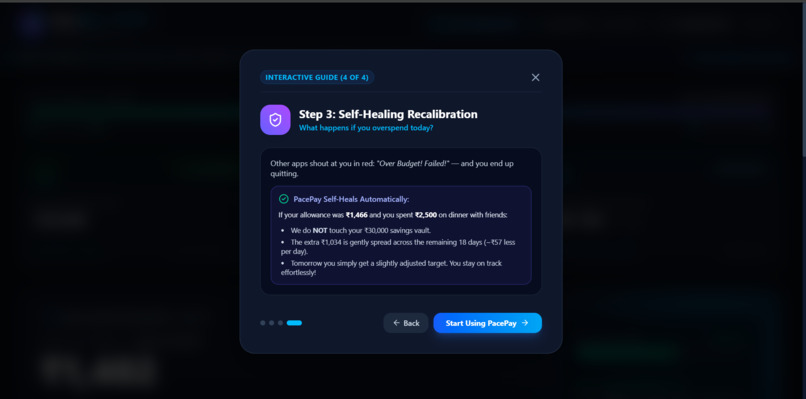
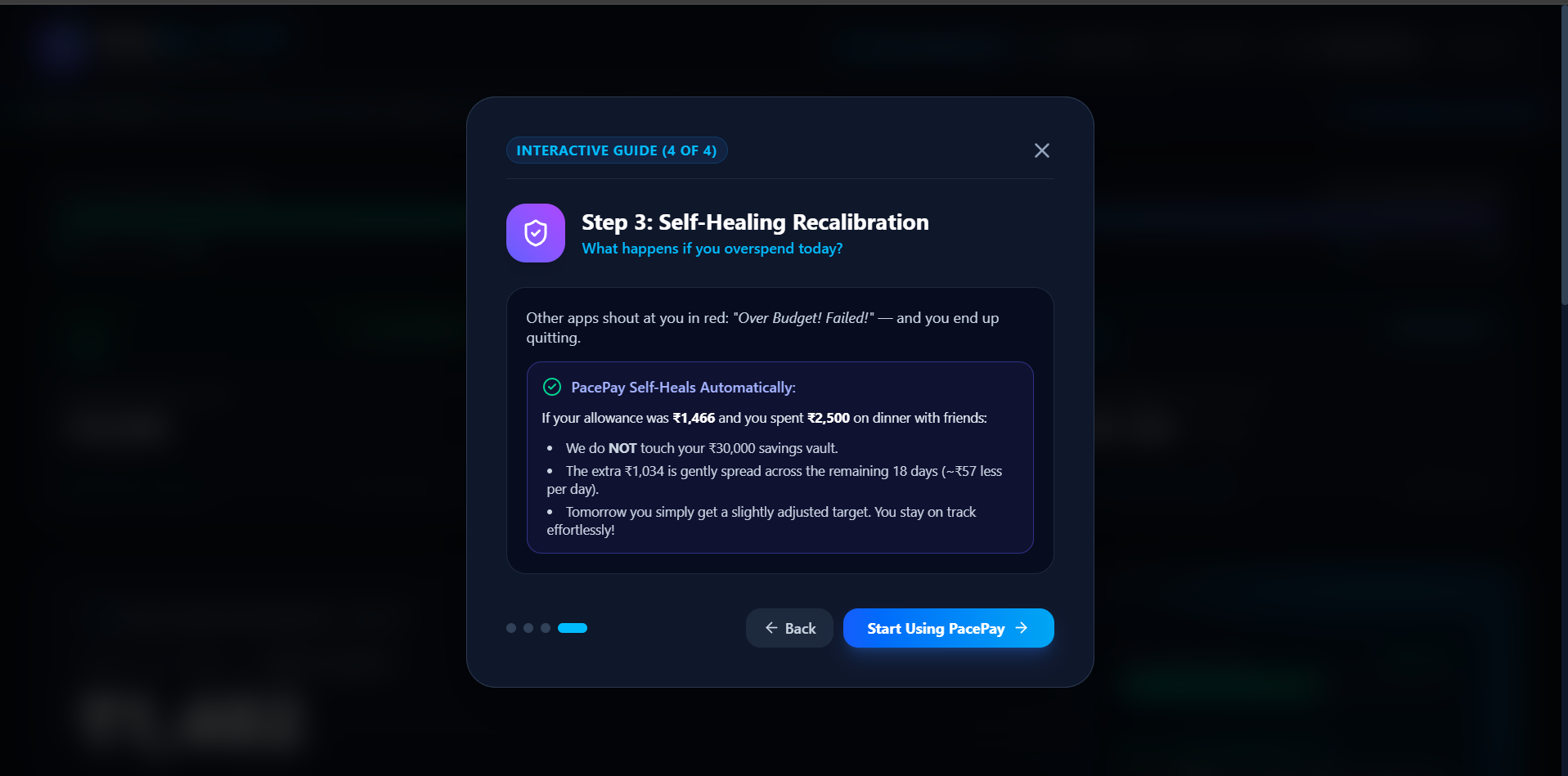
Interactive Visual Guide: 4-step walkthrough explaining liquidity pacing, Day-1 vaulting, and guilt-free daily spending to new users.
-
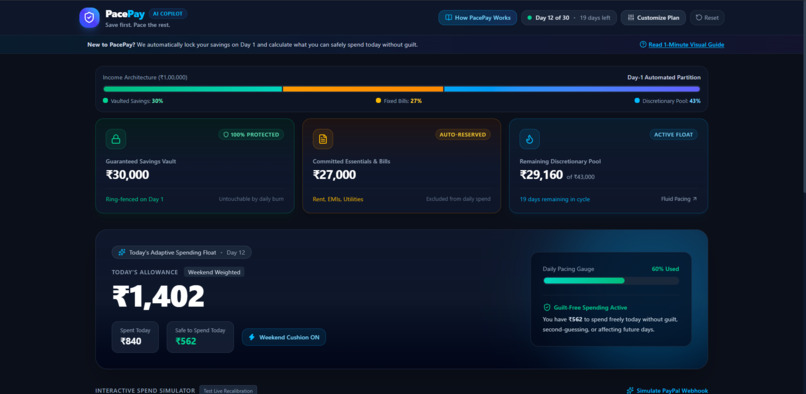
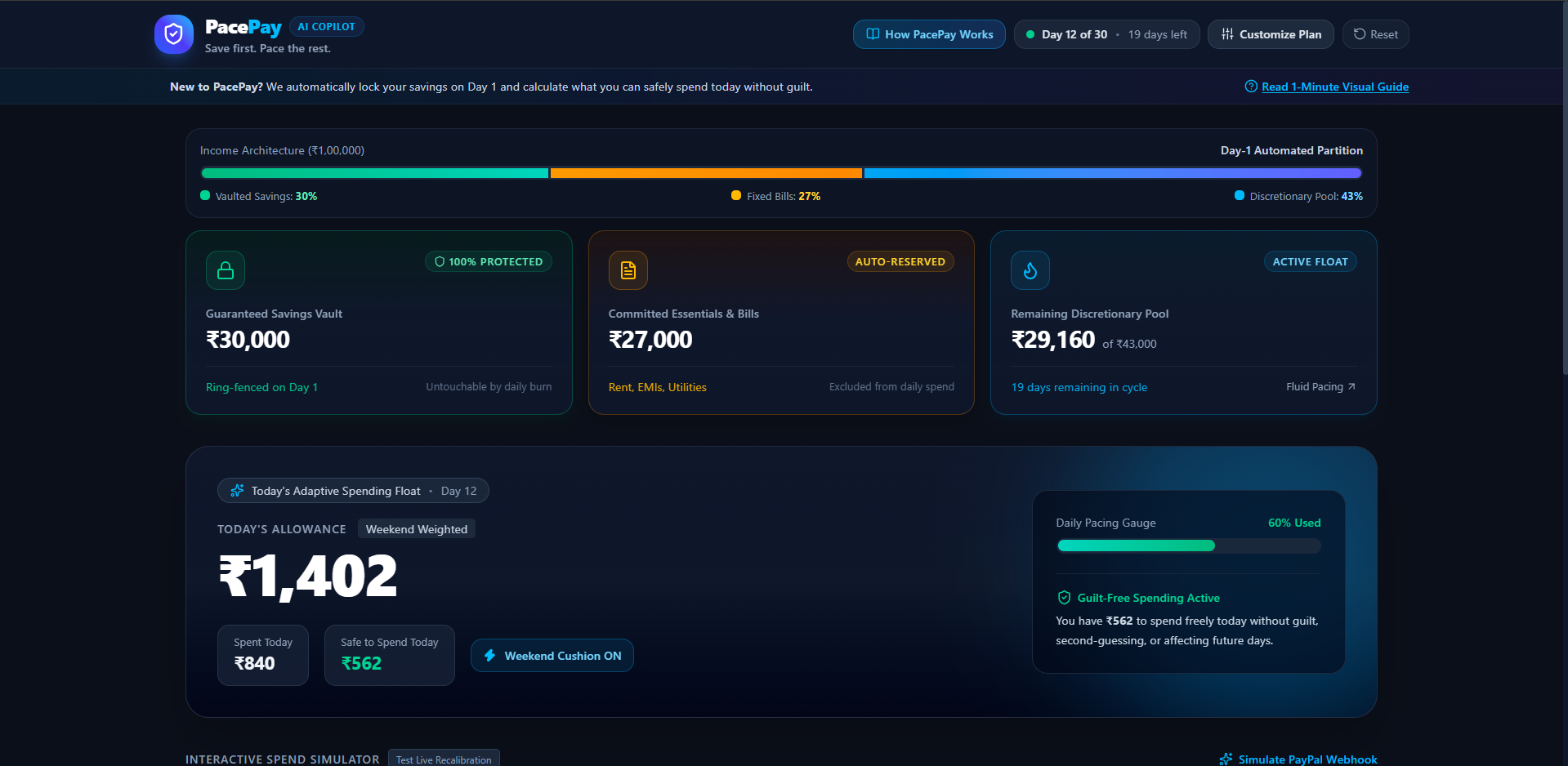
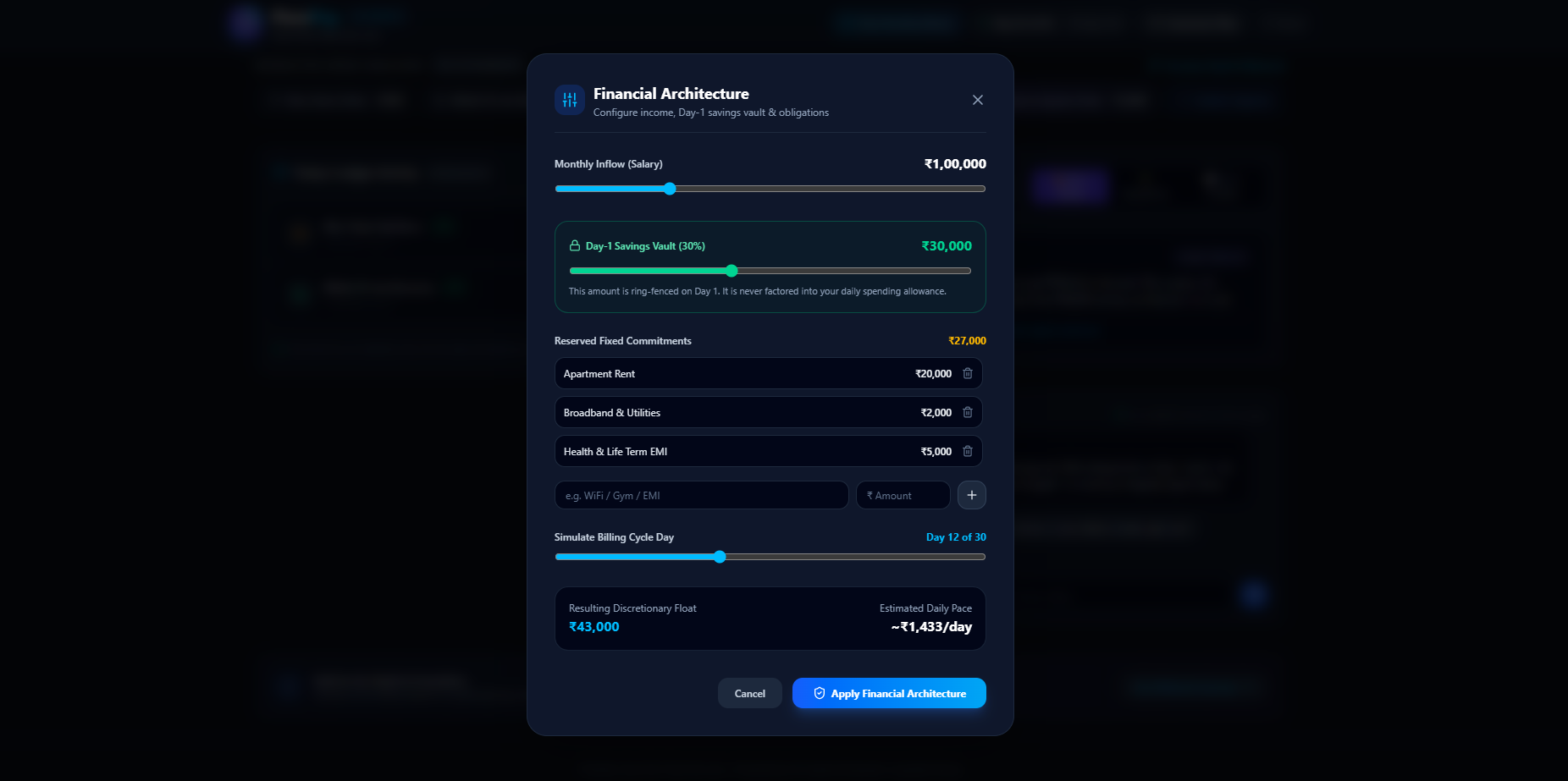
Day-1 Income Architecture: Rings-fences ₹30k savings & bills upfront, calculating daily budget from remaining discretionary float.
-
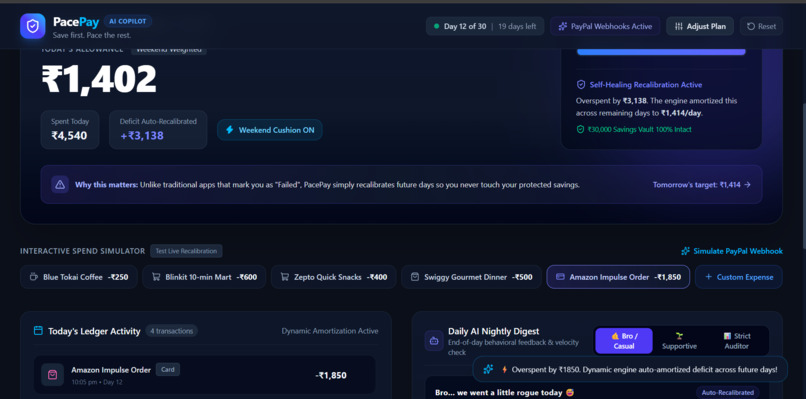
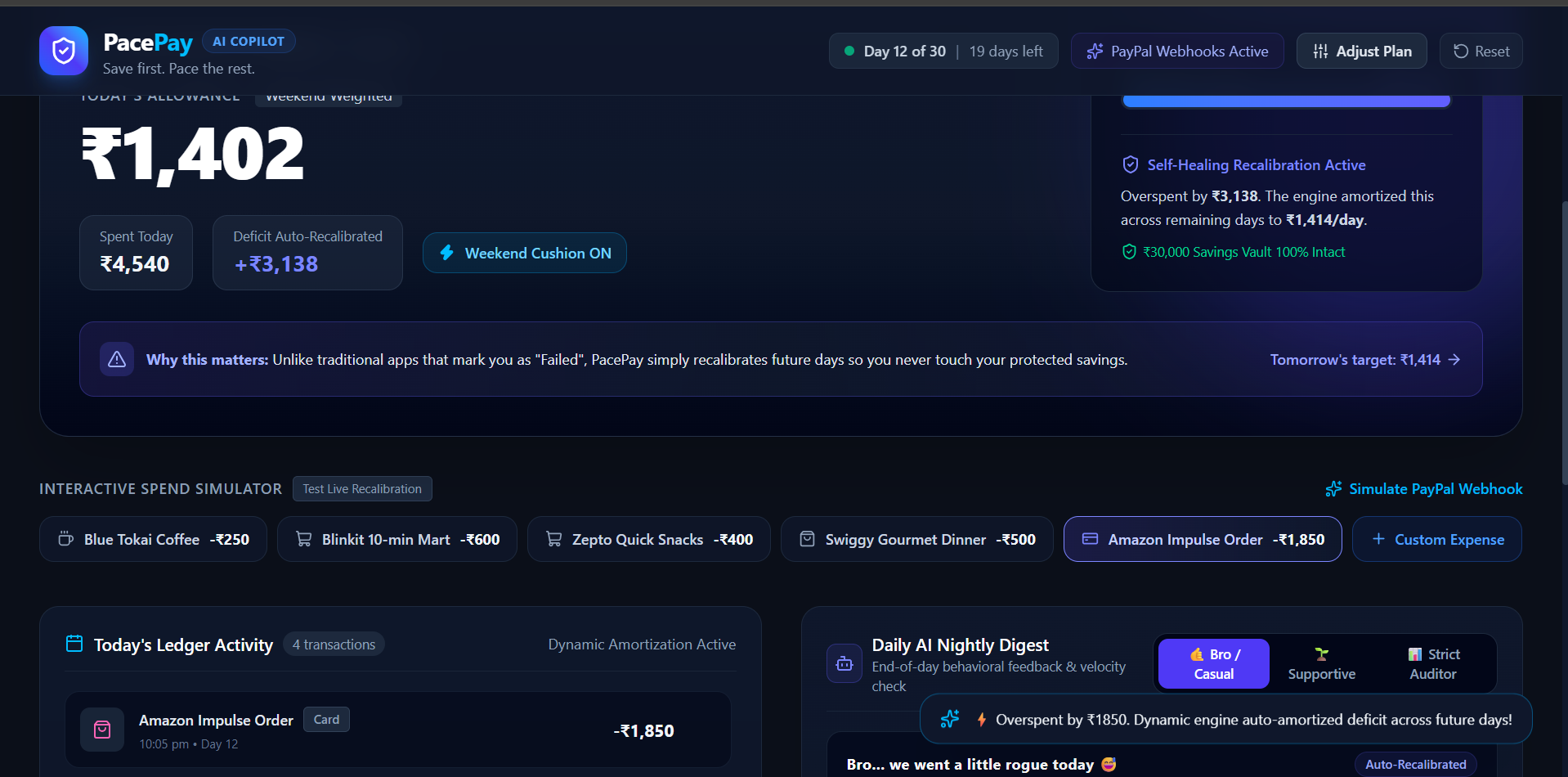
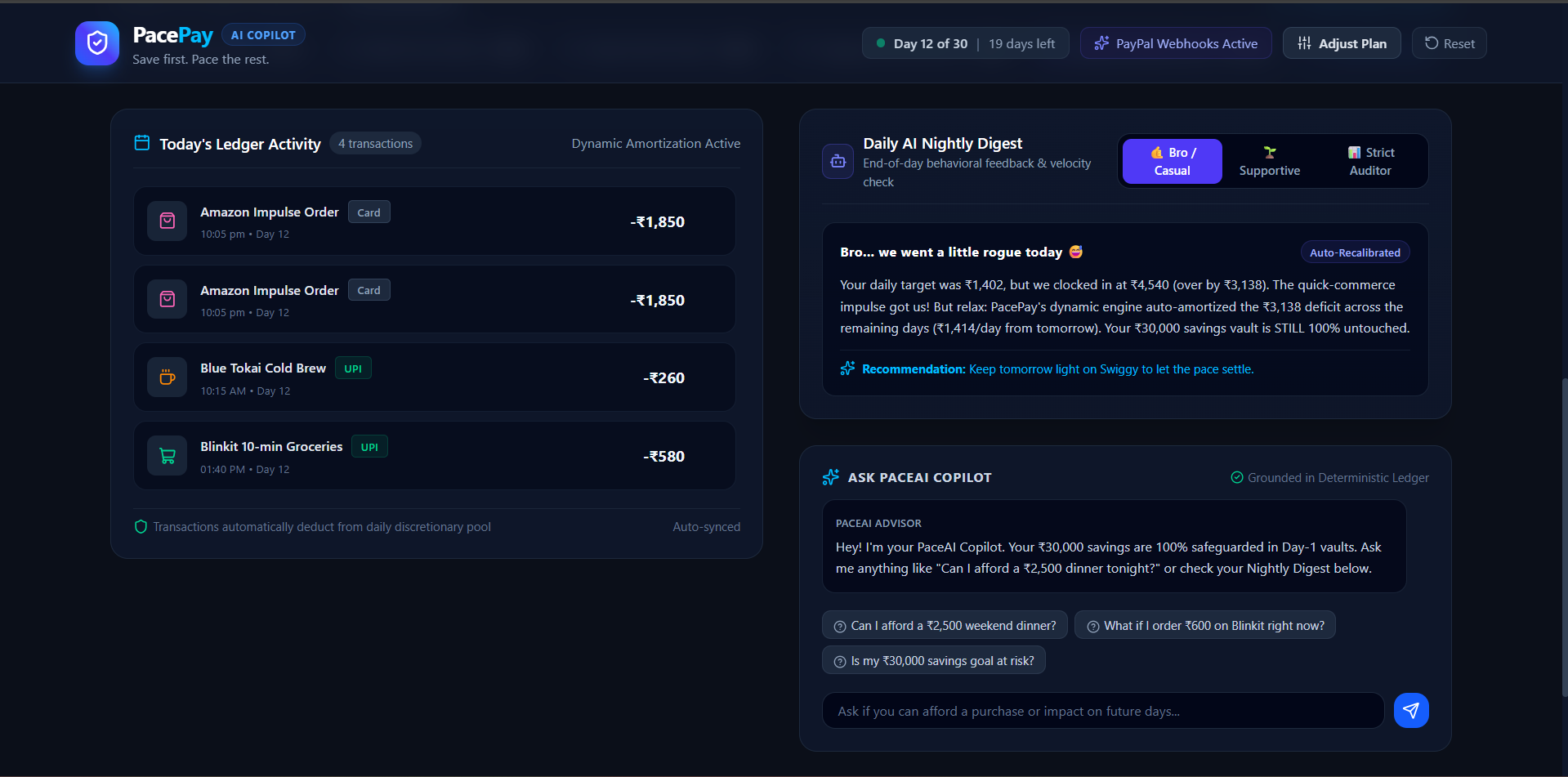
Dynamic Pacing Engine: Real-time allowance adjusts on spending, auto-amortizes deficits across future days to protect savings vault.
-
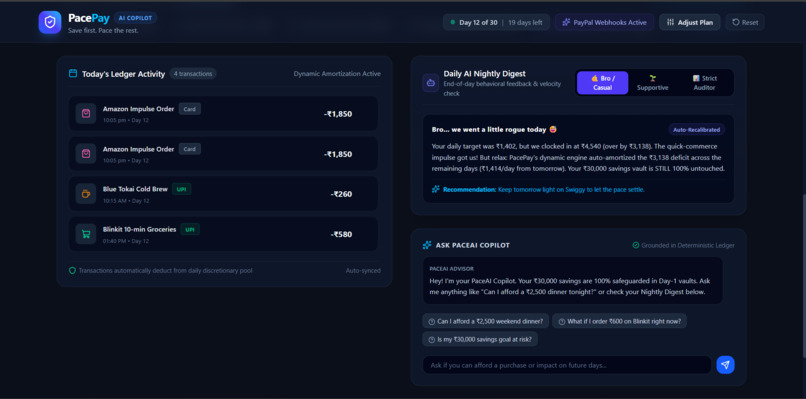
AI Financial Copilot: Multi-tone nightly behavioral digests, quick-commerce leak detection, and grounded conversational Q&A.
-
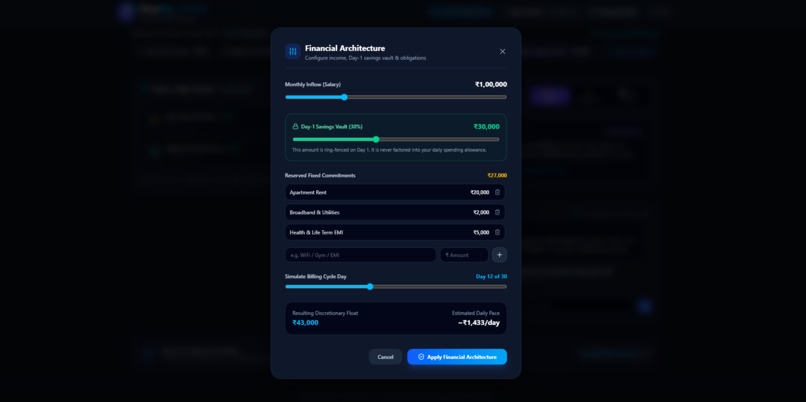
Financial Architecture Configurator: Customize salary, Day-1 savings vault, and fixed bills with real-time daily pace recalculation.
Inspiration
Earning ₹1,00,000 a month sounds like plenty of financial breathing room. Mathematically, that's around ₹3,333 a day. But here is the reality of modern consumer life: A morning coffee for ₹250, a quick Blinkit grocery run for ₹600, Zepto for ₹400, ordering dinner on Swiggy for ₹500, and an impulse checkout on Amazon, before 6:00 PM, over ₹2,500 has evaporated on autopilot. Most people tell themselves: "I'll invest whatever is left over at month-end." But when month-end arrives, that number is usually zero. The human brain wasn't built to pace a 30-day lump sum. Traditional budgeting apps only give retrospective guilt trips through pie charts after the money is already gone. We wanted to build something proactive: an intelligent copilot that locks your savings on Day 1, and translates what remains into a simple, guilt-free daily spending pace.
What it does
PacePay turns traditional budgeting upside down using the golden rule of wealth: Pay yourself first.
- Day-1 Savings Vault: The moment your monthly income lands (e.g., ₹1,00,000), PacePay immediately ring-fences your committed savings goal (e.g., ₹30,000) and fixed obligations (rent, EMIs, utilities).
- Dynamic Daily Pacing Engine: Instead of looking at an ambiguous balance, you get a clean daily spend allowance calculated strictly from the remaining liquid pool ($₹70,000 - \text{Bills}$).
- Adaptive Burn Recalibration: If you underspend today, the leftover funds automatically roll forward. If you splurge on a dinner out, the engine doesn't shame you, it automatically recalibrates your remaining daily allowances across the month so your vaulted savings stay 100% untouched.
- Weekend Cushioning: A smart multiplier (1.4x) that automatically buffers Friday–Sunday allowances so your weekend outings don't starve your weekdays.
- AI Transaction Categorization & Insights: Analyzes spending velocity, flags subtle micro-leaks (like repeated delivery fees), and produces customizable Nightly Digests (Bro/Casual, Supportive, or Strict Auditor tone).
- Real-Time Financial Q&A: Ask questions like "Can I afford a ₹2,500 dinner tonight?" and receive instant answers grounded in your remaining pool.
How we built it
For this hackathon prototype, we designed PacePay around a dual-engine architecture:
- Deterministic Pacing Engine (TypeScript / React): The ledger partitions income into three distinct buckets: Protected Vault (Savings), Committed Reserve (Fixed Bills), and Daily Burn Pool (Discretionary). The dynamic allowance is computed on every ledger event: $$\text{Daily Allowance}(t) = \frac{\text{Remaining Discretionary Pool}(t) \cdot w(t)}{\sum_{d=t}^{N} w(d)}$$ Where $w(d)$ is the dynamic weighting factor ($1.4\times$ for weekend cushioning, $1.0\times$ for weekdays).
- AI Copilot & Behavioral Layer: An agentic intelligence layer that evaluates spending velocity, generates nightly recaps, and answers conversational affordability questions without hallucinating financial figures.
- Simulated PayPal Event Stream: A real-time webhook listener simulation capturing incoming digital transactions and instantly updating the ledger and future projections.
Challenges we ran into
- Psychology of Budgeting: Traditional budget apps feel like strict diets, users abandon them the moment they exceed a limit. Designing the self-healing algorithm where overspending merely re-adjusts future days rather than triggering red failure screens took multiple iterations.
- Weekend & Day Weighting: A simple flat average fails because real human spending spikes on weekends. We had to implement dynamic day weighting to give weekends breathing room without depleting the weekly baseline.
Accomplishments that we're proud of
- Proving that the "Savings-First" daily allocation model immediately eliminates the cognitive overload of monthly expense management.
- Building a UI where anyone can answer the question "How much can I safely spend today?" in under 3 seconds.
- Creating a working, responsive prototype that demonstrates instant dynamic recalibration when transactions occur.
What we learned
- Tracking money retrospectively doesn't change behavior; real-time daily pacing does.
- Saving isn't a matter of willpower; it’s an architectural problem. If you don't isolate savings on Day 1, everyday life will inevitably expand to consume the entire lump sum.
What's next for PacePay
- Direct PayPal Auto-Vaulting: Integrating PayPal developer APIs to automatically sweep savings into locked vaults or recurring goals on payday.
- Predictive Weekend Buffering: Machine learning models that learn individual spending patterns to automatically budget higher allowances for weekends and tighter targets on weekdays.
- Direct Bank / Account Aggregator Integration: Connecting verified account aggregator APIs for frictionless live transaction feeds.
PacePay: Save first. Pace the rest.
Built With
- financial
- node.js
- openai
- paypal/react-paypal-js
- react
- rest-apis
- tailwind-css
- typescript
- vite
- webhooks
