-
-
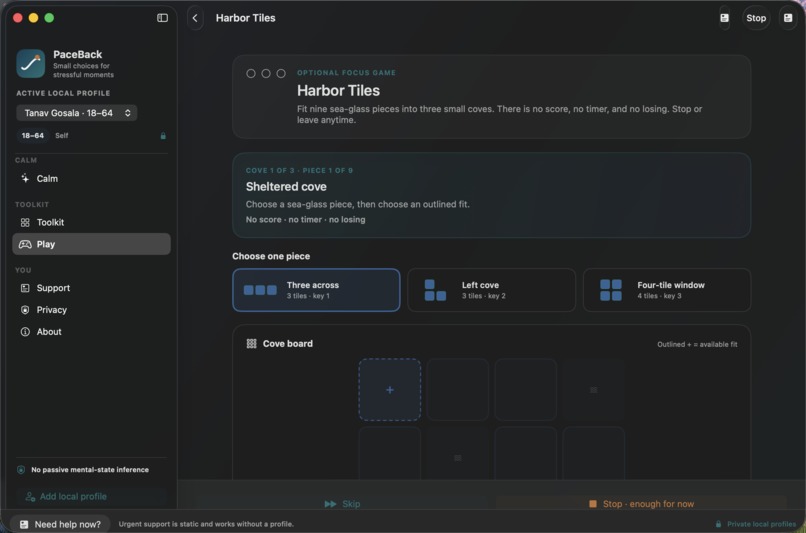
Harbor Tiles: nine finite placements with no score, timer, streak, or losing.
-
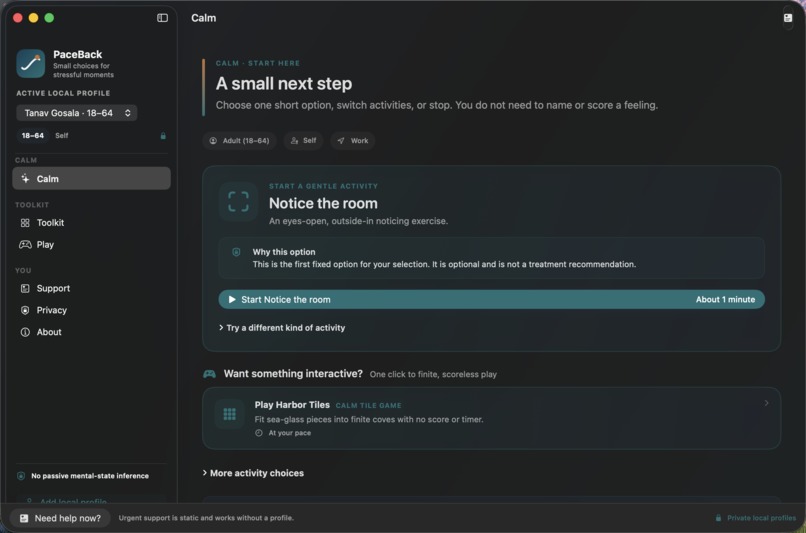
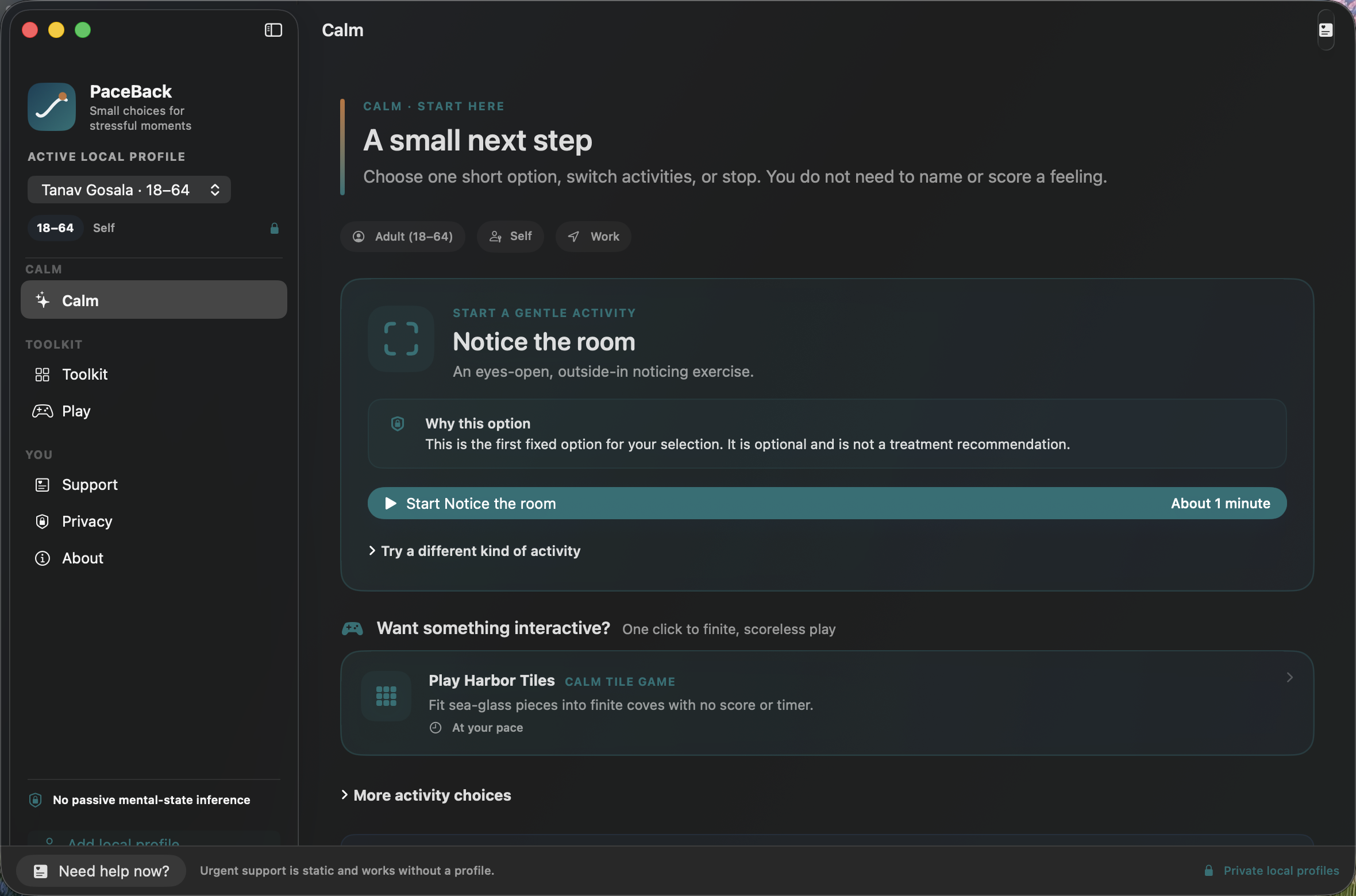
Calm: one gentle activity first, with one-click finite Harbor Tiles.
-
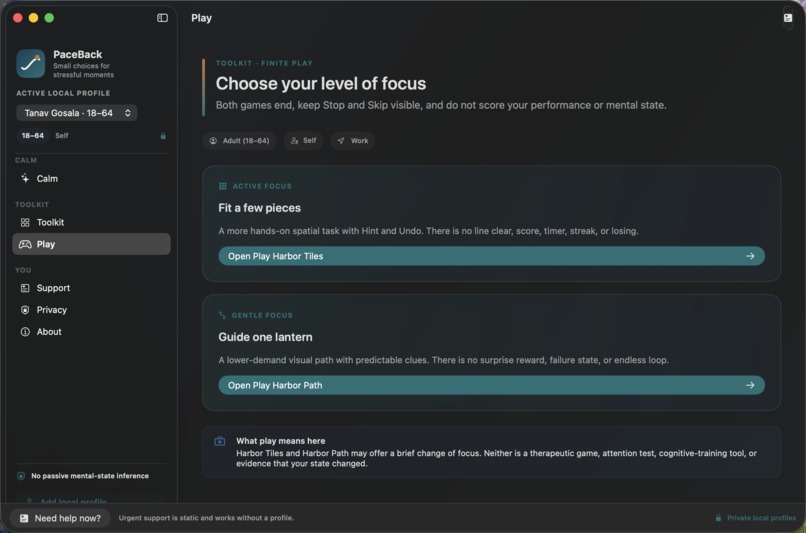
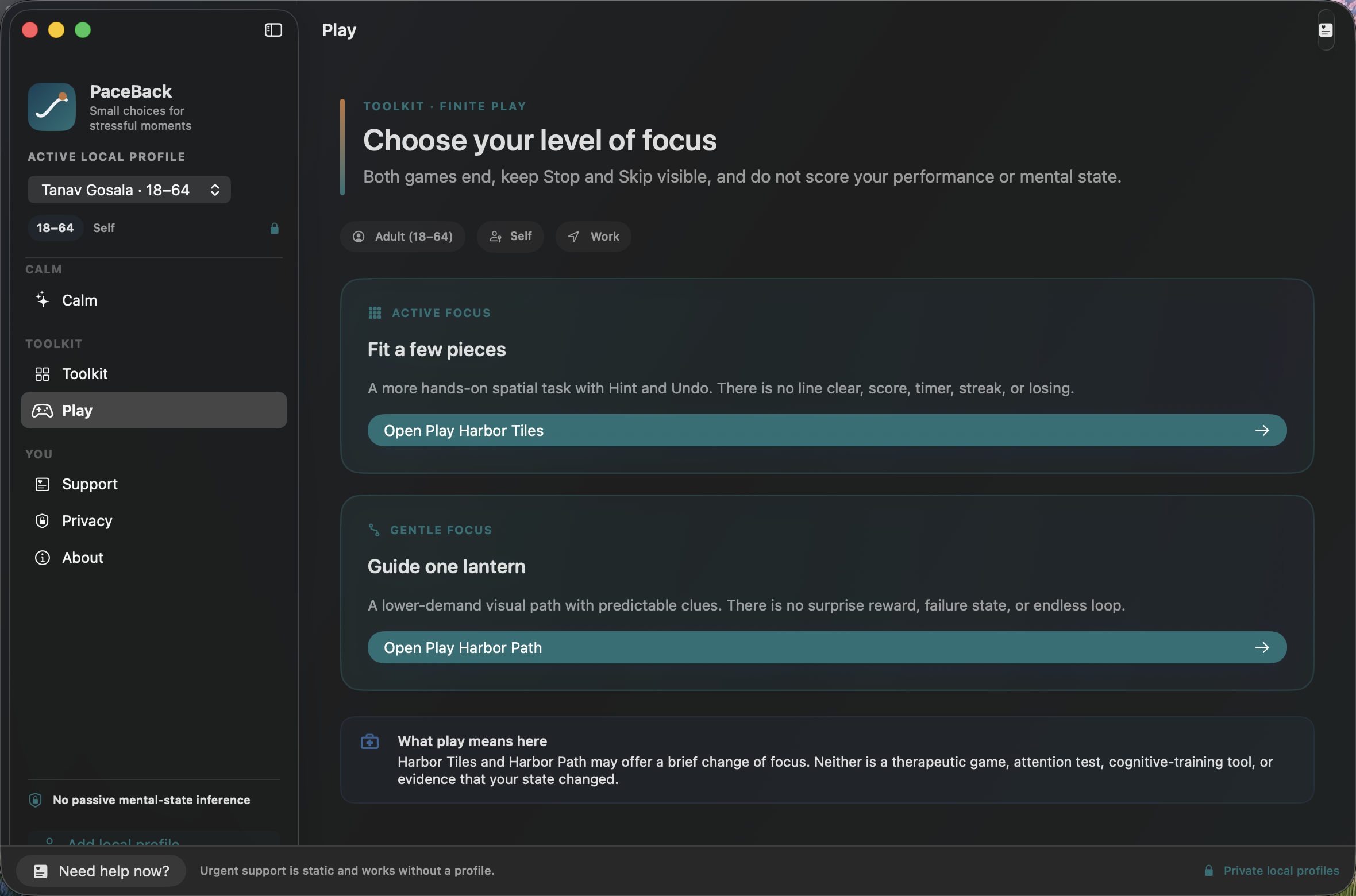
Play: choose active or gentle focus; both games are scoreless and stoppable.
Inspiration
When someone feels overwhelmed, the usual wellness-app experience can make the moment harder: create an account, answer a long questionnaire, choose from a large library, maintain a streak, or talk to a chatbot. Softer was designed around a smaller question: what is the gentlest useful next action a person can take right now?
We use "mental wellbeing" to mean a person's ability to cope with ordinary stress, function in daily life, and feel supported—not being happy all the time and not being made "normal." Softer is a non-clinical wellbeing tool. It does not diagnose, treat, or replace professional care.
What it does
Softer is a private native macOS app for moments of everyday stress, restlessness, overload, and low focus. A person can begin in a clearly labeled no-save guest session, without creating an alias or writing to Keychain.
The Calm screen offers one prominent suggested activity instead of presenting a crowded dashboard. People can select a plain-language need, use another modality, skip an activity, or stop whenever they want.
Activities include grounding, sensory orientation, gentle movement, an adjustable visual breathing pacer, and two interactive focus games:
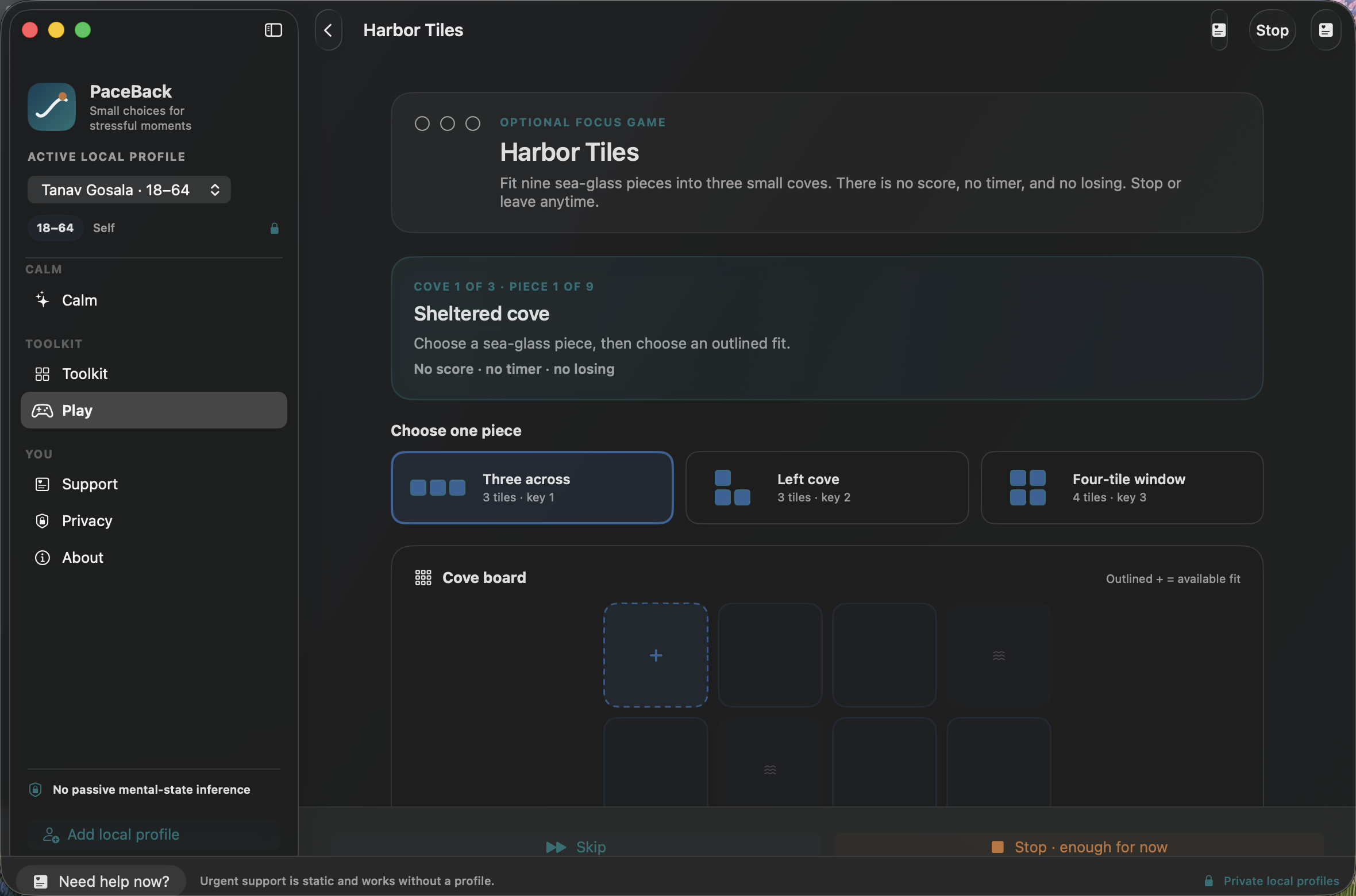
- Harbor Tiles: a finite spatial puzzle with hidden answers, multiple legal routes, optional Hint and Undo, and exactly nine placements.
- Harbor Path: a quiet waypoint activity with one to three steps.
The breathing pacer supports adjustable pacing, pause and resume, shape-only wording, and a static Reduce Motion fallback.
Neither game has a score, timer, loss condition, leaderboard, streak, or punishment. Finishing is optional. The purpose is to redirect attention through predictable, low-pressure interaction rather than create another performance task.
After an activity, a short optional checkout lets the person choose "more settled," "same," "less settled," or "skipped." Softer uses that explicit feedback only to adjust the ordering of future suggestions locally. It does not infer a diagnosis or hidden emotional state.
Urgent support remains visible through a static Need help now? route. That route does not depend on a model, recommendation engine, or profile.
Human-centered design
Softer is designed for reduced decision load:
- One clear next activity.
- A visible start action.
- Stop and skip are always valid.
- No competitive wellness mechanics.
- No guilt-based reminders or engagement streaks.
- Crisis and professional-support routes are separated from everyday calming activities.
The app deliberately avoids presenting itself as a cure. A calming activity may help someone feel a little more settled in the moment, but individual results vary.
Privacy and safety
Softer has no account system, advertising, analytics service, chatbot, or cloud backend. Profile data and activity history stay on the Mac.
Saved profile data is protected with AES-GCM encryption, with encryption keys stored through the macOS Keychain. The app fails closed rather than silently writing private wellbeing data without encryption. If Keychain is unavailable, the locked workspace remains untouched while an optional memory-only guest session keeps eligible activities and Support available.
Safety decisions are intentionally deterministic:
- no diagnosis or symptom classification;
- no generated medical advice;
- no hidden mood inference;
- no infinite reward loops;
- no loss states;
- static urgent-support information;
- explicit age and role boundaries;
- users can stop, skip, or report feeling less settled.
Softer is not emergency care. People in immediate danger should contact local emergency services or an appropriate crisis service.
Research foundation
Softer's definition of mental wellbeing follows the World Health Organization: mental wellbeing supports coping with life's stresses, learning and working, and contributing to community. WHO also identifies responsibly designed digital self-help tools as one way to expand access, while emphasizing that mental health is shaped by individual, social, and structural factors.
Softer's breathing guidance is intentionally gentle and optional. The NHS breathing exercise for stress describes slow, comfortable breathing as a short calming technique that can be done in different positions and should not be forced.
These references support the product direction; they do not prove that Softer itself is clinically effective. Independent usability and outcome evaluation remain future work.
How we built it
Softer is a dependency-light native macOS application built in Swift and SwiftUI. CryptoKit provides authenticated AES-GCM encryption and the Security framework connects to the macOS Keychain.
The activity recommendation logic is deterministic and bounded. It uses only the person's explicit selections and checkout responses. This makes the behavior inspectable, predictable, and available offline.
The release app was built with Apple's command-line developer tools, signed as a macOS application, and checked with a 58-check behavioral verification suite covering activity limits, safety routes, privacy behavior, stopping and skipping, and the finite game rules.
Challenges
The hardest product challenge was balancing privacy with immediate access. Wellbeing data should not be stored casually, but a safety mechanism must not become an obstacle when someone needs a calming activity. We also had to remove early concussion-recovery framing and redesign the product around everyday mental wellbeing, because concussion recovery is a separate clinical use case.
Another challenge was making a game stimulating enough to hold attention without importing the pressure mechanics common in mobile games. That led to short, finite play with no scores, timers, streaks, or failure.
What we learned
More features do not automatically make a wellbeing product more useful. For a stressed person, reducing choices, explaining the next action, and preserving control can be more valuable than a large content library.
We also learned to separate three claims clearly:
- the software functions as designed;
- the interaction is intended to support calm and grounding;
- clinical effectiveness would require independent real-world validation.
Only the first claim has been verified by our software tests.
What's next
Next steps include broader localization of urgent-support resources, structured VoiceOver and reduced-motion testing, an independently reviewed wellbeing-content library, and opt-in usability studies measuring whether people can reach a helpful activity quickly and comfortably.
Our goal is not to keep people inside Softer. It is to help them take one small, private step and then return to their day.
Built With
- cryptokit
- keychain
- macos
- swift
- swiftui

Log in or sign up for Devpost to join the conversation.