-
-
-
-
-
-
This image is currently processing. Please be patient...

Inspiration and what it does
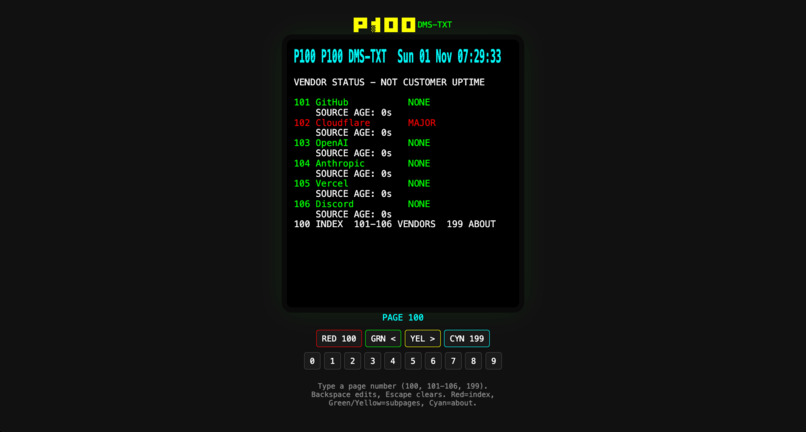
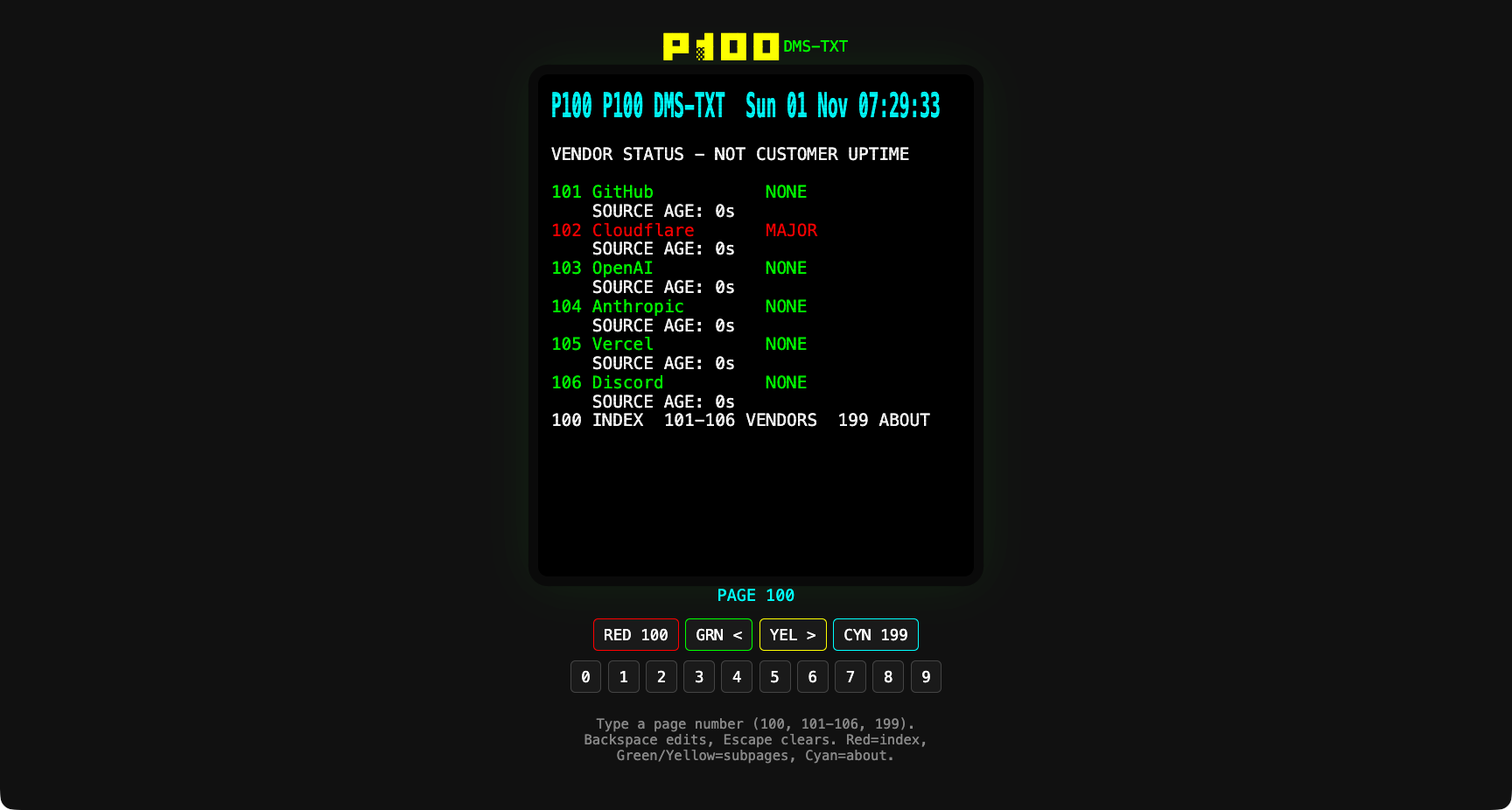
P100 brings back broadcast teletext — the 1980s TV text service that died with analogue television — and puts it to work as a live status desk for the services a small software agency depends on.
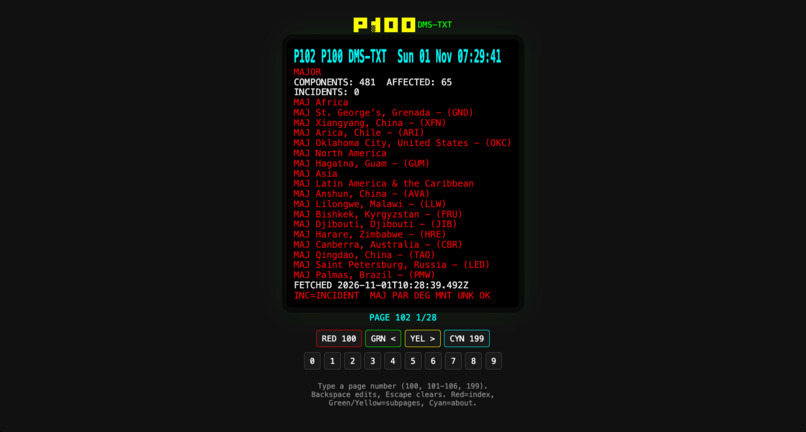
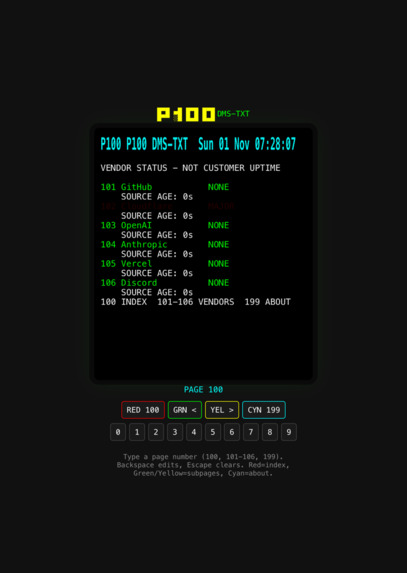
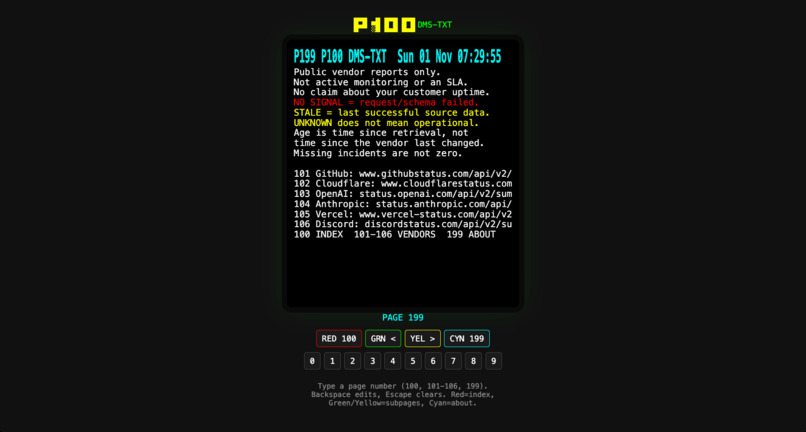
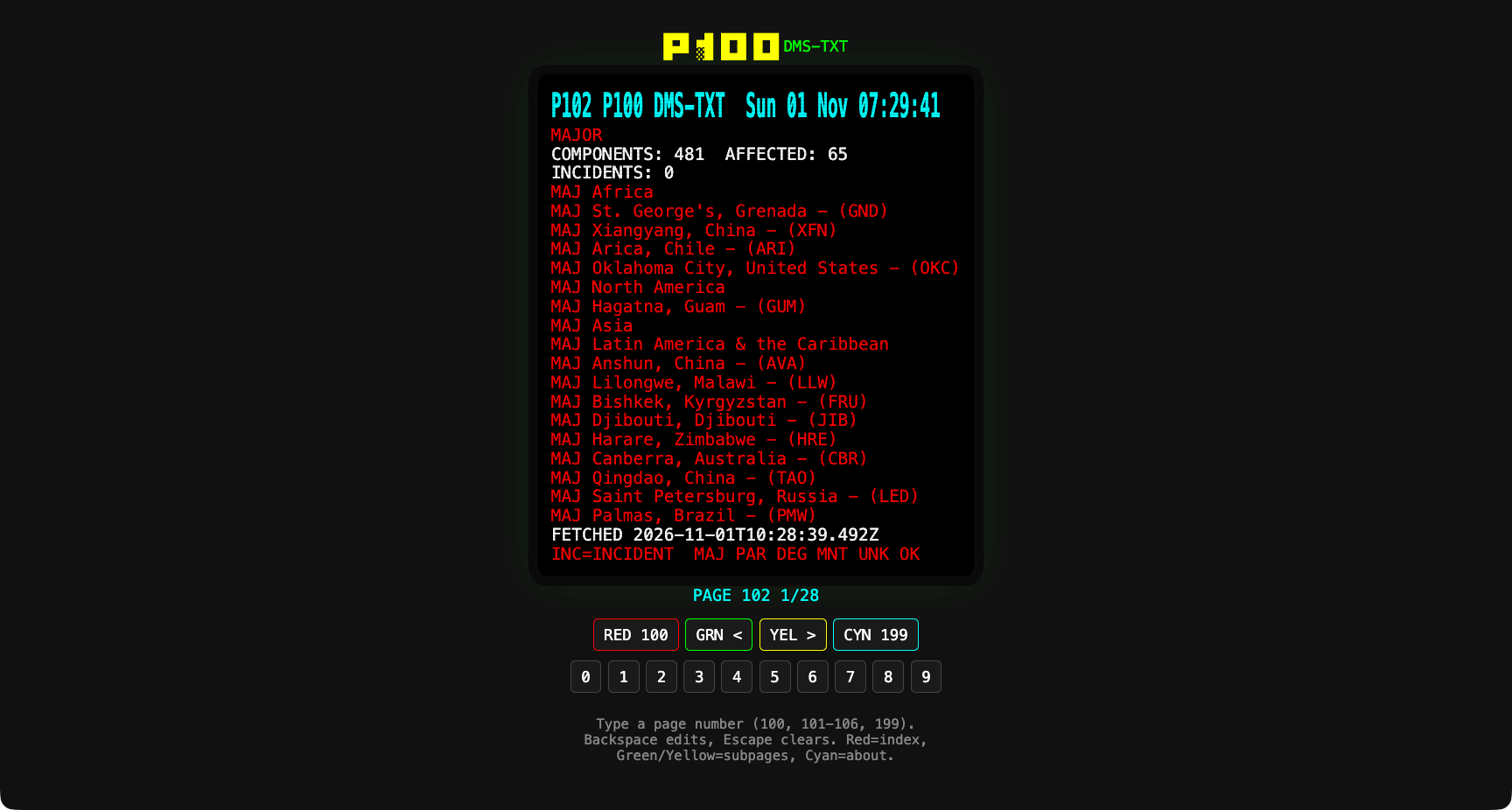
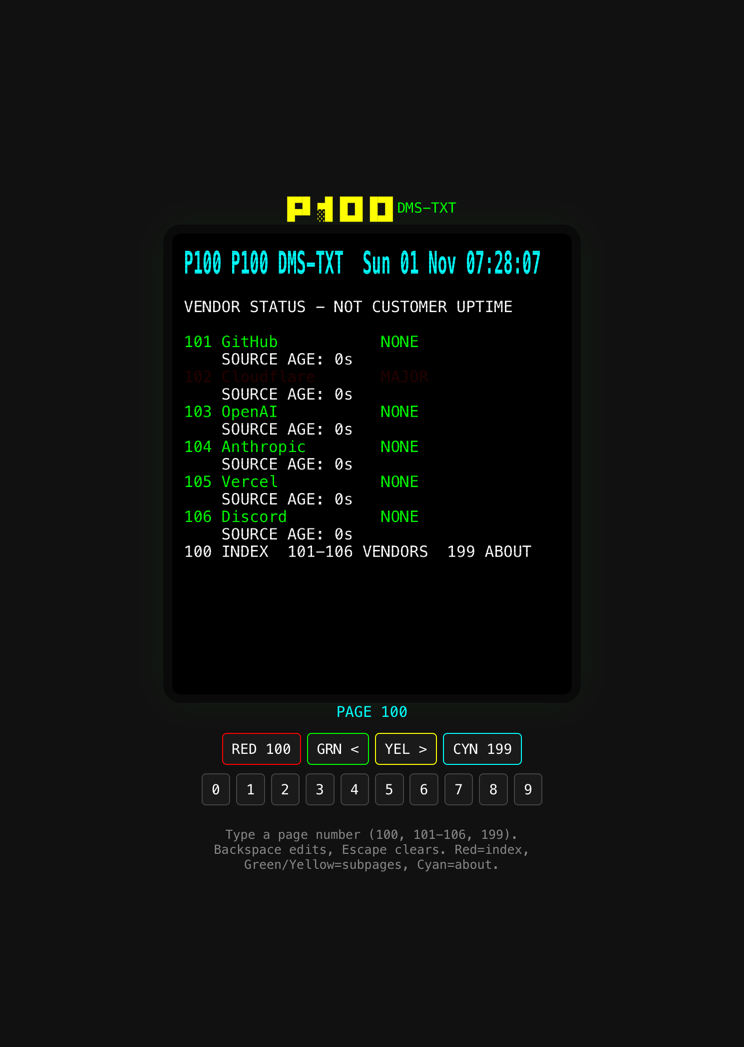
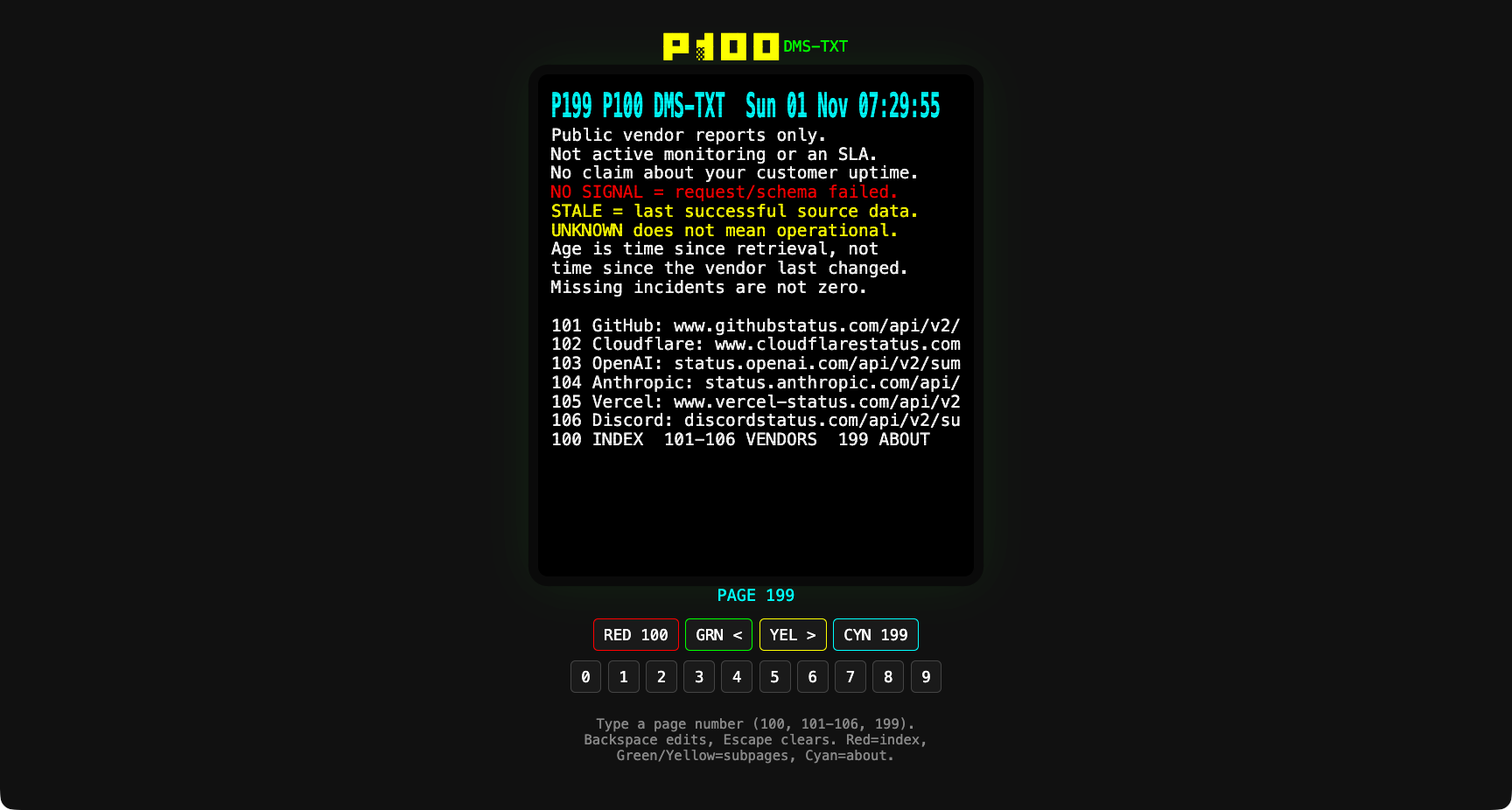
During an incident we open six vendor status pages, each with its own layout, its own clock and its own idea of what "degraded" means. P100 gives them one shelf: a numbered index (page 100), one page per vendor (101–106), and page 199 for the limits. Every page is a strict 40×24 character teletext grid, navigated by page number with a keyboard or the on-screen remote, exactly like a 1980s set.
- Six public Atlassian Statuspage
summary.jsonfeeds fetched server-side in parallel, 5-second timeout per source, 60-second cache. - Affected components are listed before operational ones; a vendor with many affected components spans subpages without ever taking another vendor's page number.
- A failed or slow source renders NO SIGNAL;
incidents = []is never shown as an all-clear. Age is time since retrieval, not time since the vendor changed. - Authentic front end: the eight teletext colours, double-height header with a live
clock, blocky mosaic logo, CRT scanlines, flashing status. Scales from a 360 px
phone to a desktop and respects
prefers-reduced-motion.
It is a vendor-status viewer: not active monitoring, not an SLA calculator, and not a claim about any customer's availability. P199 says so on the page itself.
How we built it: how Kiro was used
- Spec-driven development.
.kiro/specs/p100/holds requirements in EARS form (WHEN/WHILE/IF … THE SYSTEM SHALL …), a design that fixes the 40×24 grid rules and the fetch/cache contract, and a task plan worked through to completion. The EARS criteria map one-to-one onto the tests, so the spec is checkable rather than aspirational. - Steering.
.kiro/steering/product.md,tech.mdandstructure.mdpin the product boundary (vendor viewer, no keys, honest status), the stack (Worker, TypeScript, no framework, purebuildPages) and the module layout. Keeping the boundaries in steering stopped the build from drifting into a monitoring service. - Agent hook.
run-tests-on-save.kiro.hookruns the suite whenever asrc/*.tsfile is saved, so the grid-bounds and status rules never went stale during edits. - Red before green. The eight acceptance cases in
fixtures/cases.jsonwere encoded as tests first. Mutating the page builder (forcing one subpage, treating unknown incidents as green) turned the suite red — four failures — until the correct implementation was restored. - Property-based testing (fast-check). For any generated feed input: every page is exactly 24 lines of 40 characters, vendor page numbers are unique and stable for the same service order, and unknown or failed feeds render NO SIGNAL without throwing. The 360 px clipping bug was found in a real screenshot, not by the PBT — the properties guard the grid, they do not replace reading the screen.
- What would have been slower without the spec. The subpage rule ("never take another vendor's page number") is the part a vibe-coded version gets wrong: without it written down as an acceptance criterion, pagination silently renumbers the neighbours.
Links
- Live: https://p100.designmaster.workers.dev
- Code (MIT,
.kirocommitted): https://github.com/DesignMaster-Solutions/p100-status
The demo narration is synthetic (text-to-speech); every screen in the video is a real capture of the running app.
Built With
- cloudflare-workers
- fast-check
- kiro
- typescript
- vitest
