

P.L.U.T.O. Personal Assistant
P.L.U.T.O. stands for Productivity & Logical Utility Task Organizer—a dynamic assistant designed to revolutionize personal productivity through intelligent, self-teaching features. This project sets out to reimagine what a personal assistant can be, blending cutting-edge technology with intuitive design to adapt seamlessly to the unique needs of each user.
Inspiration
The idea behind P.L.U.T.O. arose from the need for a personal assistant that goes beyond static functionality. While most assistants focus on basic task management or information retrieval, P.L.U.T.O. was envisioned as a learning entity—one that evolves alongside its user, curating responses and adapting tools for an ever-improving user experience. The inspiration was to create a truly personalized companion, bridging the gap between technology and everyday efficiency.
What it does
P.L.U.T.O. is built to simplify and enhance productivity by incorporating a real-time OpenAI API for general communication and an o3-mini API, enabling it to learn and integrate new tools and functions effectively. Together, these features allow P.L.U.T.O. to act as a versatile and intelligent assistant that delivers customized solutions for its users.
How we built it
The development process involved the use of Python libraries like OpenAI and a dynamic tool memory, which serve as the backbone for communication and self-teaching functionalities. We employed tools such as VSCode, GitHub Copilot, and Cursor IDEs to create a robust platform with a modular structure. This approach ensures seamless updates and compatibility with a wide range of devices and systems.
Challenges we ran into
One of the primary challenges was working with the beta OpenAI real-time API, which presented unclear documentation and required extensive troubleshooting. Additionally, achieving consistent accuracy in function execution was another obstacle we faced, demanding significant effort to fine-tune the model's performance.
Accomplishments that we're proud of
Despite these challenges, the project boasts significant achievements. The evolving user interface is shaping up to be highly intuitive and user-friendly, aligning with the project’s vision. Furthermore, integrating OpenAI's ethical database ensures that P.L.U.T.O. operates responsibly and aligns with user values.
What we learned
Through this journey, we gained a deeper understanding of how to implement OpenAI’s real-time API effectively, curate adaptive agent responses tailored to user needs, and leverage stored memory to personalize the user experience further. These lessons pave the way for creating an even more dynamic assistant.
What's next for P.L.U.T.O.
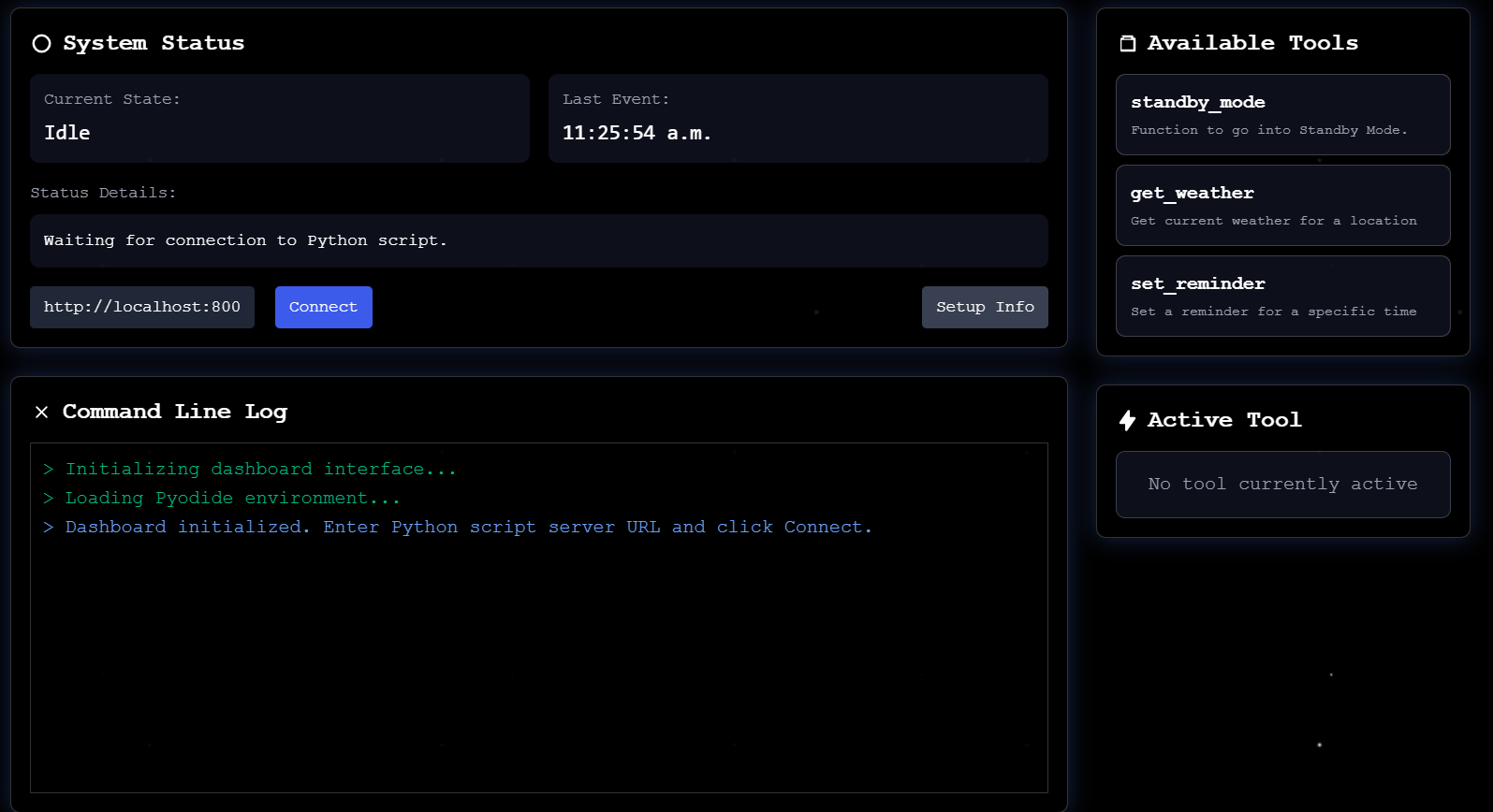
Moving forward, we aim to refine and expand P.L.U.T.O.’s capabilities. A major priority is improving the user interface to enhance usability and aesthetics. Additionally, we plan to develop a Public Tool Creator to empower users to contribute to and customize the assistant’s functionalities. A dedicated website/web application is also in the works, alongside efforts to fine-tune the assistant’s learning and real-time models for superior function calling and adaptability.
Built With
- anthropic?s-claude-sonnet-3.7-thinking-(python-code-generation)
- css
- google-colab-(training)
- google?s-gemini-2.5-(html-code-generation)
- html
- javascript
- lovable-ai-(demo-webpage)
- lucid-react
- microsoft-github-copilot-(code-generation-orchestration)
- next.js
- ollama-locally-hosted-models-(deepseekr1-and-llama-3.2)-(previous-testing)
- onnx-based-openwakeword-(trained-on-self-generated-data)-(wakeword)
- openai?s-4o-mini-realtime-api-(testing-the-cmc)
- openai?s-4o-realtime-api-(core-mainframe-computing)
- openai?s-chatgpt-o4-mini-(python-code-generation)
- openai?s-o3-(self-learning-tool-creation-aspect)
- python


Log in or sign up for Devpost to join the conversation.