-
-
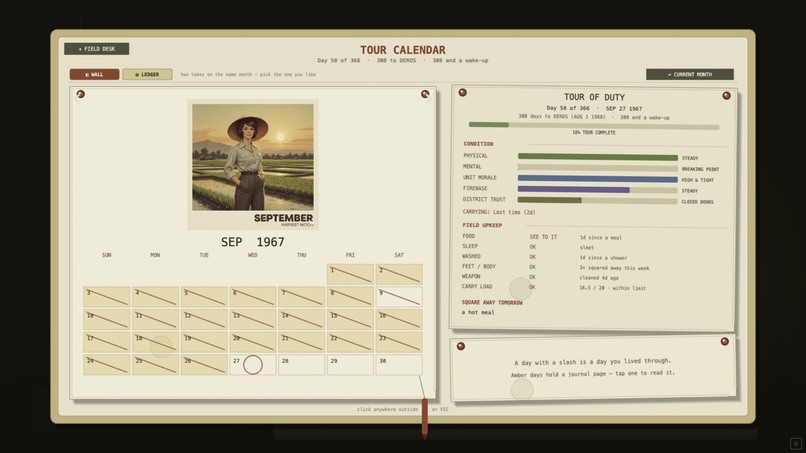
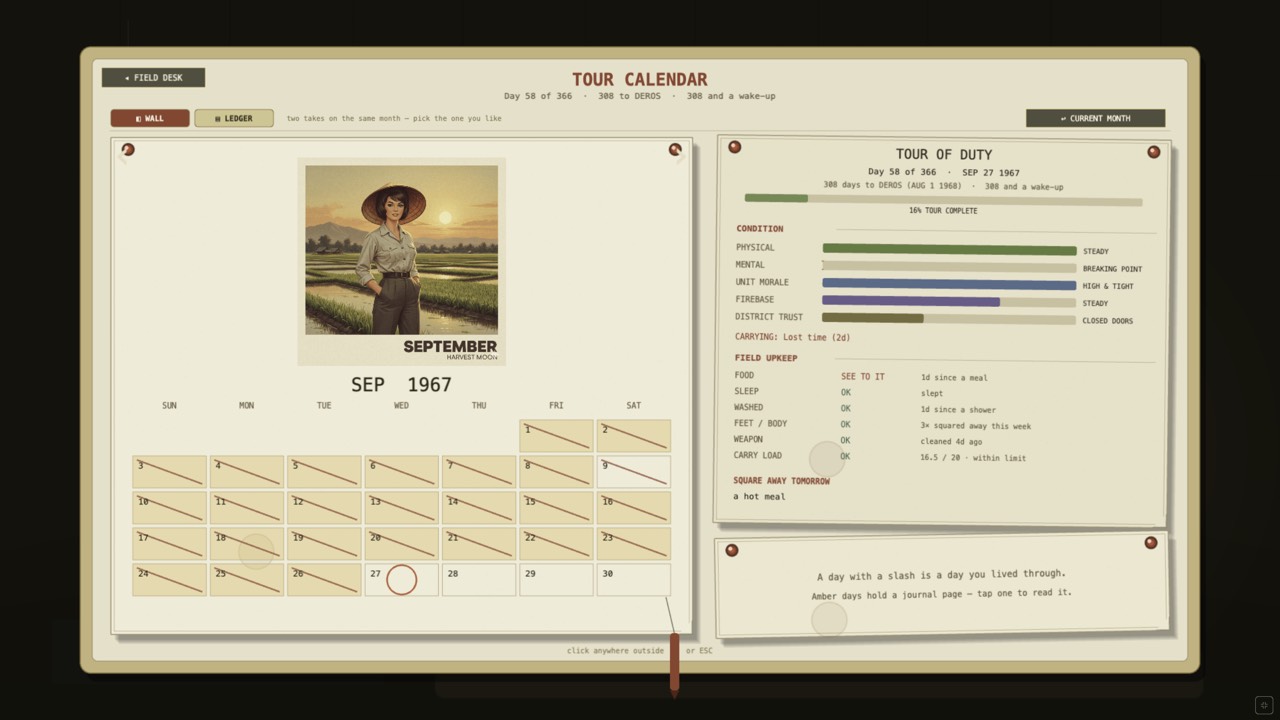
Tour calendar with interactive functions
-
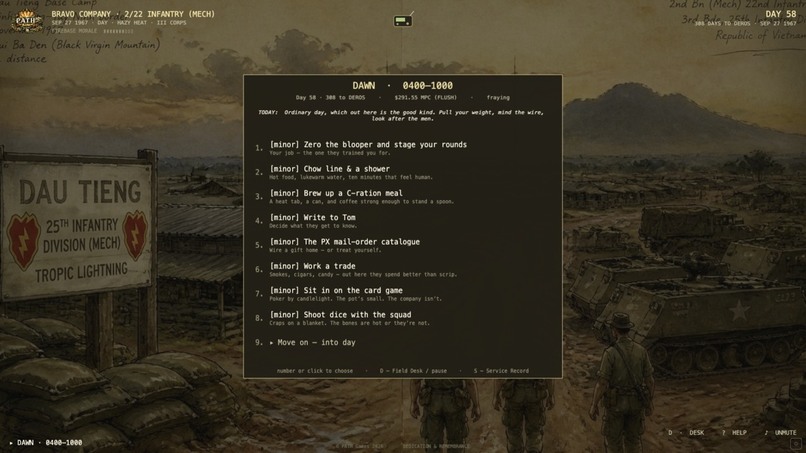
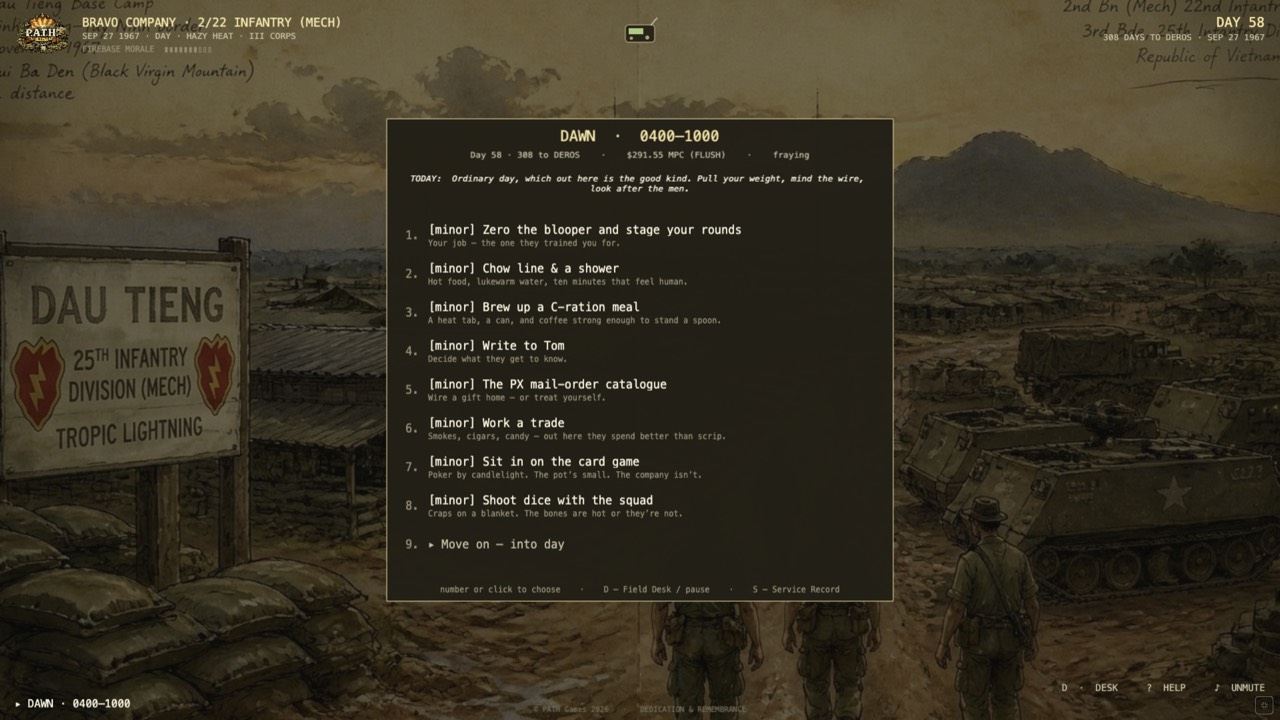
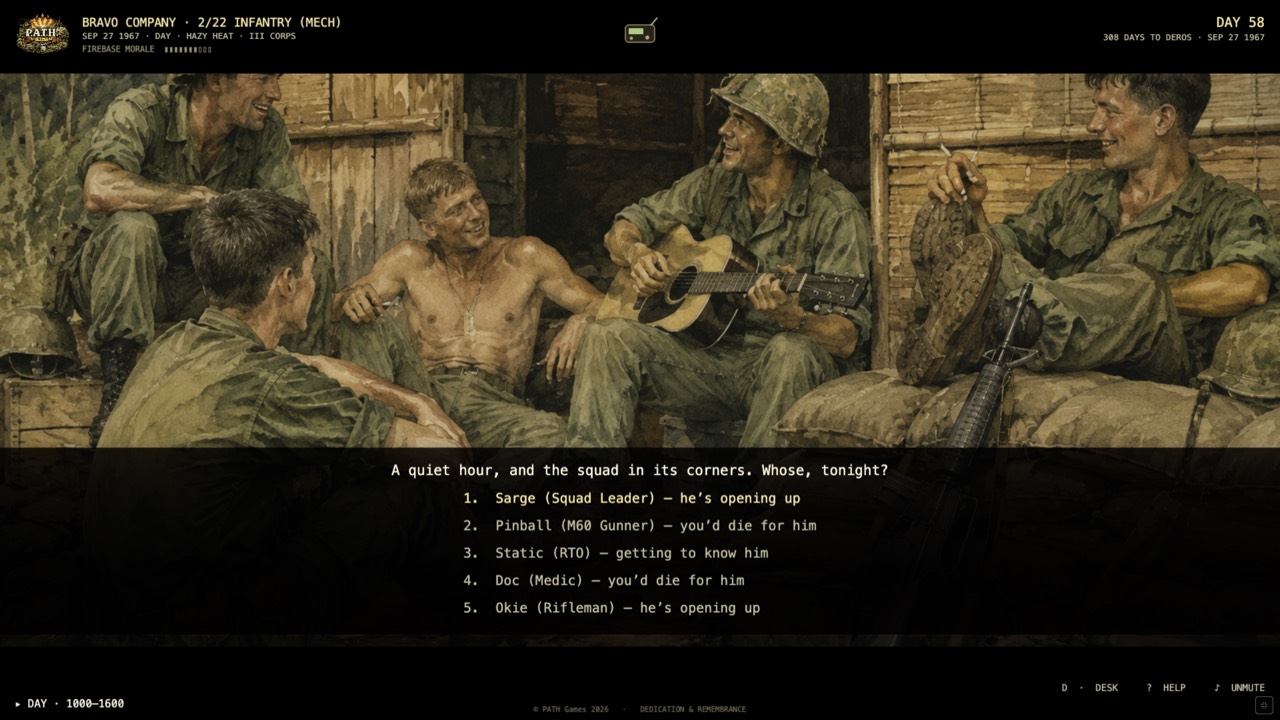
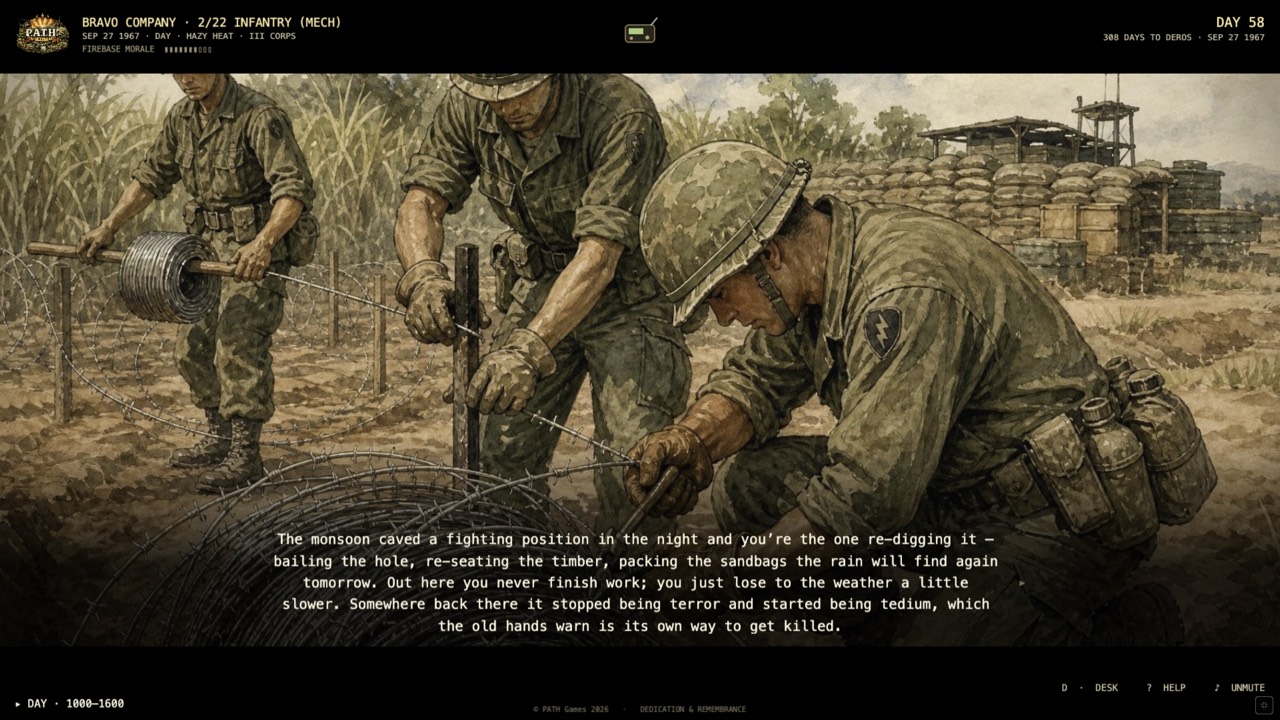
daily minor beats
-
-
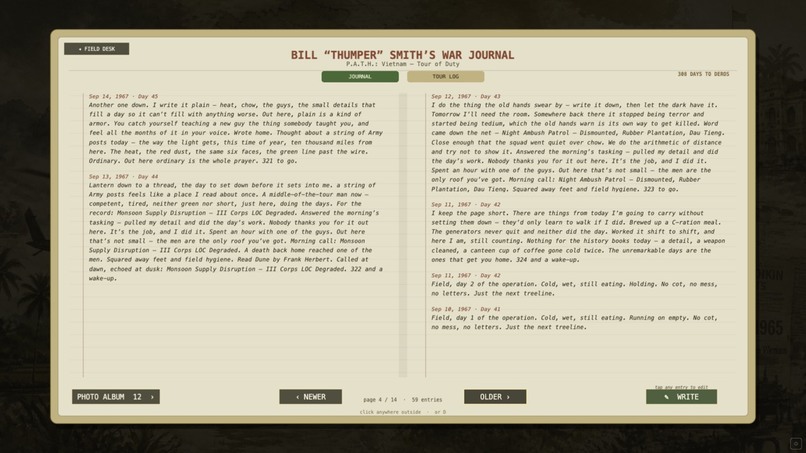
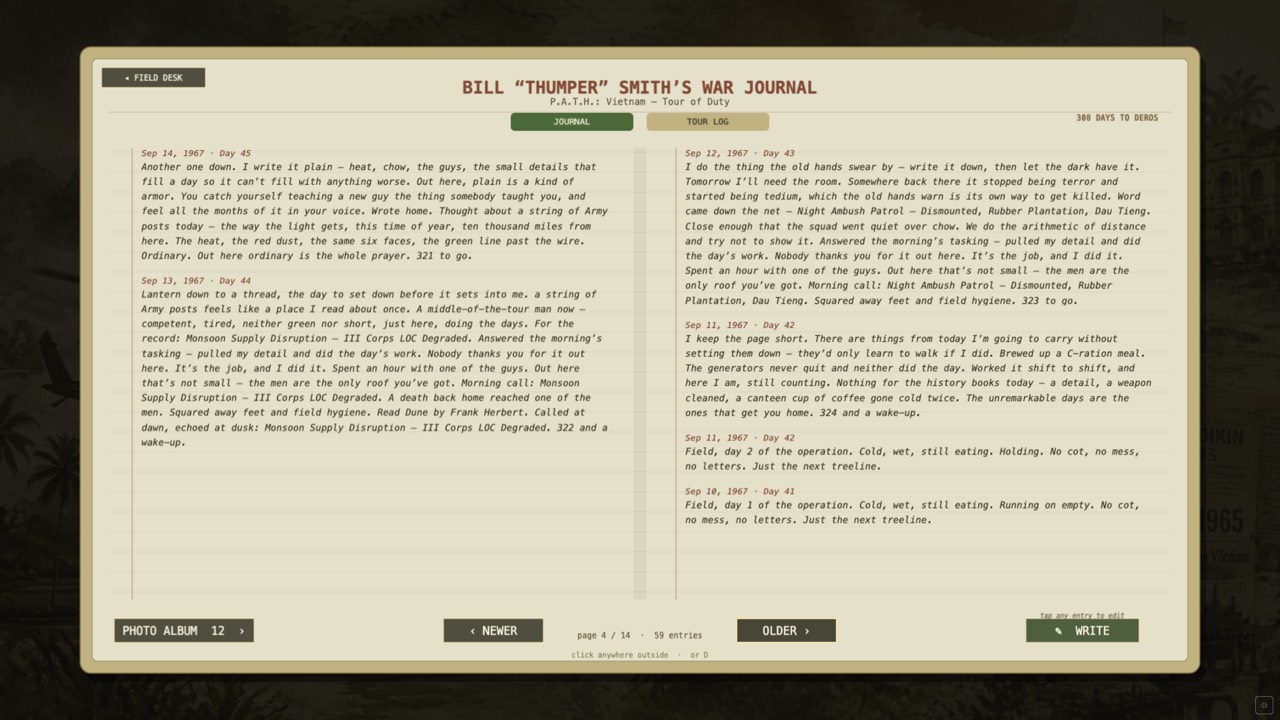
War journal with details summary of daily actions
-
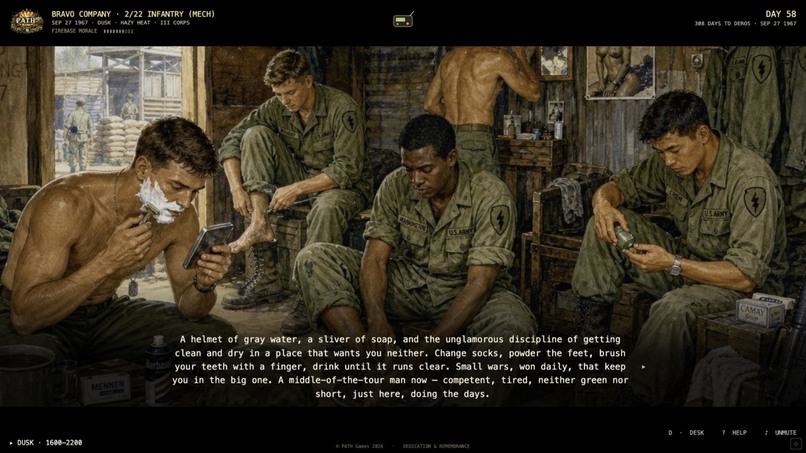
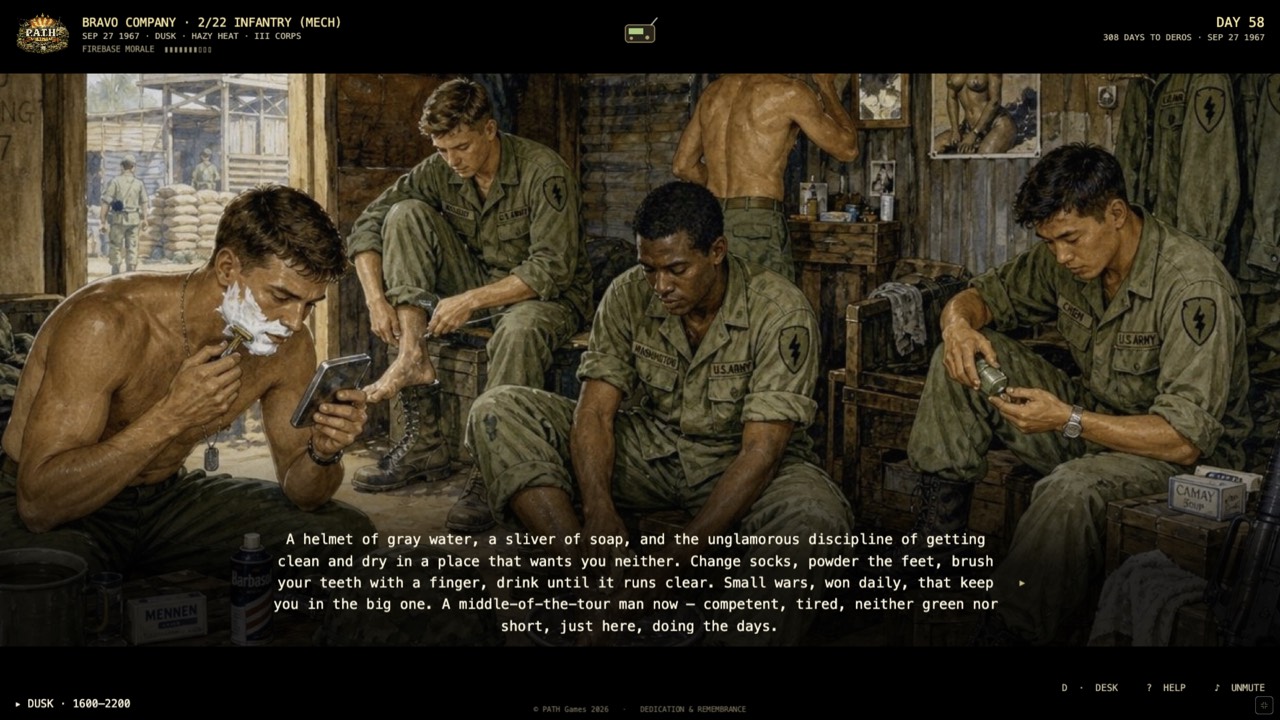
minor beat taking care of one self - could have great consequences
-
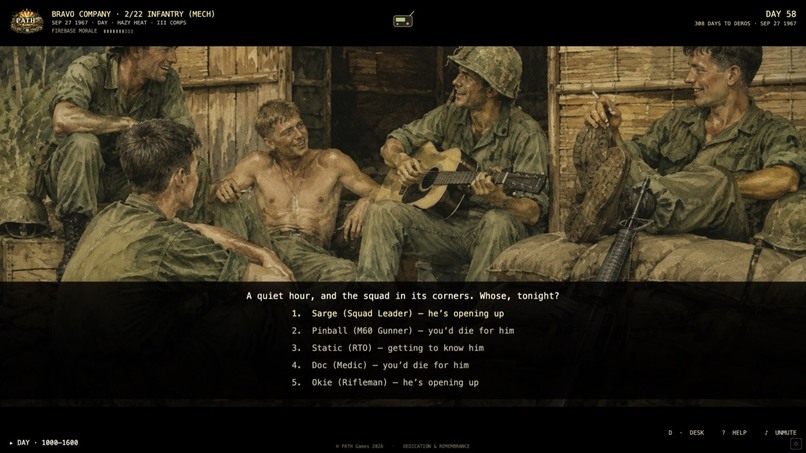
a minor beat in the game
-
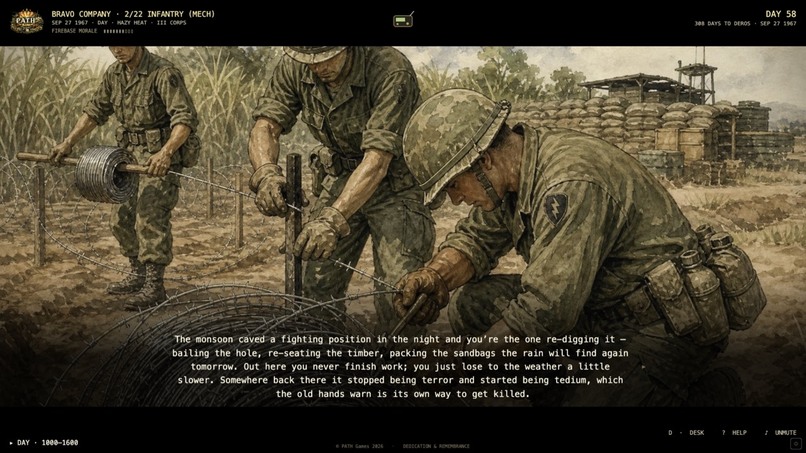
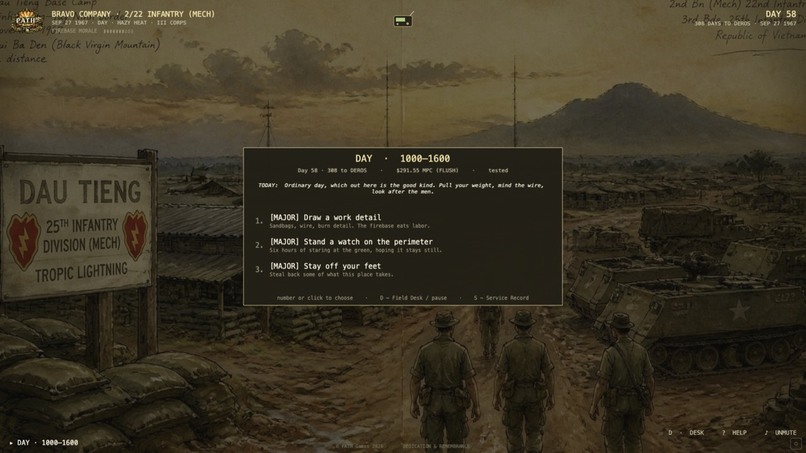
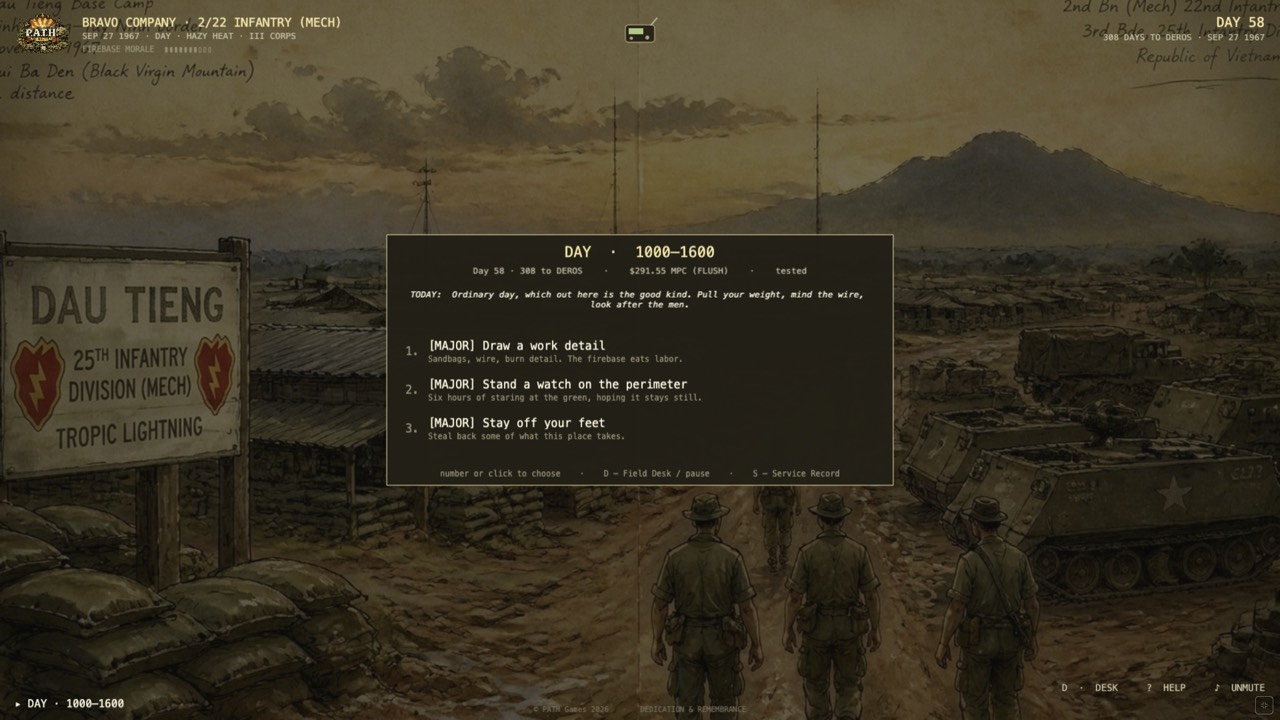
daily major beat
-
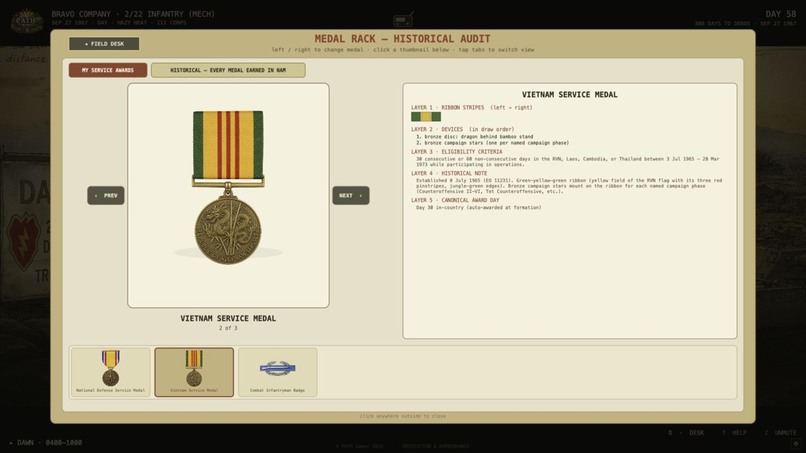
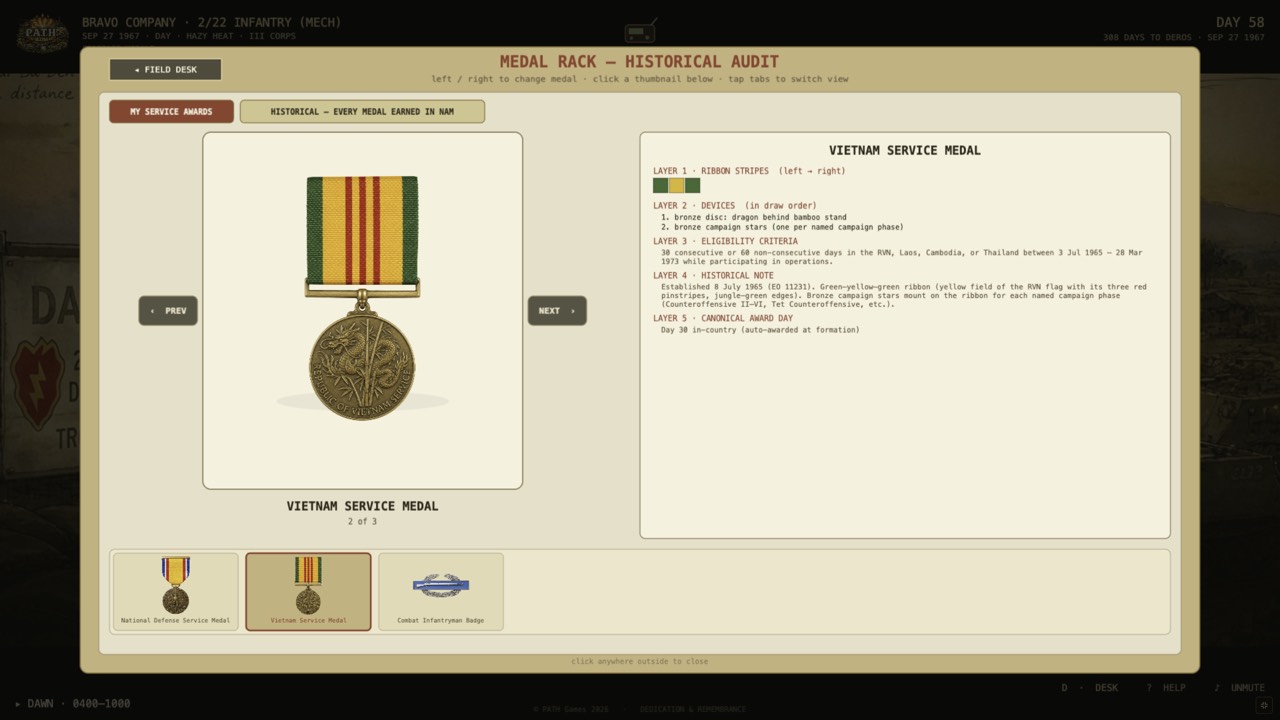
Medals earned
-
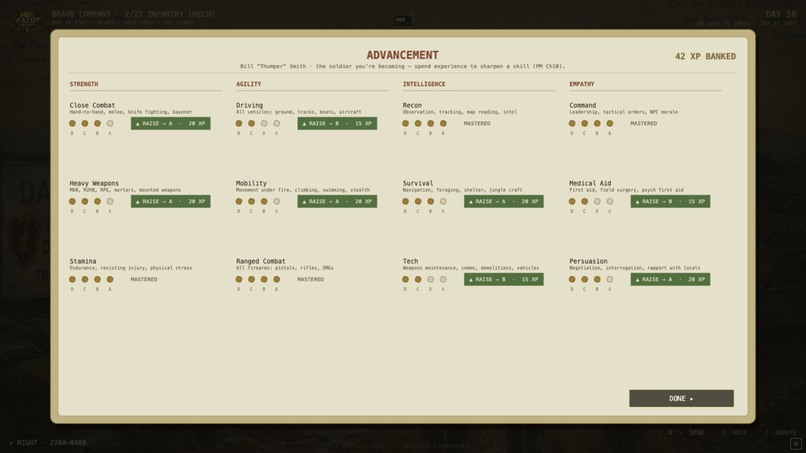
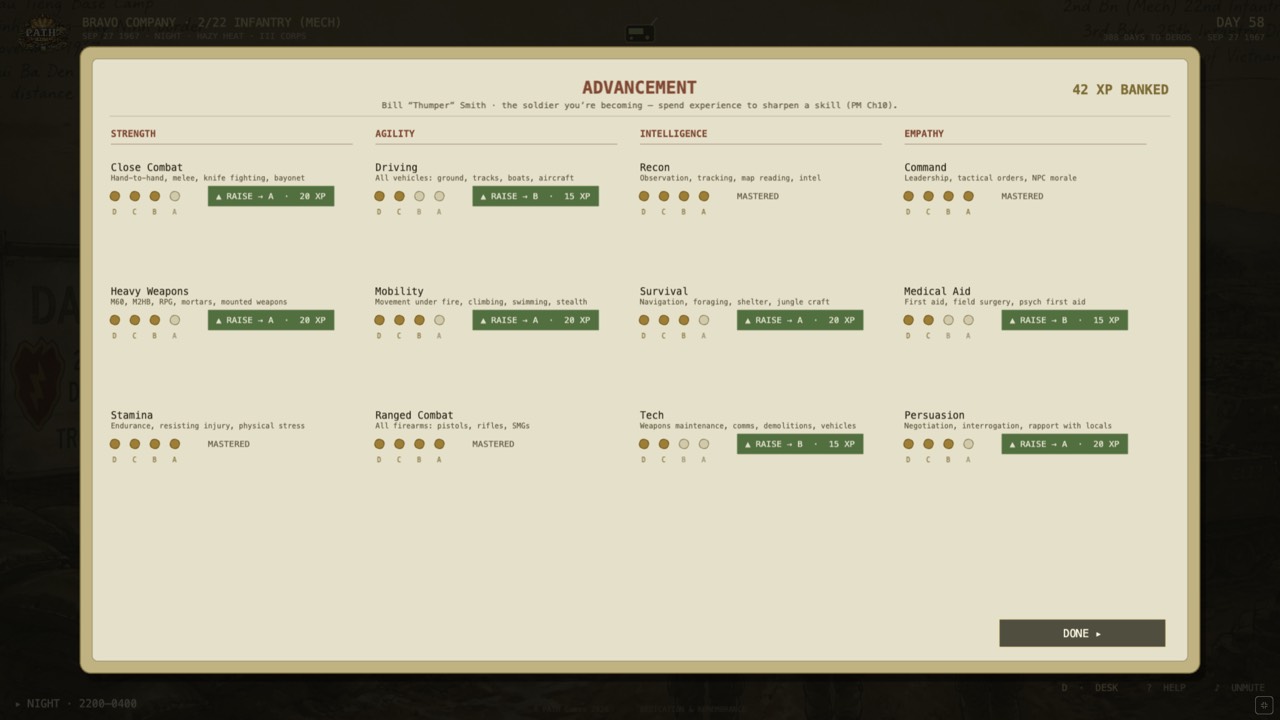
level up your player
-
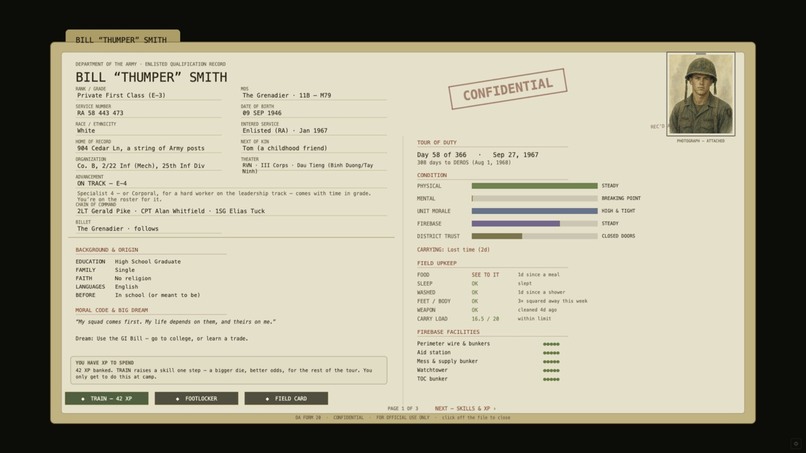
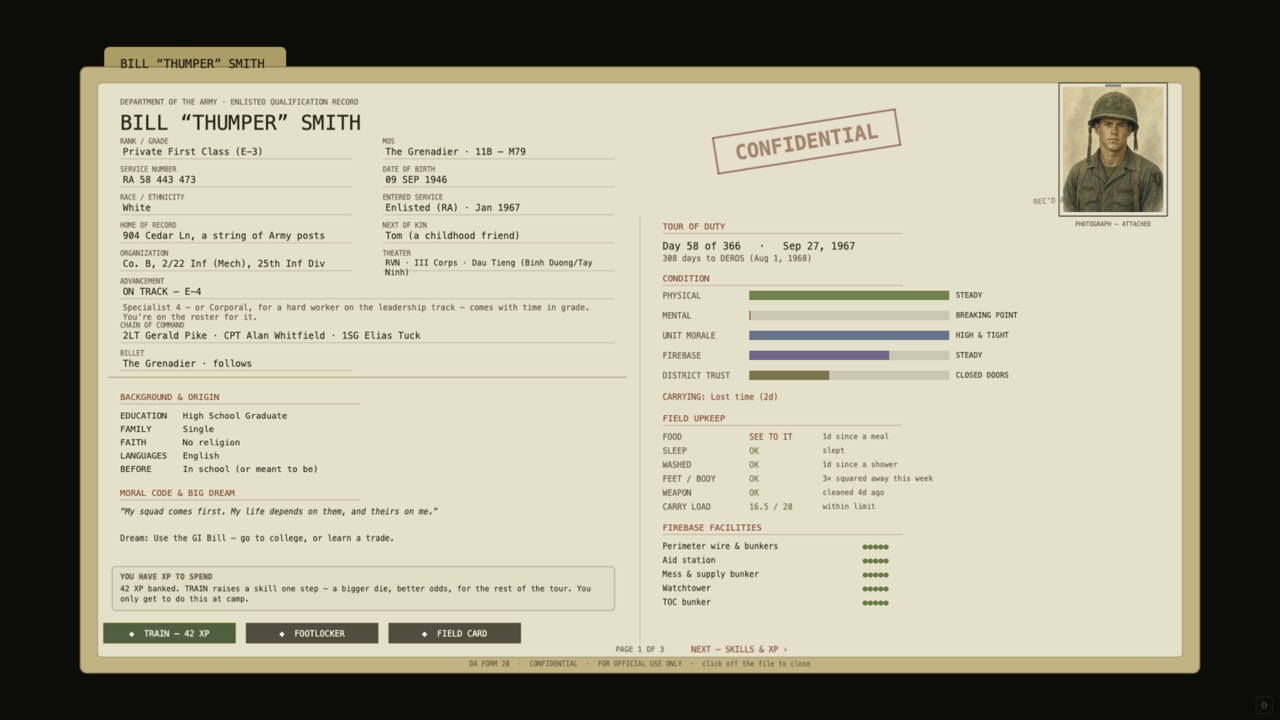
Service record
-
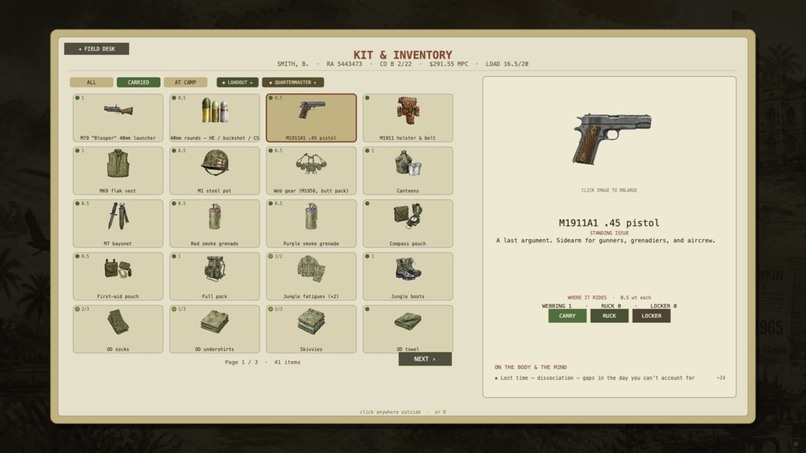
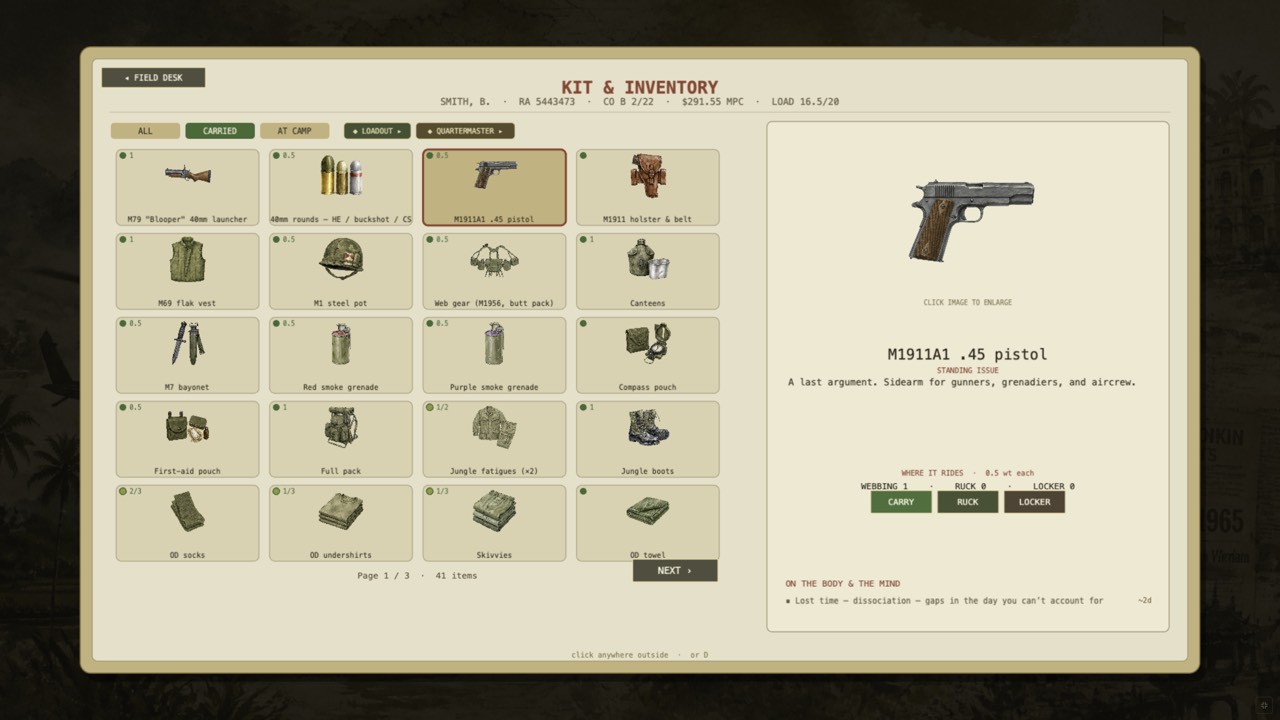
Gear and kit manager
Project story —
P.A.T.H. teaches history through lived context, imperfect information and consequence rather than trivia or spectacle. The working game demonstrates the player experience; PATH Foundry demonstrates how AI can help build historical content responsibly at scale.
P.A.T.H.: Vietnam: Tour of Duty
A visual living-history roleplaying game where service is measured not only by battles survived, but by the record of the person who lived through them.
Inspiration
I created P.A.T.H. to bring together three lifelong passions: teaching, games and history—especially the world wars and modern conflicts of the twentieth century.
Many war games reduce history to weapons, maps and victories. The player becomes more powerful, the battles become louder, and the people inside the history disappear. I wanted to build the opposite: a game that makes the past personal without turning war into “shoot, shoot, bang, bang.”
P.A.T.H. asks the player to live inside a specific time, place, unit and set of imperfect choices. Combat matters, but so do exhaustion, weather, boredom, friendship, leadership, letters, money, equipment, injury, memory, moral pressure and the plans people make for a future they may not reach.
The project is inspired by the belief that history becomes meaningful when we understand what ordinary people knew at the time, what they could not know, and what their choices cost afterward. Its design principle is consequence over spectacle.
P.A.T.H. Vietnam is the first expression of a larger idea. Future P.A.T.H. projects can explore other conflicts, expeditions, discoveries and chapters of Earth’s history while keeping the same focus on identity, uncertainty, evidence and human consequence.
What it does
P.A.T.H.: Vietnam is a live browser-based historical roleplaying game. Its first gold-master campaign follows an American soldier serving with Bravo Company, 2nd Battalion (Mechanized), 22nd Infantry—the Triple Deuce—3rd Brigade, 25th Infantry Division, based at Dầu Tiếng from August 1967 to August 1968.
The player creates a complete soldier rather than selecting a combat avatar. The Service Record establishes a portrait, represented ethnicity, background, archetype, role, attributes, skills, people at home and a Post-War Dream. Eight archetypes are currently playable, each with period equipment, responsibilities and different ways of moving through the same historical world.
The campaign then unfolds through a four-shift daily structure. Camp duties, guard shifts, patrols, convoys, mechanized operations, multi-day deployments, recovery, pay, mail, training and quiet time all compete for the same limited days. A calendar and DEROS counter follow this campaign’s exact dates; future campaigns can define different tour policies and lengths appropriate to their service, assignment and era.
Under the illustrated scenes is a substantial game system:
- the PATH step-die engine resolves skills and difficult situations without exposing tabletop machinery on screen;
- stress, acute reactions, morale, wounds, treatment, fatigue and recovery affect later choices;
- carried weight, ammunition, equipment condition and gear wear matter in the field;
- experience, training, rank, requisitions, citations and medals create a service history rather than a power curve;
- named squadmates build relationships, rotate, are wounded or killed, and remain present in memory;
- tactical, personal and moral decisions produce persistent consequences rather than isolated dialogue branches;
- historical operations, news, radio and home-front context place the soldier’s private experience inside the wider year.
The Field Desk is the physical record of the tour. It contains the player’s Service Record, medal rack, kit and requisitions, editable journal, searchable tour log, DEROS calendar, photograph album, finances, memorial and after-action reports. Photographs and journal pages are not decorative menus: they become evidence of what the player witnessed and chose to remember.
The home front is another active system. The player chooses who matters before deployment, writes to those people, receives adaptive replies and carries promises across time. Pay can be spent, saved or used through the base PX and a researched 1967 mail-order catalogue. Purchases can travel to the soldier or home and return later as relationship consequences. The catalogue is one connected part of a much larger economy, memory and correspondence system.
The campaign includes major historical beats such as Firebase Burt and the Tet Offensive, but its identity comes equally from everything between them. Depending on the accumulated record, the tour can end through DEROS, wounds, death or other outcomes. The final service record, photographs, journal, relationships, awards and ending belong to the tour the player actually lived.
How we built it
The player-facing Tour Engine is built with React, Phaser 3, TypeScript and Vite. React provides the application shell, authentication and administration surfaces; Phaser stages the full-screen illustrated game, transitions, ambience and diegetic interfaces. Supabase and PostgreSQL provide authentication, cloud persistence, operational records and analytics, while Vercel hosts the live application.
The game is data-driven. Campaign dates, historical beats, units, scene conditions, choices, rules, artwork and consequences live in typed registries rather than one monolithic script. The rules engine is isolated and tested. The campaign state is serializable. An immutable event ledger records meaningful actions, and deterministic seeds allow a specific tour to be replayed for debugging, pacing analysis and narrative QA.
I also built a second connected product: PATH Foundry.
Foundry is the private research, production and approval system behind the game. It tracks historical claims and provenance, deliberate digital rule changes, adaptive scene variants, artwork candidates, identity anchors, historical QA, approval status, campaign configuration, content coverage, simulation and analytics. A generated asset does not become canon automatically: it becomes a candidate with sources, prompts, versions and review history.
Codex has been part of this work from research through production engineering. In January, I used OpenClaw to coordinate focused research and structured drafting across a private forty-book P.A.T.H. design and manual library. Codex helped organize evidence, test ideas, structure material and draft selected content under strict historical, editorial and game-design direction. I remained the author and decision-maker, and that protected library does not ship in the public repository.
During Build Week, Codex with GPT-5.6 worked inside the real production repository and Git history. It inspected the current React, Phaser and Supabase implementation; ran the game through its developer Scene Viewer; traced lifecycle, state and asset failures; wrote tests; and repeatedly validated TypeScript and production builds.
The Build Week work extended far beyond one feature. It hardened calendar and DEROS behavior, the Field Desk, journals, photographs, multi-contact correspondence, kit flows, deployments and returning-to-camp continuity. It built save-concurrency protection, the immutable event ledger, deterministic replay, pacing analysis, expanded admin analytics, recipient-aware commerce, delayed home-front consequences, identity-aware art resolution and Foundry’s candidate-to-approval workflow.
The current verified suite contains 97 passing test files and 644 passing tests, with TypeScript and the production build passing.
AI does not improvise the released historical narrative live. Codex and GPT-5.6 accelerate investigation, implementation, structured drafting, validation and production. The shipped campaign remains deterministic, reviewable and human-approved.
Challenges we ran into
The hardest challenge was coherence. A long campaign is not a collection of disconnected scenes: wounds must remain, squad losses must stay lost, equipment must still be carried, promises must return, photographs must match what happened, and an ending must recognize the complete record.
Other major challenges included:
- Building an active game beneath cinematic fiction. The player should feel weight, stress, skill, injury and tactical uncertainty without seeing raw dice tables or spreadsheet-like mechanics.
- Historical accuracy at several scales. Dates, units and operations matter, but so do M16 magazine types, M1 helmets, patch placement, vehicles, weather, radio procedure, base-camp details and what people at home could plausibly know.
- Campaign-specific calendars. This campaign’s exact start, DEROS and leap-year chronology must be correct without claiming that every Vietnam tour followed one universal duration. Tour policies varied, including longer tours in other services and assignments.
- Narrative continuity over hundreds of playable dates. A recurring operational rhythm can become metronomic, while too much bespoke content becomes impossible to validate. Deterministic simulation and coverage tools help find repetition, dead branches and missing callbacks.
- State across React, Phaser and the backend. Rapid scene replacement, developer jumps, asynchronous saves and cloud resumptions can expose subtle lifecycle and concurrency failures.
- Representation without tokenism. Five represented player ethnicity options need consistent, respectful artwork and appropriate writing. Identity cannot be handled as a superficial skin-colour swap or a stereotyped mechanical bonus.
- Generated art that looks convincing but is historically wrong. Modern rifle magazines, incorrect helmets, malformed weapons, overlapping patches or vehicles that were not present can pass a casual visual check. Foundry turns these into explicit rejection criteria.
- Research, authorship and IP boundaries. The private forty-book library and raw research must inform the game without leaking copyrighted source material, protected manuals or unapproved text into the public repository.
- Respect. Real people lived and died in this history. The game has to remain honest, restrained and unglamorous even when it becomes more visual and engaging.
Accomplishments that we're proud of
The greatest accomplishment is that P.A.T.H. Vietnam is not a pitch deck or prototype screen. It is a live, playable, visually authored game with a complete campaign architecture, a deep rules engine, persistent player records, a substantial backend and an internal system for expanding it responsibly.
We are proud that the game now includes:
- a full character and Service Record system with eight playable archetypes;
- a calendar-accurate campaign and DEROS structure;
- camp life, patrols, convoys, mechanized operations and multi-day deployments;
- stress, medical, morale, encumbrance, equipment-wear, progression, requisition, rank and award systems;
- a persistent named squad with relationships, rotation, casualties and memory;
- historically grounded operations including Firebase Burt and Tet;
- an editable journal, searchable tour log, photo album, calendar, memorial and after-action reporting inside the Field Desk;
- multi-contact correspondence and delayed home-front consequences;
- pay, banking, kit, base-PX and mail-order systems connected to the larger narrative;
- branching endings and shareable service records assembled from the player’s actual history;
- Supabase authentication, cloud saves, save-concurrency protection and an immutable event ledger;
- deterministic replay, pacing analysis and a Narrative Observatory for technical and story health;
- PATH Foundry’s research, rules-delta, art-review and approval architecture;
- an identity-aware artwork pipeline anchored to approved service portraits;
- 644 passing automated tests plus passing TypeScript and production builds.
Most importantly, the project demonstrates that AI can help build a complex historical work without becoming an unaccountable narrator. The game can be ambitious, adaptive and deeply systemic while the released history remains authored and reviewable.
What we learned
We learned that the most valuable form of “AI memory” is not a longer chat transcript. It is structured project memory: typed state, immutable ledgers, versioned registries, research provenance, deterministic seeds, tests, approval records and clear authority by domain.
We learned that ordinary life is essential game content. A guard shift, damaged equipment, a journal entry, a photograph, a late letter or an empty place in the squad can carry more historical meaning than another firefight.
We learned that accuracy must be operationalized. Telling an image model to be historically accurate is not enough; the pipeline needs explicit checks, stable identity references, comparison views, rejection reasons and human approval.
We also learned not to collapse complex human conduct into a single morality bar. P.A.T.H. instead observes tensions among duty, loyalty, compassion, honesty, escalation and self-preservation. The ending can describe the pattern without telling the player whether he was a good or bad person.
Finally, we learned that scaling content safely requires two products: a strong player-facing engine and an equally strong private production system behind it.
What's next for P.A.T.H.: Vietnam
The immediate goal is to use PATH Foundry to deepen and polish the 1967–68 campaign: more operational variety, more adaptive callbacks, stronger squad continuity, historically reviewed artwork, richer journals and photographs, better home-front consequences, and a more complete admin Narrative Observatory.
Foundry will expand into a full production suite:
- a Research Workbench for claims, sources, units, dates and confidence;
- a Rules Lab for documented tabletop-to-digital decisions;
- a Beat Studio for conditions, adaptive text, choices and consequences;
- an Art Director for identity anchors, variants, historical review and approved exports;
- an Item and Economy Studio for kit, PX, mail order and recipient outcomes;
- a Campaign Builder for chronology, geography, units, roles and event pools;
- a Tour Simulator and Narrative QA system for pacing, continuity and deterministic replay;
- an Admin Observatory for player journeys, branch reach, moral-choice patterns, representation, technical health and historical coverage.
The larger Vietnam roadmap spans five historical periods and different ways of serving: ground infantry and mechanized units, reconnaissance, riverine operations, helicopter crews, advisory work, medical and logistics roles, and air-related tours. Each campaign will define its own unit, geography, chronology, equipment, operational rhythm and historically appropriate tour policy.
Social development will begin with shareable service histories, memorials and seeded historical scenarios. Asynchronous “same company” experiences can follow. Carefully authored co-operative crew operations—particularly helicopter, riverine and reconnaissance missions—come later, after the solo historical engine is mature.
Beyond Vietnam, P.A.T.H. can become a platform for other wars, exploration, discovery and the history of the Earth. The constant is not combat. It is a human being moving through evidence, uncertainty and consequence.
The long-term promise is:
Every journey remembers who you were, what you did, who you lost, and what you carried home.
Built With
- codex
- css3
- github
- gpt-5.6
- html5
- openai
- openclaw
- phaser.js
- postgresql
- react
- supabase
- typescript
- vercel
- vite
- vitest
- web
- web-audio-codex


Log in or sign up for Devpost to join the conversation.