-
-
Oyun - Create Gadot Ready Games in Minutes
Oyun
The Spark That Ignites Everything
Imagine this: You're a game maker with a fantastic vision—a vast medieval village with enigmatic NPCs, complex quests, and immersive environments. But standing between you and that vision are weeks of drudge work asset crafting, character creation, quest scripting, and balancing. What if you could simply issue the command "Create a medieval village" and see a fully-fledged, Godot-exportable game world develop before your eyes in real-time?
That glimmer of potential set our Multi-Agent Game Content Pipeline ablaze. We weren't creating yet another tool—we were revolutionizing the way game worlds are brought to life. Everyone was buzzing as we saw that we could actually make a dent in one of the biggest stumbling blocks in independent game development.
The Journey of Discovery
This project was a masterclass in coordinated AI teamwork, but in all honesty, it was also an emotional rollercoaster. There were times of unadulterated joy when suddenly, everything made sense, and times of frustration when agents were pitted against each other instead of working together. These are the takeaways that defined our journey:
The Strength of Specialized Intelligence
Rather than a single monolithic AI attempting to do it all, we found that agents specialized and working together could deliver much better outcomes. It felt like observing a symphony orchestra get into their groove—chaotic at first, but stunning once in sync. Each agent became a master of their field—world design, asset creation, character creation, quest creation, balance verification, and code export.
Context is King
We discovered that effective game content creation is not merely about assets in isolation—it's making sure everything works together cohesively. This was likely our greatest "aha moment." A creepy village requires matching NPCs, suitable quests, and atmospheric elements to tie everything together and tell the same tale. When we finally got this correct, it felt magical.
Balance Through Simulation
Game balance can't be an afterthought, and we learned that the hard way after creating some laugh-out-loud broken game scenarios. Our Balance Validator Agent showed us that playtesting simulation and statistical validation must be infused in the pipeline on day one.
From Concept to Usable
The loveliest game idea is worthless if the developers cannot actually implement it. This was certainly our most embarrassing lesson. We discovered that the last 20% of the pipeline—wrapping everything up into Godot-usable files with live previewing—is every bit as important as the creative generation steps. It's the difference between wowing people at a demo and, actually, altering the way people work.
Building Something Real with Google's Agent Development Kit
Architecture That Actually Works
We constructed our system upon Google's Agent Development Kit (ADK), which became the foundation of our entire multi-agent orchestration. It wasn't simply a technical decision—it was revolutionary. ADK gave us the platform that enabled us to build genuinely intelligent agents capable of reasoning, collaborating, and evolving.
Game Content Orchestrator (ADK Coordinator on Google Cloud)
├── World Designer Agent - Environment layout and design
├── Asset Generator Agent - 3D models and visual assets
├── Character Creator Agent - NPCs with personality and stats
├── Quest Writer Agent - Storylines and dialogue systems
├── Balance Validator Agent - Validation of game mechanics
├── Code Exporter Agent - Godot/Unity implementation files
Every agent was constructed with the ADK Python framework, our foundation AI model being Gemini 2.0 Flash Experimental. This is where Google's technology stack truly excelled—rather than struggling with API constraints or model inconsistencies, we could concentrate on the creative thinking every agent required.
Leveraging Google Cloud Platform for Scale
Implementing on Google Cloud Platform wasn't merely a matter of hosting—it provided the computational capacity and reliability we required for real-time 3D asset creation. If you're executing Blender automation scripts while at the same time creating character personalities, quest stories, and world layouts, you require some serious infrastructure. GCP provided us with that reliability, and the integration with ADK was seamless.
Cloud Security & Authentication: One of our initial challenges was dealing with API keys and authentication across six agents. Google Cloud's IAM enabled us to create secure, role-based access that kept our agents properly sandboxed while allowing easy collaboration.
Scalable Asset Generation: The calculation requirements of procedural 3D modeling are high. GCP's auto-scaling made it possible for us to cope with anything from a humble cottage to a whole medieval town without performance issues.
The Magic Pipeline Powered by Gemini AI
Phase 1: Understanding Intent with Gemini
Our Gemini 2.0 Flash Experimental-powered Prompt Analyzer breaks down natural language input with astonishing depth. "Make a creepy ghost town" becomes a formal specification containing environmental story elements, best-in-class layout patterns, and implications for gameplay. When Gemini first got it right on a rich, multi-faceted prompt and pulled out not only the hard requirements but the implicit creative direction, we were literally whooping.
Phase 2: World Foundation with ADK Orchestration
That's where ADK's agent coordination truly delivers. The World Designer Agent defines the environmental skeleton—establishing building locations, road grids, and important landmarks—while the ADK system provides context smoothly to all downstream agents. Each agent is aware of the world theme, space restrictions, and player flow needs. Seeing the initial village layout materialize with flawless agent coordination was like computer magic.
Phase 3: Asset Generation with Google-Powered Intelligence
Our Asset Generation Agent generates 3D structures through Blender automation scripts, but here is the twist—it's driven by Gemini's knowledge of architecture. The AI does not generate random buildings; it generates buildings that fit the theme of the world's narrative, take into account player lines of sight, and have architectural coherence. Every type of building is procedurally generated with the right materials, architectural features, and style coherence that would bring pride to human designers.
Phase 4: Giving Life to the World through ADK Collaboration
This is where the ADK agent framework really comes into its own. The Character Creator Agent populates our world with NPCs having personalities, histories, and meaningful speech—all done through Gemini's state-of-the-art language abilities. And while the Quest Writer Agent threads these characters together into engaging narratives with proper dependency management and narrative coherence, the agents communicate context through ADK's high-falutin' message passing system, so NPCs are better connected to their surroundings and quests are more engaging within the world's narrative.
Phase 5: Balance & Export with Smart Validation
The Balance Validator Agent performs statistical analysis and playtesting simulations backed by both proprietary algorithms and Gemini's analytical strength. Lastly, the Code Exporter Agent bundles everything into Godot-ready scenes with correct import workflows and real-time visualization support.
Technical Implementation Highlights
- ADK Agent Framework: Every agent is implemented as a proper ADK agent with specified tools, instructions, and model specifications using Gemini 2.0 Flash Experimental
- Google Cloud Integration: Complete GCP deployment with adequate authentication, scaling, and resource management
- Gemini-Powered Creativity: All creative choices—ranging from architectural styles to character personality—are informed by Gemini's cutting-edge language comprehension
- Blender Integration: Advanced Python scripts that build entire buildings with bases, multi-story walls with varying roof structures, and architectural features
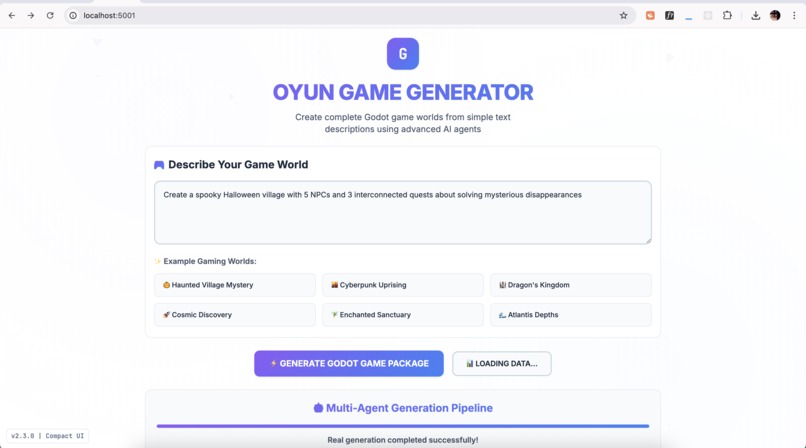
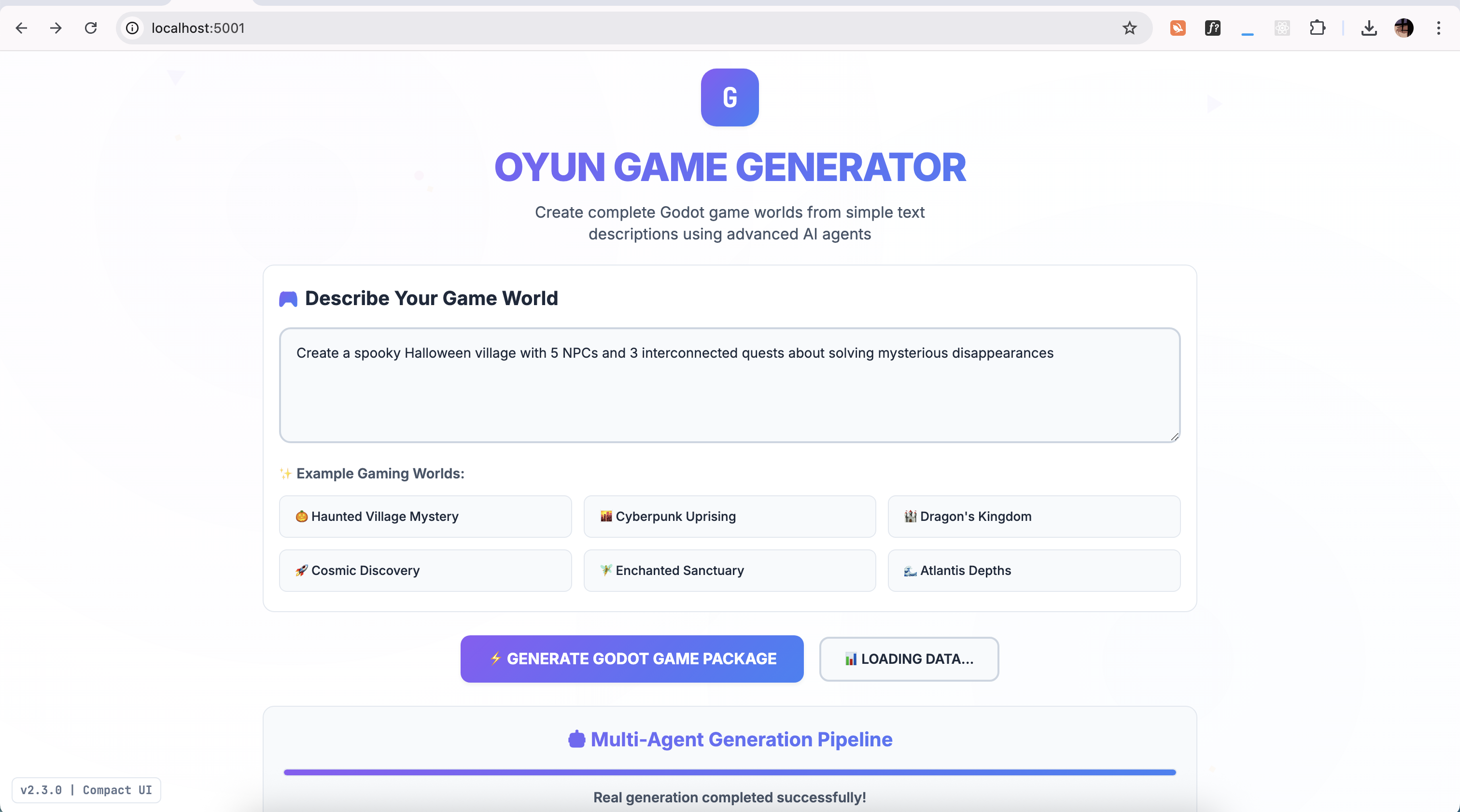
- Web Interface: A Flask web application with intuitive access to the generation pipeline with real-time visualization
- Smart Packaging: Automated Godot project creation and ZIP packaging to facilitate developer consumption
- Balance Analysis: Statistical validation systems that examine game mechanics prior to export
- Live Preview System: Real-time 3D visualization of created content while being generated
The Battles We Fought and Won
Challenge 1: Agent Coordination Complexity
The Problem: Having six other AI agents all play nice with one another without treading on each other's toes felt like playing an orchestra where each musician speaks a different language. Even with the framework of ADK, some days we wondered if this was even possible.
Our Solution: We took advantage of ADK's powerful orchestration features to design clean agent interfaces and common data structures. The epiphany occurred when we understood that ADK's message passing system was not only able to transport data, but creative context and constraints as well. Every agent was truly aware of what other agents were doing. The sense of relief when finally everything coordinated was amazing.
Challenge 2: Maintaining Creative Consistency with Gemini
The Issue: When multiple agents create separate pieces of a game world, it is too easy to have a medieval castle right next to a contemporary coffee shop. We got some fabulously strange initial results that had us laughing, but certainly not what users were expecting.
Our Solution: This is where Gemini's deep language comprehension became essential. We built a context-sharing mechanism by which the initial prompt evaluation establishes a "creative DNA" that is sent to all agents via ADK's messaging system. Gemini keeps theme, mood, and architectural style parameters uniform among all agents. When we first created an entirely unified village with flawless thematic coherence, we realized we were on to something remarkable.
Challenge 3: From Generated to Playable
The Problem: It's easy to generate cool-looking assets; actually creating something that developers can import and use is something else. This was our reality check moment—nice pictures don't make games.
Our Solution: We heavily invested in the export pipeline with automated Godot scene generation, correct asset packaging, and optimized import workflow. Google Cloud's file storage and management systems made it all easy, and ADK's orchestration provided the export agent with flawless context on what each other agent had produced.
Challenge 4: Google Cloud and ADK Learning Curve
The Issue: ADK was new technology, and getting it properly integrated with Google Cloud services meant learning completely new concepts around agent development and deployment.
Our Solution: We took the learning curve in stride and it paid off in spades. ADK's agent structure gave us order and dependability we couldn't get through custom solutions. Google's documentation and developer assistance were top-notch, and once patterns were understood, development speed accelerated significantly.
What We Learned About AI-Powered Development
ADK Changes Everything: Developing with Google's Agent Development Kit showed us that the future of AI systems isn't single models—it's advanced multi-agent systems that can reason, cooperate, and learn. ADK gives you the framework to bring this vision to life.
Gemini's Creative Intelligence: With Gemini 2.0 Flash Experimental running through our entire pipeline, we saw that current-day AI can truly be creative, rather than generative. The model has contextual awareness, is consistent, and can make creative choices that are intentional and meaningful.
Cloud-Native AI Development: Cloud development on Google Cloud Platform with ADK revealed us the future of AI-native development. Smooth scaling, authentication at the system level, and orchestration of highly complex multi-agent workflows at cloud scale.
Context and Consistency at Scale: The most significant technical innovation was sustaining creative consistency among many agents creating various content forms. ADK's messaging framework coupled with Gemini's contextual insights addressed this in ways that would have been impossible with conventional methods.
The Vision Realized
When we initially began this project, we envisioned democratizing game development. Through months of collaboration with ADK and Google's AI technology, we've created something that truly revolutionizes the way games are made.
The Developer Experience
Type "Create a haunted forest village with mysterious NPCs and supernatural quests"—then sit back and see six expert agents work together to create exactly that. With 3D assets, game mechanics, narrative storylines, and code ready for Godot. All driven by Gemini's imagination and directed by ADK's smart agent infrastructure.
The Technical Feat
We've demonstrated that advanced multi-agent AI systems can produce professional-grade game content. This is not automation—it's smart creativity that knows game design fundamentals, player psychology, and technical implementation necessities.


Log in or sign up for Devpost to join the conversation.