
Inspiration
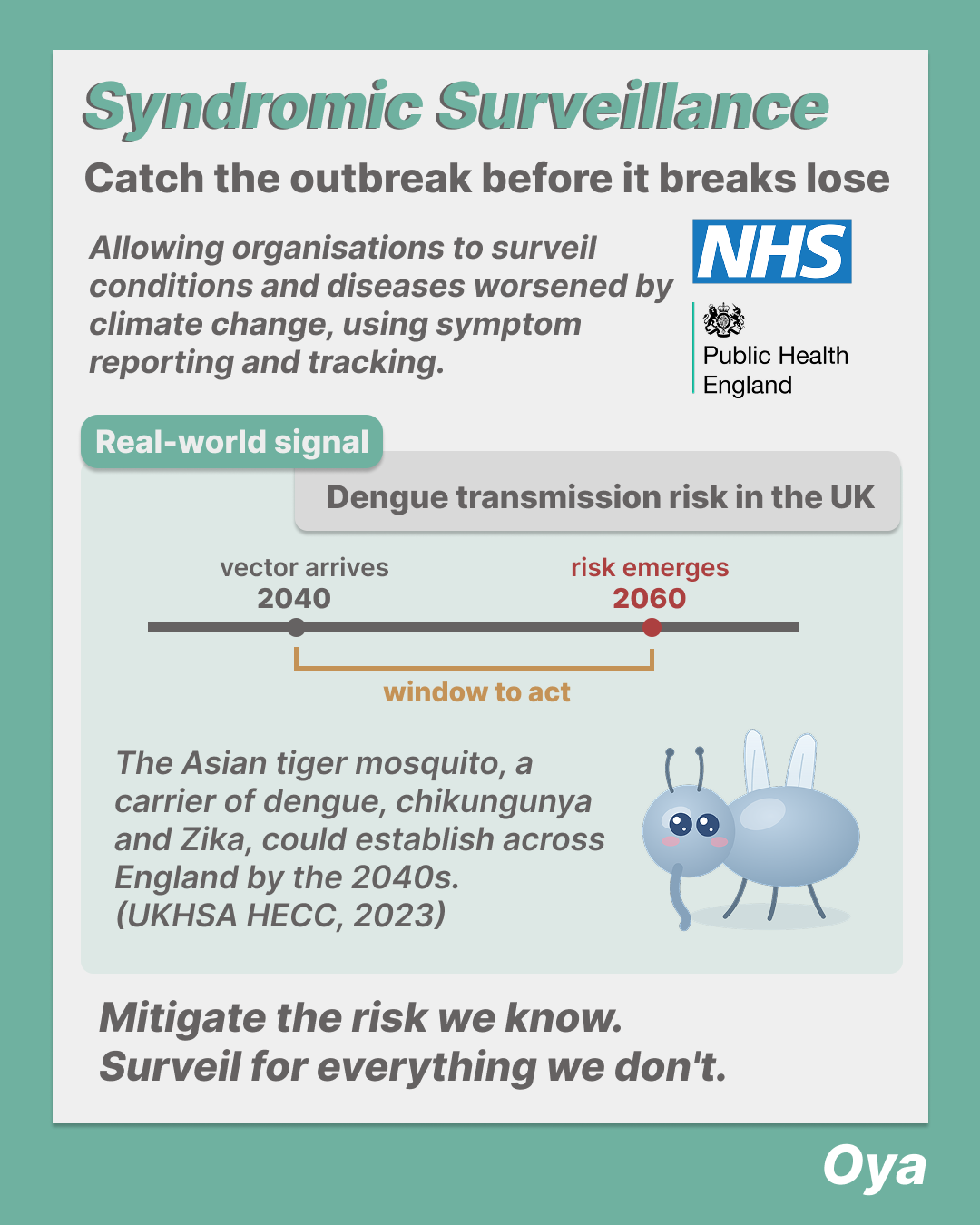
Climate-related health risks are increasing, but public health systems are still largely reactive, relying on delayed clinical reporting rather than real-time signals. We were inspired by the idea that early indicators of risk already exist in environmental data and everyday conversations, but are not connected in a usable way. Oya was designed to explore whether an agentic system could bridge that gap in a lightweight, deployable form.
What it does
Prototype (HeatWatch London)
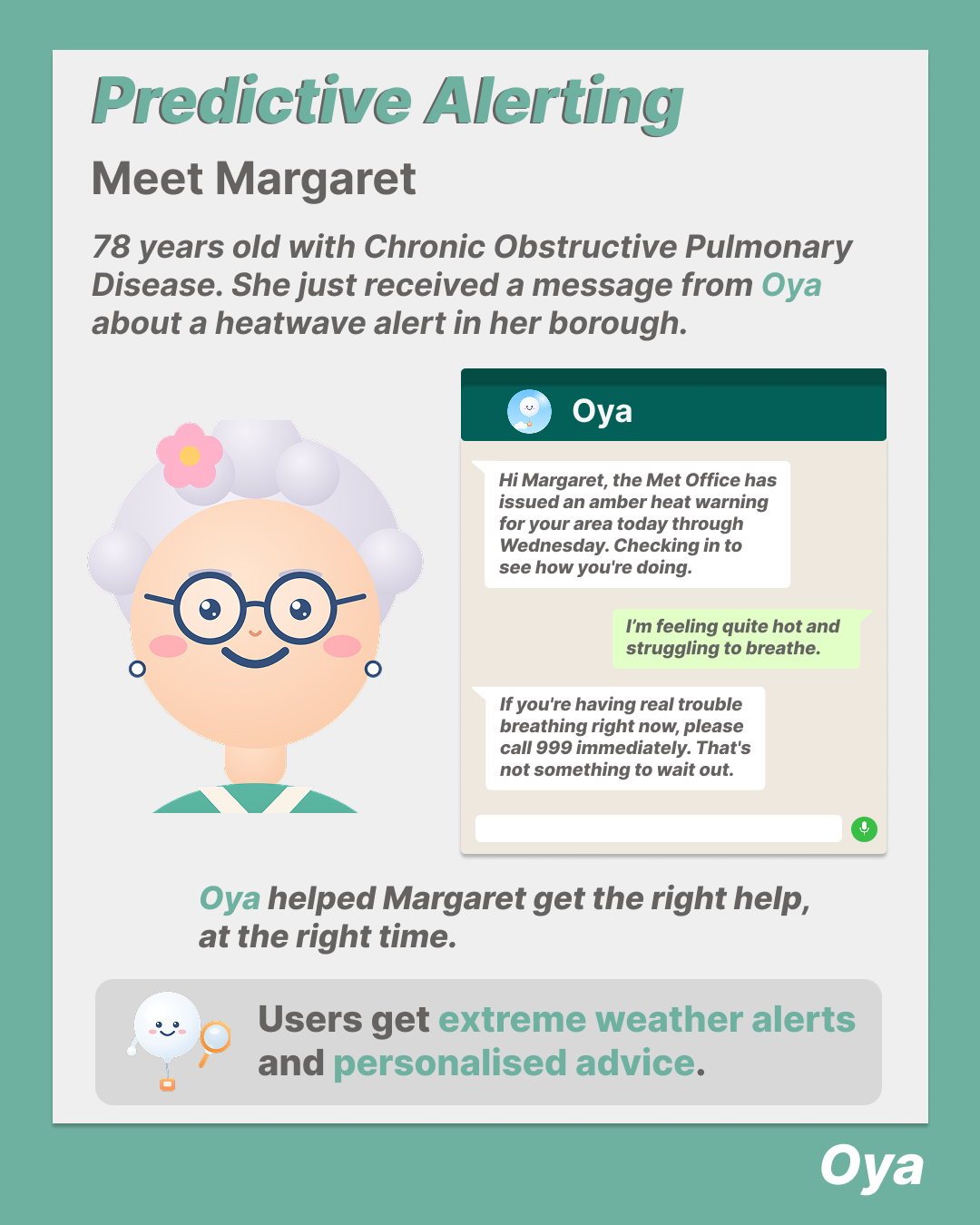
Oya is a minimal working prototype focused on one high-impact use case: heat risk in London. It uses Met Office UKV temperature forecasts (via Open-Meteo API) and UKHSA heat-health thresholds to detect elevated risk conditions. When triggered, it engages users through messaging platforms (WhatsApp/Slack-style), collects lightweight symptom reports, and provides personalised heat-health guidance. These interactions are stored in a structured database and visualised in a simple Streamlit dashboard showing borough-level reports and symptom trends.
Vision
Beyond the prototype, Oya is designed as a platform-agnostic agentic health infrastructure that can respond to multiple environmental and health triggers such as air pollution, flooding, and infectious disease signals. It works through any messaging platform without requiring users to download a new app, turning everyday conversations into real-time public health intelligence.
How we built it
We focused on building the smallest end-to-end working system under tight hackathon constraints.
The system is implemented in Python, using FastAPI/Flask for orchestration and Anthropic Claude for agentic reasoning (symptom extraction and health advice generation).
For the prototype, we integrate:
- Met Office UKV forecasts via Open-Meteo API
- UKHSA heat-health threshold methodology
- UKHSA Heat Vulnerability Index (HVI)
- Supporting datasets from ONS (demographics), BEIS (fuel poverty), and Ordnance Survey (green space)
We store structured outputs in SQLite, and use GeoPandas, Folium, Plotly, and Streamlit to build a lightweight geospatial dashboard showing risk distribution and symptom patterns.
Challenges we ran into
The main challenge was scope control under extreme time constraints—building the smallest possible system that still demonstrates the full loop: environmental trigger → user interaction → structured symptom data → population visualization.
We also had to simplify integration across heterogeneous datasets and avoid overengineering while still producing meaningful borough-level insights. Designing conversational flows that are natural for users but structured enough for analysis was another key challenge.
Accomplishments that we're proud of
We built a fully working end-to-end agentic system within a very limited timeframe. The system connects environmental triggers, conversational AI, structured data extraction, and population-level visualization in a single pipeline.
Most importantly, we achieved a complete working loop that demonstrates the core idea in practice, not just in architecture diagrams.
What we learned
We learned that the hardest part of building agentic systems is not model complexity, but reducing scope enough to ship a complete working system quickly. A minimal end-to-end prototype is far more valuable than partially implemented features.
We also learned how challenging—but powerful—it is to turn unstructured conversational data into structured public health signals in a reliable way.
What's next for Oya
The next step is to validate and harden this minimal working prototype with real users and real environmental signals. This includes testing whether the system reliably captures useful health signals in real-world conditions and refining the agentic pipeline based on feedback.
With more time, we would expand beyond heatwaves into additional climate and health triggers such as air pollution and infectious disease surveillance, while improving robustness, safety, and evaluation.
Ultimately, the goal is to evolve Oya from a small working prototype into a scalable, platform-agnostic agentic infrastructure for real-time public health intelligence embedded in messaging apps.
Built With
- anthropic-claude-(llm-agents)
- beis-fuel-poverty-data
- fastapi
- flask
- folium
- geopandas
- ons-datasets
- open-meteo-api-(met-office-ukv-forecasts)
- ordnance-survey-geospatial-data
- pandas
- plotly
- python
- slack-api-/-slack-bolt
- sqlite
- streamlit
- ukhsa-heat-health-alert-methodology
- ukhsa-heat-vulnerability-index
- whatsapp-style-messaging-integration


Log in or sign up for Devpost to join the conversation.