-
-
OxyAlarm Logo
-
OxyAlarm Notification Flow
-
https://canvanizer.com/canvas/rftuCI4EYr7d0

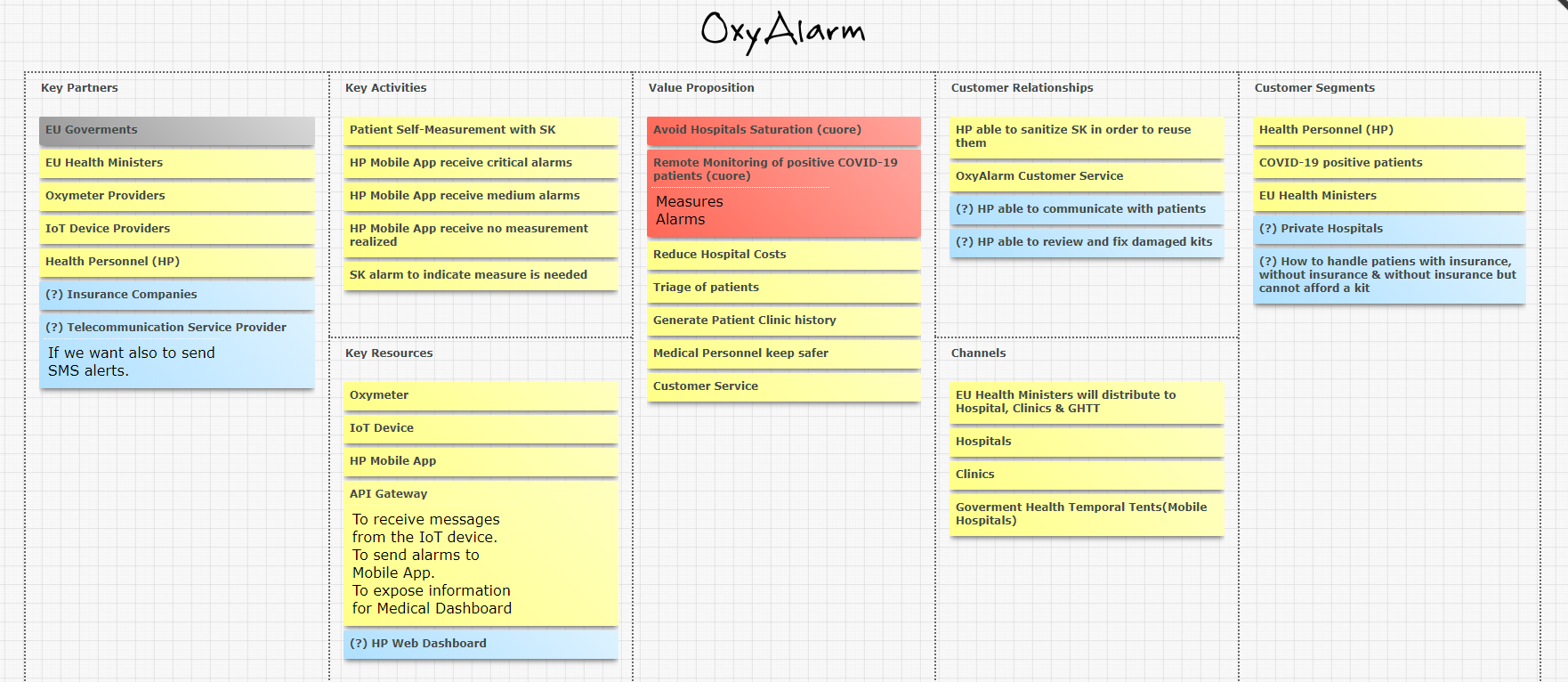
Inspiration
With the COVID-19 pandemic, it was shown that the hospitals and clinics around the world are not prepared to give massive attention in a short time. This caused hospitals to collapse, exhausted the medical personnel, and patients with high-risk were not diagnosed quick enough. We are a group of IT professionals who got inspired by technology and the search of a scalable and cost-effective solution. We developed a tool that will allow patients to be easily monitored at home, by alerting the medical staff in real time whenever an unusual situation happens. We believe that OxyAlarm will avoid unnecessary visits to the hospital, help prevent breakdowns and spread of contagious diseases. The medical personnel should be able to monitor patients without being overwhelmed, and patients should have the possibility to stay at home, with their loved ones, and with confidence that they are in good hands. We want to take patients and doctors’ trust to a new level, and bring them a reliable digital solution that they can use now and keep using in the future (i.e. COPD).
What it does:
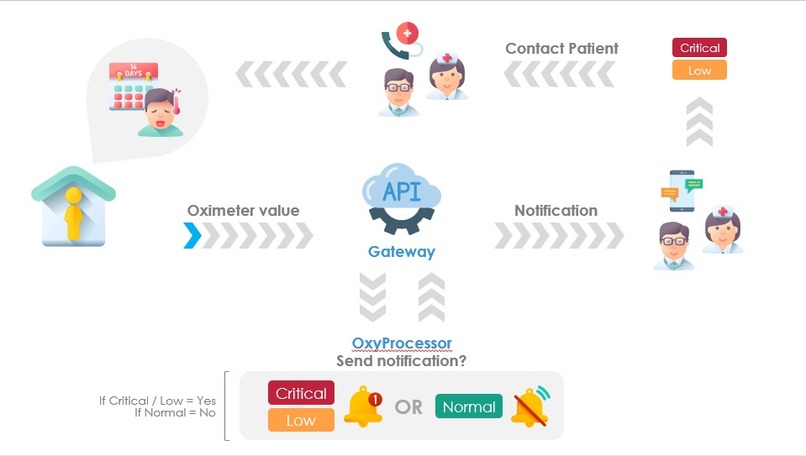
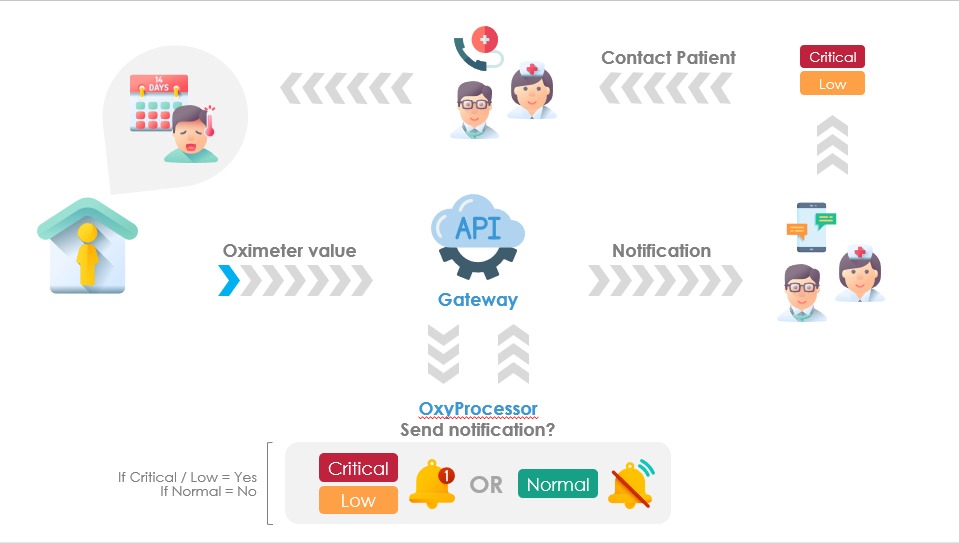
OxyAlarm is the real-time alerting device that will monitor positive COVID-19 patients and will send an alarm whenever a patient's Oxygen level is out of normal range. A patient, at home, will have instructions to take his Oxygen saturation measurements periodically (morning, mid-day, evening). The patient will use the device and wait until the measures are taken. The special sensor will send this information to a server which immediately will decide if the alert should be sent to the OxyAlarm mobile application, held by the medical staff. Measurements will be recorded, but alarms are only triggered when values are outside the expected range. These alarms will be received through a push notification, so when it’s clicked, it will display the patient's information and measures, also giving the possibility of calling him/her directly from the application. Once the contact was successful, the medical personnel can mark the patient as "Contacted", and the alert will disappear from the alarms' list view for all the medical staff.
Challenges we ran into
- As we see it, OxyAlarm has many possibilities and areas that can be exploited, so it was a challenge to just focus on 2 or 3 for this hackathon.
- Since the idea was developed in a short time, running tests with a real prototype was not possible. We are confident about the architecture, design, and scalability, but we would have liked to run some tests to show a ready to use product.
- The business plan to go live is tricky to define, as we don't have business experts in the matter, so this is an item that needs improvement.
Accomplishments that we're proud of
We are proud of how fast we developed this idea and we are confident about it. In less than 48 hours we came up with a solution built from scratch and that thousands of lives could benefit from it. Our proposal helps the medical staff have less pressure, lets patients feel less stressed by being at home, and the whole solution can be easily scalable to other diseases to keep it over time and enhance it.
What we learned
This idea was born in the middle of a lockdown state, when no close human interaction was possible, and we relied 100% on internet connectivity to be close to our peers. We discovered that each of us were capable of taking roles in areas outside our comfort zone. It was proved that we can generate creative solutions even if we are not under the same roof, and it only takes will, commitment and passion to do so.
What's next for OxyAlarm
We want OxyAlarm to be an essential tool for the medical staff. To accomplish that, we will continue improving their user experience and applying them most cost-effectively. A few of the many ideas that we have:
- In the future, we want to add a medical dashboard, so all medical staff can access through the platform of their choice.
- We want to include blood pressure and temperature measurements, this way the medical staff will have more valuable information about the patients.
- Apply the solution to patients with COPD (Chronic Obstructive Pulmonary Disease).
- We think on the patient's side too, so we want to improve the patient's mobile app experience and include their data, so they can see their measurements.
- We want to make sure that the medical staff can count on us, so we plan to conduct a pilot GoLive in a certain region, small area. After we gather results, plan on extending it to other regions as fast as possible.
- Data is very valuable, so with OxyAlarm, we want to give accurate data in order to distribute effectively the oxygen needed for conducting oxygen therapy at home.


Log in or sign up for Devpost to join the conversation.