-
-
OwnPath
Inspiration
Caridad Community Kitchen has helped over 250 people build careers through its free 10-week culinary training program. But nearly one-third of participants don’t complete it.
The problem isn’t motivation — it’s life.
A missed bus, a childcare gap, extreme heat, or a housing disruption can quickly turn one hard day into dropping out. And by the time staff realizes someone is struggling, it’s often too late.
We wanted to build something that helps earlier — without taking control away from participants.
What it does
OwnPath is a participant-first support system.
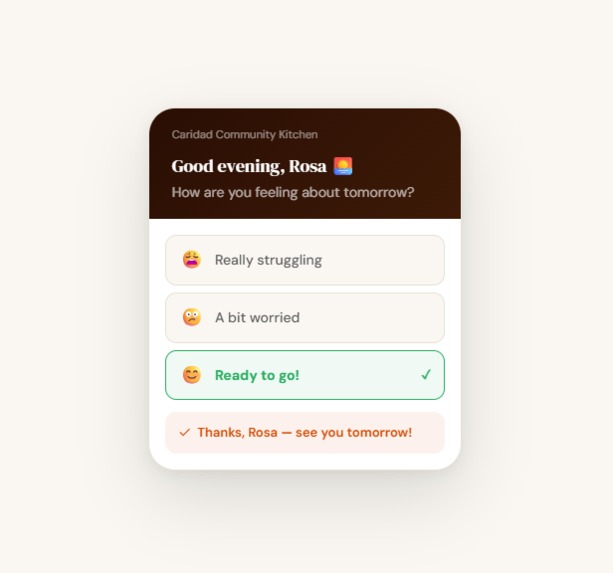
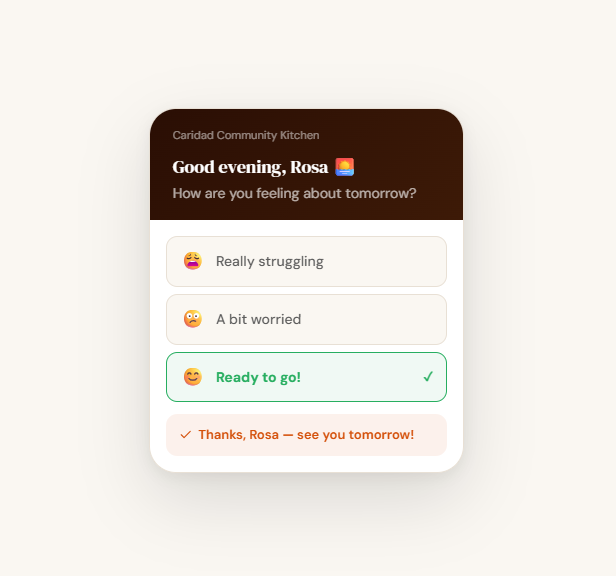
Each evening, participants receive a simple SMS-style check-in — no app, no login. They can share how they’re feeling, mention any challenges, and choose whether they want support.
Staff don’t see a surveillance dashboard. Instead, they see a calm, respectful action queue that highlights who might benefit from support — along with clear explanations and suggested actions.
Nothing happens automatically. Participants choose what to share, and staff approve every action.
This is support on the participant’s terms.
How we built it
We built OwnPath as a lightweight, scalable web application:
- React + Vite for a fast, responsive frontend
- Rule-based support engine using attendance, self-reported barriers, program week, and Tucson weather data
- Claude (LLM) for:
- generating plain-English explanations for staff
- suggesting helpful actions
- drafting warm, bilingual (English/Spanish) messages
- NWS Weather API to incorporate real Tucson heat conditions into support signals
- Real local resources (Sun Tran, 211 Arizona, ADES, Primavera Foundation)
The system runs entirely in the browser for this demo — no backend required.
How AI is used (and why it matters)
We intentionally use AI as a translation layer, not a decision-maker.
- AI explains patterns in plain English
- AI suggests possible actions
- AI drafts supportive, human messages
But:
- AI never decides who gets help
- AI never contacts participants automatically
- Staff always stay in control
This ensures the system is both helpful and ethical, especially in a sensitive, human-centered context.
Challenges we ran into
Balancing insight vs. autonomy
We had to ensure the system helps staff act early without making participants feel monitored or judged.Avoiding overuse of AI
Instead of building a black-box prediction model, we chose a transparent, rule-based approach and used AI only where it adds real value.Designing for trust
Every interaction — from wording to UI — had to feel warm, respectful, and non-intrusive.Keeping it realistic for nonprofits
We focused on low-cost, no-download, easy-to-adopt solutions that could work in real-world settings.
What we learned
Technology alone doesn’t solve social problems — trust does.
We learned that:
- Small, everyday barriers have the biggest impact on outcomes
- Early, respectful support is more effective than late intervention
- AI is most powerful when it supports human decisions, not replaces them
Most importantly, we learned that systems designed with people — not around them — create better outcomes.
What's next
In a real deployment, OwnPath would include:
- Secure backend authentication and data storage
- Real SMS integration (e.g., Twilio)
- Consent tracking and audit logs
- Model calibration using historical cohort data
- Partnerships with local transportation, childcare, and support services
Our goal is simple:
If OwnPath helps even a few more participants complete the program, that’s more people building stable careers and long-term economic mobility.
“We don’t predict people out of the program. We predict where support can keep them in it.”##
Built With
- claude-(anthropic-api)
- css
- html
- javascript
- netlify
- nws-weather-api
- react
- react-router
- vite

Log in or sign up for Devpost to join the conversation.