Inspiration
Voice cloning and AI speech generation are becoming increasingly popular, but most creators face the same problem: their voice data must be uploaded to cloud services, sent to third-party servers, and often tied to subscriptions, usage limits, or token-based pricing. Many creators are uncomfortable handing over their voice recordings and creative assets to external platforms.
We wanted to build a solution that gives creators complete ownership of their voices. A tool that runs entirely on their own machine, keeps their data private, and allows unlimited voice generation without subscriptions, tokens, or hidden costs.
What it does
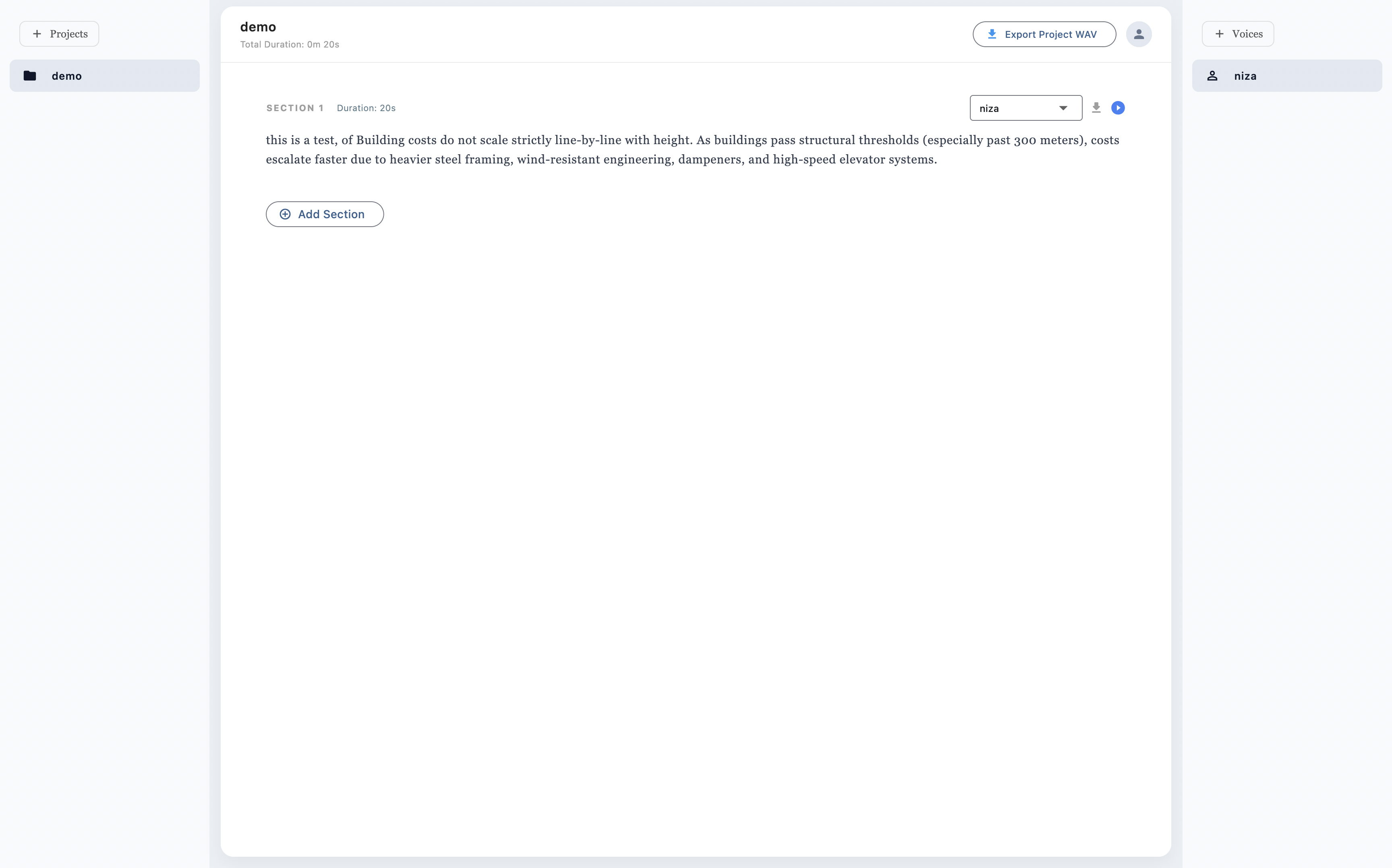
Own Voice is a local-first AI voice generation application that allows creators to generate speech using digital versions of their own voices.
Users can:
- Clone and manage multiple voices.
- Generate unlimited speech without token limits.
- Keep all voice data and generated content on their own device.
- Switch between different voice profiles instantly.
- Generate speech with different emotional styles and expressions.
- Work completely offline after setup.
- Avoid subscriptions, cloud processing, and recurring fees.
Because everything runs locally, creators maintain full control over their voice assets and creative work.
How we built it
Own Voice was built as a native macOS application using Flutter for the user interface and Python for the AI processing pipeline.
The application uses local machine-learning models running directly on Apple Silicon hardware through MLX, allowing efficient on-device inference without requiring cloud infrastructure.
We integrated:
- Flutter for the desktop user experience.
- Serious Python to bridge Flutter and Python processes.
- MLX-based speech generation models optimized for Apple Silicon.
- Local file-based voice management and storage.
- A custom communication layer between Flutter and Python for real-time generation requests.
The result is a seamless desktop experience where creators can manage voices and generate speech entirely on-device.
Challenges we ran into
Building a fully local AI application presented several technical challenges.
One major challenge was bridging communication between Flutter and Python while maintaining responsiveness. Long-running AI inference tasks needed to run independently without blocking the user interface.
We also faced difficulties managing model loading, local file paths, application sandboxing on macOS, and coordinating GPU resources used by MLX during speech generation.
Another challenge was ensuring that voice generation remained fast and reliable while supporting multiple voice profiles and emotional variations.
Accomplishments that we're proud of
We are proud that Own Voice achieves something many creators have been asking for: true ownership of their voice models.
Key accomplishments include:
- Fully local AI voice generation.
- No subscriptions or token-based limitations.
- Support for multiple voice profiles.
- Emotion-aware speech generation.
- Privacy-first architecture.
- Apple Silicon optimized inference.
- A simple creator-focused desktop experience.
Most importantly, users never need to upload their voice recordings to external services.
What we learned
Throughout the project, we learned a great deal about deploying AI models locally and building reliable desktop AI applications.
We gained experience with:
- Running large AI models efficiently on Apple Silicon.
- Integrating Flutter with Python-based AI systems.
- Managing local model assets and application sandboxing.
- Optimizing user experience around long-running inference tasks.
- Designing privacy-first AI products.
We also learned that many creators value ownership and privacy just as much as model quality.
What's next for Own Voice
Our vision is to make Own Voice the easiest way for creators to build and use personal voice libraries while maintaining complete ownership of their data.
Next steps include:
- Faster voice generation and model optimization.
- Additional emotional and expressive voice styles.
- Advanced voice editing and fine-tuning controls.
- Audio post-processing and enhancement tools.
- Batch generation workflows for creators and studios.
- Support for additional desktop platforms.
- Voice export integrations for content creation tools.
Ultimately, we want creators to have a professional-grade AI voice studio that runs entirely on their own hardware, with no subscriptions, no tokens, and no compromises on privacy.

Log in or sign up for Devpost to join the conversation.