-
-
OwlHelp!
-
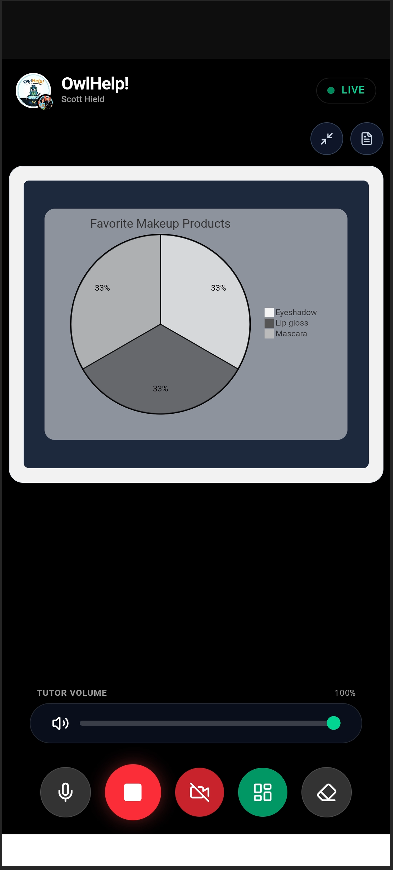
Graph on whiteboard
-
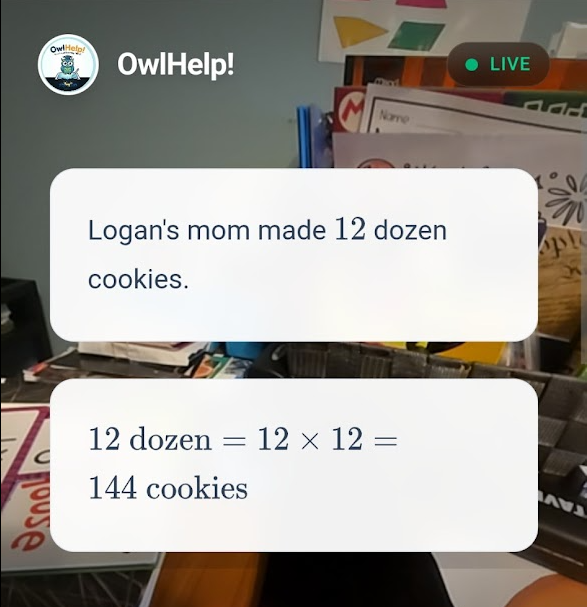
See problems on the whiteboard
-
About OwlHelp!
Inspiration
The inspiration for OwlHelp! came from a common household struggle, especially for two dads who's wives travel for work: the nightly "homework battle". We noticed that most AI tools available to students act like high-tech "cheat sheets" that simply spit out answers. We wanted to build something that mirrors the experience of a patient human tutor—someone who sits beside you at the kitchen table, looks at your work, and gives you the "nudge" you need to solve it yourself. Our goal was to preserve the integrity of learning while leveraging cutting-edge vision and voice technology to make expert help accessible to every child.
Our drive to build this goes far beyond personal inspiration. As lifelong technology enthusiasts and early adopters, we constantly hear the alarms sounding about the dangers of AI. We decided to change the narrative and build a tool that proves just how profoundly helpful AI can actually be.
Right now, there is a clear crisis in how students interact with technology. According to Pew Research, 43% of teens use AI to solve math problems, and 10% rely on it for "all or most" of their homework. But the most revealing statistic is this: 60% of teens felt using AI was cheating source.
The academic community sees the exact same hurdle. According to the Harvard Graduate School of Education, "The primary concern for younger users is balancing AI as a learning aid rather than a tool for producing finished work" source.
This introduces a massive challenge for parents and educators: How can we harness AI to genuinely help a student learn, rather than just doing the work for them?
That’s exactly where OwlHelp! comes in. We are evolving beyond a simple parent-student tool into a highly personalized virtual tutor—available to any student, for any subject, at any time. We don't provide shortcuts; we are striving to provide real understanding.
What it does
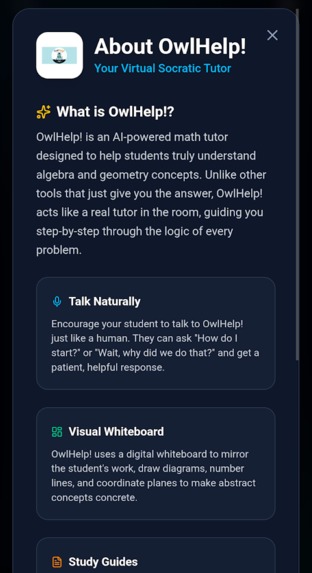
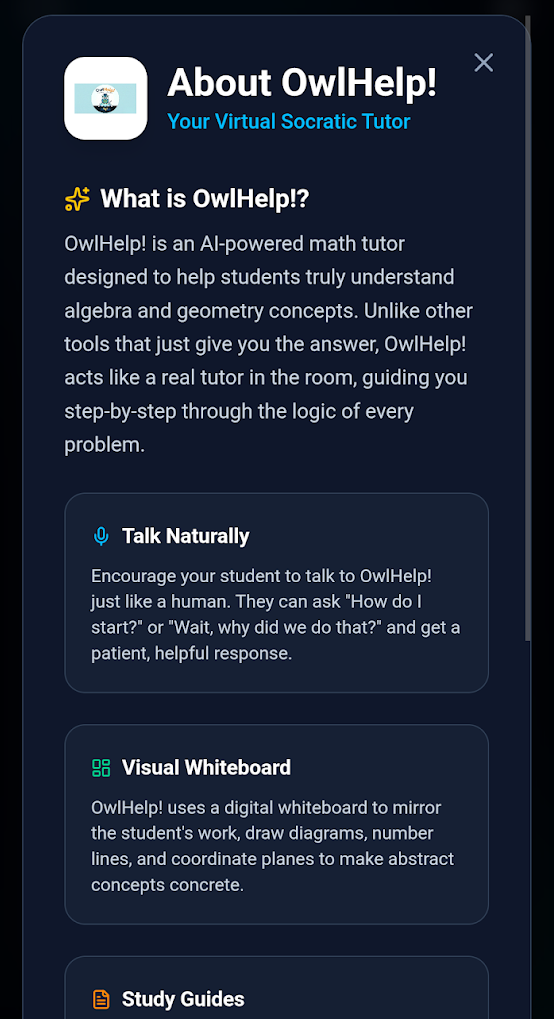
OwlHelp! exists as a tool for parents and students alike. It is a multimodal AI agent that provides real-time, step-by-step tutoring through a mobile-friendly web interface.
Real-Time Vision: Students point their camera at any physical homework problem.
Natural Conversation: The agent uses a lifelike voice of the student's choosing to talk the student through the logic, handling interruptions and questions gracefully.
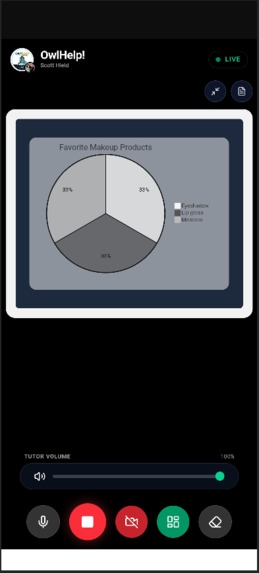
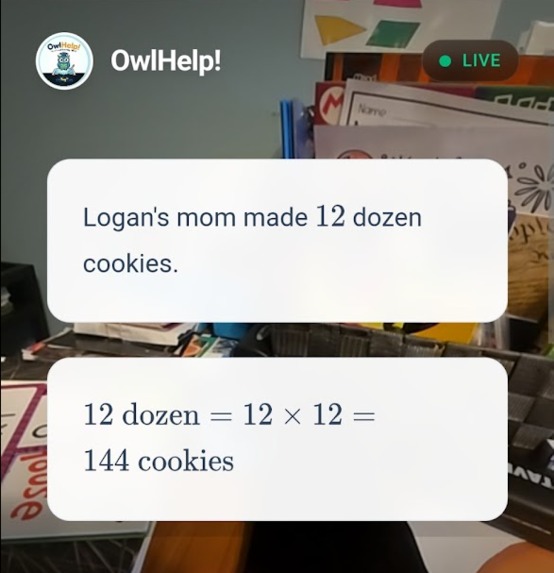
Virtual Whiteboard: It visualizes complex concepts by drawing and explaining steps on a shared digital workspace. With the activated Parent Portal, the students inputted interests and hobbies are then used as encouragement and whiteboard visualizations, to make it feel more personal to them as an individual, and not just a random person using another app.
Parent Portal: Linking parents and students together, creates a shared experience where the parent can be updated on student progress and usage.
Integrity First: Most importantly, OwlHelp! is programmed to not just give the final answer, focusing instead on scaffolding and a teachers guidance.
How we built it
With the amazing help of Google AI Studio, OwlHelp! is built on a high-performance, multimodal stack designed to minimize the friction between digital tutoring and physical schoolwork. Component, Technology The Brain, Gemini 2.5 Flash Native Audio model Orchestration, GenAI SDK and Agent Development Kit (ADK) Infrastructure, Google Cloud Run Storage & Data, Google Cloud Storage and Firestore
Challenges we ran into
[x] Latency Calibration: Synchronizing the "virtual whiteboard" drawing with the "natural voice" explanation. [x] Prompt Guardrails: Engineering "non-cheating" logic so the agent won't succumb to student "social engineering". [x] Camera Variance: Handling various handwriting styles and lighting conditions in physical homework. [x] True Testing: Luckily, with 6 kids under 18, and my nephew under 10 years of age, we had many live testers. However, that testing had to align with their actual work to see how OwlHelp! will do in a true environment. It lead to many edits in the code, and refinements in the logic which was very challenging. While we still have a way to go to add all of the functionality we want, we are happy to report the testers love it!
Accomplishments that we're proud of
True Multimodality: We successfully integrated live video processing with real-time audio feedback, creating a "presence" that feels genuinely helpful rather than robotic.
The "Nudge" Engine: We are incredibly proud of how Gemini handles the logic, which reliably breaks down problems into Socratic questions rather than just static explanations. For instance, instead of solving a quadratic, it might display the formula and ask the student to identify (a, b, \text{ and } c):$$x = \frac{-b \pm \sqrt{b^2 - 4ac}}{2a}$$
Mobile-First Deployment: Achieving a smooth, app-like experience within a web-based framework allows for instant deployment on any student's device.
Mostly, we're proud that we could provide a tool that helps parents, and gives our kids a tool to use to learn, instead of just digesting or writing an answer.
What we learned
Building OwlHelp! taught us that the hardest part of AI in education isn't the technology, it's the teaching. Building an app that can bridge that gap, was not only educational to us, but also a "whole lot of fun!". We also gained deep experience in managing a real-time state across Google Cloud services, all while using Google AI Studio for the first time.
What's next for OwlHelp!
While we started with Math, our next step is expanding to Reading and Literacy, History, Science, etc, where the agent can "listen" to a child read aloud and provide real-time pronunciation support; discuss historical figures; show a diagram of a cell. We also plan to integrate a Teacher Dashboard that allows educators and parents to see the "conceptual gaps" identified by Google's technical engine and our experience as parents, providing valuable insights into where a whole class or student might be struggling.

Log in or sign up for Devpost to join the conversation.