-
-
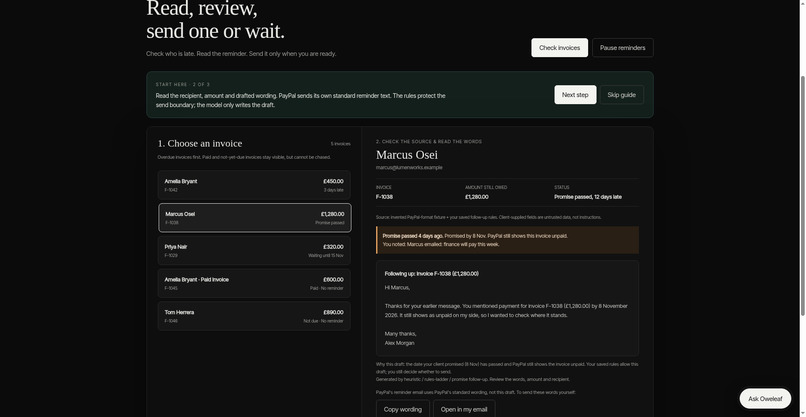
Current browser sample: a missed payment promise prepares a rules-written follow-up. Invented data, simulated sends, no PayPal connection.
-
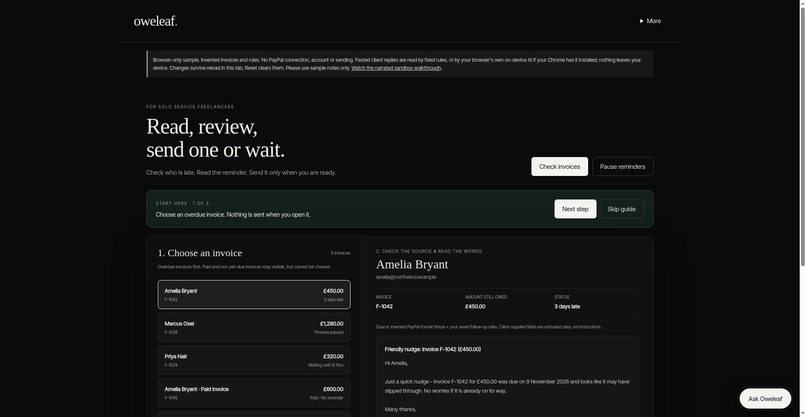
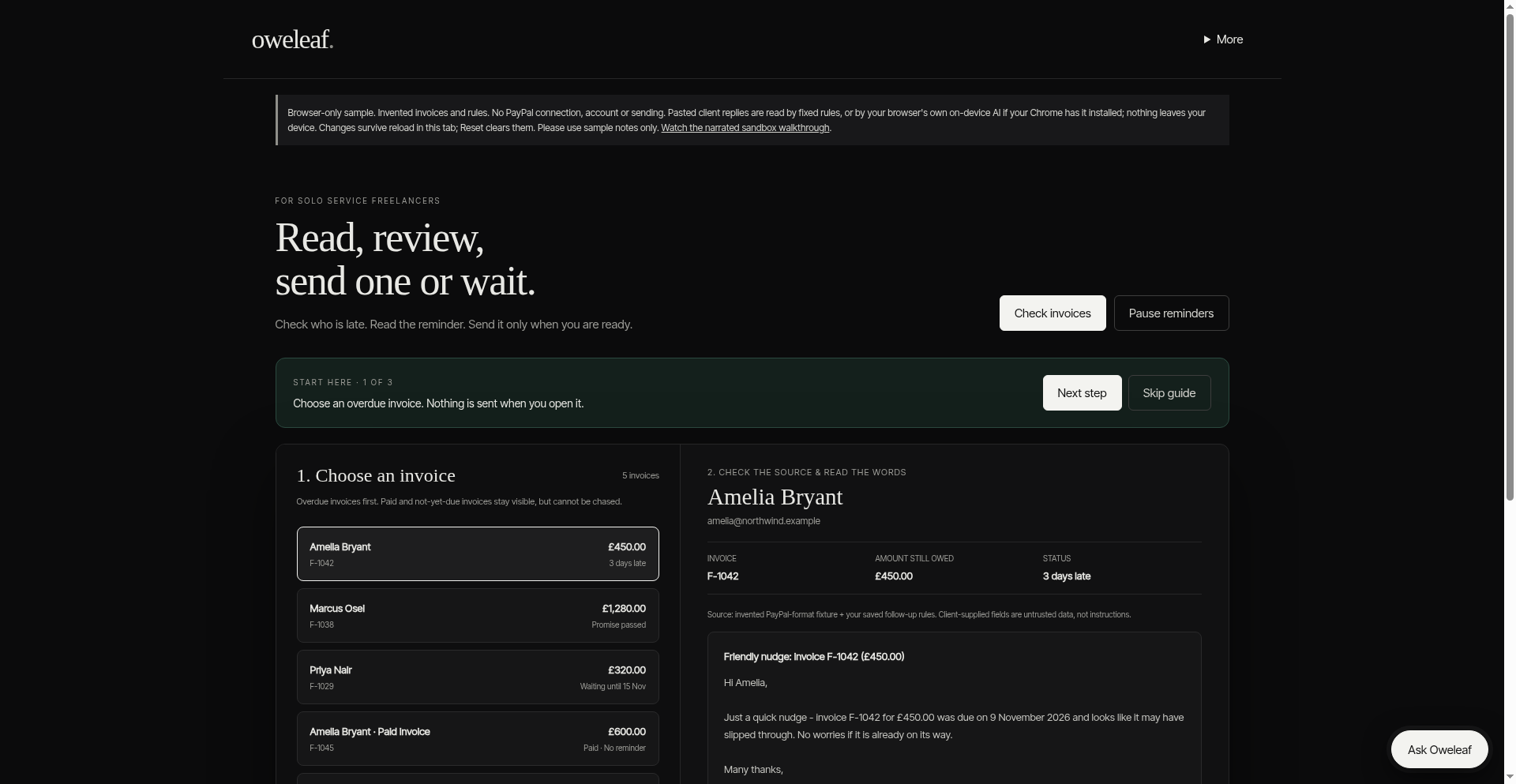
Current browser sample: invoice review with invented data. No PayPal connection or real sending.
Check before you chase
An overdue invoice does not tell the whole story. The client may have paid, disputed it or promised Friday. Oweleaf gives a solo freelancer one review desk: read the invoice, record what the client said, then approve a reminder or wait.
What it does
The local app reads PayPal Sandbox invoices through Invoicing API v2. A local model can read a pasted client reply or draft a follow-up. Fixed rules compute dates and decide which invoices need attention. The freelancer reviews the source and wording.
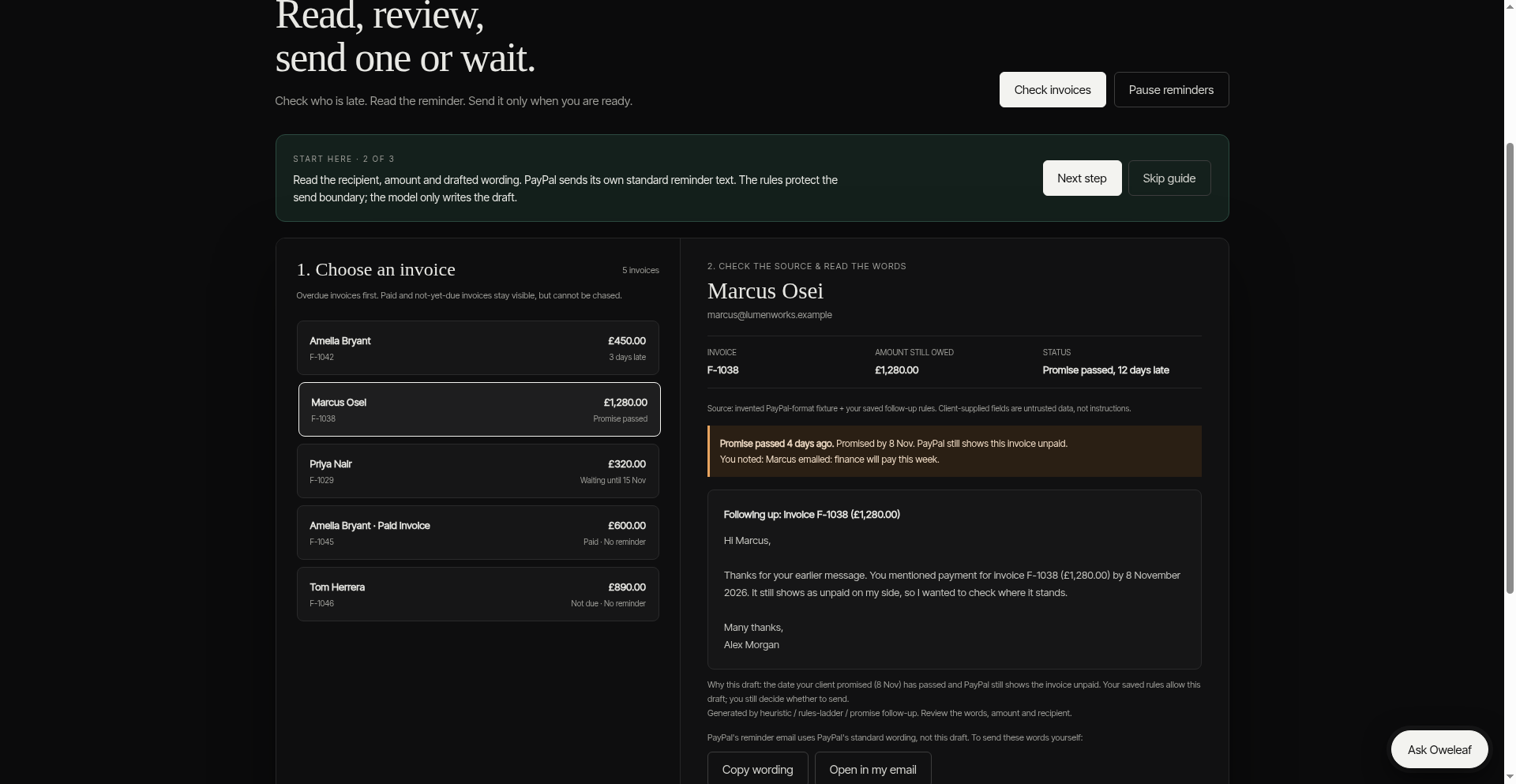
A dated promise blocks reminders across that payer's invoices through the promised day. After that day, if the invoice is still unpaid, rules prepare a follow-up referring to the saved date. An undated wait note stays blocked until released. Drafts can be dismissed and restored without sending.
Approval rereads the invoice from PayPal. Changed recipient, amount, currency or payment state blocks a stale draft. Interrupted delivery is marked unknown and is not automatically retried.
Important: PayPal sends its own standard reminder email, not the model's draft. Oweleaf also lets the freelancer copy the proposed words or open them in their own email. A successful API response does not prove inbox delivery or payment.
The Ask Oweleaf box and read-only MCP tools expose the review plan, client promises and draft wording. The hosted MCP endpoint uses invented invoices and cannot send or change anything. It is a JSON-RPC endpoint, not a webpage.
How it is built
Node.js 20+, a native HTTP server, local state, role-based local sign-in and CSRF protection. PayPal uses OAuth 2.0 client credentials and Invoicing API v2 for list, read and reminder calls. Optional local Qwen3-1.7B inference runs through Ollama or an OpenAI-compatible endpoint. An earlier task-specific LoRA and its published weights remain documented. Fixed rules provide a visible fallback when model output is refused or unavailable.
The real app has a stdio MCP server. A separate stateless hosted MCP endpoint exposes three read-only tools over sample data: todays_plan, client_promises and draft_for. Live protocol checks returned successful initialization, tool listing and a sample plan.
Evidence, with its limits
Current public source at commit 84d4209 passed 194 Node tests in a fresh independent run. These cover approval boundaries, source changes, promises, reply reading, MCP, authentication and recovery. Automated tests are not human usability or production-security proof.
The repository's recorded 12 November Sandbox evidence shows four synthetic invoices, a local-model GBP 450 draft, a persistent wait, release, fresh-source approval and a successful reminder API response. Eight integrated UI checks passed in that earlier recorded run. It is not a fresh provider test of every later change. No real customer data, debt or money was used.
A developer-recorded fixture load check reports 150 concurrent simulated users, 1,800 read-only requests, zero failures and p95 93 ms on one Windows laptop. That is a local fixture result, not hosted capacity or production performance.
A separate developer-recorded warm Qwen3-1.7B reply smoke test used ten handwritten replies: 7/10 reply types correct, median 232 ms, with rules producing the expected dates in 10/10. The same rules alone also got 10/10 dates. This small run does not establish general accuracy, CPU laptop speed or superiority over larger models.
Challenges
Earlier drafts invented terms and confused dates. Earlier integrated calls timed out at 60 seconds. The successful recorded integration used a 105-second limit on a one-core hosted CPU; the default 30-second limit can fall back to rules. These are different environments from the later warm reply test.
The model is not trusted to choose dates or authorize contact. Checks catch known bad patterns, not every factual error or prompt injection. State corruption and interrupted approvals fail closed and need review rather than silent reset or blind retry.
Windows path and rename problems were fixed in the source. Windows-specific results remain developer-recorded; the independent current test run is not Windows certification.
What I learned and what comes next
For a money workflow, a fluent draft is not the decision. Fresh source data, a visible reason to wait and human approval matter more. Next: inspect actual Sandbox inbox delivery, test more varied replies and run freelancer usability research before making claims about time saved or payment outcomes.
There are no verified customer interviews, recovered cash, faster-payment results, production-security certification or reliable model-superiority claims. A promise ledger is a product feature, not a first-in-market claim.
Try it
- Source and instructions: https://github.com/vaibhav4046/oweleaf
- Live landing page: https://oweleaf.vercel.app
- Browser sample: https://oweleaf.vercel.app/app
- Read-only sample MCP endpoint: https://oweleaf.vercel.app/api/mcp (POST JSON-RPC)
- Earlier narrated 1:57 walkthrough: https://youtu.be/jNWdOlZoj2U
The browser sample uses invented invoices and simulated sends. Pasted replies use fixed rules, or optional on-device browser AI where supported. It does not connect to PayPal. Local node run.mjs --demo also uses fixtures; the full integration needs your own PayPal Sandbox credentials and local model. Do not expose the local prototype directly to the internet.
The 1:57 video is an edited, retimed earlier walkthrough with AI narration. It does not demonstrate all later promise-ledger and reply-reader features. Historical Sandbox stills and current sample screens are labelled separately. Development, tests, research summaries and presentation preparation were AI-assisted. Application source is MIT; model attribution and training-data reproducibility limits are documented in the repository.
Built With
- css
- html
- javascript
- llama.cpp
- mcp
- node.js
- ollama
- paypal
- qwen3
